Can all posters remain on topic, or refrain from posting.
James,
I was not saying a frequency of a photon can be infinite - I am saying it can be arbitrarily high, which is a different idea. For whatever finite frequency, there is a frequency that is higher. That is the type of unlimited energy for a photon I am thinking of. I agree that an infinite frequency is not possible.
In our discussion of potential affectance, I was not sure there is a maximum potential, although there could be. For my example of an event horizon, is there a discontinuity? We are talking about the RM idea of potential (or ability) to affect an adjacent point. Let’s look at a diagram of an event horizon:
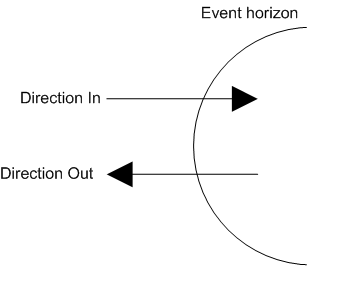
For Direction In, I see the affectance potential as either unlimited or at the maximum. This state continues until we cross the event horizon. Then I see the potential as declining until when Direction In reaches the far side of the event horizon, where it will have the same situation as Direction Out above.
For Direction Out, I see the affectance potential as zero while it is inside the event horizon. Then as it crosses the event horizon a minute amount of affectance potential appears. Is this a discontinuity? Technically, zero to something is, so I will concede that is a point of argument. I will borrow your idea that the change is very gradual. So Direction Out very slowly becomes non-zero and increases as we move away from the event horizon.
This implies that the affectance potential for Direction In and Direction Out can be completely different at any one point. I see no reason why the potential must be the same in all directions.
One clarification is important: believers in quantum mechanics (qm) claim the idea of Hawking Radiation. I believe instead in the Theory of Elementary Waves (TEW) which denies Hawking Radiation, because TEW denies the idea that a vacuum is a seething foam of particle and anti-particles appearing and then annihilating. So qm supporters can claim that a point inside the event horizon can still affect a point outside by Hawking Radiation. TEW supporters deny this, and so I claim that points inside the event horizon really do have zero potential to affect anything outside.
Final twist: I could also argue that a point inside the event horizon can very strongly affect a point outside the event horizon - by gravity. So I guess I could also argue that the potential for one point to affect another is unlimited in all points in all directions in the above diagram.
In summary, I am saying that my idea of affectance potential being unlimited can still live with the idea of no discontinuities.
So since I cannot be sure if affectance potential has a maximum or not, I claim that a statement that there is a maximum is an assumption, rather than a proof. I’m fine to continue on such an assumption.
Eugene Morrow
Emm… no it isn’t a different idea. Infinite MEANS “limitless” and thus not entirely arbitrary. It can be somewhat arbitrarily high as long as it is finite.
That is fine for now as long as it IS finite. Since it cannot be infinite, it cannot have a single location that has both high and low value. That means that it cannot get to that point and nothing can cause it to ever be at that point. If it cannot get there, there has to be a reason that it can’t.
I haven’t said anything about a maximum potential. I mentioned ONLY a maximum difference in adjacent potentials. It doesn’t matter how great that difference is as long as we know that it cannot be infinite - “discontinuity”.
No we were talking about the DIFFERENCE between two adjacent potentials.
So that is not discontinuity and irrelevant. Direction is what I was going to discuss next. I never said anything about every point always affecting in all directions. The only thing I have said even close to that is that potential affects in any direction “THAT IT CAN”, or whatever direction is available. I have already given examples of points that cannot affect in a certain direction.
I haven’t said anything different than that.
I don’t either and I can’t image it ever being so.
Those are theoretical physics issues. I am not talking about theoretical physics. We were to get to that and answer that question later. Right now, you are injecting your theory into my reasoning based on the speculation that maybe black-holes work this way or that way. Stick to the logic being presented, not theoretical ideas about extremely distance entities for which no one has proof of anything.
There is no gravity at this point in the discussion. We are talking only about the state of potential-to-affect, that it is somewhat random in a vacuum, and is not discontinuous. If it has a maximum of any kind concerning the difference in potential, there is a maximum to the slope that indicates the variance. As I stated earlier, that max turns out to be an issue of how quickly one potential can affect the one next to it and thus not ever allowing it to be very much different. It is an issue of propagation time and distance. But right now, I am just saying that there IS a limit. It cannot be infinite - “discontinuous”. Exactly what that limit is, is a matter of the mathematics dealing with cardinal infinities (an entirely different lecture/course). Value of a potential and size are actually related.
Any one potential cannot reach infinity either and for similar reasons. Firstly, the definition of infinity forbids it. Secondly the region of space it is in will disallow it from ever getting beyond a certain maximum. No one region of space can have an infinite amount of energy within it and that is what it would take to get any one location up to an infinite potential.
“unlimited” and “infinite” are the same thing. If something cannot be infinite, there is a reason for it to be limited.
The next images to discuss (please spend more than 3 seconds reviewing them before you reply and stick to the logic, not theoretical physics theories);

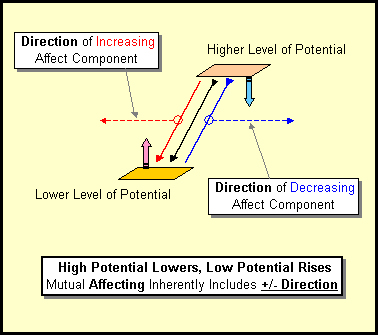

Please note that the pic says, “Beginnings of Momentum”, not “Momentum”. Momentum itself requires more than that one aspect of merely an affect always maintaining its direction.
And btw, now that I have had time to think, I have resolved the double-slit issue (90% certain). It wasn’t merely the advance affectance/gravity wavefront like I was thinking, but rather the harmonic affectance resonance between the screen and the slits affecting particle travel (still assuming that they are telling us the complete truth). Photons are a different issue of actual mutual interference.
James,
The more you question my responses, the more problems I find.
As a beginner, I am trying to get to know the idea of affectance, both potential and actual.
I started out considering affectance by looking at one point sending a photon to another. We were discussing the potential energy of photons, and I disagree with your point:
Being pedantic, I argue that a photon always has a finite energy that is unlimited in size. That is not the same as a photon of “infinite” energy.
For example, the set of positive integers is infinite, but “infinity” is not a member of the set. The same for positive real numbers. A photon can have an energy that is a positive real number, but is never infinite. So a photon’s energy is unlimited, but not infinite, and by implication so is affectance.
The problem with photons is that enough gravity can make them curve and ultimately stop them traveling in a certain direction. So I then changed my thinking to use gravity as an example of affectance.
Gravity appears to have no limits and cannot be stopped or deflected, so it’s a good example. Using that example, I am convinced that affectance potential has no finite limit at any one point.
You are concentrating on the difference in potential between two points, and the possibly of discontinuities.
On looking at your diagrams and definitions, I realize I am confused by one description. You diagram “High Potential Raises Low” has the words “Levels of Potential-to-Affect, Ability-to-affect”.
For me, potential and ability are different concepts. Imagine me with car that is broken down. There is a certain force I can exert to move the car. So I have a potential to push the car a certain distance on the flat. However, my ability to push the car is affected by reality - whether there is a slope, what type of surface, and other things like wind and temperature.
So to me, “ability” is bringing in ideas like the “Physical existence” in the same diagram. I recommend the wording about potential changes to “Levels of Potentail-to-Affect, Possiblity-to-affect”. The word “ability” has been throwing me off, as in the example of a photon that cannot escape enough gravity.
As well, there is a further complication. When considering my potential to move the car, what if I was an Olympic weightlifter? Suddenly I have more force to move the car. Is that hypothetical potential part of it?
I am meaning that there are these fine variations in meaning:
X. “Hypothetical” potential at a point, say if there was mass or energy there.
Y. "Existing"potential at a point, say how much mass or energy is actually there.
Z. “Actual” affect on another point, the physical existence, which depends on the point being affected.
I think you are meaning Y when you say potential.
Now I turn to the question of the difference in type Y between two points. One of the big things RM has stated is “no assumptions”. Are there no discontinuities in type Y potential between two points minutely close? I am starting to realise that “no discontinuities” might also be an assumption.
So I am going to change my mind and say I am not sure if there are discontinuities or not. I lean towards no discontinuities, but I cannot rule out discontinuities.
I have another point to raise about your diagrams. In diagrams “High Potential Raises Low” and “Affect has Inherent Direction” you have rectangular shapes. What are these shapes? The possibilities seem to be:
A. The potential affectance at a point in space
B. The actual affect at a point in space
C. Potential affectance that is moving
D. An actual affect that is moving
What is confusing is in “Affect has Inherent Direction” there is a red arrow showing direction of increasing affect component, and a blue arrow showing direction of decreasing affect component, and then arrows between the rectangular shapes. I am not certain of what the arrows are saying, as well as being not certain about the rectangular shapes.
So I am still struggling to really get a hold of affectance, potential affectance and RM in physics.
Eugene Morrow
I am beginning to more seriously doubt the truth of that.
Case in point^^
So you believe that an ant must use a 10 ton bulldozer to move the dirt around his mound?
I am (trying) to talk about a nearly infinitely small point with a potential to affect something. And you proclaim that it must be sending a PHOTON (10^10 times larger) to send out energy.
No we started over because you seem to have entirely missed the points being made.
A “photon” is a physics entity, not an RM entity. Physics is something we would have gotten to toward the end in order to show the similarities.
Yes, “pedantic” is the word. A few weeks ago, you switched from being a listener to what seems a word manipulator and political adversary injecting your notions of physics as fact into every statement I make, starting with a 2 week argument concerning the exact meaning of the word “wave”. It seems that if you are going to accept contemporary physics as your holy bible, you really shouldn’t be arguing against QM, their holy scripture. And you should learn what they mean when they use the word “wave” (distinctly different than what you mean by it).
By your theory. In fact it has both limits and the susceptibility to be stopped. But it seems that you are never going to understand why or how.
Oh. Maybe you could tell me more about what affectance is now that you fully understand it?
Well, I was trying to.
More pedantics.
And yet you choose to ignore what I mean in favor of an argument as to what I should have meant and what you know to be true regardless of what I am talking about.
I wasn’t counting the assumption that a listener wasn’t actually capable of listening.
I was merely referring to the logic available, assuming there to be a listener.
Oh really. Why do I suspect that if you thought out it for a while, you would begin to doubt that 2+2 is necessarily 4.
You’re kidding me.
{{I guess I should be glad he didn’t ask why affectance potential is orange}}
So exactly what has been the goal in all of this pedantics and injected obfuscation?
Preventing a book?
An attempt at making things look false or foolish?
Attempting to depress me with the futility of rational thought?
Obfuscating a thread?
What?
And please don’t come back with, “No. I am honestly trying to learn.” Such would merely be a testimony as to the high improbability of such.
Although I admit that without your focus on it, I probably would never have bothered to resolve the double-slit experiment and find the proof that QM hasn’t actually resolved it.
This is a very rough pictorial displaying the Affectance resonance between a double-slit wall and a screen.
The less dark areas indicate the inherent “affectance interference” pattern that would exist merely due to the presence of the slits.
Any particle entering that area would get persuaded toward one of the darker areas.
No Slits;

One Slit;

Two Slits;

Without the slits, the resonant affectance wave is reasonably uniform. The slits in the screen actually provide a void in an otherwise uniform resonant wave pattern. It is that void in the resonant field that causes the higher probability of each particle landing in specific areas on the detection screen than other areas.
This hypothesis can be falsifiably verified through the process of simply placing an additional particle-blocking wall significantly in front of the second slit such that it blocks any particle from going through the second slit but is not so close as to produce its own resonance with the detector screen. RM predicts that relatively the same pattern, although more dim and shifted to be centered on the first slit, will be witnessed even though the second slit has been effectively blocked. QM would predict that the pattern would change back to a single slit pattern because the wavefunction would have collapsed (or because the observer was aware that no particle could get through the second slit).
Note that the hypothesis concerns the single particle at a time issue. Waves will not behave the same way and thus it proves the distinction between particles and waves.
James,
Obviously my honest questions and comments have come across as a problem, so I will say less for a while.
I like the indications that RM has an explanation for the double slit experiment. I will be most interested in that when we get there.
Eugene Morrow
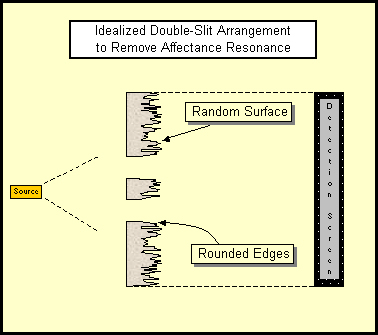
Another thing that can be done to verify the RM theory is to make the double-slit screen to have its inner surface of random height with an average equal to or slightly greater than the largest interference pattern wavelength. This is will minimize the affectance resonance and particle interference pattern.
Interestingly, this will have no affect upon the wave produced interference. So one can separate the wave effects from the particle effects.
Since a photon is a particlized wave (a wave with an entropic shell), doing the experiment with photons will reveal only the wave generated effects. That should resolve the argument concerning particle versus wave.
At that point, QM would be completely lost, but still might be able to change enough definitions of their terms and maybe come up with new theories in an attempt to explain why particles are no longer affected without completely losing face.
Let’s see if this explanation for why there can be no discontinuity is sufficient without getting into complex mathematics cardinality issues.
Every potential-to-affect, “PtA”, has a finite amount of potential. How much change it can make upon surrounding potentials defines the amount of potential it had.
The property of a PtA is that of reducing the difference in potential between adjacent points. As a higher potential affects a lower potential, it uses up its potential and becomes lower while the lower potential gains potential and thus rises. Once they have equal potential, neither can affect the other or it can be taken as both affect each other equally and thus no change takes place.
For there to be a distinction between PtA point A and point X, time must be spent for A to affect X merely due to the definition of “distinction”. If there were no time spent, if the affect was instantaneous, there would be no distinction between points A and X. Thus every distinguishable point of potential is separated by time.
Between any two points A and X, there are necessarily an infinite number of points. If A is to affect X within only a finite amount of time, the first point next to A, “B”, leading toward X must be affected in an infinitesimal amount of time, “0+”.
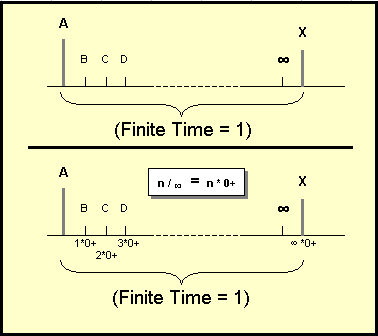
What this means is that no matter how different A was from B, within an infinitesimal time, they would become the same. And if it were not for the many directions of affects coming and going, thus making it impossible for both A and B to be affected equally, the entire universe would become homogeneous almost instantly and thus there would be no universe. But on the other hand, due to the nearness of A and B, the affects upon A very quickly also affect B, thus keeping them close to being the same.
From this we can conclude that PtA A and B, although must be slightly different, cannot be very different. There can be no discontinuity between points of potential to affect.
James,
You summed up the issue of discontinuities like this:
Surely, this is a matter of degree. How much is “slightly different”? It seems to be a fuzzy issue that is not a show-stopper. Is no discontinuities a particularly important result for RM?
Eugene Morrow
“Slightly” in this context, if you look at that pictorial, means “0+”; an immeasurably small amount, “lim->0”. And between that point and the point next to it is 0+ times 0+ and again for the next level down. There is no end to the infinitesimal.
As to how important it is to RM; in this discussion, it probably wasn’t going to come up, but you got persnickety about speed. If discontinuity could exist, I suspect the speed of light for example, would be entirely unpredictable and the inertia of a particle would probably be infinite. But frankly, it is about like asking what effect it would have on mathematics and your bank account if 13+17=33.
James,
I have been waiting a bit to see if anyone else wanted to comment or ask questions. I am also giving you room to deliver your lessons on RM with less interruption. Since things are quiet, I will ask another question.
The RM explanation of point A affecting point X in a finite time seems straight forward. Point A and point X have different Potential-to-Affect (PtA) so the higher one loses PtA and the lower one gains.
I have a question about direction, using this diagram:
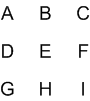
Let’s look at D and E as the same as the A and X before. Let’s say E is giving PtA to D.
My question is - does direction of PtA make a difference? Let’s say H is giving lots of PtA to E at the same time. Can PtA flow H to E to D? Alternatively, the PtA must flow H to E to B. I am guessing it is the latter: H to E to B and the only thing that might happen is pausing at E if B is chancing at a maximum rate.
Eugene Morrow
Others aren’t going to respond because in their mind we are speaking of physics. On this forum, if you aren’t talking about socio-political or social-engineering agendas, no one is really interested.
You are right, it is the latter. And also right that if the max is not met, neither affects the flow of the other. Once a PtA gets started, it never, ever changes its direction. Waves that are formed by the average PtA of the infinite number of PtA within, can change direction because the wave is merely the average and that average can shift in any direction depending on the final balance of all within the wave. If a wave is made entirely of nothing but PtA headed in one direction only, then that wave will travel only in that direction. But that is all but impossible to actually arrange. A photon comes close.
But what is not obvious is that the picture you have drawn is not physically possible. Because there is always distance between each of those points, there are also PtA flows going between and tangent to those points. Space is not a grid. Thus even though PtA gets slowed, they are never actually stopped.
James,
Thanks for the answer - this is a good way for me to clarify exactly what RM is saying about affectance. I have another hypothetical question, similar to the last one.
The same grid applies:
Let’s say the maximum rate of change is 10. My thinking is that the maximum applies to all PtA at a point, regardless of direction.
In this example, H is continuously sending a lot of Potential-to-Affect (PtA) to E - and so E is changing at a rate of 8.
At the same time we have D sending PtA to E as well. D is sending 4. In this case, not all of the PtA from D can be accepted by E. My question is - what happens? Does 2 of the PtA from D get accepted by E, and 2 slow down between D and E? Does all 4 of the PtA from D slow down between D and E?
Eugene Morrow
There is a bucket that will hold exactly one half gallon of liquid. One person has a gallon of yellow koolaid. Another person has a quart of blue koolaid. They can and will poor all of their koolaid into that bucket in the exact same amount of time… one unit of time… if they could. But the hitch is that firstly, the bucket can only hold one half gallon total, and secondly, the bucket has a hole in it that will empty the bucket in exactly one unit of time into a second bucket that can hold 2 gallons.
What is the exact color of the koolaid (percentage of yellow to blue) in the first bucket and did it ever get filled?
How long will it take for all of the koolaid to get into the second bucket?
That is the situation that you arranged.
James,
The bucket description you gave is different from the situation I described. The bucket description changes the focus to the color of the liquid. The challenge is that the numbers don’t fit.
I think RM has a dilemma here - the 4 units of Potential-to-Affect (PtA) at D will not fit into E because that will exceed the maximum rate of change at E. So there are two possibilities:
EITHER A. All four units of PtA at D will slow down between D and E.
OR B. Two units reach E and two units slow down between D and E.
The problem with A is that how do all four units know they collectively won’t fit? The problem with B is that the one wave of 4 units at D has become two waves of 2 units.
Perhaps there are other things that come into play: deflection or reflection?
Eugene Morrow
The correct answer to this thread is 42.0793. Just so you know. 
I’m afraid the analogy is pretty precise. The ratio of the numbers and the ratio of the colors were the whole point.
The end color is simply 4Y:1B, a sort of lime green.
In your model, you had a constant feed going into the E-bucket of 8H, but then you added 4E.
What was already in the bucket merely changed the size of the E-bucket from 10 to 2, the remaining free (or empty) portion.
Thus you had, in effect, a ratio of 8H:4E or 2H:1E or a “1:00 O-clock” direction or 30 degrees to the right of B as the average.
The koolaid bucket could only hold 2 quarts, the E-bucket could only hold 2 (more) PtA.
If the people had tried to pour the entire contents of their containers into the bucket, they would have exceeded the limit of the bucket.
If the PtA from both H and D could have flowed freely, they would have exceeded the max flow rate of the E-bucket.
Thus the people pouring the koolaid must slow down as soon as the bucket gets full, taking longer to empty their containers.
And the PtA from H AND D must slow down when the max of the E-bucket is reached.
The ratio doesn’t change for either; 2H:1D and 4Y:1B
For the koolaid analogy, you have:
Bucket x = 4Yt + 1Bt - 2Gt, (t = time)
thus if t=1;
x = 3 quarts
But there is that limit making things complicated. The bucket can only hold 2 quarts. Thus t cannot be merely 1 because x is limited to 2 quarts.
So ignoring the colors;
x = (4+1-2)t
x = 3t; the amount in the bucket
The bucket reaches 2 quarts in 2/3 seconds or 0.666.
Considering the original pour rate of 4/t and 1/t and original amounts of 4 and 1, that leaves the original containers at t=0.666 as;
1.3332Y and 0.3333B when the bucket reaches its max.
But the bucket is still emptying so neither person has to stop pouring, merely slow down to the rate at which the bucket empties, “2 quarts per second”.
At that rate, the people will continue to empty their containers;
1.3332 + 0.3333 at a rate of 2 per second, thus
t = (1.6665) / 2 = 0.8333 seconds longer.
Thus the actual time to empty the original containers is the original bucket fill time plus the delayed time;
Original fill time = 4+1 = 5 per second up to 2 quarts = 5/2,
0.4 + 0.8333 = 1.2333 seconds to empty the original containers.
But of course the first bucket still takes more time to empty into the second, “2 quarts per second”;
1.2333 + 1 = 2.2333 as the total time required to fill the second bucket.
=======================
In your model, you have;
E-Bucket x = 8Ht + 4Dt - 10Et, (t = time)
You were not concerned with the emptying of the E-bucket so the math is a little shorter.
Do the same form of math to get how long the PtA gets delayed from each point H and D.
======================
Of course in the real spacetime, you have to consider the infinite directions involved which is why I had to augment formal mathematics to include the cardinalities of infinity which exceeds the mathematics of Einstein’s time. Georg Cantor didn’t think it through all the way. But I don’t want to try to walk you through the Mathematics of Cardinalities of Infinity.
Hey, welcome back Ty 
Actually, after I added my 2 cents, the answer is really 42.02 (you must have used more words). 
James,
RM makes a lot more sense now. I’m glad I asked the question because it was not obvious to me that the affectance going from H to E would be slowed down by “cross winds” of affectance going from D to E. As you say, this can be any direction, so the speed of affectance in any direction is affected by the maximum rate of change at any one point.
That has answered my immediate questions on affectance. The next step was deflection/reflection?
Eugene Morrow
There are a couple of more concepts to get clear on before we move on.
You noticed that we can have “crosswinds”, but realize that we can also have opposing winds of PtA without any more interference than any crosswind would have. In your model, not only might you have H feeding E, but B might be feeding E at the same time. Neither has any affect upon the other as far as delaying unless the max is reached. That max is a flow rate, not a max PtA, so through time, no matter how high the PtA was from any direction, the flow rate dies back down. Of course if you keep feeding more PtA into the model, the max rate will stay high until enough time has passed to make up for how ever much PtA you fed into it. And every bit of PtA that you fed into the model will eventually exit from the opposite side, merely delayed.
The other concept to realize is that not only might E be maxed out, but other points might be maxing out at the same time. Perhaps not only E, but also F and/or G might be maxing out all at the same time. And because of the delay at E, it is more likely that each of the surrounding points are really going to max out also because they could not “empty out” their PtA as fast as normal. Once any one point maxes out, the surrounding points have a higher probability of maxing out as well.
That is how a particle begins to form. The particle is merely the congestion of such PtA getting delayed and causing other nearby points to delay. A cluster of PtA forms that only time could remedy. But because it takes time for the congested PtA to leave that area of space, other PtA has time to enter into that same area. Thus there is PtA coming in and going out from the same area of congestion, the “particle”. When the coming and going are exactly equal, the particle is stable.


Any question about those concepts?