New theory of quantum world

Value ontology suggests that only some affectance-peaks acquire the power to influence other affectance without losing their structure. When they happen to be self-affecting (which all peaks, concentrations must do) in such a way that we can speak of a circuit, they have a chance to persist. The circuit has to be finely tuned, which means stable, and it has to be self-correcting. All of this is a chance of one in infinity minus one, so to speak - infinitesimal, just barely possible. This particular circuit, which is only reflected in its full genius in our lives through unexpected resolutions to final seeming crises, is how we can understand the mechanism that appears as the threshold of a particle, the resistance through which it filters its in and outgoing affect. The “identity” of the particle is how we understand the nature of its separation from the rest of the cosmos.

Value ontology provides the possibility that abstract science (metaphysics) is understood experientially, as an actual reality. In this way we can strengthen the grasp on the purpose we have with this knowledge. Yes - because this has been your problem, it seems -in what way must this science come to the world? This might be the meaning of philosophy as it relates to technology - its purpose in the world perhaps - to make power work in the best interest of the greatest number of beings, given that that includes humans.

Science as it has existed since Newton focusses on what happens outside of man. It produces a massive of direct, constantly perceivable consistency, and therefore defies/obscures some things that are less directly perceivable as consistent. Things that are too specific in context, too actual to interpret conceptually (in general terms) within the frame of what is actually perceived. One has in such cases to resort to directer ways of knowing. Intuiting - knowing as true, without being able to explode the full implications into the particular requirements of ideas under grammar. This form of knowing must become a systematical technology, if man is to make use of this science, turn it into a current value, which is the only way in which it will have a change to reproduce.

Someone said today that in order to understand nature better than we do now, we have to become better. Better beings, better at being.

The idea of antiparticles as affectance-lows is interesting psychologically - does one always have a dancing demon underneath an immortal walz? And can one never “integrate ones shadow”? Perhaps this is the special quality of the human being, that he can produce justifications of both himself and his anti-being.

Well hey there, FC. I was wondering if you were still around our little hilltop campfire. :sunglasses:

I had to shift my mindset a bit, but I think I got the basic idea of what your friend was trying to say in that pic and can buy into much of it. Most of what every particle of every type is, can’t be seen, so the “tip of the iceberg” idea fits well. It is the unseen that causes the seen (Judaism 101). But I don’t really know how “Quantum Level” fits into the pic.

Quantum Mechanics posits a “reality” exclusive of anything they can’t measure or “see”. It is entirely about statistics and consequent predictions. Anything that happens outside the predicted course, just goes into an “alternate reality”, unseeable to QM, thus not of their ordained “reality” (model).

Well, that involves a question I have concerning VO, “at what point does it begin to apply?

Given an infinitely small point that happened to have a potential of perhaps 6 nEv (nano-electron-volts) with an adjacent point of let’s say, 4 nEv, an affect will immediately follow with 2 nEv and also a very exact direction. That direction is never-ever lost. An affect of that magnitude will forever continue in that exact direction. But the amplitude of 2 nEv will vary constantly depending upon what it runs across. The original magnitude of 2 gets distributed over a range of points along that direction. The “energy” is maintained, merely more distributed. And the reverse effect can take place compressing the potential back to a single point or even higher. Thus the direction is forever consistent, but the amplitude of the potential at each point might become anything.

So I have to ask, how does VO stand on that issue?

The “Potential” never travels. It is the affect that “travels” or propagates and causes changes in potential, same as with social interactions and ideas.

Yes… “..without losing the structure”. We observe only the structure, not the actual affects going on that cause that structure, “one cannot see God, only where God has been.” and “no nation arises without God’s consent”. “God” being the unseen Cause underlying all things.

Ahh… but in steps the “magic” of a particle. It has no “circuit”. It is merely the congestion of the contention. That congestion propagates and “moves”/“travels”. But there is no definable “circuit” within. It is a cloud that happens to be able to maintain its existence (for specific reasons) and acquire spin. But would still exist even without the spin (a little less stable).

And that expresses why they have had so much trouble understanding it. They believe, due to contrived efforts, that there must be a “self-perpetuating circuit” and yet there hasn’t been. Even in your life, you are merely the aggregate noise of your experiences taking on the residual spin. By seeking the inner “circuit”, you are presupposing and seeking something that isn’t actually you.

The answer to that is unwelcome. And THAT is “the problem”.
The powers that be want only for what enhances their already chosen course of action, not any understanding that might imply that they are seeking the wrong path for their own good. How many Kings have ever said, “someone please help me find out where I might be going wrong”?

The first step to that is to discover what you are, “know thy self”.

To do that, one must realize that what he is not is the “rest of his situation” and incorporate that into what he is. And thus become “One”, void of foreseeable contention, leaving the contention to the unseen, underlying all things.

Fixed Cross,

Glad to hear from you again. Very interesting thoughts, which I will leave alone.

James,

You seem to be denying there are well formed sinusoidal waves. That seems to be making the word “wave” very vague. I have been probing what the word “wave” means to affectance, and I am not at all clear. This is a foundation of RM in physics, and when you publish I am sure you get a lot of questions about this.

Eugene Morrow

When all else fails;

And in the case of RM, that “particle” mentioned in the definition, is a “point in space”.
And the “medium” is “potential to affect” (at each point).

And note nothing at all was mentioned about perfect shapes or sinusoids.

James,

Looks like RM in physics is using a dictionary meaning of “wave” rather than a more appropriate physics meaning. For physics a wave means a regular pattern up and down, but this is absent from the dictionary meaning.

Here are my questions and the implied answers I am now understanding:

A. What is the shape of a wave of affectance?

Implied answer: no shape is necessary. Affectance simply means one point of space affects the next. How affectance goes up and down at one point need not follow any particular shape or pattern, and there need not be any regular pattern of change.

B. What mechanism could organize affectance into a sinusoidal wave?

Implied answer: there is no mechanism - the affectance is not organized.

My conclusion is that RM regards affectance as a “wave” simply because affectance moves from A to B. Since there is no particular shape to the affectance, then affectance varies in a random manner.

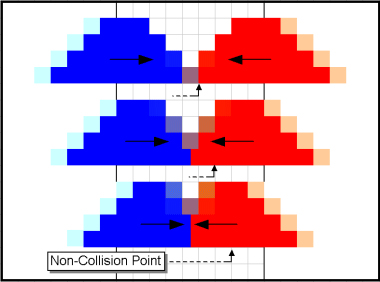
This is a problem because of this diagram:

Wave Collision Blocks - remake.jpg

Notice how the red and blue areas are organized into wave shapes (the physics meaning). The obvious question is - why are they organized like that? If RM denies that “wave” means a regular up and down pattern, why does the diagram show that? The above diagram is implying an organization, yet RM denies that is necessary and does not provide a mechanism for the organizing to occur.

I am concerned that there are assumptions in the RM descriptions of affectance and how the word “wave” applies.

Eugene Morrow

I take it that you didn’t note the word in red. There is no difference between the use in physics and the “dictionary” use.

That pretty much says it.

That isn’t exactly right.
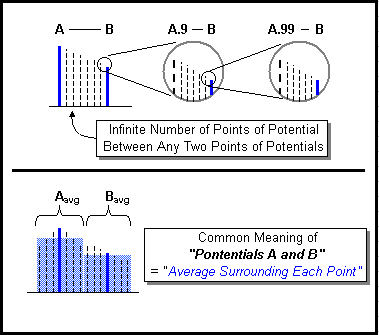
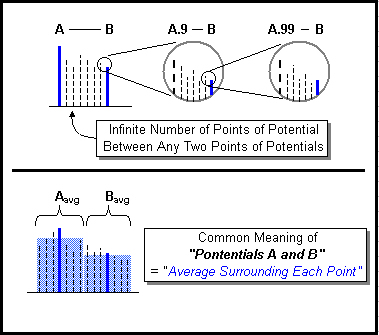
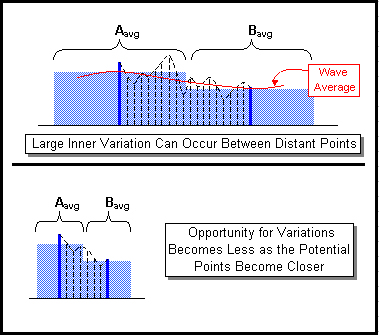
Potentials that are very, extremely, near each other cannot not be very distinguishable from each other. In a sense, that defines “being infinitesimally near”. The reason it is always that way is simply because of the infinitesimal time it would take for each extremely near point to cause the surrounding points to be similar to itself. In addition, if there was too much variation between those points, the affect rate maximum would be already violated (which is impossible to exist). The end effect of this is what causes finite sizes. What anyone could ever measure is ALWAYS merely an average of the points within.

Given any two somewhat random points near each other in the field of potential you have the following;
Meaning of a Point of Potential.jpg

I can take the logic involved to any extreme you like, but before long we would be getting into statistical math concerning standard deviations and mean-squares and such. I am trying to keep this on a layman’s level.

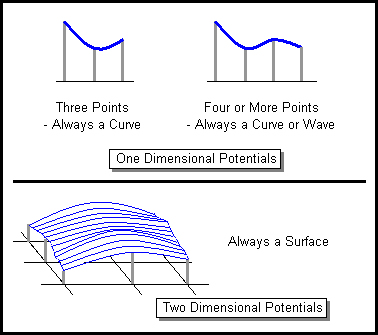
Given more points;
Potential as Curves or Waves.jpg

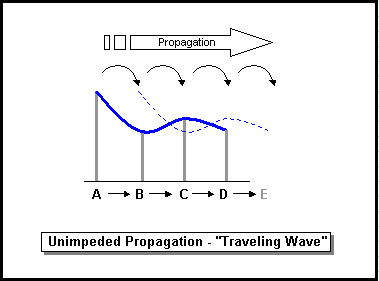
And sense affect is always in a direction, it propagates thusly;
Unimpeded Propagation.jpg
where A is affecting B which at the same time is affecting C which is at the same time affecting D and so on. Thus “traveling” or propagating.

James,

The dictionary might claim to have given a definition of “wave” in physics, but it has missed an important part of the meaning in physics - a regular, repeating change. If RM wants to use such a weak definition, then this says that RM has a very weak concept of “wave” applying to affectance.

In any case, we finally agree:

To me, this is the definition of something that varies randomly, not as a wave. The definition used by RM for a “wave” could apply to turbulence or other phenomena that are not considered waves.

Your diagram of four points is simply a line drawn between four points. To me, it is not a “wave”.

I can cope with the idea that affectance varies very little at very small distances - the avoidance of discontinuities. That is “wave like” but does not mean affectance is overall a wave.

I can cope with a fine granularity which means what we measure are averages.

The next question is speed of affectance potential moving. If the rate of change does not exceed the maximum, does all affectance move at the same speed?

I want to ask some further questions in a specific context:

Points and directions.gif

Let’s consider point E. I assume there is affectance going AEI, DEF, GEC, BEH, HEB, CEG, FED, and IEA at all times. Is the affectance in all these directions traveling at the same speed?

If point E has reached a maximum rate of change, does that delay all the affectance directions mentioned?

If it does, then I see a big problem. Some affectance has reached point D traveling towards E. Point E is at a maximum rate of change, so the affectance at D must stop. At some time later, E can accomodate some more change, to the affectance at D then moves to E.

We have just seen some affectance stop at D and then restart. Whatever affetacne is, it can stop and then resume motion (or at least the potential to affect can). This denies an idea you had given earlier that affectance is always moving.

Eugene Morrow

Just to make sure that physics wasn’t teaching something really strange, I contacted one of the physicists that I know and asked him 3 questions;

  1. In physics, is a wave a perfect sinusoid?
    He thought for a bit and replied that it is a variation in a value. And in the case of an FM radio signal, for example, obviously it couldn’t be a sinusoid. He hesitated a bit, a little suspicious of this being a trick question of some kind coming from me. Then he replied, “of course you would know more about that than I would.

  2. In the case of a photon, is the associated wave a perfect sinusoid?
    Again, he hesitated thinking a bit. "Well, let’s see. They often describe a photon as a modulated wave that increases then decreases. So it couldn’t be a true sinusoid, just basically sinusoidal. There is a lot of controversy over exactly what a photon wave would really look it. I think it varies with polarization and such. Then he started into how a photon gets created and wondered if that kind of process would really form a sinusoid or not.

  3. I mean absolutely, infinitely perfect?
    “Hmm… well I don’t know that anything could be absolutely perfect. I haven’t really thought about it.”

Basically, he agreed with everything and in the same manner as I expected. Take that for what it’s worth. If you have some reference who is speaking for the entire field of physics and professing perfect sinusoidal waves, I would be interested to know who that is.

ALL waves and curves are merely lines drawn between points with the assumption that between those points are many more points un-drawn. In the case of RM, there are an infinite number of points between each point (unlike the case of water or air). The “line” is a curve to show that the points between are not necessarily a fixed slope, although I suspected that you might surmise that, so I redrew one of those pics;

Meaning of a Point of Potential.jpg
Note that I changed the dashed lines between to indicate that they are not a “straight line” of points from A to B. Those points could vary quite a bit. That is why I showed the Averages pic. Every specified point is actually an infinite number of points immediately surrounding the point specified.

Well now, there is variation, but there is no “granularity” as such. There are no parts or pieces. There are an INFINITE number of points between ANY two specified points. There is no separation involved in the points between. The pics have to be drawn that way merely to show that there are points there, but note the pic specifically states, “Infinite number of points”.

I can see that I need to devote an entire chapter on merely what an affectance wave is. Typically at universities, the physics department will offer an entire course merely on EMF. But if I can’t cover one of their courses in one chapter, not only am I doing something wrong, but the entire book would end up being more of an encyclopedia (which it might anyway).

Well, that isn’t a yes or no question. Consider the following;
Variations Within a Wave.jpg
As shown above, a “wave” might be very small or it might be very large. As it turns out, that will make a difference in how much it is affected by other waves of the same size or less.

The rule is simply that the ONLY thing slowing any affectance wave is the summation of affects. So in the case of an extremely small wave wherein there is no room for great variations, for any added wave to slow it, means that the two waves must add, point by point, to the maximum rate change. And in the case of a very small wave, that can’t happen if the wave shape doesn’t indicate that it would.

But in the case of a huge wave such as a photon, there are extreme variations within the wave shape. Some of those variations will be close to the max already so that when even a small additional wave if encountered, that one point within the wave gets delayed. The more points there are within the wave, statistically, the more points gets delayed. As the few points within a wave get temporarily delayed, the entire photon gets delayed because it still has an entropic shell keeping it as a unit/packet. Thus a huge wave like a photon will always get slowed while encountering additional waves.

A wave 10,000 times smaller than a photon, is unlikely to have any points within the wave that vary so much as to reach near the max and cause any slowing. There are exact statistical equations to indicate how much each size of wave would be slowed and by how much. Of course also, the more dense the field of affectance being traversed, the more they slow.

If those points were extremely close, on the order of perhaps 10^-17 or less, they would all be traveling at the same speed (void of any other cross waves). To not be delayed, as explained above, the points must be close enough that there can be no statistical variations between the points that might reach a max. And realize that there is no such thing as an isolated wave. There are actually always cross waves in every direction all the time.

Well again, I suspect you are trying to think in too perfect fixed terms. There is no such thing as perfect symmetry. We can draw pictures of symmetric notions, but the universe can never actually create anything perfectly symmetric. So there is no “all of the identical waves hit at the same time”. That is a logical impossibility for the same reason as our original “impossibility of homogeneity”.

And again, you don’t seem to realize that we are talking about an INFINITE number of points between ANY two points. Thus in your pic, each of those lettered points actually has an infinite number of points between them for the waves to compress while they are being delayed. There is no actual stopping. It wouldn’t be any big deal even if there were temporary stoppage, but there actually isn’t.

It bothers me that you still haven’t caught onto what affectance is (ref; “whatever affectance is…”).

James,

The arguments about the impossibility of a wave being a perfect sinusoid are an example of the confusion I mentioned before. Because protons vary in size, you are effectively saying that nothing has a definite size so protons and raindrops vary just as much. They don’t - there is a huge difference in the variability of rain drops that protons do not have.

For this discussion, I claim that RM is treating affectance like the variability of rain drops - they can vary as much as they like, whereas to me “waves” are much more definite in nature like the variability of protons. I do not accept that the word “wave” applies to affectance. You can continue to say “wave of affectance” but I will simply read “some affectance”.

We are making progress, because I am developing my own list on characteristics of affectance:

  1. Affectance has no particular shape or organization.
  2. Affectance travels in all directions.
  3. Affectance will add together when it collides.
  4. Adjacent affectance cannot suddenly vary, such as a maximum down to a minimum. There is always a gradient of some sort.
  5. Affectance can travel at top speed c (speed of light). We are ignoring “graffect” for now.
  6. Affectance slows at a point the closer the rate of change is to the maximum at that point. Since there are an infinite number of points between any two points, then affectance never stops, it just slows down.

The idea that affectance never stops has a slight problem - the frame of reference of itself at a constant speed. A spaceship traveling at the speed of some affectance is a vacuum might conclude the affectance is not moving.

As for understanding what affectance is, the picture got really blurred by these words from July 20:

The red quote suggests to me that affectance is one thing and the potential is another.

The whole issue I am grappling with is whether affectance is a wave or a particle. I am convinced that “wave” only weakly applies, and the quote in red above suspiciously suggests that affectance is a particle, or points in space itself with the potential being the thing that moves. To me I am talking about the thing that moves so I am interpreting affectance as being the potential mentioned above.

Why am I developing my own list? Because my list does not have the words “wave” or “particle” in them, and I feel more sense of foundation from them. My list may be received more easily by physicists. (Hey, Typist, what do you think - is my list any better?)

As a general question, why does RM say that affectance is a “wave” - what is the “wave-ness” that affectance needs to have?

My next specific question: can affectance be negative? (I think you’ve said this before, but I’m checking.) I mean that in the variation of affectance at a point, the values could be positive, zero or negative.

Eugene Morrow

My reasoning concerning the size of particles has nothing at all to do with rain drops. I used a drop of water merely as an example of an object that increases or deceases with size based upon its surroundings. There was no inference that a particle does that because other objects do it.

I’m not so sure about that. In a 500 page book, we would probably be stuck on page 3-5.

There are no spaceships involved. And RM doesn’t have to worry about “frames of reference”.

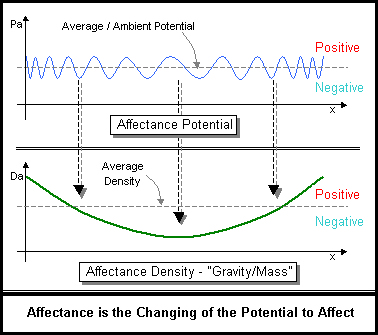
Sorry, my mistake. That should have read, “The potentials themselves don’t actually slow or move”. They are not objects. They are points or locations in space that necessarily contain potential for affect (to change something). It is the changing or affecting that travels, not the potentials or locations. But as the affecting is occurring, the potentials in surrounding points change, creating a wave of changing, or affecting - “affectance waves”.

Affectance Potential == the ability to have affect. The Potentials form a “field of potential”, very similar to physic’s “electromagnetic field”.
Affectance == the field of affecting in process. The Affectance forms a “field of Affectance Density”, very similar to physic’s “gravity field”.

Those are the two fields from which all else is derived. The Affectance field is the time derivative of the field of Potential. The field of potential is sometimes called a “charge field” in physics).

Well, I am using the word exactly as the dictionary, every physicist I have ever known, and even this Wiki article, whereas you seem to be arguing with every authority on the subject over what the word means;

But you can feel free to translate it all into Chinese if you like. But don’t go publish it. I suggest that you fix your vocabulary rather than compound the confusions that come later by trying to change a word. I can’t stop using the word “wave” because of your personal confusions over a definition.

There is no intrinsic positive or negative in the universe.
Positive and negative in RM refers merely to the state relative to an ambient.
Affectance POTENTIALS can be greater or lesser (positive or negative) than the average ambient potential.
Affectance DENSITY can be greater or lesser (positive or negative) than the average ambient affectance.
I added the words “Positive” and “Negative” to this pic for you;
Affectance is the Changing.jpg

Additional pics relating to the positive and negative particle accumulations;


And since particles are not actually point entities;

James,

A much better definition of wave. The new definition brings out some of the points I am trying to make.

I claim RM is saying “Affectance is a wave that only randomly oscillates”. To me regular oscillation is a key feature of a wave, but clearly random oscillation is enough for RM.

Notice also that the new definition carefully distinguishes between a wave in a medium and wave without a medium. RM claims that affectance is not a particle, so there is no medium other than itself. RM also claims that affectance is a field, which applies to Electro-Magnetic waves that have no medium.

Notice that waves with no medium (EM waves) are the ones that show the most sinusoidal behavior, whereas affectance does not. I am immediately alert to any assumptions that affectance might show sinusoidal behavior because RM uses the word “wave”.

Another interesting feature is that both quantum mechanics (qm) and the Theory of Elementary Waves (TEW) agree that the EM force is carried by photons (a particle), so the field and EM waves are associated with particles. RM seems to be describing affectance as a field that is not carried by particles and the waves do not have a sinusoidal shape. That neatly summarizes my concerns - I have been pestering you about what affectance is because affectance is quite different from concepts I have heard of before in physics. It doesn’t mean that RM is wrong.

My pestering will be important later - if affectance is not organised into regular waves like sinusoidal ones, then the building blocks of the universe are these random things. Somehow they combine to create a universe that sometimes has very regular waves that are very sinusoidal. How does order emerge from chaos? RM has made it much harder by starting with affectance. To understand how RM explains this, I am making sure I understand the foundations of RM first.

My analogy of protons versus rain drops was to highlight that when I use the term “sinusoidal” I am referring to a family of shapes that vary in amplitude and frequency. FM radio is still a sinusoidal wave - it just stretches in various dimensions. My analogy is that protons vary in size like EM waves vary in their sinusoidal shape - there is variation around a central characteristic. The size of rain drops is totally chaotic compared to the size of protons, even though both vary. I was just using that analogy to say that sinusoidal waves have a slight variation like the size of protons, but affectance varies in organization as much as rain drops vary in size. Philosophically, I think the difference is important.

Stunned you wrote:

Why? Surely frames of reference are a universal idea that applies to everything in the universe, including affectance which RM say is what everything is made of. Surely we can have a thought experiment about frames of reference and affectance.

The difference between affectance and affectance potential seems to be that potential is the attempt to change something, and affectance is the net result of that potential. So the potential comes first and the actual affectance may be coincident but could be delayed if there is a maximum rate of change that slows it down or other affectance creating drag or impedance. Have I got that right?

It may appear that I am holding up your expression of RM in physics. I believe my reactions are going to be roughly typical of physicists and philosophers when they hear about this - they will realize that affectance is quite a different beast to what has been described in physics before, and they will take a big double take and “Run that by me again”.

To me, I am getting so many new ideas so quickly, I am concerned that there is plenty of room for assumptions to have crept in. I want to give RM the respect of detailed scrutiny it deserves, and RM has thrown me in the deep end of new ideas straight away. Notice how few others on this forum are asking questions about RM. Why? Because there are so many new ideas they are scared of drowning. Please forgive me for being so slow on the uptake - I am swimming as hard as I can.

Eugene Morrow

Eugene, look at what you are doing.

Fundamentally RM is a pretty simple concept set; “Distributed potentials endlessly changing each other with only one constraint”. But when you inject other theories into the simple, it is no longer simple. You are trying to inject other notions onto and into RM. RM is NOT built upon or an extension of QM, TEW, contemporary physics, or any other set of theories. RM starts fresh from the very beginning. It has some associations that support many popular notions, but it also can point out where a few common notions are necessarily wrong. RM is the “independent eye”, the “third eye”, on the way the universe works.

RM is supposed to be a “different beast”. Note that it is named “Metaphysics”, NOT “theoretical physics”.

You are INJECTING OLD ideas and confusion into RM. I have spoken very few “new ideas”.

I use the word “wave”. You proclaim and insist that the word means something very specific, even though no one else on the entire planet believes that. I explain what I mean by it and give you references wherein other people have described it in the same manner as I. You then say that because I used the word “wave” improperly by your standard, “affectance” must be a particle, not a wave, or at best random turbulence.

I tell you that RM need not concern itself with “frames of reference”. You reply that it MUST, “frames of reference are a universal idea”. So what? I HAVE TO inject THEIR “universal ideas” into MY construct even before I get barely started? Yeah, let’s start with the most confusing notions and then later explain how they weren’t really needed.

I show how and why affectance goes up and down in waves. You proclaim that it MUST “oscillate” REGULARLY, even though the definition never said anything about being regular and in fact in the case of FM cannot ever be regular and they even showed pictures of it being very irregular and not necessarily even repeating more than a single hump. While you are all concerned about “regularity”, you are entirely missing the whole point.

I explain the notion of the wave versus the medium in RM and how it is very similar to EM waves. You retort with, “Notice that waves with no medium (EM waves) are the ones that show the most sinusoidal behavior”. Firstly, I couldn’t care less if EM waves happen to be sinusoidal or not. The fact that they are taught using a basically sinusoidal shape and often used in that manner is totally irrelevant.

This is NOT a tutorial on contemporary physics notions, especially not notions that are merely the result of their teaching and use methods. They have NEVER proclaimed that ALL EM waves MUST BE perfectly sinusoidal. So you are attempting to bend RM into your own private set of misunderstandings.

I present the idea that “somewhat random” potential states necessarily cause a changing, “affecting”, of those states and that leads to waves forming in “somewhat random” directions. You retort with, “Another interesting feature is that both quantum mechanics (qm) and the Theory of Elementary Waves (TEW) agree that the EM force is carried by photons (a particle)”. Did I EVER say that RM is based on QM or TEW notions???

Again, I couldn’t care less about the notions of forces being carried by particles. In RM, “force” is merely the migration of affects upon potentials and has almost nothing to do with particles of any sort. Frankly, I don’t even know what “carrying a force” really means. It seems like a seriously conflated, imaginary, and irrational thought. Force is the “pushing” or “pulling”. How in hell do you carry a set amount of pulling? What? If I carry enough force in a bucket out to my car and bump it, the car will start following me around? But the point is that such a notion and theory is NOT a part of RM, so I don’t really care.

Consider the notion that THEY have been “wrong” (to some small degree). In the end, regardless of your word usage concerns, RM explains ALL OBSERVED phenomena. It makes no attempt to explain other people’s theories or concepts.

Are you not reading my posts?

A potential is an ABILITY. It is NOT a “thing”. It is NOT an “action”. It does NOT “move”. But what it DOES do is “actuate” or “actualize” into an “actual Affect” by actually changing the next potential next to it. At each location, the potentials end up getting changed (UP and DOWN in their ability, their “potential”). Because they are NOT TOTALLY RANDOM, they end up producing SOMEWHAT randomly directed waves (going up and down toward varied directions).

Actually producing a “regular pattern” requires an oscillating system. That comes MUCH later. Systems require constructs which require INERTIA and a lot of it.

Stop insisting on “the ONLY way” to swim and fighting the one trying to help you float. You have made something very easy into a mess of your own confusion.

The one post a day thing I can tolerate. But I am getting the impression that you are spending maybe 30 seconds actually thinking about what I have said before you begin “scrutinizing”.

You are doing EXACTLY what I warned you about. You are confusing a first grade arithmetic course such that you could NEVER even get into a calculus class, much less understand anything about it. Stop trying to judge it before you understand what it is saying. “Scrutinizing” REQUIRES that you first LEARN what is actually being said. If you go judging every word before you get off the ground, then you don’t… get off the ground. Is that your intent?

STOP your current thoughts and START OVER, “remove your sandals” before G.O.D.
I had to do it and so do you.

James,

Clearly you are not liking the my probing about waves and affectance. Affectance may seem obvious and simple to you, and you may have forgotten what’s it’s like for people learning something for the first time. Believe me, I am trying to start from scratch with RM, and that’s why I am asking so many questions. I compare with quantum mechanics (qm) and the Theory of Elementary Waves (TEW) only to highlight how different RM is. Even dumb questions are to be expected, and other will ask them too.

I have a question about affectance potential and actual affectance. We looked at how affectance can be delayed if a point has reached the maximum rate of change. Does that delay both the potential and the affectance, or does it delay only the affectance?

I won’t ask anymore questions about waves and affectance for a while. You were saying that reflection is the next step, so let’s move to that. I remain on careful watch about the behavior of affectance.

Eugene Morrow

Okay, starting again from the very, very beginning…

Regardless of any Science or Religion, strictly from the Logic of the Situation, out there in the vacuum of space there is the following describing the state of the Potential-to-Affect (the Potential for Existence itself);

A “potential” is an ability to do something. In this case, it is the ability to alter the ability in the surrounding locations. One cannot actually see a mere ability, so this is merely a mental picture of a state of vacuum at one moment in time. Again, the state of a potential cannot ever be seen. It must be mentally deduced.

That pic is displaying what the state of Potential-to-Affect might look like if you could actually see it. It is showing that with a magnification of zero, nothing would be seen at all. It would appear totally black. But if one had some kind of magic microscope that allowed them to see “potential-to-affect” and increased the power of that microscope up to perhaps one million, distinctions would become visible (upper left).

As the power of the microscope was increased, every prior small variation would be seen to have even more variations within. If the power of the microscope is continually increased, each stage would show additional, smaller variations that had been too small to see at a lower power (upper right).

Because Science deals with comparatively large scale issues mathematical formulas are derived that describe the over-all trend of the states and might yield a pattern depicted in blue at the lower left. But in reality, the actual states have minute variations that are not of concern to the mathematical equation, thus are not displayed or generally discussed (lower half of the lower left).

But if the magic microscope could be taken to an ultra extreme, eventually it would be seen that there is a maximum degree of difference between two adjacent potentials. That maximum state cannot ever be exceeded. But not because there is any barrier involved, but rather merely because there cannot be an instantaneous discontinuity between adjacent potentials infinitely close else one value would have to be both a high value and a low value at the same location and if not exactly the same location they would immediately alter each other and become much closer to the same value in near zero time, thus no longer exist and could never be produced again.


Now realize that at this (new) stage, we are not talking about anything moving at all. We aren’t even talking about “things”, but merely a state of the universe at one instant in time regarding the state of potentials-to-affect (“Field of Affectance Potential”).

Later we can talk about those potentials changing. But do you grasp the mental picture involved describing merely the instantaneous “snapshot” of a typical region of vacuum? And do you agree that it is logical necessity?

James,

I am fine with a maximum degree of difference between two adjacent potentials. The diagrams are really good as usual.

Eugene Morrow

I need an honest answer to those two questions.

James,

If you want an honest answer already, can do. Your diagrams are about:

I can grasp the mental picture of the ability of one infinitesimally small point to affect the next and there being a maximum.

It is a logical necessity? I’m not totally convinced that the universe demands there has to be a maximum. In some cases I believe there will be one, because a point either side of an event horizon means the point inside has a maximum of zero potential to affect the outside. Is there a maximum to the potential of the outside point to affect the inside? I’m not sure there is.

Think of photons - is there a maximum frequency? I don’t think so - the frequency can keep on getting higher to arbitrarily close to infinity. The ability of one point to affect the next includes sending a photon, so it’s not limited, unless the photon cannot make the journey.

If we talk about points a million times smaller than a photon, then I just cannot say logically if there is a maximum or not - I have no way of knowing, and I don’t believe logic can come to any conclusions at such a minute scale.

I think the idea of a maximum is an assumption. I can go with a maximum for now.

This is one of the key points I am trying to make in this debate - I believe RM has assumptions just like any other theory. I like a new approach and the philosophical strength of RM - there is an attention to detail that makes RM worth considering. I also believe it is impossible to have a theory of physics without assumptions - our knowledge is too limited to rule out all logical possibilities.

Eugene Morrow

This thread is about James expounding tentative hypothesis as fact and then pretending they are more than ideas, whilst simultaneously attacking science for something he hasn’t done, prove it. This is what James does, you can start a thread on anything related to physics, but it wont remain on the topic because James is a crusader for his hypothesis, one who is unwilling to back anything up. A sort of Post Post modern science is nothing my beliefs and feelings are everything. What James has I think is basically on the same level as intelligent design.

I’d have a great deal more respect for him if he had done the same amount of work as people who have accreditation. This however is unlikely to happen. Nothing is wrong without evidence, and nothing is right either. James despite careful correction does not and will not understand this.

So after saying that you agree that there can be no discontinuity, now you are supporting it?

You are saying that on one side of the infinitely small point defining the maximum event horizon effect, there is zero potential and on the other side of that infinitely small point, the potential is substantially different? Wouldn’t that require that at the infinitely small location point, the value of the potential would have to be both high and zero at the same time. Can you justify that? How is it possible for the potential at a single point to be both high and zero?

My understanding of event horizons is that such an effect is gradually achieved. Whether it goes through zero or not is irrelevant. The only concern at this point is the gradually approaching value rather than an instantaneous change (discontinuity). An infinite frequency would have the same issue.

An infinite frequency requires that the highs and lows of a wave be both high and low at the same location. That would yield a wavelength of absolute zero. Even contemporary physics would require that such an event contain infinite energy.