I’m surprised you’ve changed the subject back to the double slit.
I think there will be gaps in the vertical lines in the results of that experiment. My guess is that the waves in either direction will be in phase and out of phase and then in again etc as we go up and down the vertical lines. I am not particularly concerned about that - it seems to be a matter of a lot of geometry.
As for how RM in physics defines affectance, I am giving an honest and hopefully useful philosophical view which might help you write it up. My understanding is that RM describes particles as being composed of wavelets of affectance, and I think RM is vulnerable to some criticisms of the mechanism for that. I’m still interested in discussing it, because I like hearing new ideas - it really gets my own mind going to consider new possibilities.
Well, Eugene, I don’t know what you are imagining in your head, but I can tell that it couldn’t be what I have been talking about all this time. What I have been talking about is pretty simple, just a few concepts. How you get broken waves and rivers out of it is beyond me. There haven’t been any assumptions concerning what I have been trying to say. We obviously aren’t communicating despite my attempts.
All of the religions were born out of this same kind of confusion. From Ahdam they got the Hebrew bent. From the Hebrew, they got the Abram bent. From Abram, they got the Moses bent. From Moses, they got the Jusdist bent. From Guatama, they got the variety of Buddhist bents. From the Judists, they got the Jesus bent (which to me was a serious correction). From Jesus, they got the Catholic bent. From the Catholic, they got both the Mohamed and Protestant bents. From the combination, they got the Classical physics and the Quantum physics bents. Various others along the way. What ever is said, is always bent into something that wasn’t really intended. But there is enough of that going on all ready. I really don’t want to add to it all.
The concept of the cause of delay is crucial. If you can’t get that down, the rest really isn’t worth trying to get into, because when it comes to magnetism, you really have to have your head on straight. It is even hard for me to keep it straight.
Just a few other pics that we would have gotten into;
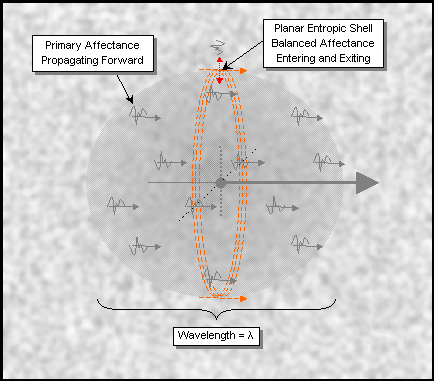
The Photon (not necessarily that shape all the time).
The “gluon” particle that never was an actual particle. They just assumed the left over energy was “probably” a “particle of glue” holding the positive particles together (hence “indirectly observed” what was never there);
Positive and Negative particle formations;
And this is one you would never figure without understanding propagation delay.
Electromagnetically induced electric current flow;
All of those and more were to let you know how much there is involved in order to discuss that simple double-slit experiment. Those are the issue of the “hidden variables”. I am still not strongly confident that I know the answer to that one. Things get complex enough that I might have to actually create a meta model for it just to keep all of the concerns straight and I don’t really have a large enough PC for that (not to mention the time).
…and one last time… a “Wave” is not a “thing”. It is just a “value” that is drifting up and down. You can’t “break it” and it doesn’t form “rivers” as far as I can discern.
You are attempting a breathtaking challenge - the first time you are going to publish a theory of everything including physics you are determined to have no assumptions. It’s like going for an Olympic Gold medal the first time you are competing in that event.
I suggest it might be a bit too ambitious, the first time. Perhaps you can change that to “as few assumptions as possible”, rather than ground zero of no assumptions. I really believe there is an assumption in RM in physics - this business of affectance delaying.
Let’s start with what we agree on:
I add: waves also don’t pause and resume (delay). Waves either add/subtract, deflect/reflect or continue or interfere. Waves can change speed in different media, which clearly doesn’t apply to affectance. Waves also don’t spontaneously break up into little wavelets unless there is interference, and even then they don’t delay.
The situation we are considering is two waves of affectance colliding and facing a situation of exceeding the maximum rate of change. We end up with “wavelets” some of which pause to avoid the maximum area. To me, that implies a larger wave breaks up into wavelets some of which pause. That is not wave behavior.
My logic is as simple as that. So I conclude affectance is not always a wave - it is something that can pause and resume, like a “river”. We can choose a different expression if you prefer - perhaps “pausable stuff”. So affectance is both a wave and “pausable stuff”.
This says nothing about how successful RM is. This is only a reflection on the behavior of affectance. RM claims that affectance is logically both wave and “pausable stuff” and I claim that is an assumption/postulate.
I have a question about a wave of affectance: does it ever interfere with another wave of affectance?
Isn’t that a bucket of assumptions that you just asserted without the slightest evidence? Every natural wave that I can think of gets delayed and/or deflects. I wasn’t assuming that affectance waves would also delay merely because every other known wave does. I proved why it delays, but of course, if you misunderstand the proof, it isn’t a proof to you.
Do you realize that in RM, the “media” is the very thing of which the waves are formed? They are much like sound waves. The density of the air controls the speed of the sound waves. As that density increases, sound waves slow. They get delayed. But those waves of MADE OF the air, the very media you are talking about. Likewise, as Affectance “media” gets denser, the waves (which are waves of affectance density or potential, depending) delay more. I was explaining why. Sound waves also have a maximum rate of increase.
But why do you think a wave of something does NOT ever delay? Where did you get that notion? I don’t think you can come up with a single example of a wave that never delays. Water waves delay. Sounds waves delay, light “photons/waves” delay, radio waves delay. Everything delays.
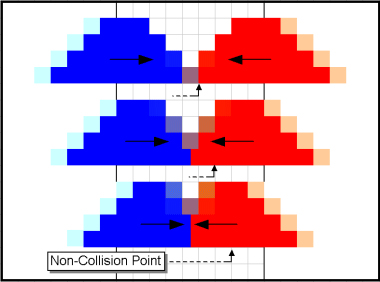
Okay, I am getting the impression that you misunderstood one of those pics. The pic of the blocks adding together displays portions of the red and the blue separated from the larger portion. But it only displays it that way because I didn’t have another way to express that “half of the red and half of the blue add into the same block”. I explained that it was a crude way merely to display the issue of “one block at a time” concerning both time and propagation distance. You have to have a degree of grace when viewing someone’s effort to draw a concept.
The little bits of blue or red don’t actually separate. I guess that is where you are thinking of “breaking into wavelets”. Those weren’t “wavelets”. They were not actually separated from the major wave. By “wavelets”, I was referring to the very many colliding waves (of which I was merely displaying one) that are within a single particle. Compared to the particle, those “waves” are tiny, thus “wavelets”.
Many talk about a particle actually being a wave itself. If it was, that wave would be enormous in size compared to the much, much smaller waves within that particle that formed the overall entity. I refer to a particle as a “standing wave of NOISE”. But realize that “noise” represents millions of tiny frequencies distributed in 3 dimensions, thus “wavelets”.
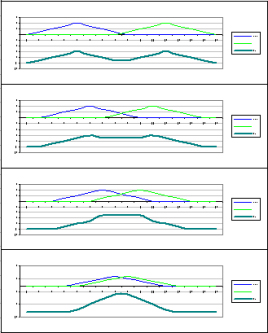
The pic of the “calculated waves” depicts the truth of it better. I just used the blocks so that you could see the “maximum of one block at a time” issue.
Note there are no “wavelets” in that pic. But that pic was to be indicative of a single wave collision. A particle might have millions of those going on within it at the same time. Compared to the size of the congested area, the particle, each collision is merely a spec, thus I referred to them as “wavelets” within the particle. The “particle” is merely “the congestion of the wavelets”. Nothing “broke up” to create those smaller waves. They came into the picture already as tiny, very minuscule waves, “wavelets”.
If the blocked pictorials confuse you, forget those. I was just trying to show how much of each, red or blue, was being added to each block as time progressed. I can’t see a way to always ensure that each little bit of blue or red remains pictorially attached to the main portion. The pic above is the same occurrence, merely calculated out and displayed a little differently. But the summation wave at the bottom of each graph is the only “real wave”. The others represent the original waves that collide and then combine to become the sum.
What is the difference between “pausing” and “delaying”?!?
I had ask you for your definition for a “wave”. Whatever you are thinking that a wave is, is clearly not what I am calling a wave.
WHAT?!?!??
How can you even ask that?
That is the ONLY thing we have been talking about for over a week now.
Your diagrams are top-class, and help your case. My issue is with how the word “wave” applies to affectance. We are making great progress on focusing on this.
I asked about interference to absolutely confirm that RM claims that affectance is a wave. I can pinpoint my issue more precisely now. Near the bottom of Page 16, you were recapping the main points, and wrote:
The phrase “wait for a bit” implies that the wave stops, and then later restarts. Is that what RM is saying? If that is true, then I claim it is non-wave behavior.
I am also concerned with this:
We know that air is made of particles. With air as the medium, there are a lot of particles sitting around that are not part of a wave - that’s why they can host a wave. By affectance being the medium, it implies that affectance has properties of particles. If affectance is always a wave, it could not be a medium for another wave. Surely the affectance can propogate in a true vacuum.
I am concerned that both of these ideas imply affectance has non-wave behavior:
Waves of affectance stop and restart later,
Waves of affectance use affectance as the medium.
To me, the idea of affectance having non-wave behavior is creeping into the description without being explicitly stated.
My original theory was that a particle was merely a wave “chasing its tail”. But after I actually built my metaspace so as to show me what was actually happening, I found that the spin issue is relatively trivial. The particle is merely a congestion of wave(let) interference. Think of a crowd mulling around in a park and a fight breaks out. They might or might not decide to start dancing in a circle. The dense gathering is the particle with its center at the highest contention.
And the only problem with laymen trying to understanding is their temptation to throw in confusions left over from prior misunderstandings. It is all quite simple once your mind settles on the only few facts involved.
I have stated many times that Affectance is ALWAYS, ALWAYS, ALWAYS a wave in one form or another.
I have stated several times that the waves NEVER STOP. They merely collide, get delayed, and compress. I didn’t mean “wait” as in “stop, waiting for the next bus”, but rather slowing propagation, “going more slowly, waiting for time to pass” = delaying.
A wave is merely the changing of a property concerned with the media. In air the property is “density”. The fact that air is made of molecules is irrelevant to the issue. Air could have been made of anything compressible. With water waves, there need not be any particles at all because the wave is in the property of “height”. With a radio wave, there certainly aren’t particles involved. The wave is “intensity” of the electric field. With affectance the wave is of the “density of the changing” or the “height/intensity of the potential” depending on which we are talking about at the time.
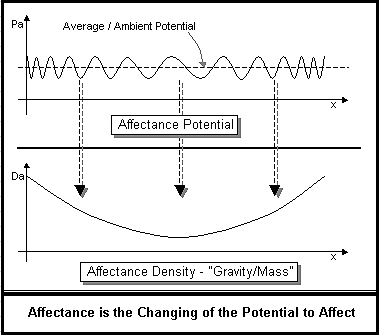
Affect issues involve a field of potential from low to high and a field of changing from sparse to dense. There are no quantum steps involved or pieces of anything. As the amount of changing increases within an area, the “density of changing” increases. As the potential to have affect increases, the “height/intensity of the potential to affect” increases. Those are the two fields that make up the more generalized “field of affectance”.
When a potential wave is propagating (the height of the potential is shifting position) and runs across another such that their combination reaches a maximum, the propagation of the wave (the shifting height of the potential) slows because the potential isn’t as free to affect the space in front of it any longer. It has to share its attempt to affect with the other wave.
When the potential to affect is changing up and down a great deal in an area with a variety of frequencies involved, more “noisy”, a “heavier”/“more dense” field of changing of affect is created. And that is what is later seen as “mass”. In a particle the changing is extremely highly dense and thus particles have “mass”/“inertia”.
The property of inertia is caused by the fact that the affects are being delayed and thus the center of the congestion cannot be shifted so easily. But once shifted, it will continue shifting in that direction without further inspiration, “momentum”.
Stop injecting it and it will stop “creeping” in.
Is this pic more to your liking;
And btw, your emotions have these same waves involved creating ALL of your motivation. Your reasoning also has waves, but is more granulated, “particlized”, fragmented and “broken”.
I had got the impression you were calling for waves for affectance to stop, and then restart. We have cleared up"Issue 1":
I should have asked this more directly earlier - it would have saved time.
Unfortunately, that’s only one issue I have with particles forming from wave(lets) of affectance. Let’s look at some more issues I have with this.
Issue 2 is with the size of waves of affectance. Let’s have a look at one of your excellent diagrams:
Question: is the blue wave one wave, and is the red wave one wave?
The problem is when the maximum rate of change might be violated. Some piece of the red and blue wave may have to slow down, compared to the rest of the wave, in order to comply with that maximum. That means those slowed pieces are now a separate wavelet, as compared to the rest of the blue and red waves. So larger waves have broken up into smaller wavelets.
We know that water and air waves do this, but actually it’s not really wave behavior. It is a wave breaking down and becoming chaotic turbulence rather than a wave. The wave is defined as a consistent movement up and down. Once we have wavelets, the consistency is lost and wave becomes more like noise.
So the maximum rate of change has made one wave of affectance break up into wavelets and hence become more like noise. The affectance is no longer showing pure wave behavior - it is behaving more like water and air when it shows turbulence. I conclude that affectance is more than just a wave - it can show other behavior that I claim is like a collection of particles.
That doesn’t mean it’s wrong. RM in physics can still be a totally correct description of what happens. I am only applying the spotlight to the idea that affectance is purely a wave. To me the description of affectance is not consistent with being purely a wave.
Issue 3 is about choice of behavior of affectance waves.
We are looking at the blue and red waves colliding as in the above diagram. When the maximum rate of change might get exceeded at one point, a wavelet of affectance has a choice of actions: either deflect/reflect (at the same speed) or slow down. Which will it choose? There seems to be no definite way of deciding which or how much of each is chosen.
If we can’t be sure of the rules of when deflection/reflection and slowing are applied, the behavior of affectance becomes something arbitrary that can be selected to suit a certain result. Philosophically, RM cannot use this as a foundation.
Once we get these two sorted I will move onto other issues. A particle being formed from wavelets of affectance is still a long way down the track yet.
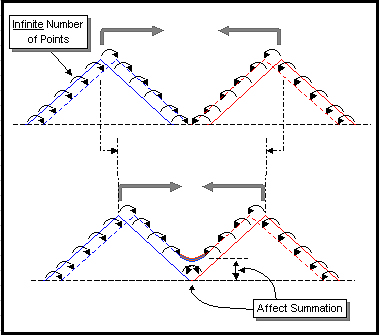
Yes. I thought that was rather obvious. Again, as I stated earlier, the ONLY reason they are being shown in blocked form was to display how each portion must add to the next position and not exceed one block in height. The waves are of course not actual blocks added together. There are an infinite number of points/“blocks” for any one wave(let), regardless of its size. But do realize that as soon as the two waves start adding, they become a single wave that is the combination of the prior separate waves.
No. Nothing “breaks up”. There are an infinite number of points. Each point attempts to add to the next. But they can each only add up to a total sum of 1. Then because the first point could not add all of its affect to the next point, the point behind it might not be able to add all of its affect to that point. Thus a pileup begins, point by point with an infinite number of points involved. It is a smooth curve and has become a single wave that is the combination of the original two.
There are no “choices” involved. It is simple addition. When you do the math in order to add the affects, the result is that the wave-shape has delayed moving forward. Realize that the “wave” is merely the calculated sum of the affects upon each point along the line that we are examining. Before the independent waves touch, that sum is merely the one wave involved. And remember that the wave is not an object in itself. It is merely a calculated value that is varying from point to point.
Well, you can’t get to the calculus if you can’t get the arithmetic.
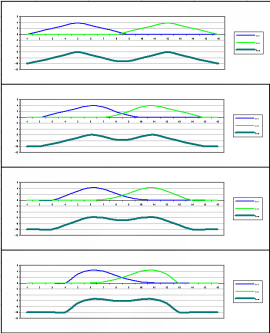
If two waves of affect happen to be approaching the same point and are NOT restricted by a maximum rate, you get the following;
That is merely the summing of the two waves point by point. The green and blue indicate the original waves. But the actual summation is the true wave. The green and blue are no longer separate entities because they have combined into one wave, the teal colored wave.
But if I merely place a restriction of the summation that no point can increase by more than one for each time-step of one, I get the following graph. Everything else is the same. And the end result of the summation is, again, the only actual wave. The green and blue are merely indicating which original wave is contributing how much to that sum.
Note the difference in the last graph of each pic. The wave shape has changed. The amount being contributed by each of the original waves is shifted/delayed from where it would have been if there had been no rate of increase restriction.
Realize that when waves propagate, they do so by each infinitesimal point having its affect upon the next in line. In normal unimpeded propagation, as each is having its affect upon the next, that next point is placing its affect on the one after it. So no points are actually interfering with the points around them.
An affect is an affect. Any one point doesn’t care from where the affects came. They simply add, infinitesimal point by point. If there is a restriction as to how much can be added, each point encountering that restriction cannot add all of its affect to the next point in line and thus maintains a degree of its original potential as the point behind it attempts to add to that potential. But if not enough potential had left that point, as the point behind tries to add to it, again the restriction gets encountered and thus the point behind doesn’t get to add all of its affect either. The next point behind that one might have the same issue and so on. But fortunately each point back in line feels less effect so the entire wave doesn’t simply simultaneously delay. It instead stacks up or “piles up” like a spring compressing.
Banks play out this same game with bank accounts and money flow. The banks intentionally delay the funds from propagating to another account specifically to keep the funds within the bank a longer time, an “artificial delay”. A bank is in effect a “particle” within the economic system wherein the delaying of the fund-transfers is how the bank gets its accumulation of money. It then uses that accumulation of other people’s money in a variety of ways. But if they did not delay the transfers, they would have much less accumulated funds with which to play their games and exercise their influence.
In the economic system, there are not an infinite number of accounts, thus the analogy is not exact. Due to the limited number of accounts, the “waves” involved are more like what you have been thinking. They are actual “bits” within the wave of money flow, much like air molecules in a sound wave. But the general principles are the same. They merely have to use a slightly different algorithm for calculating their situation. In the field of physics-affectance, the “accounts” are point by point and thus a truly infinite number of them as described in the introduction posts.
RM deals with infinity quite a bit. I had to augment contemporary mathematics so that it could handle the issues that infinity brings up. That is one of the variety of reasons that I am not showing the math involved. But more significantly, this isn’t an issue of mathematics, but merely logical reasoning and understanding the situation being described. If someone doesn’t understand the real situation, the math merely creates a misunderstanding that propagates from generation to generation and creates something like QM.
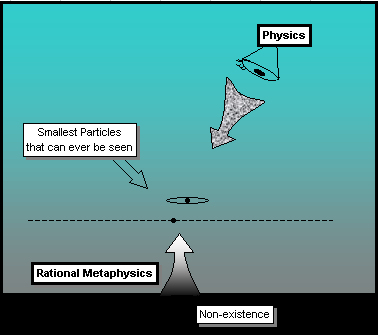
This is a pictorial to present the conceptual difference in the RM approach to understanding the universe versus the physics approach;
Rational Metaphysics begins with absolute nothingness and adds only necessary and defined concepts. The end result turns out to be a very full, precise, and serious explanation of everything contemporary physics can ever see.
And btw, how is the post-honeymoon coming along? You seem distracted.
Very important statements:
(i) that the red and blue waves are one wave and
(ii)
I am going to ask some more questions to turn the spotlight up even closer on this.
Question A: When a piece of affectance cannot add to the next point, because it would violate the maximum rate of change, why wouldn’t that piece of affectance deflect/reflect instead of slowing down? To me, it had a choice of behavior.
Intro to Question B: Here is the diagram for the combined waves when the maximum rate of change is controlling the collision:
Question B: what happens next after the two waves pass? Perhaps the red wave appears again on the other side, with the same or different shape.
Question C: If the red and blue waves are identical, is the result symmetric? (Seems likely but just checking.)
Question D: If one piece of affectance can only be partially added to the next point, due to the maximum rate being violated, does that part add to the next point and the remaining part get slowed?
Question E: Is there a smallest piece of affectance wave, or can an affectance wave be infinitely divided into pieces?
Depending on your answers there will be more questions. The spotlight remains on the relationship between affectance and the word “wave”.
In this one-dimensional example, there is nowhere to deflect to. We are just adding the affects mathematically and seeing where it leads. We can’t just decide to make 2+2=7. We aren’t choosing to guess that the waves get delayed. We are adding the numbers together and seeing that in fact the waves get delayed. The issue of reflecting is the next issue to discuss. Before we get into that, I need to see that you actually understand the whole delay concept. What we call and appears as a reflection is actually the reconstruction of a wave that is headed in the opposite direction of the original.
It does, but delayed as the graphs showed.
I designed this example to be symmetric. The result remains symmetric.
You are talking about the potential at a particular point. That potential to affect, actualizes/affects the next point to the degree that it can. If it didn’t completely expire its potential, the rest remains at that point. The potential behind that point adds to the remainder due to its own potential to affect. The “wave” gets slowed. The affects themselves never actually slow. They don’t actually ever even move. They merely actualize their affect upon the next point in space. The total in that point of space might accumulate such as to have a higher/lower potential. The end result gives the appearance of a shifting or moving.
As originally stated, there are NO pieces/parts/particles or whatever. We are dealing with infinitely small points, but an infinite number of them. A wave is merely the gradual increasing or decreasing of the potential (or density, depending on what we are talking about at the time).
The further this discussion goes, the more obvious it is that affectance is only sometimes a wave.
We both agree - a wave is a value going up and down in a sinusoidal pattern. We started with considering a wave of affectance that has such a shape.
This wave of affectance collided with another wave (the red and blue waves) and because of the maximum rate of change some affect had to be slowed down. That’s it - the pure sinusoidal pattern has been destroyed - part of it was going fine, then one bit had to be delayed, so there is a discontinuity in the shape. That is part of a slippery slope where the whole wave pattern denatures.
RM has stated before that affectance can be “noise”, i.e. chaotic values. We all know this from water and air, because of course they are composed of particles. RM claims that affectance is always a wave, but the discontinuity in the wave above, and the existence of affectance “noise” show that affectance is not a wave too.
I would describe affectance as “something that can affect adjacent points of space. Sometimes affectance appears as a wave, and other times as not a wave - chaotic and random”. I think RM is not being accurate in claiming that affectance is “always” a wave.
In fact, the further this discussion goes, the more I am convinced that the tendency of affectance is to become chaotic and random. Why would affectance be organized into a wave in the first place? What would make the affectance decide to be in such a well shaped sinusoidal pattern?
None of this reflects on how successful RM might be in modeling the universe - it’s just a reflection on the philosophical implications of what affectance really is.
The picture is getting muddier with these words:
This is sounding suspiciously like water or air particles that have forces between them and the wave is a wave of energy using those forces. In a water or air wave, the particles do very little moving and may end up in the place where they started after the wave has passed. Saying the affects never actually move is a striking coincidence with the picture of waves in a collection of particles.
To say the affectance does not move could be considered confirmation that affectance is not a wave. However, we’re getting into semantic issues here - the affectance “actualizes” the next point of space, so the “actualization” moves. The above quote has just confused the whole issue of what affectance is. I prefer to think of affectance as the “actualization” that moves.
Let’s just check something out: can the “actualization” ever stop, and then restart at a later time?
So the conclusion is very clear - affectance can have both wave and non-wave characteristics. I think RM should be clear on this right from the start.
Now I think that I am seeing the problem here.
You have the notion that a “wave” is something specifically sinusoidal.
Ever heard of a “square wave” or "sawtooth wave?
A “wave” has no specific shape.
The Potential actualizes to become an affect that propagates a wave of affecting - “affectance” being an entire field of such activity.
It is geometrically very difficult to arrange a point of potential such that it has no possible means to affect anything around it. And to do so would violate our premise that the homogeneity involved is impossible. Thus the answer is “No”. One cannot totally prevent potential from actualizing to some degree.
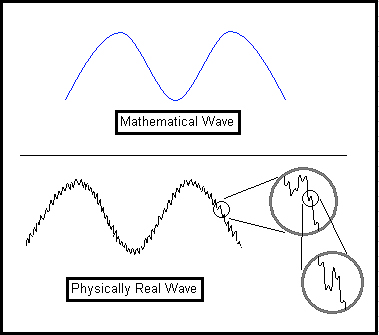
And you might want to note that ALL of Science (excluding QM) posits that no observed wave is ever perfectly formed. The universe cannot ever produce a perfect wave shape and especially not a square-wave or any wave containing a straight line or a corner. They use approximations and averages.
RM in physics has clarified that a “wave” of affectance is not necessarily sinusoidal and not necessarily perfectly formed. The electric and magnetic fields associated with an individual photon are always proper sinusoidal waves, so there is an example of a wave that stays a wave. Waves in water and air are much more than merely sinusoidal and are almost always imperfectly formed, so these phenomena seem a closer fit to the RM description of affectance.
Waves in water and air are waves in a collection of particles, so this brings into question what affectance is and how it behaves.
This has implications for the whole of RM in physics. Water and air sometimes show just turbulence or simply don’t move rather than show clear wave behavior. The ability of affectance to show wave behavior is seriously limited now, because the wave behavior is dependent on the shape of the wave and how well formed, and yet affectance must always be moving. It may show wave behavior sometimes and sometimes not.
So far, RM has not had much of an opinion on the wave behavior of matter - such as a single particle in a double slit experiment. You described this as an “edge” effect and a “miracle” experiment. The results of that experiment are described by a precise sinusoidal wave (and qm and TEW disagree only in the direction of that wave). I am now suspicious that because RM claims affectance waves are like water/air, then RM has lost the ability to describe such a result. RM would need to justify why the affectance is so well organised into a sinusoidal wave in that experiment, where affectance is not necessarily organised that way most of the time.
You can see why the characteristics of the affectance wave are such a big deal to me. The organisation of the affectance into a wave seems unimportant when two waves of affectance are colliding. The organisation of affectance will be critical later on.
We have finally got the clarification that I wanted:
(i) A wave of affectance is not necessarily sinusoidal or well formed - it might and might not be.
(ii) The maximum rate of change can make a point of affectance slow, which clearly will disorganise any wave that the point is part of anyway.
To me, (i) and (ii) mean that affectance has both wave and non-wave behavior. For RM, both (i) and (ii) fit under the heading of wave behavior.
On that basis, we can move onto the next step, which you said was reflection.
Well I’m sorry, but you are misinformed. EM waves are no more perfectly formed than any other. Anyone who has told you otherwise doesn’t know what they are saying.
What you are thinking defines a wave is not what anyone has ever meant by it if they knew anything about what they were saying.
I can’t stop using the word “wave” under such a constraint.
Realize that our original axiom was that infinite homogeneity could not exist. The reason it can’t is due to the definition of infinite. When it comes to a perfect sinusoidal wave, many things related to that wave would have to be infinitely identical - identical to 100 billion decimal places and more. Each value at every point exactly one wavelength away would have to be infinitely identical. No two things can ever be infinitely identical and certainly not an infinite number of them.
In the case of FM radio, a carrier electronic wave is produced inside the transmitter. That wave is as close to perfectly sinusoidal as they can make it, but any physicist or engineer worth his salt will tell you that there is no way it is actually exactly perfect although most probably have never thought about it in terms of infinite perfection. That electronic wave is then modulated with a signal to be transmitted, still within the transmitter. At the antenna the current, the electrons, rush up and down so as to produce the final EM wave that gets transmitted. For that transmitted wave to be a perfect sinusoid, the number of electrons, their timing, and their exact position on the antenna would have to be perfectly repeated with every cycle. No lab on Earth would be able to actually do that and I hope that any scientist would be able to tell you that.
But in the case of a FM broadcast, the transmitted wave is not supposed to be sinusoidal. Every wave hump is supposed to gradually alter so as to replicate the needs of the signal (music or whatever).
That is an example of the 3 waves involved in an FM broadcast. The carrier and signal waves are strictly electronic. But that blue transmitted wave is the actual EM wave that leaves the antenna. Note that there is nothing sinusoidally symmetric about it. Each hump would have to exactly match the one prior and after for it to be sinusoidal. It would not be able to relay the intended signal if it ever did that. A steady sinusoidal FM wave means that there is no signal at all to transmit.
When it comes to things like photons and the waves being discussed, being mere physicists, they probably have no idea whether it is perfect or not. But if you look at the many representations of the “wave within” a photon, it is a amplitude variant sinusoidal wave-shape. Any variation in amplitude means that you cannot be talking about a true sinusoid, much less a perfect one.
The point being that the word “wave” in physics, despite the many uses of sinusoid in teaching, has never meant that anything physical has ever been exactly and perfectly sinusoidal. That includes EM waves that are commonly, intentionally produced as anything but sinusoidal.
A single photon of a given wavelength has a very predictable and well formed sinusoidal pattern in the electrical and magnetic fields.
Arguing that every wave is imperfect is confusing patterns in the real world. Protons have very slightly different masses. In comparison, raindrops that can vary in size almost infinitely. Protons have a definite size and raindrops do not.
When it comes to waves, a sinusoidal pattern needs to be created by something. Water waves are often created by the wind, which generates the wave shape from otherwise disorganised water molecules.
What is creating waves in affectance? So far, we have a mechanism that dis-organises any sinusiodal wave - the maximum rate of change - but we don’t have a mechanism that created the sinusoidal wave in the first place.
The definition of RM given so far does not need the affectance to be a wave. RM could have said that affectance is simply a change that moves from A to B. No organisation of that change is necessary. Why does RM state that affectance gathers into waves? It seems to be an assumption or a postulate, not a required characteristic of affectance.
Well, you have whoever told you that to come here and talk to me. I bet he changes his story.
Considering that no one on Earth has ever actually measured the wave-shape of a single photon, and couldn’t if they tried (by their own theories stating such), I have to take it that you and/or they have a “theory” that photons magically have a perfect sinusoidal wave-shape. Of course that violates our original statement that there can be no infinite homogeneity or “actual infinitely identical entities”.
So now we are back to square one where you postulate that perhaps there are in fact infinitely identical objects. For photons to have a perfect sinusoidal wave-shape, portions of the wave would have to be infinitely identical to other portions, not to mention being infinitely identical to each other.
If you can’t accept that premise, the rest of this would be a bit pointless because it isn’t a “theory”.
Does this make sense? A classmate of my high school time drew this up as an illustration to a speculative theory of a “general field” he created 10 years ago. He republished it in light of the Higgs boson, and this diagram reminded me of the idea about particles as a sort of ‘tip of the iceberg’ that is presented here.
Het fysiek waarneembare - the physically perceptible Grens van de ‘fysieke werkelijkheid’ - threshold of ‘physical reality’. ‘Licht-veld’ - ‘Light-field’ Een lichtgolf in het ‘licht veld’ - A light wave in the ‘light-field’ (De verschijning van) een foton-deeltje - (the appearance of) a photon-particle Groot, klein - large, small
A wave, I think, is the only way to propagate across space as an ‘entity’ - as a coherence. Nothing existant can move in one dimension, it needs to have/perpetually take on ‘substance’, which is a self-relating activity.
No doubt there is a lot of potential going on that does not travel in waves, but this can never take on substance, perpetuate, ‘be’.



](https://www.ilovephilosophy.com/uploads/default/original/2X/7/7c349bf1053f368a5729d053e1e91215f22ce66c.gif "Brick wall")