. Maximum rate = necessary delay.
Maybe the affectance does a somersault, twist, and double flip over the maximum and lands on its toe. Does affectance have toes? We don’t know!!
I can see why you are considering and confused in the cloud of all of the other possibilities, but it is all a question of sticking to what you know. And what you know is only what has been defined (“Definitional Logic”). At this point, we don’t care what else might be going on in the universe. We are not going to jump from “maximum rate leads to delay and bingo, there is our electron” (actually perhaps 20 steps later).
What we know is that;
0.) existence is affect (by definition)
1.) potential to have affect cannot be homogeneous. (by definition of “infinite”)
2.) affect occurs between the differing levels of potential (by definition of potential to affect)
3.) affect propagates somewhat randomly (nothing defined to prevent it)
4.) affects add when they intersect (definition of potential to affect - multiple directions)
5.) there is a maximum rate at which they can add (definition of infinite)
6.) affects attempting to add faster is delayed in THAT direction (definition of maximum)
7.) affect always attempts to affect in all directions (nothing defined to prevent it)
8.) by affecting in a different direction, it has in effect, deflected.
Regardless of what ELSE might be going on, at least those occurrences have to be happening somewhere in the universe.
This thread was originally about an alternative to quantum mechanics (qm) called the Theory of Elementary Waves (TEW). TEW is published in the form of a book and a paper in a physics journal, both by Dr. Lewis E. Little. Since all alternatives to qm are welcome in this thread, we are now spending a lot of time discussing a new and unpublished theory of science, physics and everything called Rational Metaphysics (RM) developed by James S Saint. The debate is about how RM applies to physics, rather than all the other areas. Sometimes James has some personal speculations that extend RM, which we call JSSRM (James S Saint Rational Metaphysics).
James,
Yes, TEW has only a handful of followers, and qm has some sort of support from 99.9999% of physicists. It sounds tough odds !
I’m still keen to take qm on for a few reasons.
Firstly, I think TEW is a better theory - it’s local and deterministic, whereas qm is proudly non-local. As well, they both use the same maths, thanks to the Reciprocity theorem, so the accurate predictions apply to both TEW and qm. So TEW has the “good bit” of qm and none of the quantum weirdness. That’s the sort of theory I wanted when I decided to give up Physics at University because I could not swallow qm.
Secondly, notice I said “qm has some sort of support”. I know that many physicists are high priests and are totally believers, and some supporters are very fanatical and will pour contempt on any attempt to have a rational discussion about it. What I also see is that there are many in the physics world who are quietly troubled by quantum weirdness. Underneath, they are aware that qm does not make sense and they wish it did.
That secret doubt in physics is what gives me hope. One day, they might see that TEW is the answer - it’s having your cake (predictions) and eating it too (it’s makes sense). I really believe that one day the physics world will slap their forehead and say “Great scott ! We had the wave in the wrong direction !” and suddenly become TEW supporters.
Thirdly, TEW brings philosophy back into physics. The great predictions of qm has made a lot of physicists doubt and even reject philosophy. So qm has been wandering, lost and alone, dreaming of magic results they can conjure and lost their rational roots.
With TEW, all the quantum magic suddenly becomes somewhat dull and straight forward. Most of the magic is just an illusion - for TEW nothing happens backwards in time, there is no entanglement = spooky action at a distance, no mixing up of the concepts of waves and particles, no multiple universes, no superposition of states. It means that quantum encryption and quantum computers will not do the things that are hoped - they are wild goose chases.
TEW bring quantum physics back into the rational world, and will make all of physics dull and boring again, like lots of philosophy, and that’s the way it should be. If TEW is accepted, philosophers will again be welcome at physics discussions, and will contribute equally as much as the physicists themselves.
Fourthly, as I mentioned before, there is a new radical idea called “Socionomics” which looks at the changing moods of society, and how these can be measured by looking at things like stock markets going up and down. For Socionomics, the world is due to have a crash into a deflationary depression which will be at rock bottom about 2016. This period of turmoil is a good time to overturn “established” ideas. Right now is the time to take on qm - because in the next few years people will start to question all sorts of things. The one good thing about economic depressions is the “back to basics” mood that makes people start again and decide what they really believe in.
So I’m still keen to take on qm, despite that fact that TEW has it’s own issues. I think the TEW issues are 100 times smaller and easier to solve than the qm issues, and so TEW is a huge step forward.
With RM , I am still keen to learn more. We are getting back to basics too. You gave this list:
The more I think about this the more I am clear - I have a problem with 6. If attempts are made to add faster than a maximum rate, then something is going to give somewhere, I grant that.
What concerns me is the word “delayed”. That word has all sorts of assumptions - that the affectance slows or stops and might resume it’s motion later. It implies that the blocking action of the maximum only affects the speed and/or direction of the affectance, and not it’s form or other attributes. It asks all sorts of questions about what affectance really is and how it behaves.
I’m just repeating myself. We don’t seem to be making any progress here. I don’t know what else to do about this issue.
I’m glad you’re still willing to talk about RM - I’m still interested in the chapters to follow.
Just poking my head in briefly to invite you guys to discuss a big picture science question. I’ll link to it, as I don’t want to insert that topic here.
Yes, I have seen that site and agree with much of it, but this assertion, “‘Existence exists’ is an axiom” is meaningless.
RM fills in that step (along with many others) and says that “‘Existence is Affect’ is an axiom (actually a definition - an important distinction)”.
EDIT:
Eugene, It finally dawned on me what is going on here. Read the next post before the rest of this one.
“Magic marker waves” alone is a show stopper.
You are trying to add other concerns in where they are not of concern right now. We don’t care right now what ELSE might be going on. The ONLY concern at the moment is the issue of propagation delay and/or deflection. We want to know why the propagation slowed or deflected. The concept of inertia is what we are looking at. I can tell you that there isn’t anything else to be concerned about, but right now, we don’t really care.
Propagation
Propagation means an affect is exercising its affect upon the next location to it and then again upon the next location in line and so on.
Let’s say we have an affect at point “A” that is going to affect point B, then B is going to affect point C, and so on;
A → B → C → D → E → F → G
It takes time for each step so what we have is;
0)A → B → C → D → E → F → G
1)A → B → C → D → E → F → G
2)A → B → C → D → E → F → G
3)A → B → C → D → E → F → G
4)A → B → C → D → E → F → G
5)A → B → C → D → E → F → G
6)A → B → C → D → E → F → G
We don’t know at right now how much time that is per step, so let’s just say it is one unit and call it a “second”.
That propagation took [size=150]6[/size] seconds.
But if we had another affect traveling in the opposite direction;A → B → C → D → E → F → G
0)A → B → C → D → E → F → G
1)A → B → C → D → E → F ← G
2)A → B → C → D → E ← F ← G
3)A → B → C → D ← E ← F ← G
4)A → B → C ← D ← E ← F ← G
5)A → B ← C ← D ← E ← F ← G
6)A ← B ← C ← D ← E ← F ← G
And if they propagating waves had no maximum involved, they would merely pass on top of each other.
Our concern at the moment is what happens if the combined affects are beyond a maximum such that when they meet (at D), “something has to give”.
0)A → B → C → D ← E ← F ← G
1)A → B → C → D ← E ← F ← G
2)A → B → C → D ← E ← F ← G
3)A → B → C → D ← E ← F ← G
Now at that point, they each cannot proceed because at point D, a maximum was reached saying “stop - too much”.
That took 3 seconds. But what is stopping them is not anything fixed, but merely time dependent (a rate). So if they wait for one tick, one second, they can proceed without breaching the maximum;
4)A → B → C <> D <> E ← F ← G
5)A → B → C ↔ D ↔ E ← F ← G
6)A → B ↔ C ↔ D ↔ E ↔ F ← G
7)A ↔ B ↔ C ↔ D ↔ E ↔ F ↔ G
But note that the same journey took [size=150]7[/size] seconds, not merely 6.
What I haven’t shown in that simple version is that when point C is stopped from getting to point D, point B is still affecting point C. Because the affect could not leave C to get to D, B adds to C and begins the “pileup”;
0)A → B → C → D ← E ← F ← G
1)A → B → C → D ← E ← F ← G
2)A → B → C → D ← E ← F ← G
3)A → B → C → D ← E ← F ← G
4)A → B → C <> D <> E ← F ← G
5)A → B → C ↔ D ↔ E ← F ← G
6)A → B ↔ C ↔ D ↔ E ↔ F ← G
7)A ↔ B ↔ C ↔ D ↔ E ↔ F ↔ G
The bold letters are where maximums were reached due to the hesitation of the next affect in line.
Note the effect of a “reflection” as the maximum point echoes back to the sources.
Obviously this is a serious simplification of the real 3D and mathematical model.
But I don’t see how you can NOT see that AT LEAST delay and/or deflection WILL take place regardless of anything else going on.
And realize that there isn’t anything else involved but Affect, the Time it takes to propagate, and the Direction it propagates. That is all there is in our little existence right now. There are no “properties of materials” or particles of resistance, capacitance, or inductance involved. We only have Affect and the time it takes to do the affecting in whatever direction it can affect.
I think that I finally see what is going on here causing some confusion. And that is partially my fault and something I would need to clear up in any book.
What we are doing here right now, is starting from scratch with a clean slate. We are designing a totally logic based universe “on paper”. We are creating a "meta-space"with merely the concepts mentioned so far;
“Existence is affect”,
“impossibility of infinite homogeneity”, and
“impossibility of instantaneous affect”.
And we are seeing where the logic leads.
At this time, we cannot say that our meta-particles are the actual physical particles. We aren’t ready to make that claim - yet. If, and only if, the logic leads us to the point wherein our meta-space exactly matches what contemporary physics has actually observed, then we can say that our universe model is an accurate and useful model of the physical universe.
But note that in the end, we can’t be concerned with what physicists have proclaimed as causes for effects or “known forces”, but rather only what they actually observed, not what they speculated to be the cause of what they observed regardless of how accurate their predictions from their reasoning might have been. We are rebuilding a “causation model” from scratch. But in the end it must be a model that explains the cause of everything actually observed else it isn’t useful.
So for example, when physics says, “we see particles involved in atoms and all materials”, we don’t know yet that our “affectance particles” are the same as what they have seen. All we know is that as we are building our model, particles of affectance will form. They might not be the same particles that physicists saw. We aren’t there yet such as to make that claim.
So try to keep it straight in your mind that we are not yet speaking of materials in the physical world. Affectance waves have only the properties that we give them. We are investigating what must take place due merely to the design parameters with which we began (mentioned above).
And with that in mind, we can see that due to our defined axioms, our metaspace must have delays in propagation of our affectance noise. Those delays must cause deflection of the waves and end up accumulating into “affectance particles”. But until we see ALL of the characteristics show up in our metaspace that have been observed in actual physical space, we cannot claim that our metaspace is a valid model for physical space. But also, we need not worry at this time of common physical issues that are normally observed or other possible features. We are only following what we have accepted as beginning axioms to see where it leads.
Does that make it any more clear as to why I am not worried about what other things waves might do or not do? I am only concerned with what I can logically deduce at this stage that affectance waves must do within our metaspace regardless of what else they might do or what physical particles might do.
This thread was originally about an alternative to quantum mechanics (qm) called the Theory of Elementary Waves (TEW). TEW is published in the form of a book and a paper in a physics journal, both by Dr. Lewis E. Little. Since all alternatives to qm are welcome in this thread, we are now spending a lot of time discussing a new and unpublished theory of science, physics and everything called Rational Metaphysics (RM) developed by James S Saint. The debate is about how RM applies to physics, rather than all the other areas. Sometimes James has some personal speculations that extend RM, which we call JSSRM (James S Saint Rational Metaphysics).
James,
I really like remembering RM is modeling physics so this is the context:
I also like your model of delay using points A to G. It’s a much easier way to discuss this.
I still think an problem is creeping in with these words (my underline):
The problem is between the concepts of a “wave of affectance” and “wait for one tick”.
As you know, one of my hobby horses is keeping waves different from other things like particles. TEW (and I) reject qm because of the claim of “wave-particle” duality - that waves and particles are the same thing. To me, the concept of waves is something that must not be compromised.
I do not accept that “waiting” is a universal property of waves. To me the universal properties of waves are something like this:
The wave moves at a constant velocity.
The wave involves consistent movement or effect, like a backwards and forwards movement.
Waves add together when they meet - so they can increase or decrease the effect at one point.
Waves of the same frequency can create an interference pattern.
Waves can deflect or reflect off an impenetrable barrier.
To me, as soon as RM applies “wait” to a wave of affectance, we are allowing affectance be something other than a wave. As soon as RM does that, it allows RM to do anything with affectance - it lets affectance behave in ways that resemble both waves and particles for example.
We all know of some specific cases of waves changing speed. Light travels at different speeds in different materials. Lenses operate on this very principle. Notice the gigantic caveat - in different materials. RM is proposing rules about affectance - the stuff of the universe, so we can’t have affectance being in different materials.
So the idea of affectance changing speed, and even stopping (waiting) for a period suddenly undermines the whole claim that affectance is a wave.
There are two ways out of this:
(A) State that delay of affectance is an assumption of RM. We can check that assumption against reality later.
(B) State that affectance is not a wave (or not always a wave). This will then focus attention on what affectance actually is. If affectance is sometimes a wave and sometimes not, then this will bring up lots of really messy questions about how and why and so on.
I think this is a serious question for RM to address.
This thread was originally about an alternative to quantum mechanics (qm) called the Theory of Elementary Waves (TEW). TEW is published in the form of a book and a paper in a physics journal, both by Dr. Lewis E. Little. Since all alternatives to qm are welcome in this thread, we are now spending a lot of time discussing a new and unpublished theory of science, physics and everything called Rational Metaphysics (RM) developed by James S Saint. The debate is about how RM applies to physics, rather than all the other areas. Sometimes James has some personal speculations that extend RM, which we call JSSRM (James S Saint Rational Metaphysics).
Typist,
The Higgs boson appears to be a new particle that has been discovered.
For qm, this is a critical particle because it gives mass to other particles. For TEW, the Higgs is just another particle and has nothing to do with giving mass to any other particle.
For TEW, the mass of a single particle comes from the frequency of the elementary wave that it is following. The reasoning is too long and complex to discuss here - you’d need to see the book on TEW. For massless particles, like a photon, the frequency of the elementary wave simply gives a frequency to the photon. The photon gets it’s polarization from the elementary wave too. In TEW, many properties of particles are really properties of the elementary wave it is following.
So for TEW, the Higgs is a huge distraction, and certainly not value-for-money for the millions of Euros it cost to build the Large Hadron Collider (LHC). That shows one of the big differences between qm and TEW - if TEW was accepted by physics, the research directions would be very different.
Not acceptable. And no you can’t “check it out later against reality”.
…you will never be able to see reality.
THAT is what I am currently trying to explain.
You seem to have the notion that there are these hard things called particles and there are these other things called waves. In your natural life, that is how they appear. What I am doing is explaining how those hard things ever came to be. They are the result of waves colliding in such a manner as to not be able to be propagating waves any longer, but rather a clump of chaotic, noisy wavelets trapped in an endless struggle. That congestion of wavelets attempting to propagate yet not being able to escape, is what causes the clump to be “hard” and relatively unmovable (inertial).
How you can NOT see that a maximum rate (a maximum speed of change) means that anything attempting to change something too fast would necessarily have to slow down, is a little beyond me. But I haven’t run out of explanation options yet… I don’t think…
If you are merely stubbornly insisting that waves have nothing to do with particles, that just isn’t going to fly. QM’s explanation that a particle and a wave are the same thing is false. But a particle is most definitely made of “wavelets”, merely congested.
From my perspective, which I won’t elaborate on further here, there’s no meaningful difference. The more accurate any theory proves to be, the more power will arise from it, and the sooner the shit will hit the fan. It’s an argument amongst nerds as to who will win the honor of giving us the successor to the bomb.
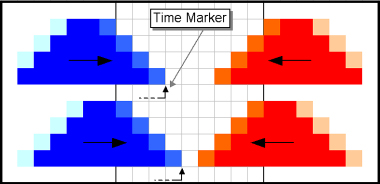
The following pictorials depict two waves colliding under the constraint that each “block” of space can only be affected (filled) by a value of 1 for each time-step of 1. It is a block style representation, so obviously isn’t very representative of real waves, but the blocks allow the communication of the concern at hand.
Waves propagating normally, each block proceeding to the next;
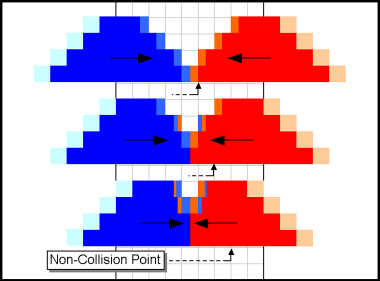
Note the time marker that tracks each “tic” of the clock and where the wavefront would be IF the collision had not occurred. As the waves enter the same space, they have to divide their affect upon the common block in the center. Since it takes one time-step to raise one block, each wavefront can only progress one half of the distance represented by one block;
The result is that the waves compress against each other. They don’t ever actually stop. They merely slow the forward progress of their wavefront because it is impossible to add all of both wavefronts to the same center block. Thus the wavefront is delayed (note the time marker) and the wave-rear piles up.
What happens next in the sequence gets not only complicated but more unrealistic due to it being a two dimensional plane presuming perfect alignment. If the universe were merely two dimensional, particles would form very quickly, fill all space, and probably never go away.
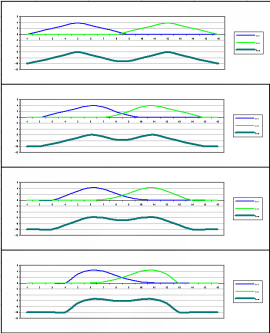
The actual calculated wave collision looks more like the following.
Note that the darker teal line represents the addition of the other two;
In a two dimensional universe, that lower clump would be your somewhat immobile “particle”.
Any additional wave (and waves is all you have) merely adds to the stubbornness of the particle’s inertia.
The 3D version is far more complex, but yields a similar effect for the same reason - maximum affect rate.
My usual blurb at the beginning is a courtesy to anyone looking at this thread for the first time. I don’t expect them to read 18 pages of history, so I give a summary.
Obviously I’m repeating it too often and it’s annoying - point taken. I’ll put it in less often. No need for you to have to do any special editing for me.
Typist,
I’ll certainly plead guilty to being a nerd ! Yes, qm and TEW make the same predictions so in one sense it’s only nerds who care about the differences. I’m also interested in RM and that makes be a three dimensional nerd. I won’t be ashamed of that - some people think philosophers automatically qualify as nerds anyway.
Sometimes theoretical physics has real world implications. For qm, there are hopes of quantum encryption and quantum computers. For TEW, these ideas are illusions. I guess those are not big problems.
The biggest problem with the qm versus TEW struggle is that qm has divorced itself from rational philosophy. Dr. Little quotes an internationally known physicist and professor at Cornell saying: “We now know that the moon is demonstrably not there when nobody looks”. The quote is from N. David Mermin, “The Journal of Philosophy”, Vol 78, No. 7 (July, 1981), pp. 397-408.
Is it nerdy to disagree with Mermin? If that makes me a nerd, I like to think I’m a member of “Nerds for common sense”.
James,
Thank you for all the diagrams and the effort to communicate. I think we have made a breakthrough, although you may not agree.
To me, the key paragraph is this one:
In the above, RM is making the case that a particle is composed of “chaotic, noisy wavelets trapped in an endless struggle” and the wavelets are not able to escape. To me that means the following;
A single wave of affectance broke up into many wavelets.
The motion of the wavelets is chaotic, meaning that is is unpredictable.
The wavelets cannot escape so they pile up.
To me, this is “river” behavior, not “wave” behavior. To me, this is option (B) - affectance is not always a wave.
That is a revelation to me, and I can finally compare RM in physics to qm and TEW. It’s all about how they view particles:
For qm, a particle is also wave as in “wave-particle duality”. This means that a particle going from A to B means also that a quantum wave goes from A to B.
For TEW, the quantum (elementary) waves are going B to A first. A particle follows those particular elementary waves from A to B - towards the source of the elementary waves. So for TEW the particle and waves are physically separate.
For RM in physics. all particles are made of affectance. Affectance is what the entire universe is made of - matter and energy. Affectance sometime behaves as a “wave” (for deflection and reflection) and sometimes as a “river” (for delay = piling up).
Now I feel I’ve got a better handle on RM in physics. It’s an important distinction because I ask myself - what a “river”? It’s a collection of particles under a force. To me, as soon as you introduce the maximum rate of change and then claim this necessarily leads to “delay”, then this has implied that affectance can behave like a collection of particles.
You might say this is just an argument over whether the affectance wavelets can be considered as particles of affectance. I claim that one big wave of affectance breaking up into smaller wavelets has crossed a boundary - affectance is not purely a wave. That is a critical foundation of RM.
Since affectance shows both “wave” and “river” behavior, we then get the question - when does it show one or the other behavior?
In the example you’re giving, you’re arguing that affectance must show the “river” behavior to comply with the maximum rate of change. That argument sounds good, because it appears the affectance has no choice.
What if the affectance does have a choice? What if the two waves collide and the maximum rate of change is not going to be exceeded? Does that mean there is no “river” behavior (no delay)? How do we know if some affectance might choose to switch from “wave” to “river” behavior from time to time?
You might say that affectance always behaves as a “wave” unless it is forced into “river” behavior. Is that true?
I’m a huge nerd too, though in my case it’s perl nerd and word nerd.
I’m happy to report I just saw a couple of great “Physics For Dummies” shows on PBS, which were right up my alley. Newton, Einstein, QM etc. So go head, ask me anything about physics you want, anything at all, but you’ll have to use qm to calculate the highly remote probability of me actually answering intelligently.
I could probably be a baby physics nerd if I tried, but I’m rather distracted by big picture nerdiness, and still questioning the point of it.
A) I have no idea what you mean by “like a river”.
B) As stated before, Affectance is ALWAYS in the form of waves. By “wavelet”, I merely mean very small waves like a choppy sea.
C) Waves don’t “break” up into smaller waves. Waves radiate, get distributed, and portions get delayed if they collide with others.
I am beginning to wonder how you define a “wave”. A wave is indiscreet. It has no exact shape or boundaries and infers a buildup of whatever it is a wave of. The “wave” is not the substance. The wave is a rising or lowering of some property of a substance (height of water, density of air, position of a hand,…). In RM, that substance is Affectance (either potential to affect or density of the changing depending on which kind of wave we are talking about at the time). In contemporary physics, the EM wave is merely referring to the temporary rising or falling of electric charge. A “gravity wave” is the rising or falling of the gravitational potential.
A TEW “wave” seems to be a totally independent (somewhat magical) entity. I don’t even see why it is called a “wave”… a wave of what?
Affectance is absolutely NOT made of little bits and pieces of stuff. Affectance, from our original discussion, is merely the changing of the potential, relatively smooth. There are no “particles” or whatever. A wave of affectance merely means that the amount of potential affect is changing (a “wave” of affect). It has nothing to do with bits of stuff.
No.
A “wavelet” is merely a small wave. It has nothing to do with being a part of a prior bigger wave.
And Affectance, for the third time is ALWAYS a wave, unless it is very small, and then it is CALLED, a “wavelet”, just because it is smaller than whatever else we were talking about. A “wavelet” merely means that the affect is changing a small amount at that location. There is no “substance”, “pieces”, “bits”, “particles”, or “graininess” involved. It is just a value smoothly changing through time.
I have no idea what “river behavior” means.
Affectance is an ocean. But everything in the entire universe is within that ocean. And it is merely an ocean of changing potential. The waves are merely the potential changing, no bits and pieces of anything involved. And I have no idea what an affectance “river” would involve.
Affectance has ONLY the choices that we gave it from the start; to spread in whatever direction it can, but take time to do it. We then realized that when two or more affects add, there would be a maximum rate that they cannot surpass. That point of maximum changing rate is what causes the delay in the changing potential. A potential to affect cannot instantaneously become greater or lesser. Thus any affect attempting to change that potential too quickly, cannot propagate at the same rate that it would have if it hadn’t reached that maximum.
I couldn’t say. I have no idea what “river behavior” is or how it got into this. A river implies some kind of shoreline keeping the flow going along a specific direction.
I have gotten the notion that you think in terms of a wave being an entity into itself, as though there could be a wave floating through space, but not a wave OF anything, merely a wave. A wave has to be a wave (a changing through time) OF something.
QM treats its “wavefunction” that way as though a wavefunction was a physical causal entity. But a wavefunction is a formula or equation that results in a wave plot. A wavefunction is an formula, not a physical entity. A wave refers merely to a changing, the changing itself, but a changing OF something, just like the wavefunction is a function concerning something. Of course saying that a function travels through space affecting things is just QM silliness.
I have no idea what a TEW wave represents. To be called a “wave”, there must be something changing such as to form the wave through time. There is no such thing as merely a wave that isn’t formed by something changing through time. So in TEW, what is changing such as to form the “elemental wave”?
In RM, we have;
Existence is defined by affect.
Randomly dispersed variations of potential to affect. Every point in space has a slightly different potential to affect than any other point around it.
Potentials to affect cause affecting in random directions determined by the difference in potentials. The changing potential is in the form of “waves”.
There is a maximum rate of affecting (of changing the potentials). Affects cannot be infinitely fast relative to each other.
The entire field of changing potentials (the “waves”) is called “Affectance”. Before we get into other issues, I need to know if you can accept with confidence that waves of affect will necessarily be delayed if they add up at a faster rate than the maximum, whatever that maximum rate might be…?
If so, then;
5) Multiple affects upon a single point that add to more than the maximum are delayed (not stopped).
This is great - we are debating the right issues - the dynamics of affectance waves and the waves in qm (quamtum mechanics) and TEW (Theory of Elementary Waves).
In qm, the wave is the square root of the probability of the position of the particle. Squared it gives the right probabilities, and so qm supporters claim that proves that all the qm claims are true. The lack of alternatives for the last 80 years of so has made them supremely confident they have a monopoly on the truth.
In TEW, the wave is a physical wave the goes in the opposite direction to the qm quantum wave. These ‘elementary waves’ are like an infrastructure to the universe - they are there whether there is mass or energy around. Elementary waves sometimes interfere and sometimes collide and often ignore each other - you and I covered the assumptions of TEW.
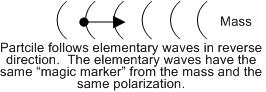
Most importantly, elementary waves never “delay” or “pile up” or break up into smaller wavelets. They are going through all points of the universe with all polarizations anyway - the only thing that changes are the “magic markers” they get as they pass through a mass. I may not have pointed out the polarization issue much before - I was remiss if I did not.
The way elementary waves make themselves felt is by carrying particles. All single particle are following a set of elementary waves (with the same magic marker and same polarization) at all times, period. Because the particle follows in the opposite direction is it always meeting new waves of that type “head on”. All the “wave” behavior of a single particle comes down to following elementary waves that interfere.
The footnote is that a lot of the properties of a single particle come from the elementary wave it is following. Frequency and polarization of photons comes from the elementary waves, and mass of particles like electrons and protons comes from the frequency of the elementary wave. So a lot of particle behavior and attributes are coming from the elementary wave that the particle is following.
What’ s the point of elementary waves? They make a description of the quantum world local and deterministic. Obviously takes a lot more description which we won’t go into right now. The above is just a quick summary of what sort of wave is an elementary wave.
Elementary waves also give the same probability calculations as qm. Why? Remember we square the quantum wave. That allows for the opposite direction (sign) giving the same result. TEW is just the opposite direction, that’s all.
For qm, the quantum waves are also particles, and so qm quantum waves can delay and pile up just like a particle can. This is not modeled in their mathematics, it’s just accepted as part of “wave-particle duality”.
My debate with you is about assumptions I claim are creeping into your description of affectance. We looked at two waves of affectance colliding. I’m fine with the waves adding, I’m fine with the concept of a maximum rate of change. The critical bit for me is that in order to comply with the maximum rate of change, some of the affectance is delayed.
That is the big moment - one wave of affectance is now more than wavelet and some are delayed. That is what I call “river” behavior - breaking up into smaller bits with delay for some. To me RM has just implied “river” behavior. To me “river” behavior is something particles do, not waves, so affectance has some qualities of both waves and particles.
Can I accept this:
To me, I accept that 5) is an assumption of RM in physics.
RM was never forced to state 5). You could alternatively have written this:
5B) Multiple affects upon a single point that add to more than the maximum are deflected/reflected, not stopped or delayed.
That would have been another way RM could have described affectance. That would have been totally consistent with “wave” behavior.
By choosing the 5) instead of 5B), RM has made a huge statement about affectance behavior. To me, 5) is not a logical deduction or a proof.
That concern destroys both the QM and the TEW explanation.
The QM wavefunction is about the probability of being able to detect a particle at any particular place. If you plot out the probabilities involved in finding the particle anywhere along its path, it forms a “wave” of rising and lowering probability. The wave doesn’t travel through space. It isn’t a physical wave even though they treat it as if it were. The probability function merely correlates to the particle size and location, it has nothing to do with actually causing anything.
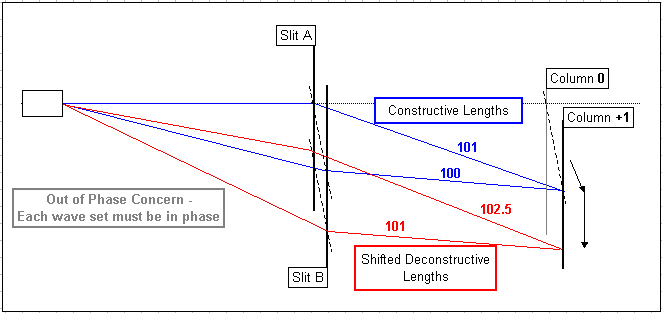
But those pics display how it wouldn’t matter whether they were talking about a physical wave or not. You cannot use a point source and an interference wave projection from that source, and end up with parallel lines on the screen. You would get concentric circles, not vertical lines. Also it wouldn’t matter which direction the waves were proposed to travel. It is merely an issue of distance and phasing.
So neither QM, nor TEW has an actual explanation concerning that experiment and I can’t seem to get across to you the relevant issues in RM concerning the whole thing, so there we are.
 Does affectance have toes?
  We don’t know!!