If affectance “congestion” is the reason a particle forms, this implies a few things:
For a stable particle, the PtA coming in balances the PtA going out, at least approximately.
If the particle enters a region of space with very low PtA all around, then the particle will eventually “evaporate” as the PtA leaves and not enough new PtA arrives.
Obviously there is a lot more to it. I am only summarizing where we are now.
Both of those are true.
But remember that right now, we are talking about RM particles, not necessarily physics particles.
We can prove them to be the actual physics particles later.
In RM, if a particle were to travel to a region of space that had extremely low affectance (the turbulence of the PtA), that particle would gradually vanish. In a region wherein the PtA affectance is very high, that particle will grow and possibly even merge with another (such as alpha particles).
And try to keep in mind the difference between “Affectance Potential” (“PtA”) and “Affectance Density” (the amount of changing of the PtA, “turbulence”).
Density is the amount of something within a given volume. The upper blue line represents the varying PtA strung across an area. The lower green line represents the amount of changing of PtA along that area. Note the amount of changing per segment creates a higher density.
A particle represents an extremely high density of the changing. That changing is what creates the “Affectance Field”, more commonly known as “Gravity”.
In the diagram “Affectance is the Changing.jpg” the word “Positive” seems to mean “above the average” and the word “Negative” seems to mean “below the average”. Is this true?
I seem to remember Potential-to-Affect (PtA) and affectance itself are not negative - they are zero or positive. Is that true too?
Positive and negative only make sense relative to some expected norm or average (ambient). One cannot have less than zero affect. To affect means to cause change. Something is either causing change or it isn’t. How could there be less than zero change?
I have used the words merely because you asked about it earlier and physics speaks of positive and negative particles. But in reality, any negative is merely less than some norm. That is an issue for the Higgs field theory in that it presumes that negative is some quality independent of positive. In the case of particles, it means less charge (PtA) than the ambient space. “Positive particles” refers to particles that have greater charge (PtA) than normal space. But keep in mind that the affectance density is an entirely different issue.
Density refers to how much changing is going on within a volume. Thus both positive and negative particles can have the same amount of changing even though one might have a low amount of PtA and the other high. Affectance Density translates into the mass of the particle, or its total energy content. The amount of PtA refers to the electric charge potential.
The following display positive, negative, and neutral particles forming, as indicated at the top of each pic;
Each of those particles could end up with the same amount of affectance density (amount of changing going on inside) or the same “mass”. When it comes to particles, their mass/“Affectance Density” and their physical size tend to be strongly related. That happens because there is a limit to how much changing can be happening within a volume, so the more changing there is, the more volume is required to contain the “congestion”.
While we are on this subject of the congestion and affectance density, we can return to the issue of particle migration;
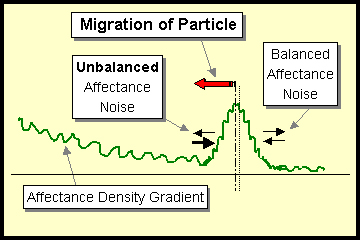
How can you get a particle to move from its location if the affectance within has slowed such as to cause a pileup? You simply shift the center of the pileup by adding more affectance to one side than the other;
If the affectance noise or turbulence is higher in the area to the left of a particle than the right, the PtA and/or Affectance on one side of the particle builds faster than on the other. So the center of the particle, marking its location, shifts. In a sense, the particle reforms slightly to the left.
In physics that effect is known as gravitation, but in RM, it is “migration”. The difference is merely an emphasis on the fact that the particle is not being pulled by a “gravitational force”, but rather merely migrates toward the greater density as it is constantly reforming itself.
Surely there is a problem with the arrows in the diagram “Migration of Particle”.
On the left of the particle there is a big arrow in and a small out. On the right both arrows are equal. The particle should be getting bigger to the left, rather than migrating. Is that how it works ?
It migrates BY getting bigger on one side which in turn causes it to lose a little more on the other. That shifts its center - “migrating”.
Think of it this way. You add an extra room onto the left side of your house. The center of your house has just shifted. Later you get a notice from the City that because you are not zoned for that size of house, you have to pay a $5000.00 fine. Rather than use cash, you decide to take down the old room that was on the right side of your house and sell it for lumber and scrape. Your house “migrated”.
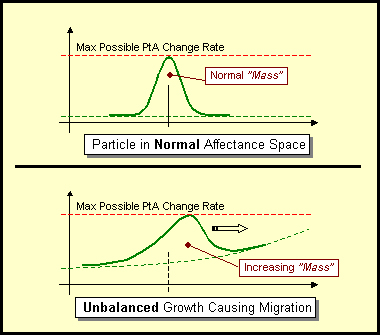
The first thing to realize is that the ambient affectance density determines the actual size of a particle.
But if the ambient field is a gradient of increasing affectance density, migration takes place along with the growth.
I changed the direction from left to right because this pic is used later in the book concerning the “electroweak force”.
And “affectance content” equates to “non-relative particle mass”.
To me, by having a delay before the “old room was dismantled” this creates a problem: if the particle was at least briefly stable with the extra PtA, why not stay that bigger size? This must happen when the particle originally grows.
There could be another problem: how long does it take for the old room to be dismantled? The time scale must be dependent on the environment of PtA - in a higher ambient level the dismantling may take longer, hence the larger size is more stable.
The process of particles forming seems very random so far.
If photons are made of PtA, then their speed would be faster if the ambient PtA is higher. Yet photons travel slower in air than they do in a vacuum, even though air has lot more mass (PtA) than a vacuum. So I’m obviously not understanding RM photons yet.
A) That is not “a problem”.
B) The only point that I was trying to make is that migration occurs due to an unbalanced growth process that rebalances with a relocated center. You seem to have gotten that message. The timing involved is irrelevant in that it is an ongoing, continuous process.
C) A particle is not a fixed perfectly formed entity. A particle is merely a cluster of “affectance noise”. At any one time, any one particle is likely to be slightly misshaped and resizing. The ambient environment is a bit chaotic causing slight shifting in shape, size, and location all the time. The diagrams display merely an average. Averages are always more perfectly uniform than that of which they are an average.
It is a continuous process. The particle stays stable during the process but is shifting and slightly growing to suit its new slightly different environment.
Particles ARE a case of randomness (the changing, the “affectance”) merely clustered more tightly in an area due to the fact that the more the changing PtA, the Affectance points, slow each other, the more they cluster together. They end up forming a “stable” point of dense changing/“affectance”, in space .
Now you are confusing PtA with Affectance. Try to keep those straight. PtA, “Potential-to-Affect”, is NOT the affecting itself, but merely the potential or ability to affect. The affecting is referred to as the “Affectance”, the changing of the PtA. Inside any one particle each point of PtA is changing due to its immediate surroundings and causing delays due to that maximum issue. The particle is thus made of Affectance, the changing of PtA points within.
So photons are actually made of affectance (as is everything else), not merely PtA.
Why you are thinking that photons would travel faster in higher affectance, is beyond me. They don’t travel faster. They significantly travel slower. Higher affectance is the only reason anything slows down. This occurs merely because when the affectance is higher, the changing of the PtA in the chaos (which is that affectance) more often reaches that maximum. Each small point that happens to reach that maximum slows and slows anything behind it. When the affectance, the changing of the PtA is lower, that maximum is not reached as often so less of the entity gets slowed.
And “photons in air” has nothing to do with anything. Air, being formed of molecules does increase the average affectance, but the fact that they are huge atomic structures brings in a lot of other concerns.
The reason I am thinking that a photon might travel faster in air is because of the diagram “Migration of Particle” below.
In the Unbalanced Affectance Noise there is a big arrow going into the particle. Think of a photon in a vacuum compared to being in air. In air, there is a lot more mass and affectance around, so the arrow going in is larger than the arrow going in for a vacuum. Therefore, to me it follows that RM is saying the photon would migrate faster in air because it is getting more affectance coming in. Yet in reality photons travel faster in a vacuum, so I’m confused here.
Perhaps I am not understanding the difference between Potential-to-Affect PtA and actual affectance.
Well firstly, that pictorial concerns a particle, not a photon (typically thousands of times larger). And secondly, note the direction of that arrow. That arrow indicates that more affectance is headed into the particle and thus causing the particle’s center to relocate more to the left. But remember that I said that affectance, once given a direction, never, ever changes that direction. Thus even though the center of the particle has shifted to the left, the direction of the affectance that caused that shift is headed in the opposite direction, to the right.
The sum result of that is that the entire particle, even though shifting to the left, is made more greatly of affectance that would carry the particle to the right, thus the particle shifts to the left, but more slowly because the affectance is flowing to in the opposite direction. If the affectance did not have that property of maintaining its direction, the particle would shift much more rapidly to the left than it does. As it is, the particle has to take time to lose the newly gained affectance out to the right as even more, due to being even further to the left every second, replaces it. The particle shifts slightly more, gaining slightly more affectance. That process is continuously flowing causing a steady migration toward the left at a slower rate, not a faster rate. The affectance must flow through the particle. The center of the particle is merely the apex of the cluster of contention, it is not any particle bits of affectance, only the position of most contention.
Thirdly and in addition, with each addendum to the affectance content, the number of points inside the particle that reach a maximum and get delayed increases. So the further the particle goes to the left, the more maximum points occur, further slowing the particles migration.
The more interesting effect that you should have asked about concerns not how fast the particle is going, but rather why it continues to the left even after the unbalanced affectance is removed. Why does it acquire “momentum”?
The answer to that is simply that once the particle has been experiencing such migration and then the imbalance is removed, the particle contains only the last acquired bit of right-directed affectance. A very large part of the particle still has the affectance that was headed to the left which was also increasing because the particle cannot out run the affectance from any direction.
Thus after some acceleration has occurred, the particle contains more affectance headed in the same direction as the particle itself was headed. Thus the particle center continues to shift or migrate to the left even though it is not being further inspired to do so. The particle is more reflecting the actual flow of the affectance within the faster it travels.
Please don’t get pedantic about the exact positioning of the red and blue in the pictorial. I just don’t have a way to display the proportions without physically separating the colors involved. The actual affectance is distributed throughout the particle, with merely a little more blue on the front side due to that being the direction encountering new affectance.
The actual physical existence is the affectance, the changing of the potential. The potential for such change is the “PtA”. The PtA is merely the ability value associated with each point, not the actual affecting itself. It is exactly like the difference between a voltage potential and an actual electric current. The voltage is not the physical electricity. It is only a potential for electricity to begin. The flow, the actual changing of position, of electrons, is the electricity “actualized”.
The new diagram makes a lot more sense. As the small amount of blue finally moves to the left, the larger red is free to move to the right with less delay and hence faster. Ideally, there is only PtA moving in one direction, so it moves at maximum speed. That matches a photon travelling faster in a vacuum, and seems logical.
In one of your previous posts, you’d said a particle moves towards areas of higher ambient affectance. Have I remembered correctly?
Just checking - the diagrams are showing Potential-to-Affect (PtA). As it changes at a point, that results in actual affectance. So the particle exists at a point as the PtA passes by, but once the level of PtA is stable again, the particle is no longer at the point. Is that a summary of a particle passing a point?
Yes. Particles migrate toward the more dense affectance, and thus toward each other because they are no more than very dense affectance (dense, noisy changing of the PtA).
Well careful. You seem to be slipping back into “PtA being the object” in motion. PtA doesn’t move. It merely changes. The changing moves. Again, much like voltage and current, the voltage is merely the pressure involved. It is not the physical entity we call electricity. The flow of electrons that results from that “pressure” (or “potential”) is the actual electricity. Likewise, PtA is merely the potential or “pressure”. It is not the physical substance. The changing of that potential is the physical substance that moves or shifts around due to the PtA points changing each other.
“i. As it changes at a point, that results in actual affectance.[/i]” - that part is right although it isn’t a mere point, it is infinite points all changing.
“So the particle exists at a point as the PtA passes by,” - Here you have PtA doing the “passing by”. PtA doesn’t pass by. It merely changes its value as it either uses itself up by changing its neighbors, or it gains more potential by getting changed by its neighbors. It is that changing process itself that forms the substance we call “the physical” and a great deal of that changing in a very small spot becomes what we call a “particle”.
So the particle exists at a point only because the PtA surrounding that point happens to be changing a great, great deal (highly “dense”). As that changing shifts/ relocates/migrates, the “particle moves” to a different point where the surrounding PtA is changing a great, great deal.
“but once the level of PtA is stable again, the particle is no longer at the point.” - That part is right. When the PtA at any location is no longer changing so much (it can never entirely stop changing), the particle cannot be there because the particle is made of a great deal of the changing, the “affectance”.
It takes a while to get your mind to keep the distinction between PtA and affectance straight. People aren’t raised thinking in such terms. But once the mind settles in, it all comes together much easier. I am trying to maintain a standard of using green in the diagrams to indicate affectance density as opposed to blue or red to indicate PtA. I already know that I don’t really have enough colors to do it all exactly the way I would like, but we’ll see how consistent I can manage to get it.
The RM ontology can be perhaps more simply stated as this;
I am gathering that a particle in RM is a region of points where maximum rate of change is occurring with a lot of Potential-to-Affect(PtA) getting in the way of each other, and there is some sort of balance between incoming and outgoing PtA.
Let’s pause for a moment of cosmology. You wrote:
Does that mean the Universe will end in a “big crunch” when all the mass and energy comes together again in one big singularity?
Other than that aside, I think we can progress to deflection and reflection.
Once again…
PtA does NOT move. Every point in space has a PtA value associated with it. That value changes. The changing moves (the “Affectance” moves), not the PtA.
You seriously need to get that straight before we go any further.
As I said, I haven’t taken RM into the cosmos yet, so what I believe concerning that issue is my personal speculation, “JSSRM”.
A “Big Crunch” isn’t actually as likely as merely the dissipating of particles into the vacuum and black-holes that eventually collide and start the whole thing all over again from different points. I liken it to rain drops hitting the ocean surface. Each drop of rain splash is an entire universe to us.
We are “Potential-to-Affect” (PtA) and how Affectance is the change in PtA. If PtA is only a value you could argue that Affectance is only a change in value too (of PtA). So whenever I say “the PtA passing by” you could take that to mean “the value of PtA passing by”. I am interested in the relationship between the two, not which one is “moving” or not.
I can see the relationship between PtA and Affectance, which is like voltage and current in electricity. This is the central contribution of RM as far as I can see so far: it describes what a particle is. It is a totally new and refreshing way of looking at things.
I still prefer the Theory of Elementary Waves (TEW), and yet I like exploring and testing new ideas and RM has plenty of that.
I read the link you provided, and I must say I like a lot of that too. I have never accepted that the Universe and time somehow “started” with a Big Bang and will “end” with a Big Crunch. To me, just saying that implies there was something before and will be something after. While I do not believe in Hawking Radiation (which is the TEW position), I am convinced that Black Holes are not the end of everything, nor the beginning. There must be a recycling sort of process, as you outline. At least partially Lewis Little seems to agree - he is not a believer in the Big Bang either.
Values can change or entirely disappear. The changes themselves, the Affectance, is that “energy” that can never disappear, but merely gradually relocate or disperse.
But you keep injecting doubt in me that you are truly understanding it when you misuse or reword the concepts.
RM merely has the advantage of being unavoidably true (even if TEW or QM were also true).
It is unavoidable that every point in space has the potential for affect. If it could have no such potential, it wouldn’t be a point in space. Nothing could pass into or out of it. It would be a permanent discontinuity in the universe.
It is unavoidable that such points already have different potentials to affect within them.
It is unavoidable that each of those points actualizes to affect/alter the potential values in their adjacent points.
It is unavoidable that such changing can never stabilize into an equilibrium.
It is unavoidable that such changing has a maximum rate of changing that necessitates delays in the motion of the changing.
It is unavoidable that such delays create a congestion of surrounding delays.
It is unavoidable that such congestion is comparatively immobile (inertia) and migratory.
It is unavoidable that such congestion centers migrate toward each other (gravity).
It is unavoidable that once set in motion such congestion will continue in motion (momentum).
We haven’t really gotten to talk much about the positive, negative, and neutral particle bit yet. You keep mentioning reflection and I can see how the issue of reflection can get very complicated if the fundamental understanding isn’t well settled into your mind. I still can’t figure out how to make a pictorial to show the needed 3D effects so as to properly display why reflection occurs and what it actually is.
If we can agree to those prior posted points, we can start getting into interactions such as collisions and reflections, what they actually are and why they behave as they do.
The following is an effort to display what is happening when two neutral (no charges involved) particles “collide”.
The thing to note in that pictorial is that the particles do not actually bounce off of each other but they would appear to because there would be no way to distinguish each particle as they actually pass through each other. They necessarily delay their forward migration as they encounter each other, but the affectance within never alters its trajectory.
The way this works is that the particle is actually a “cloud” of congested changing PtA (“Affectance”). Within that cloud are the ramps or waves that keep producing that maximum rate change and thus continue to delay overall movement of the cloud/particle. But as that is happening, the affectance traveling in the opposite direction slips between the maximum points that could not be added to. Due to the added overall density, the entire process is delayed even more than what was already occurring within each particle. It is important to remember that those maximum points are infinitesimally small and it is impossible for any two of them to actually directly collide because they don’t actually move, but merely reform or migrate.
So from the outside, or to the physicist, it appears as though the two “masses” have bounced off of each other when in fact, they passed through each other. But remember this is about neutral particles. Charged particles have a little different scenario involved.
You seem to have a problem when I reword RM ideas in my own way. This is natural and expected. If there is imperfect understanding of what you were trying to convey, that is to be expected too. I’m surprised you even commented on it.
The diagrams of two neutral particles passing through each other - might that apply to two neutrons? Can you think of experiments when physicists claim that single neutral particles bounce off each other? I can think of heaps where physicists claim neutrons bounce off whole atoms, but not of any claims of neutrons bouncing off neutrons.
Yes, I do have issue with rewording them “in your own way”, because your way alludes to something that isn’t true. Learn the entire field before you go changing it into what you think might be true while still learning. I seriously doubt that you scratched out Dr Little’s words and replaced them with your own while you were first reading the book. And if you did, I’m pretty certain he wouldn’t have approved if he saw that your words were not making sense.
Yes, it applies to neutrons. I don’t know any exact experiments proclaiming “bouncing” per se. But that is what is commonly taught. On the other hand, I don’t know of any physicist that would claim that a neutron bounced off of an atom. They know better than that (I certainly hope). Usually a neutron will pass right through an atom because the distance between the orbiting electrons and the nucleus is huge compared to the neutron. When it doesn’t actually make it through, it has met the nucleus. Hitting the electron is like a car running into a fly. But the same scenario takes place.
The neutron affectance literally passes through the nucleus assuming that is didn’t stick and become a part of the congestion. What would be “seen” “bouncing off”, is affectance that got released from the nucleus with the same characteristics as the neutron that struck it, merely in the opposite direction.
That is a type of “reflection” of affectance. It would appear that the particle reflected off of the other particle, when in fact, it combines with and then passes through. What comes backward is a countering reaction from the nucleus. This phenomena in Science is thought of as the “conservation of energy and momentum”. What I am describing is why it gets conserved. If you ask a physicist why momentum is conserved, he will merely say, “it just does”, which is paramount to saying “God does it”. I am explaining how and why God does such things.
I would still appreciate some confirmation or refutation concerning this post;