I really, really would have loved to, but if the above is the kind of thing I’m expecting to read…I might have to withdraw any offer to help.
That was a string of some of the fundamental concepts involved to get the foundation built from which the more interesting things come about.
But it seems to me that anyone would be able to ask questions concerning any of them, just to make sure they are understood before things start getting complicated.
“For affect to take place, there must be potential to have affect, “PA”.”
Was that too hard to understand? Any question about that one?
If you like to start with “the void” concept, realize that a true absolute total void would represent an infinite potential for affect/change. But in addition such a situation proposes the impossible state of infinite homogeneity. The end result of those 2, or of either, is that it is logically impossible to ever have an actual infinitely pure void.
Everyone,
This thread was originally about an alternative to quantum mechanics (qm) called the Theory of Elementary Waves (TEW). TEW is published in the form of a book and a paper in a physics journal, both by Dr. Lewis E. Little. Since all alternatives to qm are welcome in this thread, we are now spending a lot of time discussing a new and unpublished theory of science, physics and everything called Rational Metaphysics (RM) developed by James S Saint. The debate is about how RM applies to physics, rather than all the other areas. Sometimes James has some personal speculations that extend RM, which we call JSSRM (James S Saint Rational Metaphysics).
Typist, Helandhighwaver, Flannel Jesus,
Let James get past the RM “In the beginning” stuff before you jump on him ! Have some patience and he’ll get to the good bits sooner.
Helandhighwater,
You wrote:
Amongst qm supporters on physics forums, the Quantum Eraser and Delayed Choice Quantum Eraser experiments are regarded as proving retro-causality. For example:
The above quote comes from http://en.wikipedia.org/wiki/Quantum_eraser_experiment
You are right to point to the fine print where the possibilities of using the effects for that or faster-than-light communication appears to be limited with caveats. Most qm supporters seem to ignore the caveats.
There is one experiment where qm clearly claims retro-causality because qm cannot explain the result any other way. TEW explains the result in normal time. It is the neutron interference experiment that I originally posted, and have re-posted recently. There are hard numbers on the neutron coherence length that qm cannot explain without retro-causality.
You said I had not substatiated the TEW claim that Bell’s Theorem proves nothing of any value. I will get my notes together and post that soon.
You wrote:
Let’s have a look at the publishing of TEW details, and then review the qm reaction.
TEW is published as follows:
You can have any opinion you like on Physics Essays as a physics journal.
There is a book published:
The book was not peer reviewed, so you can make comments on that if you like.
There is also the website elwave.org.
There are internet pages that criticize TEW as not being a theory etc. I would rather discuss the ideas here, so there can be a proper debate about them.
There is an important aspect to the qm reaction to TEW: qm supporters believe that qm has “proved” that a local and deterministic theory of the quantum world is not possible. There is a big flaw in their “proof”.
There are different assumptions in qm and TEW. For qm, the assumption is that the quantum wave travels in the same direction as the particle. That is assumed as soon as you say “wave-particle duality”. For TEW, the assumption is that the quantum wave travels in the opposite direction to the particle.
Two theories that have incompatible assumptions cannot prove anything about each other. All you can say is “Assuming A, we prove X”. For example, qm can say “Assuming that the quantum wave travels in the same direction as the particle, a local and deterministic description of the quantum workd is impossible”. TEW would agree wih that and say “Assuming the quantum wave travels in the opposite direction to the particle, it’s possible”.
This is relevant because physics has forgotten this piece of philosophy (or never learned it). For qm supporters, qm has “proved” that TEW cannot be a valid theory, because TEW claims to be local and deterministic. So qm supporters, especially qm professionals, reject TEW before they have even read anything about it.
So the fact that there are no qm professionals even considering TEW says nothing about TEW and a lot about the lack of philosophy in qm. Most of the criticism and dismissal of TEW is based on the flawed qm “proof”.
You wrote:
The experimental values in the neutron interference experiment are one of the few experiments where the difference between qm and TEW is very stark. The cavity emission experiments I mentioned in recent posts are also another example of qm and TEW having stark differences in explanation.
In one sense you are right: TEW uses the same maths as qm so in most experiments TEW calculates the same probabilities. So a cynic can say the TEW is just another interpretation of qm.
The big issue is of course that all qm interpretations share the qm assumption on wave direction, whereas TEW has a different assumption. That is the key to why TEW is local and deterministic, and is the whole point of why Dr. Little developed it.
Yes, TEW has a lot to say about philosophy (and TEW criticizes qm for having ignored philosophy). That’s one reason I have created this thread on a philosophy forum.
There are still lots of physics issues in TEW. For example, TEW describes mass by the frequency of the elementary wave that a particle follows. For TEW, the search for a Higgs boson is a red herring - they may find a particle that might fit their definition of a Higgs, but for TEW it is irrelevant in the concept of mass. If physics believed in TEW, the direction and priorities for research would be very different.
Eugene Morrow
You might want to co-opt my Infinite Regress of Causality thing, since you are moving into territory which asks how existence came about in order to have a potential for affect.
Either ex nihilo or infinite regress. Best to account for that straight off.
As I think I pointed out in that thread of yours, you have the common misconception of what the word “God” actually represents. Other than that, I don’t disagree with what you had presented. As far as RM is concerned, “God” merely means “the reason the universe exists”, not “who started it from nothingness”.
In RM, nothingness is a logical impossibility, as stated above. The primary thought concerning that issue is that it is illogical to think that anything can be infinitely homogeneous. The foundation for that assertion is simply that “infinite” means that such a state cannot be reached. Thus it is merely a question of logic to proclaim that if any quality is proposed to be infinite, that quality can’t exist (or “be reached”).
The inevitable conclusion is that the universe simply never began. No big deal. But that statement, despite the yearnings of anti-religious people actually says nothing against the existence of God, because God wasn’t meant to be “the starter” of the universe, but rather, the ongoing cause, the reason, the universe exists. RM explains GOD (Grand Original Design) - the reason all things, the universe itself, exists and does what it does.
It all begins with an understanding of what it means to exist and proceeds to what the state of any proposed universe must be merely because of what existence means and what infinite means. Those are an issue of Definitional Logic.
… which are two concepts that are intertwined to many people. If God is not a previous link in the causative chain of which the universe is the next, then he nevertheless represents to you a distinctly separate force which permits the universe it’s ongoing existence.
In fact, there is not much difference there at all. And as I pointed out, it becomes a matter of distinct phenomena appearing, then disappearing in order to generate a new phenomenon - the next causal link in the chain. God, then universe. Nothingness, then existence, with no real link between the two. Like Platonic Idealism.
What I endeavoured to show was that causality represented a constantly mutable and everchanging interaction of phenomena such that, ahem, the capacity to affect and be affected defined whether a phenomenon could be considered to exist or not. That this capacity to be affected implied that existence was not composed of static states in the manner of Platonic Idealism where phenomena do not change but manifest into and out of existence, replacing eachother, and thereby fooling an observer that change is indeed taking place.
The universe, to me, is sufficient to itself, no need of external causes. There is no externality. If the universe is defined as what exists, there can be no externality.
All that I ever said was infinite was time, as a measure of change. As above, no ex nihilo, no beginnings, therefore infinity. Not an infinite amount of something, an infinite regress in time. If you are saying that time cannot be infinitely homogenous then you are suggesting that the universe is ex nihilo.
In RM, God is not a “force”, but a situation or logical condition. That is why God exists in all places at all times, because that logical situation never changes, “God never changes, is omnipresent, eternal, and accounts for all things (omniscient)”.
The RM position is that there was never a “God then, afterward in time, a universe”. But rather that due to the situation of Reality (“God”) the universe must exist and can never not exist.
That gets back to the issue of the definition of existence. The Platonic entities can only be said to exist within their own realm of existence, what was once called, “the Divine Realm” or the "realm of perfect concepts ".
A perfect square can be said to exist among the list of all perfect geometries. The physical universe, being made strictly of the things that are composed of changing, cannot have a perfect square within that realm.
One chooses an epistemology and ontology with which to use as a means to think and predict. The realm of perfect entities, the Divine realm, is merely a tool for thought, a very useful one that has never been abandoned, and frankly, I don’t think that it can be. But one cannot mix and match between the two realms. A perfect concept cannot exist as a physical thing unless merely defined to be that regardless of its constant state of change. The changing state would have to be a part of that definition of perfection. It is merely a choice of epistemology and associated ontology.
Time is the measure of change. It is a concept, not a physical entity. Any dimension can be infinite in length because it is not a physical thing, merely a defined concept.
What I was stating was that physical existence cannot include any infinite properties such as homogeneity, and doesn’t. The past is not a physical entity. The present is (even though past, present, and future are really only vague concepts). A “straight line” is perfectly homogeneous, but the physical universe will never experience a straight line.
On physics forums they agree it is proof of retro causality? What credibility to forums have anyway? Even if I accepted that assertion which I do not, maybe on bad physics forums full of widely unregulated assertions by highly uneducated people who are full of unscientific opinions maybe. If I could suggests you take your assertions to a forum that actually has some standards, although frankly I don’t really see the need to, Forums? Really? It’s irrelevant anyway, read those links, understand them and the assertions are clearly thoroughly debunked, and what’s more they are done by Scientists with citations to peer reviewed journals, not any old person with an opinion. Forums, you will claim next you have proved free will exists 'cause some chancer on here made an argument, please. Forums are about as trustworthy as my gran was when she claimed she would only drink one glass of gin at Christmas.
And no the caveats are clear, there is no scientific proof of any of them having any distinction from the current agreed consensus, and they have been widely dismissed even by the people who had the contentions in the first place. All that remains is a few fringe people who insist there will eventually be a way to show retro causality is a viable experimental concern and they are generally now reaching at things that are closed as loop holes, to ever more far fetched ideas about universes being holographic and so on.
Get your notes together anyway, it should prove interesting to note why you think the consensus is wrong, hell it should prove a diversion from James’s I am right and everyone else is wrong because I say so and I just am, tactics anyway.
A book is not peer reviewed, a published paper in a science journal is. Anyone can publish a book, that does not make it peer reviewed or The Bible would be peer reviewed. 
I do apologise for my in your face contentious style, but having dealt with James for 3 weeks on various threads where he just talks the talk and doesn’t walk the walk, I am just about bored with all the nonsense flying around, so you will I hope excuse me for being abrupt. 
Well it seems to me that your definition of God is “reality”… which is not at all consistent with the typical definition of God, as I gave it, as a supernatural origin of reality. So why then do you even use the concept of god? Why do you not simply say that reality is reality?
Well… any sort of description of reality is an abstraction that merely references what is perceived, yes. A measurement is a cataloging of this perception in accordance with some sort of standard. If time is a measure of change then one is measuring that change in accordance with differing perception of mutable phenomena taken at different occasions; one is comparing one perception with another and extrapolating the difference.
From this, it follows that such change must be infinite in extent “backwards” in time (tracing causality as much as one is able through looking at the present and speculating how it was brought about) because events are not manifesting from nothingness, without instigation.
The past and the future do not exist, but the effect of the past can be seen in the present; else there would be no present. Similarly, the potentiality of the future can be inferred, otherwise time would stop and there would be no possibility of continued interaction.
I’m not entirely sure what you mean by homogeneity in this context.
You brought it up. I don’t think you are fully understanding what has been said. The word “Reality” doesn’t exactly fit the definition of God. “God” would refer to the most fundamental Principle involved (or the “Highest”), but it is all a bit irrelevant to RM.
All of that is fine. Although RM isn’t concerned with perceptions, not at this stage anyway. RM is about what logically results merely by the defined concepts. Homogeneity on a straight line would be indicating that every point on the line was exactly identical to every other. As a concept that is fine. In the physical universe such a thing can never exist.
“The potential to have affect is what is being affected such as to cause what we experience (an affect) as the universe.
The universe is merely the changing of the potential to have affect.”
That is a statement concerning of what the entire universe is fundamentally made.
Any question about that part? 
These are some pictorials just to hopefully make it a little more clear;

That is merely a pictorial of the Potential for Affect (the “void”).
There is no universe yet. It is merely the concept of where to begin realizing the situation. At no point was the physical universe at that stage.
But that pic represents infinite homogeneity. Infinite homogeneity is logically impossible. No two points in that pic can actually be infinitely similar to any other, and certainly not to all others. Thus a little closer to the reality this the following pic;
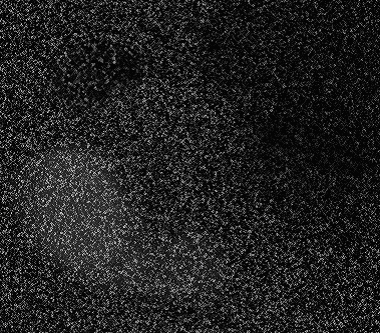
In that pic is displayed a Gaussian variation of the potential for affect. Each tiny area has a different potential to have affect upon any others than each other tiny area. If you could carefully examine “empty space” and see the potential for affect, that is the kind of view you would see. “Empty space” is never actually empty. But so far, we are still merely talking about the Potential for Affect, not any actual, existing affects.
The question might arise to the mind as to how large those little dots are. Interestingly, they don’t actually have any particular size. If you were to examine any small volume within that volume a little closer, you would see the same kind of picture;
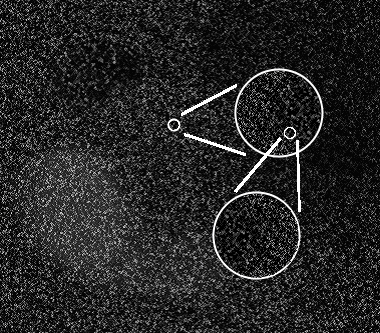
There is no lower limit to that statistical effect. No matter how small of a volume you take, you would see that exact same kind of picture.
This is nothing new to the world of mathematics. That effect is typically called a “Gaussian Distribution”, after Johann Gauss. It involves an infinite number of values recursively distributed in an infinite number of points for any given volume of space.
That somewhat random pattern is merely the state from which to begin seeing what happens next and is applicable from absolute zero volume up to a special point called the “Level of Inertia”. No particles can form on any level lower than the level of inertia. When we get to the level of inertia is when things begin to get interesting.
Now please note that so far, this is NOT a “theory”. It is an epistemology, defining the concepts, and the beginning of an ontology, an understanding of the physical universe. So far, all of this is mathematically and logically provable. The few concepts involved leave no alternative concerning the pics above. It is easily distinguished from Quantum Mysticism because note that there is no Plank length (minimum size) involved. Physical quantizing cannot begin until we get passed the level of inertia. What has apparently mystified scientists is the issue of exactly why there would be a level of inertia.
Everyone,
This thread was originally about an alternative to quantum mechanics (qm) called the Theory of Elementary Waves (TEW). TEW is published in the form of a book and a paper in a physics journal, both by Dr. Lewis E. Little. Since all alternatives to qm are welcome in this thread, we are now spending a lot of time discussing a new and unpublished theory of science, physics and everything called Rational Metaphysics (RM) developed by James S Saint. The debate is about how RM applies to physics, rather than all the other areas. Sometimes James has some personal speculations that extend RM, which we call JSSRM (James S Saint Rational Metaphysics).
Everyone - I am traveling most of today, so my post can only be short this time.
Helandhighwater,
This is good - you’re taking on the case for qm, and you are excluding the more colorful interpretations of qm and you want to stick to the more limited claims that are written in the experiments themselves.
James,
I like the philosophical foundations to RM.
You’ve made one critical assumption in your sample diagram (I know it’s not a material assumption to the theory). You stated the distribution of the dots was gaussian.
Why do so many people assume this distribution? It’s like a reflex.
I suggest the distribution is fractal. As Mandelbrot has pointed out, a lot of what we see in fractal in form - clouds, mountains, plant life, parts of our bodies, and at the galaxy level. The difference is the “fat tails” in the distribution - things that are rare events in a gaussian distribution are much more common in a fractal distribution.
It’s just a small point. It irritates me, because Mandelbrot pointed out lots of errors that mankind has made assuming a gaussian distribution, when reality was a fractal one. The sad case of the failed investment company LTCM is a cautionary tale on this.
Eugene Morrow
Well okay…
I didn’t “just assume it”. For anything to be this way or that, there has to be a reason for it. If it is to be organized or fractal, it must have a reason for that particular structure.
Now what I have spoken of so far, is merely what comes from the axioms that existence must have potential for existence and that no 2 points can have the exact same potential. Those are the only things considered at the moment. But we aren’t done. We are building what will be a final picture by filling in some of the background issues.
In the long run, particles will form. So far, I haven’t mentioned anything about why a particle would pop up. I have in fact implied that perhaps they could never exist. But that is because I haven’t gotten far enough in the explanation. The reason I mention that issue is that your notion of fractal spacing is similar to a particle forming in that it might pop up as an apparent reality at some point. I can tell you, only because i have read ahead in the “book”, that it doesn’t, but we are following ONLY what the axioms presented logically lead us to believe. If at some point that fractal issue came up, then by all means, it would be undeniable.
Keep track of the axioms (that are actually only definitions). Don’t go throwing in speculations. RM cannot tolerate speculations.
Too late James is trolling up a storm. Good luck having a coherent argument with him talking endless shit at everyone. The trolls win again. =D>
Slow claps*
James is just plagiarising other people’s theories as his own, the people he links made these theories and had these ideas, linking them just highlights what he is doing: the theory he states is just there’s and sciences theories and ideas but said slightly differently, which ironically makes science wrong. Frankly I think it’s disgusting and dishonest and clearly against if not the rules of this forum the actual law of stealing other peoples ideas and passing them off as your own AKA intellectual property rights, but what I think does not matter. Suffice to say this is just someone elses idea repackaged like ID is just creationism said slightly differently so that it sounds scientific.
If its any consolation I have him on ignore now and will only respond to your points but I am afraid it wont matter. Will respond later.
If I was you I’d report James for trolling, it will be ignored but it certainly couldn’t hurt. Otherwise this thread is headed nowhere methinks.
There is a fundamental principle to existence/reality which you are calling God.
James… all that we can say of existence is based upon what is perceptible. All conceptions of the nature of existence must be based on the perceptible or they are superstition. I reduced it to the capacity to affect and be affected, which you took up; the only justifiable concept of existence is that of being perceived by an observer, to be perceived requires the capacity to interact. This is the fundamental principle you must start from if you are to justify your conceptions.
The only principle.
Is that something that you perceived to be true? Or is that something that you deduced to be true?
Since you cannot possibly perceive what everyone else can or cannot do, it must be a deduction, or more specifically, an “induction”.
We ONLY know of reality through deductions. We can make no direct observations at all. Your eyes only register hits of photons. Your mind has to take that raw data and deduce the probable location of the object that those photons came from. Your instincts are embedded in inherent reasoning that isn’t always correct. Your emotions do similar with merely a different data set. Your cognitive mind then attempts to deal with it all even further… through deductions, just like the one you just made.
Yes… all that is a given. What is the relevance? You are implying that God is undetectable and unprovable, because both human perception and deductive reasoning are inherently imperfect, but that it nevertheless exists. Somehow. James, I expected better. Perhaps you should wonder whether the deductive reasoning leading to the conception of God is flawed, following as it does from a flawed metaphysics, as I demonstrated.
But since the subject here is conception of reality based upon sense perception, you know quite well that you and I are performing deduction based on that perception, as I already said above:
Now… are you still going to argue in bad faith or can we continue?
Perception is taken by the observer and formulated into conceptions to account for what is observed. Because human perception is limited and perspective-based, this necessitates comparison of differing perception of reality not only of differing occasions but of differing observers in order that a consensus can be reached upon any one thing; the implication being that no perspective is special (may in fact be unreliable) and that a thing can only be agreed upon if all perceive it - Peer Review and Reproducibility, among other things.
There is a distinction between perception and the awareness doing the perceiving. To imply otherwise is to suggest that one can experience the photon impacting the eyeball directly, rather than the information carried to the brain by the optic nerve that such an event causes.
You really don’t have any point here, you’re just saying that absolute knowledge is impossible… which was not my position. as you well know. Absolute accuracy is unattainable, because a conception can only refer, it cannot be what is referred; but it is merely the proximity to the absolute that matters, not it’s attainability. The degree of accuracy; not either/or.
James… do you believe in God? And if you do, quit being evasive and account for that belief. You have stated that God represents a “fundamental” or “higher” principle to existence. Expound on that statement.
And what I am doing is called peer review, by the way, or perhaps peer interrogation. From a philosopher to a scientist. You will be asked all these questions by better and more hostile minds than mine were you to ever publish this theory of yours.
That is really a completely different issue. The concern of God and His characteristics is not fundamental to understanding RM. I can take that issue up at a different time. It involves proper Hebrew reading and a lot of other social concerns that have nothing to do with what I am talking about right now.
I am going to remind you (or inform you in case you haven’t read enough of this thread) that RM is based ENTIRELY upon DEFINITIONAL LOGIC, having nothing at all to do with perceptions. I have stated that many times throughout the thread.
RM develops an ontology that is mere conceptual architecture. But it becomes relevant when in the end, that architecture exactly matches what contemporary physics has observed. The big difference is only that RM has a logical causal chain that leads all the way back to the very fundamental concepts at the base of all thought that cannot be any different than the logic dictates. In effect, it completes what the original scientists were looking for - a single theory that truly, logically explains all of what they observe.
I have no problem with peer review. But one issue at a time. Right now, the issue of God along with about 50 others will have to wait. I have barely even cracked open the book. The thing to be scrutinizing and asking about is whether the logic that is being presented is good and valid. To some people of course, nothing is going to be valid regardless, but I can handle that.
Currently I have only mentioned actually 3 concepts/definitions;
- Physical Existence is demarcated or defined by affect. If something has affect then it exists. If it has no affect then it doesn’t exist.
- Affect requires that there be a potential to have affect. [depicted in that first pic]
- Infinite Homogeneity is impossible. [thus the second and third pic]
The next issue to consider in detail is what “affect” actually means and leads to.
To affect something means to cause a change in that something. So with all of these potentials to affect, what are they going to affect? What else is there… but each other?
So the idea is that each point of potential to affect exercises its potential on the points surrounding it. If the potential was the higher of two points, the higher affects/alters the lower. But by default, the lower affects the higher merely by accepting that affect. Both points begin to change.
But change how? What can change about them? Well at this point, the only thing that they have is their value of potential. That is what they change in each other, else they are not affecting anything. And they wouldn’t actually have any potential if they can’t exercise it.
So each point, in effect, attempts to bring the points around it to its own level. The highs go low and the lows go high. So why don’t they merely balance out as they bring all potential to an even median? Of course, that would be impossible because such infinite homogeneity would be impossible, but still it would seem they are trying to do the impossible with nothing stopping them.
What actually prevents them from ever being able to reach an even homogeneous level is the fact that not only does an affect change something, but it takes time to change it. Why does it take time? Why not instantaneously?
Well first, if the changing was instantaneous, there would be no changing. Everything would be homogeneous instantly… back to the impossible situation of every point being infinitely similar to every other. But there is more to it than that. Each point can only affect the immediately adjacent point. There is a reason why that must always be the only case, but I will get into that later. As each point affects the one next to it, that next one is affecting the one next to it in line. As point A affects point B, point B is affecting point C while C is affecting D, and so on. So by the time point A gets to point D, the affecting from point B has already gotten to point E and that from point C has gotten to point F. The affects propagate simply because they have to go through each other to get to the next. Thus affect propagates.
The next question is why it takes any particular length of time to propagate. The answer, in a sense, is that it doesn’t. All we know is that it must take time. How much time is both unknown at this point and irrelevant. It turns out later that the speed that they propagate is strongly associated with the speed of light. And that speed is so special simply because it is due to that speed, that all other sizes, shapes, and speeds are what they are. If the speed of affect were to suddenly alter to be something else throughout the entire universe, everything in the universe would simply shrink or grow accordingly and the universe would notice no change at all. The exact reason for that becomes apparent later.
So now we are not talking merely about points of potential affect, but waves of propagating affecting, somewhat random and chaotic as every point attempts to alter each point around it while it is being altered itself. That second pic above begins to alter as the brighter points shift around, disappear, and reform.
Now that much should have been pretty easy. The more serious questions begin with why such chaos continues. As it turns out, each affect wave has a direction of propagation and the affect continues along that direction, thus the total amount of changing, of affecting, never stops. It merely proceeds further. But for every outward affect leaving a region, an affect is coming inward.
So at this point, we have not merely a scalar quantity for the potential for affecting, but we have a vector of affecting and also a location of the propagation at any one point;
) PA - amount of potential for affecting
) A - amount of affecting (PA/dt - the amount of changing in potential per unit of time)
) x - amount of affecting in the x direction
) y - amount of affecting in the y direction
) z - amount of affecting in the z direction
[ P,A,x,y,z]
That constitutes our initial field matrix element. Each point in space can be described by those values. Space represents an infinite number of those points. The fun begins when we try to describe them all mathematically.
That element gets augmented later to include the change rate of the changing itself, the second derivative of the potential, PA/dt^2. And then depending on which type of mathematics you want to use, what degree of accuracy you need, it can also include volumetric shape dimensions. I believe that the model that I used in my metaspace program ended up with around 20 variables for each element containing a variety of concerns merely so that the computer could keep track of everything going on. I used 200,000 of them in my matrix to represent a very tiny bit of space roughly 1/100th the size of a hydrogen atom. That translates into 200,000 simultaneous equations to resolve for each unit of time.
Next is a little on why particles form…