I think you are being much too personal in your attack on James.
His ideas on RM and affectance seem a new approach to me. When RM describes physics there will have to be lots of common ideas like light and charge discussed, so any physics theory has to mention the same things. Still much too early to see if James is copying other people’s ideas.
If you ignore James, that will work fine.
When you get a chance, let me know your thoughts on the issues I raised for you in Page 13 - the neutron interference experiment especially. That is where qm claims retro-causality, because qm has no other way of explaining the result of the experiment. It is a critical experiment for TEW, because is shows the reason why TEW has the quantum wave going in the opposite direction - it makes explaining the experiment much easier.
James,
Glad you were not distracted too much by my discussion on distributions. I am just giving fair warning that I will be watching any descriptions of distributions in RM very closely for assumptions.
I like the general introduction so far. The introduction of maths will also make me go into super sleuth mode - I will look for assumptions in the models chosen for variables, should you be ready to reveal any formulas. The method of deducing formulas from data is what really interests me.
I agree that God is outside the main business of this thread - let’s stick to RM and how it looks at reality and makes deductions about perceptions.
Yes, please do that. RM forbids assumptions. But remember that I said that there are a few details that I must not yet mention. Consider them “go purchase the book” details.
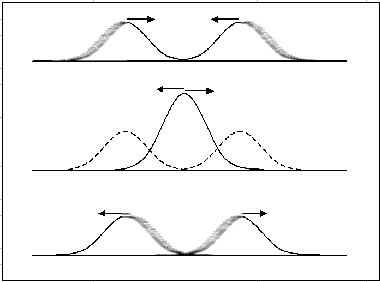
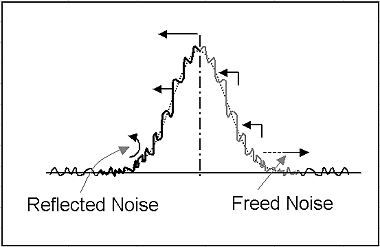
The following is a typical pictorial of two waves crossing each other. In this case they are two waves of affect, “affectance”.
The affects add together as they cross the same point because both waves represent an effort to alter the potential for affect in the same direction, in this case, to increase the potential for affect. But because of the propagation issue raised earlier, the waves continue the effort in the same direction to raise potential, thus they pass through each other yielding a temporary high point.
But next comes the critical issue, the very “secret” of the universe’s formation of inertia.
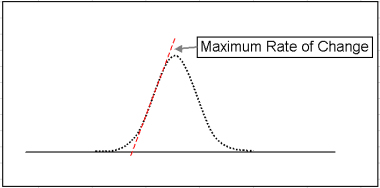
Note earlier I had mentioned that affect or change cannot occur instantaneously. An instantaneous change implies that at some point, a value must be two values. That is a violation of Logic (2nd Law: A != !A). Thus by necessity there is a limit to how fast the potential to have affect can be raised or lowered.
The waves were formed due to the affects trying to change their surroundings as fast as possible. As long as they are not trying to change the potential too much too quickly, the waves merely propagate. But when two waves add up to a change rate that exceeds the maximum (whatever the maximum might be) a new feature to our universe arises;
When something can’t be done, it isn’t done.
So what happens when you have two efforts trying to change something faster than possible? The affect potentials can’t merely sit there. By definition, they have potential and thus by definition they CAN affect… but what?
Well, when you must releave yourself, but can’t get to a restroom, what do You do?
You go somewhere else.
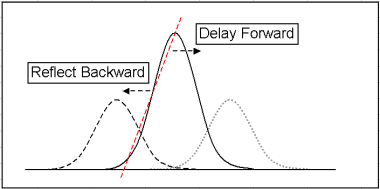
As long as the potential to affect could affect in a direction, it affected in that direction. Every potential to affect affects in any and every direction possible. There is nothing to prevent it, so it does its thing. But when a direction gets blocked, in this case by too much affecting already taking place, the remaining potential merely exercises its affect elsewhere. In this line drawing, that means that it either continues affecting in the reverse direction, or it merely affects more slowly. It does both.
The potential doesn’t just suddenly ignore the direction it was headed. That maximum gets reduced as soon as either potential ignores it. Thus it wouldn’t be a maximum any longer, but the potential hasn’t gone away yet. So the maximum point gets fed until the potentials have reduced to the point where they no longer add up to the maximum change rate. At that point, they continue affecting in every possible direction, including the direction they had been going before. The end result is that most of the wave merely gets delayed, awaiting for enough reflection to take away some of the potential.
Both the properties of reflection and, more importantly, delay, become a necessity of any logical universe. And that delay is the really important aspect.
The concept of inertia is the property of reluctance to change. When something is getting delayed, there is a reluctance to change, there is inertia. And that is the very beginning of what later Science identifies as the property of Inertia and momentum. But note that right now, we are still merely talking about the nebulous entity “Affect” and its propagation… any Affect… in any proposed universe.
That is an extremely relevant philosophical issue. It has nothing to do with what Science noticed as a particular property of THIS universe. That inertia arose merely out of the 2 logical notions that;
A) infinite homogeneity is impossible
B) instantaneous is impossible
And due merely to those two concerns, ANY proposed universe absolutely must have waves of Affect and Inertia within it. This could have been deduced long before Science ever noticed such a thing. Note that so far, I haven’t mentioned anything unknown to the Greeks, for example. Science is merely naming what absolutely had to be there. We will get into exactly what names they gave these truly universal properties a little later.
Next (because I can’t post more than 3 pics), the Affectance Particle…
What happens when a car traveling down a very busy highway suddenly slams on the brakes? Often the guy behind him runs into him because the guy behind didn’t see any reason to slow down until it was too late. And the next guy behind might do the same. You end up with a “car pileup”.
When there is a flow and any portion, for whatever reason, slows, a pile up occurs as the portions of flow that had no reason to slow run into the portions that did slow. Noisy affectance waves are no different.
Once merely two affectance waves add such as to create a changing of potential at a maximum rate, a slowness occurs in the free flow. Other small ripples of affect, not having slowed, run into those that did slow. And thus they join in on the effort to raise the potential for affect… They all unite in an effort to raise the potential for affect. But as each adds its own little bit, that maximum hangs around a little longer awaiting for the potentials to fade down through reflected dissemination.
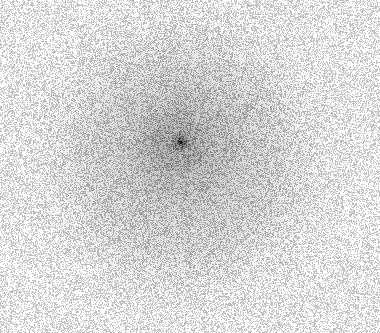
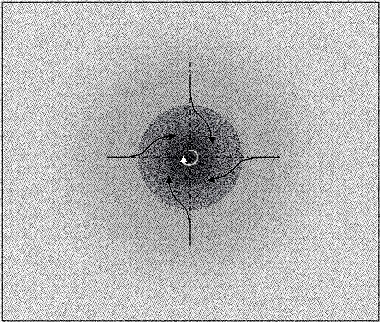
The affectance waves slowed because they added up to too much. But that caused others to add even more. That causes more delay, which causes even more to be added. You end up with an “Affectance Build Up”;
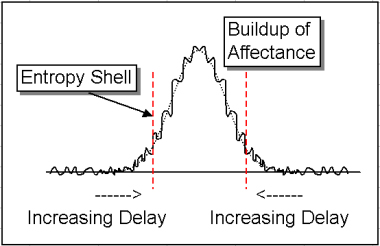
Or in a planar pictorial;
Do you see something familiar about that pic?
That dark spot in the center is there because inertia formed and wouldn’t go away fast enough. That is a pictorial of our first Particle of Affectance. That particle cannot travel and propagate as the waves that make it up can. It has Inertia.
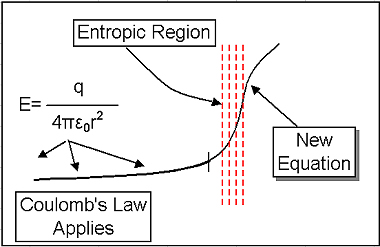
Within that line drawing, there is a dashed red line. That line indicates about where a certain special effect takes place. On the outside of that line, waves are pretty free, but inside that lined space, they are more trapped in time. The tiny bits of waves eventually find their way back out, but they take a long time to do it compared to the speed of travel for the outer bits of waves.
That lined space is where the balance of how much slowing occurs such as to trap what manages to get inside such that it can’t quickly get back out. It is due to that property, the “Entropic Shell”, that the particle remains a particle, reluctant to ever be anything different than it is – an Affectance pile-up. It takes a while for the car pileup to dissipate. But what if the oncoming traffic never slowed? That car pileup on the highway would never go away.
The Entropic Shell is very strongly related to what they call the “Event Horizon” concerning a black hole. The equations for that point are very similar to those for an event horizon. Subatomic particles don’t go trapping other particles, but they do trap loose affectance waves. A black-hole actually does that also and affectance waves eventually escape black-holes, but not as full particles.
Note that the affectance density (the “buildup”) that forms the particle doesn’t simply drop to zero at that entropic shell point. That detail becomes extremely relevant a little later.
So now we are up to the point that ANY proposed universe must not only have waves of affect and inertia, but actual particles of affect – stable “hard” spots in that universe that are reluctant to move or change what they are – Affectance Buildup. There is no alternative.
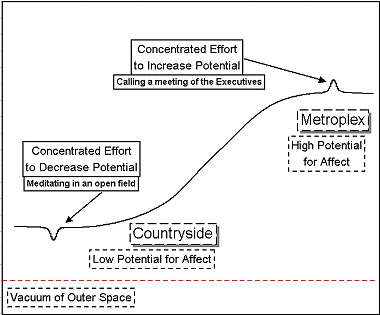
Just for a quick demonstration as to why this is a subject for Metaphysics, not merely physics and why I insist on using those nebulous terms, “Affect” and “Affectance”;
That pictorial is an example of the buildup of potential for affect. In the metroplex there is a high potential for affect due to the concentration of types of people available to accomplish a variety of tasks. Calling a meeting of the executives is the example of concentrating some of those people into a small space so as to raise the potential of accomplishing a chosen goal.
Out in the countryside where it is relatively quiet with very few people there is much less potential to accomplish the variety of things that people might want to accomplish. Any effort to accomplish much of anything will tend to dissipate due to too little available potential. But there is the noise of life wherever there is life, thus perhaps a Buddhist farmer chooses a moment to reduce his efforts both physically and mentally by meditating. He is making the effort to stop all other efforts and become selfless and closer to nothingness.
Both represent concentrated efforts to accomplish what “matters”, one to increase potential effectiveness, the other to reduce potential noise. Both involve an entropic shell produced by the one declaring the act. They both allow in only what helps the concentrated effort. They both keep out what might disturb the concentrated effort. The monk refuses to let other people around him and the executives refuse to sit idly and do nothing. That filter is the “entropic shell” formed around the focused efforts. It is there to preserve what they value.
Half way between those extremes are the suburbs, quieter than downtown, but noisier than the countryside. Any effort in that region to either increase or decrease potential causes either the overall picture to shift right or left, or the effort itself to move toward the more favorable region. If the effort is to build a warehouse, the downtown region is too congested with too many regulations, thus such efforts migrate outward toward the countryside even though the potential use of the warehouse is more favorable downtown.
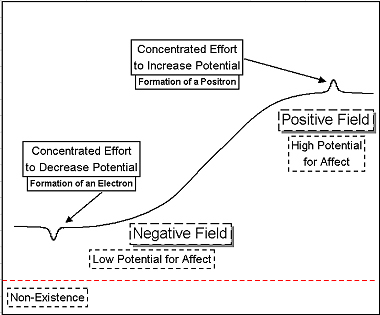
When referring specifically to physics, we have;
This is a pictorial of what physics has come to call an “electric charge field”. All of the same effects are in play, merely caused by a different incentive within a different realm.
Although it hasn’t been completely detailed yet, that area of positive charge field is actually a region of space where there is a higher potential to affect the universe as a whole. The potential for physical affect has slightly gathered in that region. The negative field is a region where there is less potential to affect the universe as a whole and potential has migrated out of that region.
In either region there can be a concentrated effort to reach the extreme. Such is caused as explained above by the propagation delays due to the limit of how quickly any potential can be changed, either increased or decreased, either more positive or more negative.
Half way between those extremes is the “suburbs” of the charge field, less potential to affect than the positive field, but more potential to affect than the negative field. Any affect in that region to either increase or decrease potential causes either the overall picture to shift right or left if the effort is accomplished, or the affect wave itself, finding less reluctance to change will to migrate toward the more favorable region. Since there is nothing to keep an affectance wave in that spot and it is always moving, the wave will migrate toward the field that least resembles its direction of affect because less potential offers ease to an increase and more potential offers ease to decrease.
Light from the Suburbs
In the case of a negative electron orbiting a proton and dropping its orbit, getting closer to the positive proton, the affectance noise in the suburbs is what forms the released photon of light as it leaves the entire region. Light from atoms comes from the suburbs. We can get into that in more detail later.
But please note that right now, I am NOT declaring or presuming that this ontology fits into physics… yet. It will be shown that in fact it does, but we haven’t gotten there yet. I am still merely talking about absolute principles that must exist in one form or another.
This thread was originally about an alternative to quantum mechanics (qm) called the Theory of Elementary Waves (TEW). TEW is published in the form of a book and a paper in a physics journal, both by Dr. Lewis E. Little. Since all alternatives to qm are welcome in this thread, we are now spending a lot of time discussing a new and unpublished theory of science, physics and everything called Rational Metaphysics (RM) developed by James S Saint. The debate is about how RM applies to physics, rather than all the other areas. Sometimes James has some personal speculations that extend RM, which we call JSSRM (James S Saint Rational Metaphysics).
James,
Thanks for posting the diagrams and details about RM. Looking forward to reading more.
I am interested in more about the entropic shell. I know you will probably answer this at some stage - I’ll just ask my question so that you’re aware of what I’m waiting for.
You wrote about affectance building up:
I can understand a buildup or “pileup” forming. To me, such buildups only last as long as the incoming flow sustains the buildup - otherwise the buildup dissipates. You covered dissipation when you wrote:
My question is: is the “entropic shell” an actual object in itself, or an apparent object?
To me, an entropic shell is simply the result of the incoming affectance overcoming the natural tendency of affectance to spread out to areas of less potential around it. The incoming flow needs to be pretty constant, and so the “entropic shell” is dependent on the constancy of the incoming flow. It seems to be a lot like fluid dynamics. I’m thinking the “entropic shell” seems to be an effect itself - it not actually a “thing” in it’s own right.
Yes. That’s correct. An entropic shell example is the water tension on the surface of a drop of water that is in a sauna. Bits of water still go through the tension barrier and come out, but that tension between the molecules maintains the drop as a drop. It prevents entropy of the form, thus a “shell” protecting the entity. But the shell is merely a specific region where behavior is slightly different and performing a specific function.
Take that same drop out into dry air and its entropic shell still functions but isn’t strong enough to prevent gradual entropy and the drop slowly dissipates.
A reverse scenario could be seen by taking a drop of water mixed with calcium chloride into a fog of the same mix. The drop would begin to grow larger and larger. That is what happens when you have an affectance particle in a region of high density affectance. It is important to keep a distinction in your mind between a high potential and a high density of affectance. The affectance is the noise. The potential isn’t a “thing”, but merely a situation.
Unlike the water drop examples, due to the 3D geometry and the exact cause of the delays of affectance noise, there is a maximum size for the affectance “droplet” or particle. If the particle gets any larger than that size, the equations don’t balance any longer and the affectance within begins to escape as fast or faster than it enters. So the entropic shell is the balance of the total situation of geometry and affectance accumulation such as to cause a particular and exact size for a given surrounding affectance density. That is the beginning of the notion of quantizing and is why all particles of a given type will be the same size. The inherent entropic shell creates the particular size, the consistent “quanta”.
Philosophically speaking, anything of interest that has any affect different than what is around it, is an entity. That is how all epistemology works. But as you noted, the entropic shell isn’t made of anything any different than what is around it, it is merely a region where the affectance has reasons to behave a little differently. Outside the shell, the substance of the particle is substantially more free. The fact that how free it is changes rapidly at that point is what makes particles so stable. A photon for example is much less stable barely capable of maintaining its form.
You might be interested in noting that the epsilon constant in Coulomb’s Law is not actually a universal constant. It is specific to the region of space that you are in. If you go out perhaps between the galaxies, that epsilon will be different. And although I haven’t done the math (and without a mathematician by my side, I’m not inclined to) I suspect that due to that difference, atoms might not hold together. If you get far enough into a low affectance region, particles will not hold together either, just as that drop of water in dry air and for the same reason.
Realize that such is not merely a theory. It is a logical necessity. It would be merely a theory that at any one location in outer space, that region had sufficiently low affectance density to allow for the dissipation of particles. It is merely my speculation that if you were to go so far out as to be beyond our visible universe, the affectance level might be so low that even photons, light, cannot traverse the region. It is conceivable that at an unimaginable distance, there is another “local universe” similar to ours but separated by a region of extremely low affectance that we could never see it, neither could they ever see us.
If the potential gets too low, light will certainly not traverse such an area, but will both help fill the area, gradually increasing its potential, as well as partially reflect back, “background radiation”.
Also, you might be interested in the fact that a high affectance density region (a great deal of loose noise), regardless of the potential in the region, will have the characteristics that they have dubbed as “dark matter”.
This thread was originally about an alternative to quantum mechanics (qm) called the Theory of Elementary Waves (TEW). TEW is published in the form of a book and a paper in a physics journal, both by Dr. Lewis E. Little. Since all alternatives to qm are welcome in this thread, we are now spending a lot of time discussing a new and unpublished theory of science, physics and everything called Rational Metaphysics (RM) developed by James S Saint. The debate is about how RM applies to physics, rather than all the other areas. Sometimes James has some personal speculations that extend RM, which we call JSSRM (James S Saint Rational Metaphysics).
James,
Thanks for the detailed answer to my question. RM continues to be fascinating.
I will be looking closely at the mechanisms for an entropic shell forming. With the water droplet in a sauna, I agree that the humidity helps sustain the droplet that would evaporate in dry air. I am also aware that the hydrogen bonds between water molecules sustain the surface tension on the water droplet. By analogy, there will need to be bonds between affectance to create the same sort of surface, or some equivalent process. To me, the “humidity” of affectance alone is not enough to create entropic shells.
I like the new ideas that RM puts up - that the cosmic background radiation may be a reflection from areas of very low affectance, and that “dark matter” may be excess affectance noise. I’m not saying I believe RM on these points - I am simply enjoying a new way of looking at them.
TEW supports a new idea on “dark matter” - that this matter does not exist. At the moment, physics assumes that the large scale structure of galaxies and the universe comes from gravity alone. TEW supports the idea that the structures come from two forces - gravity and the electromagnetic force. The structure of galaxies would be mainly spherical if it was gravity alone, but the presence of magnetic forces is what makes so many galaxies flat, like our own. The effects of magnetism would also account for the “missing mass” of the universe - i.e. the “dark matter”.
On page 135 of the book on TEW, it mentions Swedish physicist Hannes Alfven who developed the idea that the second major force at the cosmic level is electromagnetism. Dr. Little strongly supports Alfven, and so do I.
Hmm… I suspect that you are missing a point here. I will have to see if I can come up with a better explanation or example.
Do you understand what causes the event horizon of a black-hole? That is a region, or a “shell”, beyond which there is no return for particles or photons. But gravity didn’t need any extra “hydrogen bond” effects to arrange that region. It is merely a point where the gravitational attraction exceeds any contrary momentum. Affectance works that same way. There is a point, do merely to the inherent delay mechanism, where any effort to leave the particle is overcome by excessive delays. The “Entropic Shell” is merely a more philosophic term, applicable to anything, that equates to an “event horizon” for the entity in question. “Event Horizon” refers to the entropic shell of a black-hole.
In RM it is improper to refer to electric charge and magnetism as the same thing, “electromagnetism”. If that kind of thing is allowed, then gravity would also have to be included, because they are all merely aberrant effects of the affectance field. But they each have their own nuances. Gravity is a neutralized, noisy charge field (equal amounts of potential). Magnetism is an accelerating charge field (not so noisy). Potential IS the charge field (which is actually merely a situation, not a substance). The entire mess is the “Affectance field” - affects caused by the potential for affect, the situation of any universe.
As far as electromagnetic effect having impact on galaxies, I have no doubt that they do. It couldn’t be avoided. The only question is one of amount of each. To answer that, I would have to have more information concerning what has been witnessed. The flatness issue is mostly an issue of how they came to be, not so much about how they function. At this point, I can’t confidently comment upon exactly how they came to be. But I can with extreme confidence tell you of what they are made simply because there is no alternative.
I guess that I should mention that regions of extra affectance buildup, higher affectance density cannot be avoid. Affectance density can never be uniform any more than potential can be. Thus there are regions in space that are only unique in that they are, in effect, “thicker” space than others. Those areas will display the same effects that they are calling “dark matter”. So perhaps other than the specific name, the effects of dark matter certainly exist somewhere.
Now presumably you understand the basics of why a particle forms and what is keeping it as a stable particle. The mature particle has an equal amount of affectance noise coming in as going out and thus has a stable size. The noise moves around inside the particle more slowly than the noise outside merely because noise adds to noise and delays when it adds up to an inherent maximum. That maximum is reached more often inside the particle than outside. That occurrence is what makes it a particle in that location.
But then, how or why would a particle move? The answer to that is pretty simple. If for any reason one side happens to get a little more affectance noise, due to a higher density on that side, the center of the clump of noise, the center of the particle, shifts slightly. This can be seen on a highway during heavy traffic hours as often cars will form bumper to bumper packs. Looking from above, it is like looking at a spring in that the pack slows then springs forward then slows again, over and over.
The center of the pack shifts at a different rate than the cars involved. As time goes by, the pack is still on the highway, but every car that was in the pack earlier has already left and been replaced with other cars. The pack is determined merely by the point of congestion, not the particular cars. A particle is like that, in that the center of the particle is merely the point where the congestion is highest.
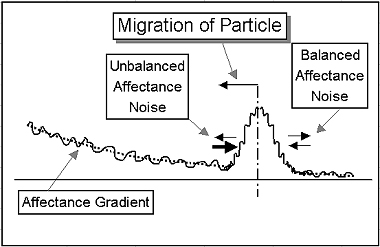
If we place a particle in a gradient affectance field, a field wherein the density slowly increases or decreases across a region, we see the following;
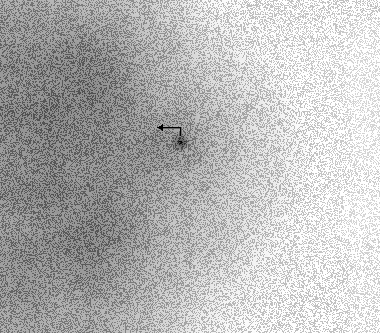
Or in a more realistic pictorial;
Due to the uneven affectance noise level from side to side, the center of the congestion of noise, the particle, begins to shift toward the higher density area. More noise is stacking up on one side than on the other which shifts the center of the total congestion. Later this will be identified as the “force” known to contemporary physics as “gravity”. Note there is no pulling or pushing involved, merely delays that cause migrating of a center. But the particle is a hard object, so anything getting in its way will “feel” a push from the particle. That is why it is observed as a “force”.
Again note and confirm that these kinds of events absolutely must be occurring somewhere in any universe. There is no alternative.
And btw, when that dark area happens to occur without a particle being the cause of it, that is what they are calling “dark matter” (I presume).
Now that we have established how a particle begins to move, a question arises.
If we were to suddenly remove that gradient field and restore it back to a more even field, would the particle suddenly stop? It had been merely migrating due to having more affectance noise on one side than the other. So wouldn’t the migration merely stop happening once the gradient was removed? Actually no.
Although the gradient field caused the initial motion, once the clump of noise begins to move, it gains a prejudice to continue in the same direction. This occurs due to the total balance of all of the noise going on inside.
A particle is formed by bits of affectance noise headed in a variety of directions within the clump. The average direction of that noise is what determines the direction of the overall particle. As the center shifts to the left, the bits of noise that were on the right trying to get to the left are suddenly a little more free to do so. And the bits that were trying to leave the particle toward the right are also freer to leave the particle because they are further from the denser center. But the opposite occurs on the left side.
As the center shifts to the left, the noise that had been trying to get to the center gets delayed more than it would have and partially reflects back due to reaching a maximum affect peak. The buildup on the left side increases even faster because the noise can’t so easily get out of the way. They then become a part of the overall amount of noise of the particle and are then headed in the same direction as the particle.
The end result is that those bits of noise that were headed in the same direction as the center, keep trying in that direction, but some of the noise that was trying to get to the center from the left turns around, reflects, and adds to the over all average direction of all of the noise within the particle toward the direction that the center was headed. Any bits of noise that became freer to leave the particle from the right, reduce the amount of noise that had been heading toward the right by leaving the particle entirely.
Once an affect has a direction, and it always does, it maintains that direction until it has a reason not to, which is only when it runs into another maximum affect occurrence.
That is why dear Isaac Newton noticed that objects in motion will continue in motion until they have a reason not to.
Newton’s First Law of Motion; “First law: Every object continues in its state of rest, or of uniform motion in a straight line, unless compelled to change that state by external forces acted upon it.”
If you want to stop the particle, you have to supply enough reverse affectance noise to make up for the amount of affectance noise within the particle that was going in the wrong direction – “Momentum”.
“Third law: When two bodies interact by exerting force on each other, these action and reaction forces are equal in magnitude, but opposite in direction.”
This particular behavior is not an obvious case of logic. As stated here, it would be merely a theory. I don’t like theories. I prefer to be certain. So I wrote a small program to deal with several thousand bits of random level and vector of noise with the parameters outlined earlier.
The program had instructions to merely handle noise interaction on a bit by bit basis independently and proportionally. The program had no knowledge of particles. When a cluster of noise developed and was given a direction via average noise vector, the program merely calculated the interaction of each affectance encounter. As expected, the calculated average velocity of the clump after the encounters, was always the same as before the calculation. Momentum was conserved.
Philosophically, this principle applies to politics, religion, and economics as well. People tend to follow the crowd unless they have incentive not to. And once the crowd has a direction, it keeps going in that direction until there is a reason not to. In order to stop a social movement, one must create a counter movement of equal momentum (assuming the movement is not subject to the resistance of merely being too tiring, boring, or unfruitful).
This thread was originally about an alternative to quantum mechanics (qm) called the Theory of Elementary Waves (TEW). TEW is published in the form of a book and a paper in a physics journal, both by Dr. Lewis E. Little. Since all alternatives to qm are welcome in this thread, we are now spending a lot of time discussing a new and unpublished theory of science, physics and everything called Rational Metaphysics (RM) developed by James S Saint. The debate is about how RM applies to physics, rather than all the other areas. Sometimes James has some personal speculations that extend RM, which we call JSSRM (James S Saint Rational Metaphysics).
James,
The developing story of RM seems to be easy to read and follow so far. Not a lot of work for Typist to do editing yet.
The entropic shell concept still bothers me. You wrote:
I do understand about the event horizon at a black hole.
Are you are saying that the entropic shell is an imaginary envelope that encompasses an area of maximum affectance? So that means a particle is a zone of “maximum affectance”? I could understand that idea - because a particle would move because it lost affectance at the back and gains affectance at the front, and then perhaps momentum takes over (as long as the maximum is not exceeded at any point).
If that is true, my thought would be that the particle should spontaneously explode - affectance going in all directions - in order to relieve the condition of maximized affectance. What are the reasons that doesn’t happen? Or can it, in certain situations?
How an I doing with my thoughts on the entropic shell?
That’s great and better than I stated it. Can I use that?
But keep in mind that inside the particle is not homogeneous. It is extremely noisy and chaotic… at a maximum level… of noise. This is to say that the maximum rate of affect causes the delays and accumulation that ends up with a maximum amount of noise within the small volume. There are two maximums involved; one of individual affect rate and the other of maximum amount of noise trying to challenge that maximum affect rate. A particle is a maximum accumulation of efforts to challenge maximum affect.
What affects things the most is what matters the most, thus where the most affectance accumulates is called, “matter”.
Actually this is very analogous to a 70’s disco club. People randomly incident the club. Depending on how active they intend on being themselves as well as their tolerance for being bumped by other people, they might stay or reflect away and go somewhere else. There is no one squeezing more people inside such that the walls would explode. At some point, there is insufficient room for more people to enter until someone leaves. But that decision is being made by the people themselves unless the manager gets bouncers to try to regulate the activity as they do these days. The noise of the music attracts more participants in the noise, but there is a limit to both how much noise can be made as well as how many people can fit into the allotted space.
If that same occurrence is held at a concert in an open field, the same kinds of things occur. There is still a limit for the amount of noise involved for each person as well as how many people can be involved (because they can’t get close enough to the music/stage to keep their interest). In order to have a really huge concert, they have to have exceptionally large speakers and video screens. But there is always a limit, not set by the management, but by the people themselves, and thus no explosion.
It doesn’t explode because it doesn’t allow anything inside that area of maximum affectance until something leaves it on the other side. The affects inside are not pushing to get out, they are the only reason the maximum is there. If they aim outwards, the maximum that they were encountering at that infinitesimal point isn’t a maximum any more. They only stay there because they are still trying to stay there. They are not slaves. There is nothing holding them in other than themselves. What escapes is merely bits of reflected affectance, which becomes very relevant in a little bit.
Doing great. I have intentionally avoided the mathematics involved. The concepts should not be usurped by mathematics, else you get Quantum Mysticism again.
A little about spin before we get further into this thing called “gravity”…
As mentioned in the beginning, there can’t be infinite homogeneity, but that principle is really merely a corollary to the more fundamental principle that there can be no infinite similarity between any two entities or even points (hence no “Quantum World” or universe).
What that means, besides never being able to have an infinite void, is that a particle can never have infinite similarity from one side to the other. Sense that particle is made of noisy affects, there will always be a little more noise on one side than another and also the average directions of affects of opposite sides cannot be infinitely similar in scalar value even if the direction might be different. Thus any particle must always have some degree of spin. There is no alternative.
Additionally, due to the effect mentioned above concerning momentum, that spin will inherently continue until something gives it reason not to. That is the angular momentum within every particle that contemporary physics calls “spin”. Once it begins and it must always begin, it continues and affects the total amount of affectance that can pack into the particle, the total “energy”. If everyone at the disco club were dancing in a harmonious circle, more people could fit into the room. The concept of enthalpy comes into play.
Realize that when two affects combine, the direction of the incidence angle affects the amount of delay encountered. When two people bump into each other, the direction they were headed and thus their angle of incidence makes a difference as to how much delay is caused. Running into someone head on, delays more than merely glancing off of them because they were headed off to one side.
So due to the spinning, the angle of incidence of affectance interaction tends to be more orthogonal than head on. That in turn means that more affects can be compressed into the same amount of volume making the particle even more tightly bound (that entropic shell issue again). In a sense, a particle is a whirlpool of affectance.
This issue isn’t greatly relevant to isolated particles until we get into charged particles, or more accurately, “particles of charge”.
Note that the spin of an isolated charge-neutral particle is not something that can be observed. Physics merely assumed that they spin which accounted for energy equations relating to what happens when a particle is destroyed. They assumed correctly. Particles have no choice but to spin.
Later when we get into how such particles combine into for example the nucleus of an atom, that spin becomes more of an issue and affects the final energy equations.
This thread was originally about an alternative to quantum mechanics (qm) called the Theory of Elementary Waves (TEW). TEW is published in the form of a book and a paper in a physics journal, both by Dr. Lewis E. Little. Since all alternatives to qm are welcome in this thread, we are now spending a lot of time discussing a new and unpublished theory of science, physics and everything called Rational Metaphysics (RM) developed by James S Saint. The debate is about how RM applies to physics, rather than all the other areas. Sometimes James has some personal speculations that extend RM, which we call JSSRM (James S Saint Rational Metaphysics).
James,
Use any of my words if you want - I’m just playing with RM ideas to get to know them.
I still feel some uncertainty about affectance gathering in one place to form a particle. Sometimes the affectance seems to seek out other affectance, and other times the affectance seems to reflect off maximum areas and seek out areas of low affectance. The dynamics of affectance gathering together and dispersing are a little confusing to follow for me - it seems almost arbitrary.
With gravity, for example, masses always want to get together - all the way up to a black hole. Why doesn’t affectance do the same thing? Once we reach a maximum, wouldn’t that area of maximum always grow?
By the way, TEW (and my own view) does not accept that black hole evaporate slowly as Hawking claims, because TEW rejects the idea that pairs of particle and anti-particles just form spontaneously and then annihilate each other. TEW does not need those pairs to explain anything.
With particle spin, you seem to be saying that every particle has a spin, but the spin cannot always be measured. Looks like charge is the deciding factor on whether spin can be detected. If we can’t detect something, does it exist? I understand you are claiming that universal spin is a deduction. I will think about that one a bit more.
Looks like all you needed was to start writing - not much editing required. If all this was in a paper or book, it would be great reading. Hope this thread kick starts you getting that done.
First affectance doesn’t “seek out” anything. It merely encounters things. When it encounters other affectance such that they add together to a maximum, they form a point of inertia that cannot be added to. Any other affectance that encounters that point of inertia stacks against it causing more delay as the maximum gets reinforced. Additional encounters keep adding to the spot of maximum affect. With each encounter any affectance left over that would have been above the maximum, reflects and/or deviates around the maxim. Of course this is happening in three dimensions, so a volume begins to fill.
The volume creates somewhat of a surface upon which new encounters cannot fold around a maximum point without merely encountering another, so they have to reflect. But often the reflection causes another maximum from behind and adds to the volume of the maxim. The particle that has formed is not a solid ball. It is made of moving, very high frequency ramped wavelets, a “noisy clump”. So the surface is not a smooth surface that you might see on a ball, but rather closer to the surface of a dense cloud. It is sharply contrasted at a distance, but up close it would be very hard to distinguish where the particle actually began, just as with a cloud.
As the particle is made of this cloud of noisy activity, some of the noise escapes. And as with all entities, its size is determined by the comings and goings. When the amount escaping statistically matches the amount incoming, the volume stops increasing. That level is determined by the ambient density of affectance. Just like that water droplet, in the dry air, it shrinks. And in the sauna, it grows. Unlike the water drop, the particle has no hard surface, but rather merely a region where the density more sharply increases due to the type of affects involved. That region is the entropic shell that most profoundly determines when a bit of affectance is going to enter or reflect.
A particle cannot be formed if the ambient affectance density is too low. But a particle already formed, can easily be sustained by the exchange rate in a low density field, as long as it doesn’t get too low. Once formed, a particle is much less dependent upon its ambiance (ambient affectance density).
The particle is constantly encountering noisy affectance, reflecting and releasing the noise. That causes a higher density of noisy affectance immediately around the particle only because the more dense the affectance is, the more dense it becomes, which is how the particle formed in the first place. But what we call “normal space” has an extremely low affectance level compared to that of a particle. So the particle seems to be merely floating, again like the cloud in the sky, except a bit thicker and harder.
To the particle, the gradient variation in the surrounding space seems as nothing. But to other particles, that field of gradient noise is sufficient to indicate the location of a particle as though the distant particle was the source of the noise. It was really only the source of the gradient in the noise. But encountering slightly more noise on one side of a particle has consequences.
Gravity
As discussed earlier, every particle is both absorbing and distributing affectance. The affectance leaving the particle has a vector away from the particle. That being absorbed is obviously headed toward the particle.
As affectance from varied sources encounters other affectance in a region, there is a degree of delay effect. That effect is the affect that was causing the delays, which caused the particles to form. The more affectance within a volume, the more incidental delays occur. The more delays that occur, the denser the region becomes.
So when affectance is emitting from any source, such as a particle, there is a concentration of affectance close to the source forming a gradient region and within that region is more delay. The derivation of exactly how much delay is kind of interesting, but I’ll leave that as a “book topic” concerning Afflate Analysis. The point right now is that the closer you get to a point of concentrated affectance, the more dense the region gets (as depicted in the first affectance particle pictorial).
Given two particle sources, the cause of particle migration, and the fact that the affectance field density gets gradually denser the closer anything gets to a particle, guess what happens. Each particle, in effect, is spewing affectance out. The volume between the particles becomes more dense than other regions. Such causes each particle to have a higher affectance density exactly toward the other particle. They migrate/gravitate toward each other – “Gravity”.
The speed of the migration is determined by the field density as a particle migrates across the gradient field straight toward the other particle. This is also later seen as why photons bend in a gravity field.
Note that there was no pushing or pulling involved, merely absorbing and distributing. In a sense, the “force of gravity” doesn’t actually exist. But gravitational migration, or simply “gravitation”, does. As things gravitate, they gain momentum, so you still need to keep out from under the falling rocks and ladders.
An analogy to the field density involved in gravitation is the traffic slow downs that occur when two cars a few blocks away tried to occupy the same place at the same time. The event doesn’t merely stop the two cars involved, but creates a surrounding field of slower traffic. Slower traffic causes more slower traffic, thus there is a gradient in car density from the collision point outward. Affectance collision, trying to add too much to the same point (“trying to occupy the same place at the same time”), has that same effect. The affectance slowing causes additional slowing as a gradient field centered on the initial collision.
If indeed black holes are proceeding outward from a prior big bang, and I can’t be confident that they are although it is possible, they must eventually begin to dissipate just as all other particles must (if they don’t run into more affectance).
Any sponteneity is coming from the affectance density in the region, which would be high around any black hole. But being created in pairs that annihilate each other is not necessary and highly unlikely.
Does TEW have a theory on where particles come from in the first place, how they ever became particles?
It is an error in Science to claim that if it can’t be measured, it doesn’t exist. On the other hand, if it can’t be deduced, it has no affect and thus doesn’t exist. Every measurement is actually a deduction. There is no such thing as direct observation. The photons hitting your eyes is merely a data stream from which your mind must deduce what it is seeing.
Consider yourself my “muse”.
Yes you are.
And “wider audience” means what exactly?
On a quick philosophical note (this IS a philosophy forum);
Philosophically, as per this RM introduction;
What causes a collective?
What moves it?
How does it move others?
Those answers are absolutely fundamental to every religion, political or social movement, government, military, economic, propaganda strategy, and every influence upon every mind and life (You ARE wanting to change some people’s minds concerning TEW, right?).
Note there is a lot of chaotic/confused affectance involved between and within the “particles” involved.
This thread was originally about an alternative to quantum mechanics (qm) called the Theory of Elementary Waves (TEW). TEW is published in the form of a book and a paper in a physics journal, both by Dr. Lewis E. Little. Since all alternatives to qm are welcome in this thread, we are now spending a lot of time discussing a new and unpublished theory of science, physics and everything called Rational Metaphysics (RM) developed by James S Saint. The debate is about how RM applies to physics, rather than all the other areas. Sometimes James has some personal speculations that extend RM, which we call JSSRM (James S Saint Rational Metaphysics).
Typist,
You wrote:
Science explanations are for everyone, not just scientists. I know that science can get complicated especially when maths is involved, yet the basics must be understandable by anyone who bothers to look.
James is starting at the basics. So no being qualified means you are perfectly qualified. Does James make sense to you? If not, join in this discussion - no need to be shy.
James,
Thanks for calling me a “muse” - it’s a huge compliment. I see myself as returning your thoughts and patience when you looked at TEW and gave me feedback. I got a lot out of that, and I hope you are getting something out of my responses to RM.
I am continuing my exploration into RM. You wrote:
I still find the dynamics of particles forming from affectance a bit like fog - there doesn’t seem to be a definite start and end. You gave an analogy of a cloud so you might say that I’ve understood it.
The problem is that every cloud is different. Yet the universe I see has atoms made of protons, neutrons and electrons. To my mind, the characteristics of each proton, neutron and electron are very consistent to the point that each proton seems identical to another and so on.
The cloud analogy does not fit here - if particles form like clouds, why are most particles so consistent in weight? With the RM description of affectance, we could get protons of all different weights with no one weight being favored over another.
This also comes up when thinking about gravity. You wrote:
A bit later you wrote:
I am a little puzzled why two particles migrate towards each other. Gravity seems a lot stronger than must a random accumulation. If it is like mist accumulating between clouds that’s when I feel like the particles should merge into a new particle of a different weight, albeit very slowly.
You have said we’re not done, so I’ll be patient. I just want to highlight where I am looking for more details.
TEW has not attempted to describe particles in anything like the detail RM does. For elementary particles like electrons, Dr. Little made a comment about them being “point like” objects, but I cannot find the quote yet.
In Chapter 5 of the TEW book, Dr. Little talks about how TEW rejects the Heisenberg Uncertainty Principle (HUP) for particles, because the uncertainty is about elementary waves instead. For qm, physicists believe a structure to particles is impossible, because such a structure would violate HUP. Hence physicists have not looked for a structure of particles. From the TEW point of view, physics has been asleep on particle research for about 80 years. For example, in Chapter 11 of the TEW book, Dr. Little talks about larger particles not being symmetrical, which explains some “handed” behavior. There definitely seems to be an inner structure to some particles that is not being acknowledged.
It’s great that you are highlighting the issue of the structure of particles. I am not saying I agree with your conclusions - I am supporting the raising of this as a topic for discussion. Physics needs to get back to some basics.
True, but they are succeeding in changing that so as to instill more worship.
Exactly the point.
What is intended is not actually anything complicated or in need of grand education. If it seems that way, it is just my poor wording skills of late. Only through your questions can I detect what language makes sense to you. If an issue is complicated, it is only because of language issues and having too many details involved at once.
Hmm…
Particles are initially formed in very dense regions, like inside stars and such where the affectance is extreme compared to what we think of as space. At that stage, they are very cloud like and don’t necessarily stay as single particles. I have watched this taking place in my metaspace. As the ambient affectance lowers, the particles still have the same incentive to stay as particles, they just have less cloud-like form. But that cloudy edge never entirely goes away. It merely gets really thin in comparison. The point is that the gradient density is still present even at extremely low levels. No matter how thin the affectance gets, it will always be thicker closer to the particle. That gradient is the gravity field.
As we will see a little later, every particle has a tipping point where it decides to become positive, negative, or neutral while it is starting to form. Once formed and out in low affectance space, each particle has the same incentive to stay the same size as each other of their type (but never infinitely the same). Thus Science has only seen what typically floats around our region of space except in very serious lab experiments involving extreme energies. But even for them to detect or “see” a particle requires a hell of a lot of speculation and approximation. An electron could be 10% larger than the one next to it and they would have no means to know it. They can’t isolate them like that.
Not being able to clearly communicate this concern is largely why the book hasn’t been written. The book isn’t for physicists. I don’t really care that much what physicists think. The book is intended for intelligent people.
I suspect you need a better sense of perspective concerning these matters. Go outside and stamp on the ground with your foot. Then wave your hand through he air.
What you were stomping on was the particles just under your foot. What you were waving your hand through was the gravity field produced by the entire planet. The proportional differences are unimaginably huge. Yet they are basically the same thing merely packed differently.
If you went 100 miles out into space and waved your hand, you would notice almost no difference than when you had waved it before. But if you hold a heavy weight in your hand out there, it isn’t heavy at all. But back on Earth, that same weight significantly pushes your hand toward the Earth. The stuff that you are measuring with your hand is so thin that you can’t even tell it is there except for the weight thing. The difference in its density and that of a particle is perhaps a million times the difference that you felt stomping your foot. By comparison the Earth is mere jello to a particle. Yet it took the entire Earth merely to make that little weight difference that you would have noticed. Btw, there are no forces that actually pull anything… ever. Even the idea of “push” is a little ambiguous.
It is an issue of understanding the scale of the things that we are talking about.
Larger particles are not symmetrical (for a understandable reason).
My problem is that if you are not agreeing, it can only be because of my language. That is why I have to have these conversations. I can’t figure out what words or pictures to use, as I used to be able to do very well many years ago. I used to ensure (with ease) that everyone in my classes understood 100% of the material (no curve non-sense).
What language is best suited to create a bridge between the author and the intended audience?
Why should the intended audience care about whatever is being said, what is their stake in it?
Perhaps this last question is the most important? If the intended audience is going to be asked to exert their brains, the first question they will be asking is…