Another way to look at potential is that it is an opportunity due to an imbalance, a situation wherein, for example, forces are not evenly distributed yielding the opportunity for something to change.
If you imagine having 20 electrons inside a vessel out in space and you had the godly ability to stop and restart time while you make adjustments to the positions of the electrons, no matter what arrangement you placed the electrons, even with infinite precision, you would not be able to restart time without having them relocate themselves. There is no possible geometric form that would allow a balance of forces between all of the electrons.
The ever present imbalance of forces is the ever present potential for movement. And since any change in position requires time, even after the electrons were released to try to achieve balance, the potential wouldn’t instantly vanish. And then because no matter what new position was found, there would still be imbalance, there would always be potential that was always creating movement. The electrons would never be able to settle.
People in physics often think of “potential” as a type of substance. But it isn’t a substance in the normal use of the word. It is merely a situation of imbalance. Potential is not something that is possessed by an object, but rather is created by a situation. Potential is not a property of an item, but the property of an arrangement in an environment. In the above example of the box on the table, the box does not possess the potential, but rather the combination of the box, the table, and gravity creates a situation of potential. By merely removing the table, the potential for the box to move changes, even though the box wasn’t touched. It is the situation that determines potential.
Just as those electrons could never find an exact balance of forces and thus remove the potential for motion, space itself cannot ever have infinitely identical opportunity for change, “potential”, concerning every one of the infinite number of points within it. The situation of perfect balance, even in empty space, cannot exist.
At this point is where one begins to propose that age old question, “why not absolute nothingness rather than imbalanced forces?” There are a variety of ways to understand the answer to that and they all conclude with the same answer that even without “forces” being present, it is still impossible to have infinite homogeneity. And if it isn’t infinitely homogeneous, it has potential. Potential can never be avoided.
It can be, and general is, reasoned that if there is no reason for something to exist, then it will not exist.
But it can be equally reasoned that if there is no reason for something to not exist, then it will exist.
No matter what the state, there must be a reason for it.
In the case of absolute nothingness, there is no reason for anything to come into existence. But there is also absolutely nothing to prevent it. So in the case of absolutely no greater reasons for any particular state (ie. all reasons are equal), probability must be exercised concerning all possible states.
“0+” means an infinitesimal amount or “1 / infinity”.
Considering then, that you have an infinite number of those points, what is the probability that any two of them are infinitely identical?
What is the probability that those two would be adjacent?
What is the probability that they would all be infinitely identical such as to be infinitely homogeneous?
Existence, the result of potential for affect, has a 100% probability at all times.
There are still major faults in your diagrams about the double slit fringe pattern lines.
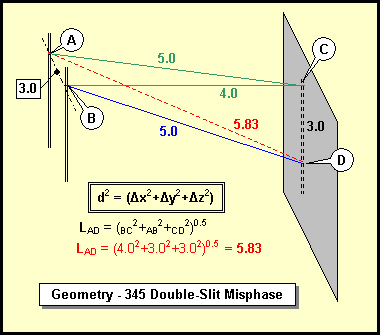
In your first diagram “Geometry - 345 Double Slit Misphase”, you define BC as perpendicular to AB and CD. That at least fixes the axes problem.
The problem in this diagram is that the line AD is completely irrelevant to the phase at D. The path between the source and D does not go through A, so calculating distance AD is a complete waste of time.
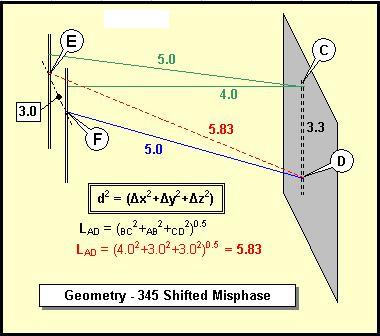
In the second diagram “Geometry - 345 Shifted Misphase”, you lowered the positions of A and B. These are different points, and by still calling them A and B you are confusing all the calculations.
Let’s call the new positions E and F. I have marked them on this diagram and not changed anything else.
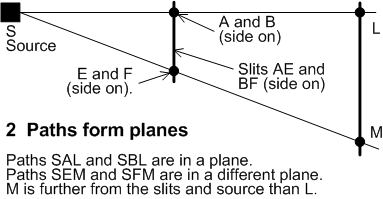
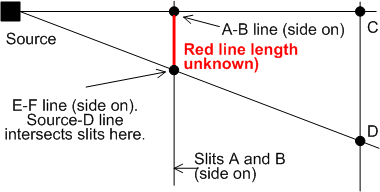
To see the errors in this diagram, let’s look at the scene with the slits side on, so the E-F line is looking straight at you (and so is the original A-B line):
Now we can see the problems with your diagrams. The red line length is not known - it depends on how far away the source is. Your diagrams claim to know the red line length, showing your whole argument is just inventing numbers to attempt to prove something. You can try and argue that you change the position of the source to ensure the red line length is a certain number - and this argument would reveal an unstated assumption.
My diagram also shows how irrelevant the distance AD is - it is completely misleading to show it at all.
To make matters worse, you are only comparing the distance between the slits and the points C and D. The whole argument about the phase at the points C and D is about the entire path lengths from C and D back to the source. Even with correct calculations in your diagrams, they are only half the story anyway, and will prove nothing.
This further proves what I said before - you are snowing everyone, because your diagrams here have calculations that are not always complete or relevant and have unstated assumptions.
In your last post about this, you finished by saying:
The problems are all yours.
You have repeated often that Rational Metaphysics(RM) is completely based on logic and is incontrovertible. The logic in your diagrams above casts doubt on the logic used for RM, not on the Theory of Elementary Waves (TEW) or quantum mechanics (qm).
Eugene, first realize that we have managed a phenomenon on this site in that we have been discussing 2 incompatible theories without getting hostile for nearly 600 posts. Please don’t screw it up now by accusing me of basically being a manipulative, insidious liar merely trying to pull the wool over people’s eyes. You have repeatedly ignored very relevant questions concerning both TEW and RM, but all I said against you was that you are being religious about your favorite theory, not that you are trying to manipulate people.
I stated that while I was getting to the problem that you are now facing, I discovered a simpler, immediate problem and I asked for you to address one issue at a time because it was going to get more complicated. You ignored that request and the question at hand in order to jump into what I already told you was a more complex problem. I wasn’t really ready to debate that problem and I told you that. Okay, so I posted a picture that had actually two errors on it because I had rushed and hadn’t checked it yet. YOU are the one causing such rushes by not handling the simple cases first.
I am having to make these pics merely to show you where there is a flaw in TEW. My job is not to show you (or others) where you are wrong with your theory, but rather to show you why I am right about my own theory. But since you ignore my direct questions concerning RM in favor of merely saying, “It isn’t what TEW says, therefore I can’t accept it”, I have to now create pics to display the many problems with TEW, which I had no intention of doing.
Although that pic had errors, your accusation is more than a little offensive. Up til now, as I stated before, you have been an exceptional forum participant. Don’t let this forum rub off on you.
And on top of that, your reasoning concerning the errors have been completely in error. The only thing wrong with that last pic was that I didn’t move the “C” marker down where it needed to be. Yet from that, you are saying what amounts to, “well YOU misspelled a word. I hope you don’t intend on publishing RM with that kind of thing, else it will obviously be a questionable theory!”
And btw, you can easily copy, edit, and paste these pics to and from MS Word. There is no need to recreate. You can merely mark through what you see as errors or place pointers on the pic, or whatever. You can even blank out parts if need be by editing an borderless object like a square or circle on top of whatever you want to erase. Or you can create one from scratch within Word.
I don’t see how you could make that statement without totally misreading the pictorial (which wouldn’t have been a problem if you had addressed the first simpler problem first). In the double-slit situation, there are always two paths involved in the phasing. How else could there be phasing. The vertical double lines to the left in the pics are the two slits. The waves must go through each slit at points A and B in order to get to either the source from D or to D from the source. The distance from A to the source is the same as it is from B to the source. So the only concern is the distances AD and BD. If those paths are not different by only an integer, the waves will be out of phase.
When the all of the pnts are moved down, you don’t know how far down they have moved because of the hidden variable as to where the source is actually located. But the problem is that it doesn’t matter where the source is located because at some distance from the top 345 triangle (which btw, I chose only in an effort to keep it as non-confusing as possible) down to where those pnts indicate, the same problem arises. No matter where you put the source, there will be a 345 triangle situation below the top where the phase must be out, “misphased”. The misphasing begins as soon as you move away from a horizontal plane.
Of course it doesn’t have to be a 345 triangle. Like I said, I merely chose that one because the math is simpler and more obvious. Any triangle will yield the same issue. The distance to the source merely affects how far down you would have to go in order for the same triangle to be used in order to see the problem. If you would prefer, YOU pick the positions of the source, screen, and slits, and I will show you where your choice creates the same problem.
You had found valid criticisms of TEW earlier in our debate, and you heavily criticised me for not being logical and being religiously attached to my ideas. It’s my turn to give you some heavy criticism. You have been totally casual about dismissing the lines in the interference pattern of the double slit experiment. You are under estimating the problem this issue is going to cause for Rational Metaphysics (RM). Just claiming there is a problem with the lines in the pattern is by far the biggest weakness for RM in this whole debate.
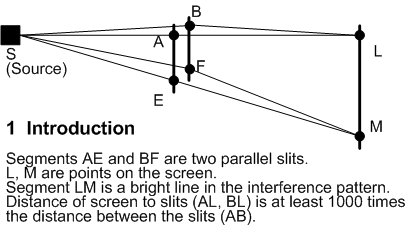
There is an important condition in the double slit experiment that makes calculations in diagrams a lot more tricky. It’s about the distance between the screen and the slits and the separation between the slits. The screen distance must be at least 1000 times the distance between the slits. So clearly, the distances you suggested will not meet this condition.
The reason for the condition is that experimenters found the interference pattern is fuzzy or not there with the screen closer. Unfortunately, once the condition is met the calculations in the diagrams will need to include at least 4 significant figures. If you want to persist, then I’ll keep nitpicking the calculations.
I am very surprised you are criticising something about the double slit experiment that has been looked at in such detail before. Do you still believe the pattern should be circular? If you do, I have now looked it up and I will go through the mathematical description (not my intuitive description) of the lines that applies to both quantum mechanics (qm) and the Theory of Elementary Waves (TEW).
The challenge for RM is that the double slit experiment has to be one of the all-time classic experiments in physics, and anyone evaluating a new theory that covers physics will want to see the explanation for the lines. TEW and qm use the same maths for pattern of the lines, so the acceptance of TEW comes down to the wave direction and the magic markers.
For RM, there needs to be a reason for the maths behind the lines and the spacing of the lines. Both TEW and qm have waves going through the slits (in one direction or the other), but my understanding of RM is that waves through the slits are not the explanation of the experiment. You have given some words on this before, but I not yet understand how RM explains the interference pattern. That explanation will be avidly read when RM is written up. I am convinced this is a make-or-break issue for RM in physics.
And why is that? It has nothing to do with RM. Again, you are making a religion out of what should be a discussion of the logic involved.
I told you to give me a set of distances. I will show you where the problem arises. As I said, I used the 345 triangle merely for its simplicity.
The 1000 times isn’t an issue. It is the column height compared to that distance. As soon as you leave that top plane, you are no longer in phase but will return into phase as you go further (that is what would cause the circle pattern). But that column height would clearly indicate whether QM or TEW was more correct. As the first problem that you ignored would indicate, even with no height to the columns at all and regardless of the 1000 times distance, TEW still has a problem.
RM could have told you that.
Provide any figure you want. That would be better than me wasting my time trying to come up with numbers that mean anything to you.
For TEW, it must be.
No. QM is not based on what you and perhaps Dr Little is thinking. It actually has nothing to do with direction of waves, but rather the probability of being able to measure at given points.
The only “make or break” issue in physics is purely politics. I could be saying that fairies make it happen that way and if the politics was right, then fairies it would be, world over.
The RM explanation requires a reasonable understanding of acoustics and harmonic resonance, besides the normal RM fundamentals (which you will not except merely because they are not TEW - as I said - politics).
It was a little hard for me to accept that Dr Little had misunderstood QM to the point of making the claim that you have been presenting. And after I saw how you seem to misunderstand the things that I say, I began suspecting that perhaps you have misunderstood Dr Little as well (especially because you keep talking about reciprocity).
So if I give Dr Little credit for actually understanding QM and take it that you have merely misunderstood him and then predict what he actually meant from what you have said, not only does he make a lot more sense, but more than that, and perhaps something that he didn’t realize is that he has inadvertently disproven QM entirely. What he has effectively said is that if QM were true, then TEW would also have to be true. And he would be right about that due to the reciprocity issue (a mathematical concern, not a physical concern). And then because TEW would show a different pattern than what is seen, QM cannot be true.
Dr Little is saying that if the wavefunction direction (not a physical wave) is true for one direction, then it must also be true for the reverse direction. That is a mathematical certainty. But I can prove, if Dr Little didn’t see it, that his reverse direction would show a different pattern than what is seen. That means that the non-reversed direction must do the same. Yet it doesn’t. So the QM postulate cannot be true.
To make all of that clearly the case, I need to explain a little to you about QM and the wavefunction. But let’s get this 3D issue straight first.
The following calculates the horizontal and vertical pattern based on a sinusoidal wave either to or from a source with a single wavelength separating the slits and the screen 1000 wavelengths away.
A Gaussian curve is superimposed onto the interference pattern indicating the generally assumed dispersion of waves passing through any slit. That Gaussian curve merely causes the tapering of the otherwise regular pattern that would emerge.
I can plug in any distances combination that you would prefer. You will get basically the same results, with merely a slight variation in column width or intensity.
The upper graph displays the interference pattern that is always talked about. The lower graph indicates that the same equations and principles would show the same basic pattern vertically as horizontally. What that means is that if you can see highs and lows in the horizontal directions at specific widths between columns, then vertically those same widths would have to appear between rows.
I am working on the diagrams that show the mathematical proof that there are lines in the interference pattern, and these agree with both the Theory of Elementary Waves (TEW) and quantum methanics (qm). It’s taking longer than expected. The line C D that has the interference pattern line does have points all share the phase because of the same path difference to the source, even though you are convinced the numbers don’t add up. I will show you why ratio of 1000 to the distance does affect the results.
You didn’t like my intuitive description, and that’s fine. I will show you the maths that was behind that so it will make more sense.
You have raised new issues, such as whether Dr. Little is saying whether qm is true as well or whether he said qm is entirely disproven. I will get to that later.
Before you post anything, check it very closely for incontrovertibly.
Your conclusion will depend upon a specific list of concerns.
Make very certain that I could have no question of the truth of each item on that list.
Make very sure there is no alternative possible given the example.
If there is a length that must be necessarily the same or different than another, ensure that there is no possibility of your statements being wrong.
I believe that invisible links or cords are between all objects and particles and waves.
The fabric moves in a general direction, but has many little smaller sub directions.
There is small reverse processes in the universe, or illogical forces, but the majority follows the “natural laws” anyways.
These can be transcended by the matrix if the matrix is altered.
The matrix is all the cords, which are aethers. Aethers are conductors of potentiality.
Not all of them are the same. But in the density of time space the universe has a certain sort of momentum.
We can change the momentum with like alien super technology and move back in time if we wish,
but that rewrites reality. Reality is a fluid, and it can be rewritten, but it tends towards its base majority, and science is all about the base majority.
We have been debating the lines in the interference pattern for the double slit experiment.
The Theory of Elementary Waves (TEW) and quantum mechanics (qm) use the same mathematics to describe the interference pattern because both theories involve waves going through the slits. For qm, the waves travel from the source through the slits to the screen. In the TEW, the waves travel in the opposite direction from the screen through the slits to the source.
Both theories agree that there are two paths to consider – one through each slit. The difference between the two path lengths determines if there is constructive or destructive interference, and this applies whether the waves travel backwards or forwards.
Let’s remember how phase differences work for waves. If two identical waves are exactly in phase or differ by an integral number of wavelengths, then constructive interference occurs. If they differ by half a wavelength or an odd integer number of half wave lengths, then destructive interference occurs.
There are minute differences in these combinations that still give a result. For example, if one wave is out of phase with the other by 0.999 or 1.001 of a wavelength, then constructive interference still occurs, just with slightly less intensity. Minute differences in phase still produce effects that look the same.
A generalised picture of the double slit experiment is below.
Let’s look at the same scene from the side, so AB seems to be on a line directly toward us, and so is the line EF:
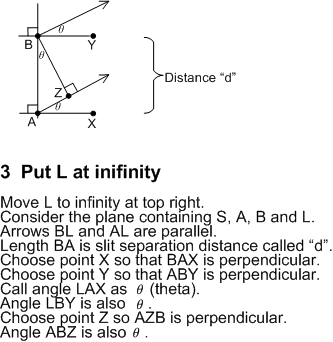
As a thought exercise, let’s put L on the same plane but infinitely to the right. The reason for this will become clearer below. Let’s look down on the plane with S, A, B and L from above:
In this diagram, L is “above” A and B. The results we will look at can adapted to the cases for L being in line with A or B, in between A or B and below A and B.
Notice how the angle ABZ is theta, which is same as ZAX (and LAX). Why?
The angle BAX is a right angle = pi/2 radians. The angle ZAX is theta, so angle ZAB will be pi/2 minus theta.
The triangle AZB is also a right angled triangle, because of the angle AZB. This means that if angle ZAB is pi/2 minus theta, then angle ABZ is theta. This will be useful in a moment.
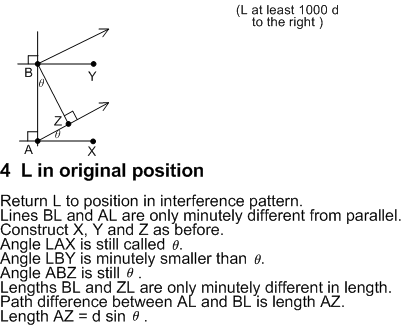
The above diagram is very close to the previous diagram, with the noted differences. What matters is that the distance BL and ZL are so close to equal that the difference will be minute and not affect phasing. One of the factors in deciding whether point L is in the interference pattern is the path difference between AL and BL. That path difference is length AZ = d times sine theta.
The formula comes from AZB being a right angle triangle. The formula is not necessarily a perfect calculation of the path difference AL-BL to an infinite number of decimal places, because of the minute differences noted in the previous paragraph. The formula is accurate enough that the minute errors in the calculation will not be noticed when comparing phases over the two paths.
The accuracy of the formula is dependent on the screen being at least 1000 times distance d away from the slits. This means that the theta angle is of the order of 0.001 radians. Such a small angle justifies the claim that lengths BL and ZL are the same distance for the purposes of comparing phases.
The significance of this formula is that the path difference for point M is the same formula. The diagram for M is the same as the above diagram for L – just change L to M, A to E, and B to F. The angle theta and the distance “d” still apply. Even though M is further from the slits and on a different plane, the path difference is the same.
All points on the segment LM will have the same path difference to the appropriate points in the slits. The minute errors in the calculations will not change the phase comparison in a meaningful way. So if L is a bright spot, so is M. This is what I was referring to in my intuitive summary before, but perhaps it’s not so intuitive to others.
The length of segment LM depends on the lengths of the slits – ideally there is a plane between the point on screen and the source passing through the slits. If line LM is extended beyond where such planes are possible, the brightness of the line fades very quickly to nothing.
Notice that on the other side of the slits, very similar diagrams can be drawn for the path differences between the source and the slits. This means that ideally the source is also at least 1000 times distance d away from the slits. The consistency of the path differences is why we have lines on the interference pattern.
The usefulness of the d sine theta formula has been verified in experiments. If the wavelength is taken into account, the number and spacing of bright lines can be accurately predicted.
So the d sign theta formula is great success for both TEW and qm. Both theories have the same huge weight of evidence on their side. Most people support qm because they have never considered the possibility of the wave going in the opposite direction.
All this presents a huge problem for Rational Metaphysics (RM). On September 22, your post included this diagram:
You wrote:
Then on September 30, you wrote:
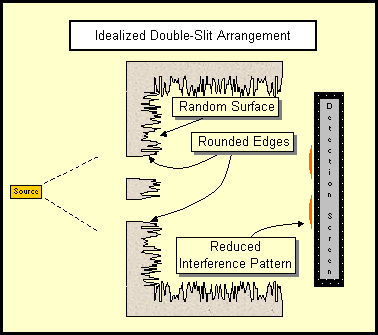
So RM claims that an interference pattern for particles is affected by the shape of the inner surfaces. How can the shape of the inner surface matter, when the results are predicted by a formula purely for path lengths of waves through the slits? What would happen if there is no inner surface other than the screen and the barrier for the slits – does resonance occur then and what is the result for the interference pattern? What’s the mechanism in RM for all this happening? You dubbed the elementary wave markers as “magic markers” – I claim RM needs “magic resonance” to create the results of the double slit experiment.
By criticising TEW for not explaining the lines on the interference pattern, you have actually touched on a strength of TEW and highlighted how RM has no obvious mechanism for the lines other than the phrase “acoustics and harmonic resonance”. RM has lot of explaining to do in this experiment to generate the same formula for the lines on the interference pattern.
I’m starting to work through your kind explanations (rational mechanics for dummies). I’m not being deliberately argumentative, honestly, but I don’t understand why the adjacent “potentials”, whatever the heck they are, cannot be infinitely identical. Again, I still see a backward deduction from affect or effect, but can you point to any area in space, as you could with a book on a table, and say, BEFORE actualization, there be x potential, in a predictive fashion?
Oh, on the 2-slit experiment, which is above my knowledge of physics and math, I would ask one general question: are you guys working with an experiment in which enough controls remain unchanged so that all possibilities of hidden variables skewing the results, when controls are changed, have been reasonably eliminated?
On to your next post on potential. I know I seem dense, but I promise that I’m not being deliberately argumentative. No one desires understanding more than I, but I am limited by concrete thinking; I have to be able to visualize a concrete example of the abstractions. (Can you imagine how well I do with square roots of negative numbers? Not so hot.)
So if everything in the universe was in perfect balance infinitely, nothing could change, and there would be no movement? But since everything known is in constant movement, nothing can be in perfect balance, and the universe is in constant flux because everything is in constant movement? Is that what you are saying?
Eugene, that “intuitive summery” is your error. The “minute differences” is exactly what the entire issue is about and is what causes all of the interference pattern displayed, regardless of who is right about why.
I had asked for specific numbers so that I could show you what comes of any number you chose. Rather than a specific number, you chose infinity. It is only at infinity that there will be no pattern indicated. This would be an opportune moment for me to accuse you of what you accused me, of choosing your numbers merely to “snow-job” the viewers. I also asked that before you post, you ensure that whatever you proposed could not be reasonably questioned, “incontrovertible”. A proposal concerning merely an infinite distance, does not apply. The intuitive notion that the difference between 1000 and infinity is insignificant is… well… infinity incorrect.
The real issue isn’t one of the distance involved, but rather the fact that any vertical pattern will be nearly identical to any horizontal pattern. The table and graphs that I showed proves this mathematically with given example numbers starting with 1000 as a distance.
Given 2000 as a distance, you get this;
And given 10,000 as a distance, you get this;
At an infinite distance, you merely get a Gaussian bell curve with no interference pattern at all in either the horizontal or vertical.
You seem to be missing the fact that vertically angled line distances are NOT the same difference as the horizontal line differences. Once any triangle is angled downward, the difference between the two sides changes in percentage unless it is a symmetric isosceles triangle centered between the two slits. At every other column location, the vertical angle necessarily alters the phase difference between the two legs. You have to do the little bit of math that it takes to verify that fact. It is merely squares and square roots, nothing you can’t handle.
Again, given ANY non-isosceles triangle, once you depart from the horizontal, the amount of difference between the legs begins to change. That amount of difference is what determines the phasing and interference pattern.
You are arguing with the mathematics, not RM, JSSRM, or me.
Because everyone has been presuming that the particles follow a straight path. They don’t.
The resonance that absolutely must exist between any surfaces, is proposed as the cause of the path deviation necessary to cause the resultant “interference” type of pattern. In other words, JSSRM is claiming that a particle is NOT a wave other than merely a rising clump of noise and that it does NOT divide into two parts going around the slit blockage and magically reforming on the other said as QM requires. But neither does a particle choose to follow a magic marker coded wave being emitted by screen particles as TEW requires.
The only thing close to any magic involved in RM is the notion that the affectance resonance between the surfaces could build sufficiently to deviate the path of an electron sufficiently to cause the pattern seen. And frankly, I admit that it was hard for me to accept that such resonance would build to that degree. But in considering that harmonic resonance waves in merely air can tear down a steel bridge (and often has), that the degree of variation in path is minuscule, the pattern of resonance within the double slit chamber will necessarily yield the exact pattern indicated with or without any particles involved, and particles merely migrate based entirely upon the variation in surrounding affectance, it all seems a little more reasonable that in fact, the particles are really getting maneuvered into specific locations that will certainly be columnar.
My first estimation of the pattern assumed that there was only a screen and a slit wall. That is all it takes. Further walls, or irregular walls wouldn’t change the results much unless all walls were intentionally random surfaces. That is the only thing that can prevent a resonance from occurring.
The resonance is being instigated by merely the electron orbitals in the surface materials. As each electron orbits, it creates a minuscule affectance wave that proceeds across to an opposing surface. That surface is affected to a very, very slight degree affecting the orbit of the electrons encountered. Those electrons then reciprocate causing a slightly larger affectance wave to return back to the initial electrons. Because that wave is slightly larger that the original, the initial electron deviates its orbit slightly more than before, instigating an even larger affectance wave than the original. That process continues across the volume between the screen and the slit wall (or any other set of walls). That is basically how all harmonic resonation works. The same effect will occur regardless of the direction of the resonance. And the frequency of the resonance will depend upon the electron orbitals, not the wall distances. Thus you would get the same pattern for any wall arrangement that wasn’t random.
Actually, that is exactly what we are talking about, the hidden variables. Eugene opened this thread (to whom I give thanks) by announcing a theory by Dr Little concerning the “Theory of Elemental Waves”, TEW. I examined Eugene’s presentation of the theory and found a few concerns, one of which we now call the need for “magic markers” to be embedded in these elemental waves in order for them to be able to do as professed.
But in addition, we are now discussing a more direct concern involved in both TEW as well as QM, which is the fact that the pattern that is obtained by the experiment is not actually predicted by either theory. That is what all of those graphs and tables are about.
But earlier in the discussion, I had mentioned that I have my own theory (of everything) and it involves extremely minute events. As such, for my theory to predict the pattern indicated, I would have to know a great many of the variables involved in each exact setup for the experiment. “Hidden variables” was my very first comment.
But in further examination, I realized that there is something that RM predicts (and is irrefutable) that could not only give explanation to the pattern, but also gets around the mathematical problem that both TEW and QM seems to have. When there is something related to RM, but something that I have not entirely modeled and empirically proven, we call it, “JSSRM”, meaning my own speculation extending beyond what has been proven. My explanation of the double-slit experiment is merely JSSRM, a hypothesis, not a proven fact.
My hypothesis involved a resonance wave of “affectance” (similar to a very small gravity wave) that necessarily exists within the space between the slits and the detection screen. It is my theory that such a harmonic resonance would be sufficient to cause the pattern indicated, but I would require a much, much larger computer to actually model and prove the theory. So I proposed a fairly simple alteration to the experiment that would either prove or disprove my hypothesis involving randomized inner surfaces of the walls and screens.
If my hypothesis is correct, the experiment would be able to distinguish particle behavior from wave behavior, which is the entire issue. Given the randomized surfaces, the particles will no longer yield an interference pattern, but waves will. The problem of course, would be getting anyone to actually bother doing an experiment when they have no reason or understanding of RM such as to believe that such random surfaces would have any affect at all. To them, if the experiment actually did cause a change, it would be pure 100% magic.
Don’t worry, I never assume guilt until strongly indicated, although at times, I do fall into the common trap of assuming a degree of understanding that wasn’t there. So I am used to backing up to some agreeable point, and taking the explanations from there, “no harm, no foul”.
Actually nothing would exist.
Existence requires affect of some kind, some kind of changing taking place. Change in locations or centers, is merely one of the many types of changes that could be expected and actually could never be avoided. In essence, you can’t have a “thing” unless that thing is affecting something and thus changing it. And you can’t have that other something unless it is affecting the first and thus changing it as well. If there is no changing at all taking place, neither proposed item exists in the physical sense. Physicality stems only from affecting/changing. And any affecting/changing defines physicality. But that is a conclusion, not an axiom. The prime axiom involved is the definition of existence that requires that for anything to be said to exist, it must have affect (which, being an action, requires time to take place, hence “changing”).
Almost, but there is a significant difference.
It is true that because things are moving, they cannot ever stop moving each other. But that isn’t my point. My point is that it is mathematically impossible to arrange influences (affects) in such a way that they are so perfectly balanced that movement would not instantly begin as soon as they were released.
An interesting effort has been around for thousands of years, at least since Aristotle involving the attempt to “pack space” with tetrahedrons. The issue keeps coming up because people keep attempting to explain the universe in terms of quantized forms of one type or another, hence Quantum Mechanics. In that effort, they have never been able to pack space with tetrahedrons beyond about 87.xxx%, despite having computers run through countless arrangements and mathematics. I could have told them that it would never actually work, but they didn’t send me the memo regarding the effort.
That effort represents the effort to create a totally balanced system of points (the vertices of the tetrahedrons) such that if, for example, each point was an electron, the repulsion from all of the other electrons would be perfectly balanced and no movement would occur.
If you were to take merely 2 electrons (representing identical points of affect upon each other) locked into a closed system or vessel of some kind, you could arrange them along a straight line and they would not move once released. You could do it with 3 in the form of an equilateral triangle, or 4 in a tetrahedron, but once you get to 5 and above, is begins to get geometrically and exponentially more difficult. I don’t even know if there is anything above merely 19 that actually works.
The situation is that you do not merely have 19 or even 10,000 points within a given small volume, but rather an infinite number. The quantum theories try to say that infinity doesn’t exist, thus there are really only a finite number of points within any given space. But seriously if there is even more than 19 identical points of affect or influence upon each other, there WILL be imbalance and thus change and movement.
Now all of that is presupposing that there is affect or influence already in existence, which there is. But the challenge is to uncover why there is already affect there, not why it would be changing IF it were already there. And that is where RM comes in.
The “potential to affect”, PtA, merely means the ability to affect. A potential is an ability that is due to the situation of the environment. A potential is not a “thing” or a substance. It is an opportunity to cause affect upon something. Such opportunities are typically measured merely by slightly opening up an otherwise closed door. A voltmeter measures the opportunity for electrons to flow to another location if they were given a path with which to do so. From that measurement, it is said that “they have electric potential” - “voltage” (being an instigator of volatility).
But for a “potential to affect” to exist, there must be some other different potential to be affected. Electric potential, for example, is measured as the difference between two “potentials”. Neither is said to have potential except in comparison to another. Thus there can be no potential to cause anything unless there is a difference in potential somewhere. Total homogeneity would result in absolutely no changing, no universe, nothing at all.
But what would it take to establish total homogeneity if you tried? Even if you were a god with the ability to stop all movement until you were ready, there would be no means to cause total, infinite homogeneity. Why not? Because of that very issue of trying to fill space with any arrangement of identical anything, even if that “anything” was nothingness itself.
Nothingness represents a potential of zero. So if you could place an infinite number of zero potentials equally spaced throughout all space, you would have your homogeneous state of pure nothingness. But you can no more place and infinite number of zero potentials into a volume than you can any other number. Regardless of the value of those electrons, given any more than 19 of them, there is no volume that would allow them to equally affect each other. Reduce their affect to nearly zero, and you change nothing of the situation. The size of the affect is not the problem, it is the situation of having an infinite number of identical entities within a volume. Even at the potential of zero, they would not be balanced, and thus couldn’t really be at zero.
Merely the probability as explained before forbids the notion of infinite similarities within any volume given no reasoning for influence to exist nor for it to not exist (and thus equal chances). Thus there must be differences in the ability to affect, the “potential” or “opportunity to affect”, simply because you have 100% probability from the only choices available; some affect of some degree or no affect at all at each point. Add to that, that you have an infinite number of those points, each already with nearly 100% probability of affect, and you have seriously multiplied the probability even closer to exactly 100%. But then add additional to that, the fact that even with identically zero potential for each point, there could be no balance of potential merely because of the geometry involved.
The end result is merely that it is mathematically, geometrically, and logically impossible for the state of absolute nothingness to ever occur even if it was intentionally attempted. In reality, even God could not have formed a universe of pure nothingness.
The following is from back on page 14 of this thread;
James said: “The end result is merely that it is mathematically, geometrically, and logically impossible for the state of absolute nothingness to ever occur even if it was intentionally attempted. In reality, even God could not have formed a universe of pure nothingness.”
Of course God cannot create a universe of pure nothingness as that would necessarily require that even God did not exist. This is actually better than the big rock argument about omnipotence. Can God create a universe (multiverse? reality?) in which nothing, not even God, exists? And on further consideration, perhaps creating such a universe (if it is not a multiverse or reality itself) is something even I can do. Poof! There it is. Either way, thanks for the fun thought, James. By the way, I do agree with you that absolute nothingness, the condition of non-existence, “is mathematically, geometrically, and logically impossible.”



 … something has occurred to me.