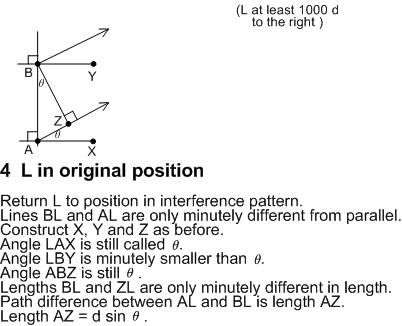
You don’t seem to understand what the formula for the path difference (d times sine theta) proves. The interference lines (and gaps) are fully explained by the formula, so the path difference is accurately enough calculated. The “minute differences” are proven not be a factor - that’s why the formula is verified in experiments. You have claimed the minute differences matter, when the experiments show they don’t.
The derivation of the formula shows why point M has the same path difference as point L, even though M is further away from the slits. You seem to be stuck on the idea that if M is further away it must have a larger path difference. You need to see that AZ is the path difference and it applies to both L and M and all points in that segment.
The formula for AZ is taught to all physics students and appears in physics textbooks. An example is the textbook “Physics” by Douglas Giancoli, sixth edition, 2005, Published by Pearson Education Inc., New Jersey, USA, ISBN 0-13-060620-0. See page 669 for a very similar diagram to my number “3” diagram, and the formula d sine theta. By challenging this formula you are ignoring how accurate and well established the results are, and how universally it is taught. You will have a very difficult job to prove somehow the formula is wrong in the context it is used.
I realise you need a lot of time to work out how the magic resonance will work. You are proposing that waves of affectance are exchanged between the electrons orbiting in the walls of the slit barrier and the walls of the screen. Good luck - it will be a challenge to show why that results in particles coming through the slits being guided by a formula that describes path differences for waves through the slits. How side walls affect this will be a further dimension of challenge.
Samm, melonkali,
It’s great that you are asking questions of James. If you accept his ideas, he may say a bit more about his theory Rational Metaphysics (RM). He’s been keeping a lot of it to himself, and just making claims about how good it is. You guys might get him to reveal a bit more.
Samm and I are goin’ at it again on this imaginary potential concept
For me, it is this simple. I understand that a book sitting on a table has the potential to go splat. I understand if there are flammable gasses or radiation floating around, whether or not I can see them, they have potential to do particular things. What I don’t get is pointing at any old blank spot where we know nothing specific to be there and saying, “look, there is potential.” “Potential what?” “Don’t know, but since it exists, it has potential” “What exists?” “Potential” ARRRGGGHH!!
Well believe it or not, I well understand from where you are coming. And the jump from that point, to the point where you can"see" that total homogeneity is impossible, is a little difficult to get over. So let’s take it one tiny step at a time. There are multiple arguments to support the idea, so if one doesn’t connect the dots for you, we can try another.
First question;
Can you understand that in a state of true absolute nothingness, not only is there nothing to cause an event, but also there is nothing to prevent one?
Intuitively, we expect that if there is no cause, then there can be no action. But we are born into an environment where everything around us has inertia, the ability to resist change. But what if that ability didn’t exist either? With absolutely no reason required for something to change in order that it did change, would it change? There is nothing to prevent it. It has no reason to stay the same and it also has no reason to change.
Do you understand the equality involved and agree to that reasoning so far?
James, I have long argued that true Nothingness–that is, non-existence, actually–can possess no properties of any kind, not even identity or location. It cannot therefore possess any causal attributes or any quality by which it might explain the being or becoming of any thing. You agree with what I am explaining here about Nothingness. And you go one step further, by realizing that inertia, the property that prevents change, also cannot exist in true Nothingness. So it seems that Nothingness cannot cause an event–such as the materialization or origin of some thing–but neither does it prohibit or preclude such an event from occurring in the manner that inertia would typically prohibit the occurrence of the event in the universe. In the universe then, no event may occur without a cause. In Nothingness, where there is not and cannot be any force of inertia, the corollary is true, that any event may occur without cause, and in fact, only without cause. Rebecca and I have carefully discussed your post and we have jointly concluded that this is what you are saying.
If there is a condition in which absolutely nothing exists, including no objects in space, no events in time, no space or time themselves, and none of the laws and forces that work in the universe to bring about such things, then none of the laws and forces that preclude events from occurring without cause or explanation in the universe can exist in this absolute non-existence. It is entirely possible in such a condition that an initial event may occur without cause by which event the space-time universe may come into being from true absolute Nothingness.
It may be said then that Nothingness, although devoid of all properties and causal efficacy, still exhibits the (“negative”?) potentiality by which it accounts for the derivation of something from nothing.
Well, that’s great because frankly, I was sweating how on Earth I could explain the truth of that situation in any other way if you guys couldn’t agree on that. So from that point, the reasoning can branch in either of two ways (at least).
As long as the situation is nothingness, then you have a 50/50 chance for something to occur rather than continued nothingness. But once something does occur, the situation has changed. You no longer have mere nothingness and thus your reasoning must adapt to the new situation. It is typically intuitive that once you have something, it does require a reason for that something to become nothingness again.
So going toward having something, you don’t have to have a reason for something to come from the nothingness. But going toward having nothing, you do have to have a cause for the something to become nothingness. So once you have something, it is like having dandruff, you are stuck with it until you do something about it. But then, why is that? That is the second branch of reasoning involved.
The only thing that is required in order to have something is mere distinction from nothingness. But how much distinction? Distinction has inherent degree. And no matter how small a distinction is, there must always be an infinite number of degrees between it and absolute nothingness. You can’t have a number without an infinite number of other numbers between it and absolute zero. Or you could say that no matter how small something is, you can always divide it in half and get something smaller. But with nothingness, you can’t divide it to make it anything other than what it already is.
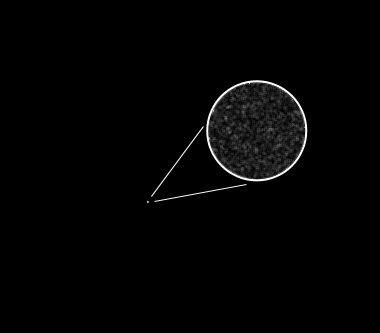
So that leads us to the situation in that pic;
So merely from the probability stand point, you have a 99.999…% probability of having anything other than absolute nothingness merely because of the degrees inherent in any somethingness state. Which degree did you get? But there is an additional concern involved.
Existence is defined by the property of having affect. If something is proposed to have absolutely no affect upon anything, we say that it does not exist. If something is proposed to have affect upon something else, then to that something else, the something exists. Existence Meaningfully defined.
Note that having affect means causing change. It is an action requiring a duration. If an affect were to be truly instantaneous, there would be no distinction between the affecter and the affected and thus no affecting going on at all. There would merely be an apparent effect void of affecting. Thus what we call existence would only be there for zero time. But we call any affect that took only zero time is “not existing” as well anything not affecting at all, because there is no time between the proposed two states.
So if something were perhaps being affected such as to get bigger, it would have to go through an infinite number of changes in order to go from any small size up to any larger size. And the opposite is true as well. If something is going from being small down to being nothingness, it also must go through an infinite number of changes to get there. If it skips those steps, the change would be instantaneous and thus would not be “affecting” and would not exist.
So what this is saying is that time (the measure of relative change) is required once you have anything in order for that anything to become anything else, including becoming nothing.
But remember that I said to have something, there must be distinction. That means that there must be two states minimum. For example we could have the two states of;
A) nothingness at one point and
B) something at another point
But with every one of the infinite number of steps required for the something to become nothing, the nothingness has a 50% chance of becoming something for no reason at all. That is 50% raised to the infinite power for the probability of nothingness to remain nothingness while the something was becoming nothing. And it only takes one out of those infinite number of opportunities for the state of nothingness to no longer be that state and then require an infinite number of steps for it to return to nothingness.
All of that is assuming that the nothingness had no reason to change. But also remember that in order for something to be said to exist, it must be affecting. So if you had only the points A and B, point B (the something) must be the cause of point A to be changing, else it couldn’t be what we call “existing”. And also point A, the nothingness, must be the affecter of point B becoming smaller. The distinction between the points must be reducing, else the distinction can’t be said to exist. But why reducing instead of growing? That is merely a question of epistemology.
The something, point B, had the affect of causing the nothing, point A to gradually become something. Thus point A is still smaller than point B compared to the state of nothingness, zero. But when we said that point B had a degree of affect, we were naming it in accord with how much affect it was capable of imbuing. So as point B affects point A, it loses the ability to have such affect, else the degree that it had must have been higher than we said. If it isn’t losing its “potential to have affect”, then it actually had an infinite degree of affect because it would never stop affecting no matter how much affect it imbued.
So the situation becomes one of one thing raising the ability of another (the “potential-to-affect”, PtA) while the other is lowering the first. They are equally affecting, but in opposite direction. We call that positive and negative affect. Thus as soon as anything is not nothingness, there is both “positive” (raising of potential) and “negative” (lowering of potential) affect of equal magnitude and both above zero affect. And that is exactly what electric charge potentials are and nothing else. Positive and negative are merely the direction of the affecting, either increasing or decreasing, but never going below zero. Zero affect is defined as non-existent. There can never be less than zero affect.
A) is that book using that angle θ to refer to a vertical angle in the experiment?
B) is that book talking about particle distribution at that moment rather than wave?
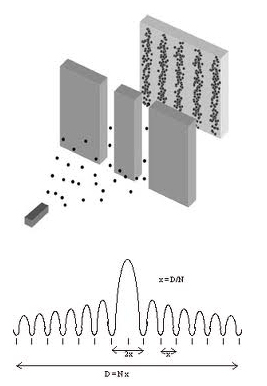
This is the picture of the experiment that I am talking about;
James, forgive me for not YET finishing your post at the bottom of page 25. It truly is amazing isn’t it how voluminous our writings can become when we are trying to communicate something we consider essential and exciting?! I’ll finish it shortly, but the notion of Nothingness within Somethingness, that is, a non-existence in relation to an existence–well, it’s a show stopper for me. But first…
It seems to me that your concept of Nothingness reveals a flaw in our understanding. We agree that true Nothingness can have NO properties of any kind because there is no object to possess those properties. Therefore, Nothingness can have no causal efficacy. But you have explained how even the total absence of all properties can produce causal efficacy. The absence of inertia permits existence to occur without cause, but this condition is itself causal in nature, passively causal. Something may suddenly begin to exist without cause, but again…only if some hidden potentiality is expressed in the doing so. Without this hidden potentiality manifesting opportunistically in the condition in which inertia is absent, Nothingness would simply remain forever Nothingness.
Therefore, what for all the world appears to be Nothingness Absolute,is yet something. It is unmanifest being, hidden being, potential being. Existence cannot NOT BE; it is either manifest and active or it is subdued and hidden. I call the latter condition “the Ground-State of Being” and think it to be Something hidden in Nothingness clothing.
Nothingness, with its absence of inertia, only permits the possibility that something may pop into existence; that is, it is a passive causal state where something CAN occur but it is not required to occur. Were this condition to be absent of an innate potentiality for manifesting existence, nothing would ever occur. Something does occur because Nothingness hides a boundless well-spring of potentiality, which the absence of inertia allows to manifest without cause.
You see, existence is independent of space-time; therefore it is Boolean in nature…either it is or it isn’t. If it is, it can’t cease to be and if it isn’t, it can’t become.
When we speak of Nothingness and Existence, we are actually speaking of Unmanifest and Manifest states of Existence. The Manifest state of Existence is actually Experience (which after all is what manifest means–Affective Existence.
James, your philosophical vision is very close to mine I believe. I had never considered the absence of inertia in Nothingness, and I consider that a wonderful insight. And I speak of Experience where you speak of Affect, but I believe we’re talking about roughly the same thing. I define Experience as:
“That interactive process in which That-which-Experiences responds to the stimulus of That-which-is-Experienced.”
I’m recognizing that Affect is also an interactive relationship between existing things. I have focused on consciousness as that-which-experiences and you have approached it from the more active Affect as that-which-is-experienced. The duality is mandatory for experience to occur and it derives immediately from the unity (that-which-is) of existence. Experience is the manifest state of being, of existence. I think we are close in this area and hope you will find that you can agree with much of this, although choices of terms differ and create some superficial confusion.
The angle theta is in the plane that contains the slits and the point on the screen. From the point of view of a frame of reference x,y,z the angle theta would potentially have components of all three. In the plane it is described, it is just a normal two dimensional angle.
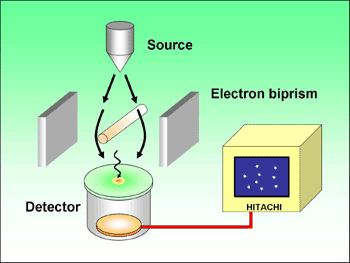
The d sine theta formula is talking about the difference in path lengths of the waves traveling between the slits and the point on the screen. Theories vary a bit on what the particle does. For the Theory of Elementary Waves (TEW) the particle goes through only one slit and travels along one path to the point on the screen (for relevant screen points).
You asked before about Dr. Little’s and TEW claims about quantum mechanics (qm). Dr. Little says that the mathematics of qm works (it’s already proven to be accurate in experiments) - it’s the explanations of qm that make no sense and disprove themselves. Dr. Little claims there is no evidence for things backwards in time, multiple universes and other such ideas, and I totally agree. TEW simply reverses the wave direction, and that means that we use the same maths and have the same predictive success, but none of the quantum weirdness is needed. So Dr. Little focuses on the explanations of qm.
Looks like you have found at least one philosophical friend - that’s great.
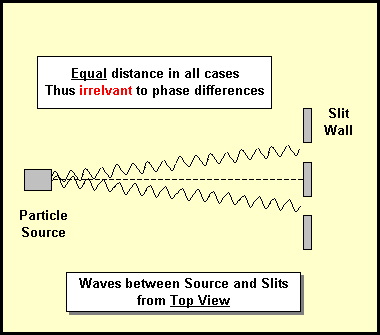
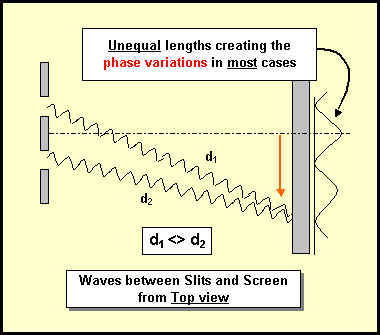
The following represent the views of the experiment that are relevant to the phasing concerns in the horizontal plane.
This first pic shows and displays that the particles or waves that travel to the slits from the screen, travel the same distance in all cases and thus maintain the same phase relationship. That distance is irrelevant because the source is always centered between the slits.
In this next pic, the waves head in a spread of directions. But in almost all cases, the path lengths are not equal and thus phasing becomes an issue. At any point on the screen, if the lengths have become exact multiples of one wavelength in their different lengths, the phasing is back in sync.
When the phasing is back in sync at the screen, is when a bright spot appears.
Do you understand and agree so far with what I am saying with these pics and the experiment?
Yes choices in terms is expected to be a temporary issue. My mind tends to go blank when people start talking about consciousness and experience because I think of those in such different terms than most people. In my own epistemology, I chose the word “Affect” for a variety of reasons which have all turned out to be positive. The philosophical foundation based upon affect yields a true unified field theory involving “Affectance” as the fundamental “field”, similar to a gravity or charge field. The mathematics gets intense, but it all works together to display exactly why particles form and do all that they do. But in addition, because of the rudimentary concept of “affect”, that same theory holds to be true concerning absolutely anything that exists. Thus the rules of the game are the same no matter what the field of study. That yields a “ToE” or a “Theory of Everything”, that can be philosophically, logically, and mathematically proven to be necessarily true.
I went to the trouble of creating a program on my PC to actually use only the basic rules involved and let the logic take it from there to see what a proposed empty volume of space would become if left alone. I was quite pleased to find that particles formed with positive, neutral, or negative characteristics and attracted or repelled each other exactly as Science has noted. It goes far beyond merely that. But that was my first goal and achievement with the project. The combination of understanding the logic involved as well as seeing that it all results in an exact duplicate, “metaspace” of subatomic behavior, in every detail even beyond what Science has reported, is sufficient to proclaim that it is no longer merely theory, but certain law of reality. The issue so far is merely that only I have seen the program at work and understand what it is doing. So only I can see and claim that it is anything other than “just another theory”.
But now back to our “Nothingness” discussion.
Someone can make the statement, “This statement is false.”
Applying logic to the truth value of the statement gets you nowhere because if it is true, then it must be false and if it is false, then it must be true. The statement is an “irrational statement”. Logic doesn’t apply to irrational statements, but the statement can still be made.
My point that I have been trying to ease into is that the very concept of Nothingness, is an “irrational concept” and for the same reasons. It is really not any different than the concept of a square circle. When trying to apply logic to the concept of absolute nothingness, no matter which way you apply reasoning, you get a result that denies that there was nothingness there in the first place. Reasoning doesn’t apply to the concept. If it was nothingness then it, as a “situation” or “potential”, will cause affect. But that means that it wasn’t really nothingness. And if it has no such potential then it can’t exist as a situation.
I forgot now what name they give it, but there is a formal name in logic for syllogisms that prove that their own premises can’t be correct. That is my intent. But any proof depends upon the proof-reader and what they currently understand as true.
So where I am trying to head to as the bottom line is merely that the very concept of absolute nothingness, even though it can be imagined as a black void, is an irrational concept exactly like that irrational statement even though the statement can be made.
I think so. I imagined myself holding a balloon at point X, sticking it with a pin, and watching my balloon deflate as the air in it went over to point Y. Close enough? rebecca
That is probably true. I imagine a barrel with a small hole in the top and the bottom, turning it upside down, the air comes in the bottom and the water goes out the top. Get it?
Actually I hope you didn’t because that was my way of expressing that I have absolutely no idea of what you were just referring.
You quoted Samm, so maybe he knows to what you were referring. But you “think so” to what? The balloon represents what? “Close enough” to what?
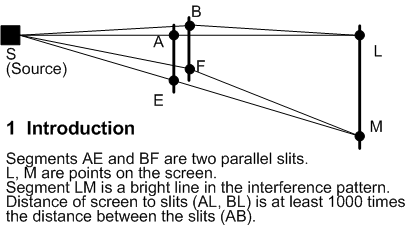
You are pointing out that when the distance to the screen is only a few times the distance between the slits, there is a clear difference in path length of points on a line like LM. That’s true.
What we disagree on is what happens when the screen is at least 1000 times further than the distance between the slits. You imply the path difference will still be different for L and M, whereas I say that L and M will have the same path difference at the new screen distance.
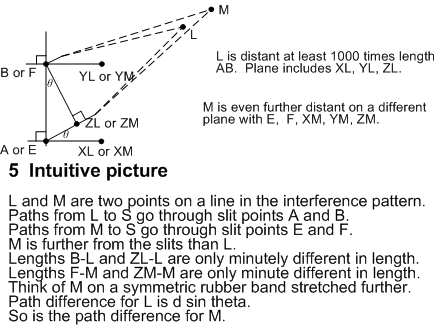
My intuition is below:
The fact that M is further away from the slits is not a problem - that part of the journey is symmetric. It’s the angle theta that creates the path difference which is calculated by d sine theta.
The geometry changes for a screen very far distant. That’s why the double slit experiment doesn’t show interference patterns when the screen is up close, but does so when the screen is further back.
The pics that I showed display why there is a pattern at all. No one has argued with that since day one, whether QM or any other theory. I seriously doubt that Dr Little would argue with that either. So exactly what is it that you believe is causing the pattern? Please give the details because you are denying the very most basic principle involved that everyone else has agreed upon.
Everyone uses the same basic concept that you are now denying;
Adjusting my variables so that my horizontal graph exactly matches the common display (merely an issue of the amount of wave spread), we get this;
But of course, the vertical still shows that a vertical pattern must be there also.
I have no argument with anyone (but you it seems) concerning the horizontal pattern.
But if you are even going to deny what everyone else says, including Dr Little, there isn’t much point in me trying to explain that vertical issue.
Yeah, James. She was only trying to make sense out of your post about something becoming nothing again (or becoming something else bigger or smaller), and how there is this infinity of imaginary Zeno infinities in every infinitesimal measure of size or distance, and finally how energy is acquired or lost as something becomes something else. The balloon was her humorous little analogy for that change in energy you seemed to be talking about, blowing up and deflating and blowing up again. Sorry you didn’t get it. You know, Zeno doesn’t work for you. You say that affect takes (definite, measurable) time, and any measurable time will only go into another definite time duration a definite number of times, no matter how many infinities of singularities we may imagine there to be. There is an infinity within any distance of twelve and another within any distance of two, but two will still go into twelve exactly six times.
What had me confused is that she had quoted you before that comment, not me. So I didn’t know what to make of it.
I’m not sure what you were trying to say with that. I have no issues with the Zeno paradox. If pressed, I can use the cardinalities of infinity to show how and why Zeno isn’t a concern (nor a paradoxical situation).
But if we are past the issue of why there is something rather than nothing, I can get into exactly what the something is in the RM ontology.
What that pictorial is trying to represent is that on an extremely small scale, there is distinction between very small areas of affecting, some being greater than others. They cannot be infinitely identical merely due to the definition of infinity plus the fact that they must be affecting merely to exist and thus cannot be equal.
In that pic, I was trying to display the fact that no matter how small you get even after you could see the variations in affecting, there would still be more, smaller variation within those variations and that situation could not change no matter how small you kept getting.
Just pulling your leg. Sorry about the confusion in making my last post. So, the bottom line is, did you or did you not endorse my deflating balloon analogy? Are we together that far?
As for infinitely smaller sizes/degrees/amounts, I suspect that we are not going to run into a smallest possible size for “whatever the hell potential is”, are we?
It sounds like you are heading for Zeno’s paradox again, and you claim a way to rectify that. If it’s not smallest possible size, and is, instead, infinitely small points on a continuum? a continuum of what? “potential”? “something” undefined? Will you be employing the same solution for Zeno’s P as in the Calculus for Humanities Majors course that I once took – essentially dividing the “paradox” into a two-step solution? Or are you going to propose something “really bizarre”?
Perhaps this is the point where I should remind you that it was YOU who asked us to be hard on you and to ask the difficult questions. I’m throwing in the annoying sarcasm for free – nothing personal, just the way I’m wired. Sometimes I’m best able to explain my understanding of complex issues in a frank, simple, acrid bit of rhetorical exaggeration. rebecca
Actually, I have never had trouble explaining away Zeno, but I don’t know that I could do it using balloons. Although I don’t see Zeno coming into this picture. Where do you see the patter of his lil feet?
In your analogy, I imagined a balloon deflating and all of the air rushing out in its mad attempt to fill all space. Where was point Y? And what exactly was it to be an analogy of?
We are talking about the vertical issue. Let’s see if we can agree on what that issue is.
Let’s go back to my first diagram.
You are arguing that L and M have the same horizontal distance from the slits (top view) so that would agree with L and M having the same phase relationship. In the vertical direction, you are arguing that since L and M have a different distance from the slits, then they will have a different phase relationship, and so the interference pattern should not have a solid line between L and M - as M moves up and down the line there should be gaps as the points go in and out of phase.
What I am arguing is that the vertical problem is strong when L and M are very close the the slits, but once you get at least 1000 times the slit separation away, the vertical effect attenuates, and the angle theta becomes more dominant.
Think of the vertical effect as still being there but getting so small it doesn’t matter. You can see that with the vertical angle - if L is just distance 5 from the slits and M is distance 1 below L, then the vertical angle for M is a certain amount. If L is 1000 away from the slits and M is still 1 below L, the vertical angle to M is far smaller. So a certain vertical separation of L and M matters less the further away we get.
In comparison, the angle theta is still the same for L and M no matter what distance we are from the slits, so the effect of theta has not changed. So the effect of theta eventually wins out - the vertical issue fades away (for the same vertical separation between L and M). That’s why this diagram describes the phase relationship for both L and M further out:






 Just pulling your leg. Sorry about the confusion in making my last post. So, the bottom line is, did you or did you not endorse my deflating balloon analogy? Are we together that far?
 – nothing personal, just the way I’m wired. Sometimes I’m best able to explain my understanding of complex issues in a frank, simple, acrid bit of rhetorical exaggeration. rebecca