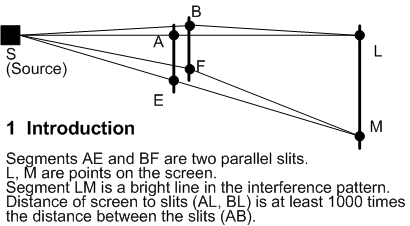
No no. That is not what I am arguing. I am saying that the DIFFERENCE in AL and BL is different than the DIFFERENCE between EM and FM. Obviously AL is shorter than EM except from a top view, which disregards the entire vertical concern.
It is that difference in the DIFFERENCES that causes the phasing.
Their distance from the slits isn’t an issue. The issue is entirely one of the DIFFERENCE between each leg for both cases, AL and BL vs EM and FM. Because those DIFFERENCES will be different in each case, the phase that results from each, L and M, will be different from each other.
That part is mathematically correct as shown in the graph. But it is due only to the fact that the 2 legs that reach to point M change in how much they are DIFFERENT from each other than they were when M was up at L. In the graph and table, those legs are b’ and c’.
Note that the pattern only appears where the waves overlap. The distance to the screen must be long enough to allow such overlapping.
Closeness to the slits isn’t the issue. That closeness is only brought up because if you get too close, the spread of the waves will not overlap each other. As long as the screen is far enough back, that 1:1000 issue, the wave spreads will overlap enough to display the effect.
My concern is beyond that concern. Assuming that you have the effect, which means that you ARE far enough back, whatever pattern you see in the horizontal direction, you will also see in the vertical direction FOR PARTICLES. This issue doesn’t arise for laser waves because they do no spread vertically.
Something that I wanted to emphasize is that the concept that we call “inertia” does not merely apply in the way commonly used in physics. In physics it means somethings ability to maintain its relative location, or its relative motion, then called “momentum”. But in the more philosophical and abstract sense, it merely means the ability to maintain a property, of any kind, against entropy.
The proposed state of absolute nothingness proposes a state wherein no properties exist. But what that would mean is that there could be no property of being able to maintain that state, “inertia” of the state. Thus even if the state came into being, it couldn’t last for even the shortest moment of time because it has no inertia property. And if it had that property of inertia, then it wouldn’t be nothingness. If a state cannot exist for any length of time, then it has no affect and doesn’t exist even as a state.
Let’s see if we can agree where we disagree. You wrote:
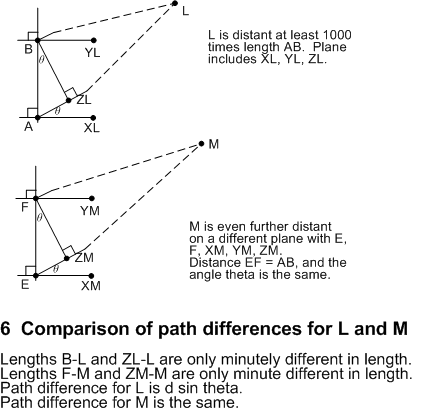
Here’s a picture of those path differences:
You are saying that the path difference for L (AL - BL) is different to the path difference for M (EM-FM). I think the reason you believe that is because M is below L.
As you can see in the diagram, I am arguing that the vertical distance of M is much less important once L and M are distant from the slits at least 1000 times the separation of the slits. The lines in the interference pattern are determined by theta, because the vertical separations of L and M in those lines has no significant effect - the difference are minute. The further the segment LM is from the slits the more accurate the d sine theta formula becomes.
What do you think of the argument that the vertical distance between L and M matters less the further L and M are from the slits?
No. I would much rather find out upon what we agree.
In this pic of the top view, do you agree that even at the distance ratio of 1:1000, d1 and d2 are only minutely different?
And even though they are only minutely different, it is different enough to cause the phasing pattern?
The light areas of the following pic show the typical pattern obtained along that horizontal plane at a ratio of 1:1000.
Everyone I know other than you agrees with that much of it.
What that pictorial is trying to represent is that on an extremely small scale, there is distinction between very small areas of affecting, some being greater than others. They cannot be infinitely identical merely due to the definition of infinity plus the fact that they must be affecting merely to exist and thus cannot be equal.
In that pic, I was trying to display the fact that no matter how small you get even after you could see the variations in affecting, there would still be more, smaller variation within those variations and that situation could not change no matter how small you kept getting.
Does that part make sense?
Why do we assume there is no smallest size of an area of affecting? If there is no smallest size, aren’t we getting into the same kind of division you get w/ Zeno – an infinite number of divisions so the hare never crosses the finish line? What am I missing?
As for my X-Y deflating balloon, it was perhaps too simple an analogy for this level. Simply showing air, something, going over to where there was no air, nothing? That’s all.
First, you DO realize that the hare does actually get to the line, right? The Zeno paradox is merely a mind game. The resolve to all of the Zeno paradoxes is merely an issue of comparative infinities.
In the case of the hare taking half of the distance with each jump, you have to realize that he is also taking half of the time. Although the number of jumps approaches infinity, the time it takes to make the jumps approaches zero. So what do you get when you multiply infinity times zero? You get a finite, but undetermined number - the actual time involved. Put in the actual numbers and you can determine the actual time.
In the case of always getting smaller in the search for the infinitesimal, there is no actual motion going on in the search, it is merely expressing that there is no lower limit to be found. The reason there can be no lower limit is merely because no matter how small you were to get, you could always divide that volume in half. Now if the time it took you do increase the magnification of your microscope was inversely proportional to the scale difference that you accomplished (half as much time to double the magnification), then it would only take a finite amount of time to get to infinite magnification.
The problem of course, is actually accomplishing infinite magnification… at any pace. Long before you reached infinite magnification, you would have to double nearly-infinite magnification in half of nearly-zero time. Thus infinite magnification isn’t actually possible to achieve, regardless of where you started.
Thus man is in the position of having to logically deduce that it must be there even though he would never be able to see it. How do you know a brick has an inside? How could it not have an inside? Whether that inside is made of anything in particular is another matter. Similarly, you deduce that no matter how small you get, there is always a smaller even though you might not know anything about what is there.
Yes. You need some serious pictorials and explanation because you are arguing with everyone in physics for at least 200 years as well as Dr Little and whoever wrote that book you referenced and also some pretty simple mathematics.
You are not supporting TEW right now. You are merely off on a tangent, but go for it if you think that you have to.
Discussing the lines on the interference pattern for the double slit experiment is a critical issue for Rational Metaphysics (RM), not a tangent.
The Theory of Elementary Waves (TEW) and quantum mechanics (qm) both agree on the lines on the interference pattern - they are a result of the path differences of waves going through the slits with one end at a point on the screen. TEW and qm disagree only with the wave direction.
For RM in physics, there is only a vague phrase “acoustic and harmonic resonance” to explain the lines, because RM has waves everywhere else except going through the slits. RM claims the shape of the inner surfaces affects the pattern, which is a daring forecast to make. RM appears to have never considered the mathematics of the interference pattern in detail, and it’s understandable that you would prefer to raise doubt about the lines on the screen than work on the details. I will show how the lines are a simple geometric fact - a fact that will very challenging for RM to explain.
You have claimed that RM can explain all results in physics. The double slit experiment looks like a high profile missing piece of the picture for RM.
Talk, talk, talk.
Show your math.
So far you are disagreeing with all authorities on the subject, including me.
And just to make sure, don’t forget that the “Harmonic Resonance Theory” concerning that experiment is so far merely JSSRM. I don’t have a large enough computer to model it for sake of RM yet. I might come up with a means to use what I have, but don’t see one yet due to having to model every particle of every atom, of which there are trillions.
At the moment, I am thinking that I might be able to presumptuously model a simple covalent molecule like lithium to form a pure material for the screen and slit walls. The 1000 times distance could be an issue but since RM works with measurements 1000 times more precise than physics, I might be able to reduce that down considerably and still be able to measure the pattern. I don’t know that I could reduce it down as far as I might need for it to be so that it could fit into memory. That number might be more like merely 50 times.
I would have to use VBA for the foundation and that means taking for ever to ensure that it has no significant bugs (Visual Basic is anything but visual). It would be a serious headache merely prove that one concept. And once again, no one would really know that I had actually accomplished it but me. I don’t know that I am that curious about it.
And again, it isn’t my business to prove anyone else wrong about their theories. You have forced my into that position concerning TEW merely because you use it like a holy revelation rather than a theory that might be wrong. As soon as you see that something implies that TEW might be wrong, you repel away to the point of denying that 1+1=2, or at this point, denying that even Dr Little understands basic geometry.
We can agree on something - that Rational Metaphysics (RM) has not yet done a fully complete model of the double slit experiment. I suggest you don’t write up RM until that is done. Obviously it will take a while given the fine detail that RM prefers. Until then, RM cannot claim to have explained all the basic experiments in physics - this one is too important. I think you have a lot of work left to do.
I still have work to do on the numeric example of the double slit lines. It’s just a lot of calculations to lots of decimal places - the geometry is very straight forward. It may take another week to get it all done. I think it will help you because you’re challenging the lines in the double slit interference pattern - the geometry behind the lines is a fact, and it needs to be part of the RM explanation.
The issue that we are talking about doesn’t have anything to do with RM. In this issue, I am agreeing with everyone else.
The mathematics concerning that horizontal plane is pretty simple.
Using your letter designators;
Note we don’t have to bother with the more complex issue of your “M” with this horizontal plane.
For each point on the screen, “Lx”, there is a value that represents the intensity of the screen at that point, “Vx”.
Just put in the distances that you want to use then increase L to the next location; 0, 1, 2, 3,…
You should see that the value is decreasing slowly as you increase L. If you keep increasing L, the values will begin to increase again.
Then they will begin decreasing again. They will reflect the interference pattern that everyone recognizes.
In this simple geometry, we don’t need to worry about the Gaussian distribution because it merely causes the values to all decrease a little more as L increases. It doesn’t change the rising and lowering pattern. It merely causes the pattern to slowly fade down as L increases (as shown in my last chart).
It shouldn’t take more than maybe 30 mins. If you have a spreadsheet on that PC or a calculator with Sine functions, it is all pretty easy. And if not, just pass to me what numbers you want to use and I’ll show you the details of where they all lead.
The calculations for paths and path differences are different from what you have specified.
This can be seen in this diagram:
My L is your L0. My M is your L1 or L2 etc.
You can see that your calculation is for the wrong paths. For each M, there is a different E, F to calculate a path to, rather than keep referring back to A and B as in your example.
I will have my examples complete next week. You’re right it’s not hard - I am simply pressed for time with work right now.
Since you aren’t going to be able to resolve the horizontal plane interference pattern mathematics, let’s move on to another serious issue with TEW. You are going to have to repel into total denial on this one too.
Because of your regular mentioning of the direction of the wave as being an important issue in TEW, I have to take it that there is something significant that Dr Little didn’t understand concerning QM. In QM, the wavefunction doesn’t actually travel anywhere, in any direction. The wave that they are talking about in QM is a mathematical calculation concerning at what points in space any chosen particle might be able to be detected.
If you calculate, by their formula of wave theory for particles (a false theory, btw), you get a sinusoidal wave pattern of highs and lows spreading (in 3 dimensions) between the particle source and the screen. It is a measure of the probability of being able to detect the particle at each location along the possible paths. The wavefunction itself doesn’t move anywhere. It is merely displaying where along the paths, one could detect the particle if the particle were there. This is the result of the concept of a quantized universe which led to the uncertainty principle.
The wave that you see in the pic is not a moving wave, but merely a graph showing where the probability would be higher or lower for detecting a particle along a chosen path. The theory is that if the probability is high at the screen, then the screen will encounter more particle strikes. If the probability is lower, then fewer particle strikes will occur, thus leaving bright and dim regions on the screen. In the double-slit experiment, two paths must be added (statistically, they should be multiplied, but that is another issue).
Apparently in TEW, an “elemental wave” is supposed to be an actual entity. But in QM, the wave is not an entity, but merely a graph. QM does not propose that there is an actual wave traveling anywhere other than the particle itself proposed to be made of a wave. So the whole “which direction” issue is non-sense in QM theory. That could explain much of why Dr Little wasn’t taken seriously. Dr Little is proposing an actual physical entity, a wave, proceeding from a particle and traveling across space. He was apparently proposing the existence of an entity that has never existed in any Science or even in QM.
In the double-slit experiment, that wave function is calculated as a spreading wavefunction extending from the source toward the slits in 3 dimensions. The graph then takes two paths through the slits with continued calculation for each location in the space between the slits and the screen. The probabilities then add together at the screen to get a total probability of detection.
After making all of those calculations, it can be seen that there are regions on the screen where the probability of detecting a particle would be higher or lower due to the combined path probabilities. And that pattern matches the proposed QM particle-wave theory. It doesn’t actually prove anything at all, but that is what they have been talking about.
What I was pointing out earlier is that by using their theory and examining the vertical probabilities, it is easy to see that the columns would be intermittent and actually form concentric circles of brightness on the screen unless the source was intentionally placed very far away from the slits so as to hide the evidence.
(1) The direction of the wave in quantum mechanics (qm) versus in the Theory of Elementary Waves (TEW).
(2) The vertical probabilities in the lines on the interference pattern.
For the first issue, the idea of the wave traveling in qm depends on the interpretation. In the Copenhagen interpretation, the particle is the wave so there are wave packets or wave-particles, and the wave definitely moves as the particle does. In other interpretations like the “Shutup And Calculate” interpretation the physical description of a wave traveling is ignored and it’s all about probabilities.
Dr. Little was clearly referring to the most popular interpretation - the Copenhagen interpretation. The inconsistency of qm explanations and interpretations is a problem for qm, not for TEW.
For the second issue it’s the phase difference between the two paths that matters, and I will show later that the vertical lines correspond to points with the same phase relationship. The brightness of the vertical lines is an issue that is partly affected by the length of the slits, so it is a complex discussion. If the slits were meters long, I will have to think about what is predicted for relative brightness along one of the lines.
We can go into that more when I finally deliver my promised examples. I really have been tied down with other things, and I am as frustrated as you that we cannot make more progress on this. I have been working overtime so that I can go on a two day holiday with my wife, so I will be unable to respond again until three days hence. I accept that my delay in producing the examples is holding this up.
QM is not proposing a direction of anything other than the particle itself.
Classical Physics: A particle is a spec of indivisible mass material. Quantum Physics: A particle is a wave in a packet. Rational Metaphysics: A particle is a packet of gravitational turbulence, “Affectance noise”.
Theory of Elemental Waves: Every particle emits a wave that particles, of whatever nature, follow.
TEW is an entirely different issue proposing the existence of an entity that emits from every particle regardless of what constitutes a particle. The proposal is that TEW is a “better theory” that provides the same results as seen in experiments.
Due to the wave packet concept, the probability of detection arose as an issue from the uncertainty principle that would necessarily follow from such a packeting concept. That probability of detection charts out as a wavefunction with highs and lows along the path of the wave packet.
There are two wave concerns in QM;
the particle itself as a traveling wave packet and
the wave of the probability of detection as merely a graph.
The probability wave is merely a graph, not a physical entity and does not travel in any direction. The particle as a wave packet travels from the source to the screen. TEW is not proposing anything about the particle wave packet and its direction. TEW is proposing that another entity, an “elemental wave” is causing the particle wave packet to follow it to the screen.
One could propose that apples fall from trees because fairies cut them loose. You couldn’t really prove such a theory wrong, but is it a “better theory” than the pull of gravity versus the corruption of stem connection?
TEW proposes that a self-identifying fairy wave lures particles toward their destiny. Even if I couldn’t prove that TEW’s fairy wave didn’t exist, would it really be a “better theory”?
Well, everyone agrees on that issue. And it is the difference in distances that causes that phase difference.
The only way that can happen is for the particle source to be extremely far away from the slits such as to make the vertical phasing unnoticeable. But then the immediate question is, “why don’t they want it to be seen”? Why wouldn’t TEW want it to be seen?
Let’s do a high level review the choice of theories we have in physics.
You suggested this:
Your definition for classical physics is OK.
For quantum mechanics (qm), I would say “A particle and a wave are the same thing, so the particle is a wave-particle or a wave packet.”. That is the most popular interpretation. It implies the key assumption of qm: that the wave goes in the same direction as the particle.
I know that some interpretations just talk about probability, and want to ignore any physical interpretation of what the wave means. That is very common in qm - the idea of avoiding talking about reality, just look at the maths (which works).
So a simple description of a particle in qm is almost impossible due to the interpretations. The most popular interpretation is the Copenhangen interpretation, so I’ll go with the words I choose above.
You are the expert on Rational Metaphysics (RM), so that summary is clearly suitable.
For the Theory of Elementary Waves (TEW) the waves and particles are separate. The waves are like an “infrastructure” to the universe - they are there anyway. When they pass through a mass they get a “marker” (which you call the magic marker) which uniquely identifies that mass. So the mass does not really emit waves - the mas leaves a marker on waves that already exist.
All particles are following some particular elementary wave at all time, period. The dynamics of how elementary waves collide and interfere, and how particles start at sources and then reach collision or interference points is essentially what governs the sub-atomic world.
TEW makes the same predictions and has the same probabilities as qm, because they use the same mathematics - the wave maths works equally well in both directions, thanks to the Reciprocity theorem.
Why is TEW a better theory? Because TEW is local and deterministic, whereas qm is full of magic such as multiple universes, effects backwards in time, “non-locality” and other associated ideas. TEW is offering a local and deterministic world - a gigantic difference arising purely from changing the wave direction.
RM seems to be local and deterministic as far as I know so far. How well RM forecasts compared to qm and TEW remains to be written up.
So my summary is this:
Classical Physics: A particle is a spec of indivisible mass material.
quantum mechanics (qm): A particle and a wave are the same thing, so the particle is a wave-particle or a wave packet.
Rational Metaphysics (RM): A particle is a packet of gravitational turbulence, “Affectance noise”.
Theory of Elementary Waves (TEW): A particle is a point-like object that follows an elementary wave at all times.
Notice the symmetry between qm and TEW - the wave is with the particle in qm whereas in TEW the particle and wave are in opposite directions. Classic Physics did not have waves for the matter in a particle, only in the energy between particles.
In RM, as far as I can tell, the affectance itself can forms waves, so the waves and the particles are made of the same stuff - a bit like qm.
The “particle is made of a wave” and the “particle goes in the same direction as the wave” are two different issues. The particle is not “following a wave” in QM. The particle is proposed as a wave that is merely packeted into a small ball for some mysterious reason. That ball is not following a wave. They tried for over 50 years to invent ways for that to be true. When I first began investigating what a particle actually is, I too tried to find a way to make a wave into a packet. But it only took me about 6 months to realize that it isn’t a coherently ordered wave of any kind magically held into a ball. Instead it is merely a clump of incoherent noise that is held together for the same reasons that gravity works. If I had tried to figure it out in the 80’s it would have probably taken no more than a couple of weeks.
I used RM’s concept of “affectance” (the cause of gravity) and built a computer model of empty space to see if I had to add anything to the concept in order to have particles form. But as it turned out, I didn’t have to add anything. Dense affectance automatically forms into particles of the types already known to physics. You don’t have to tell it to form a particle. And the particles are made from the natural affectance noise. They attract to each other and move exactly as physics has noted without any additional concepts or concerns (no magic waves, no time distortions, no 4th spatial dimension needed).
The probability wavefunction is an entirely different issue that doesn’t involve any moving wave other than the packet itself.
Yes. I apologize. You had explained earlier that the waves preexist.
But still TEW is proposing the existence of a new entity. It is not merely the direction of a wave. QM isn’t proposing any direction of any wave other than the packet itself.
Except;
A) they are two totally different kind of waves; probability and physical.
B) they are both ignoring the vertical issue which disproves both theories.
Well not really. But that gets into my next issue.
Those 3 are about what a particle is.
That is the proposal of a new entity, saying nothing about what a particle is or why it would follow a magic wave.
My point is that the TEW proposal has nothing to do with any difference in direction of a wave. TEW is merely proposing a new entity that lures particles. The mathematics working out the same for the double-slit is irrelevant.
I disagree with that “symmetry”.
TEW says nothing about the direction of the “particle-wave”, nor does QM.
TEW is proposing a new type of physical wave extending between the screen and the particle.
The only distinction in QM and RM is that RM doesn’t assume that the universe is quantized and thus doesn’t have to get into time travel and multi-universe issues (nor relativity for that matter).
A key part of your argument is that quantum mechanics (qm) is not proposing a wave direction. You wrote:
You are not correctly describing the qm claims. A central part of qm is “wave-particle duality”. The whole idea is that a particle is also a wave, and that the wave and particle behaviors are just aspects of the same entity. Wave-particle duality is a central claim of qm and appears in all textbooks of qm.
As soon as you say “wave-particle duality” you have assumed that the wave or wave packet is going in the same direction as the particle. Some believers of qm think only about probability and ignore any physical description of what the probability results mean. That is an option that some qm believers have - it does not alter the fundamental development of qm which is based on wave-particle duality.
That means that qm does assume the wave direction, and Dr. Little calls that the “forward wave hypothesis” in his book. Dr. Little shows lots of reasons why the forward wave hypothesis does not make sense. For the Theory of Elementary Waves (TEW), it is the same quantum wave going in the opposite direction.
Yes, elementary waves are a new entity. In TEW, particles are particles and waves are waves: the two ideas are completely separate. In qm, the waves and particles are the same entity. The difference is about separating or combining entities. Rational Metaphysics (RM) seems to claim that there is one entity (affectance) underneath both particles and waves. So the three theories are different ways of considering what the building blocks are.