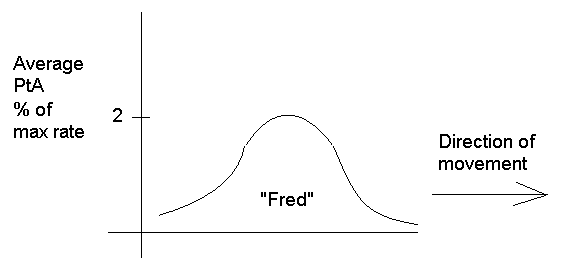
Well realize in this case, “Fred” is NOT a hard particle of any kind. Fred is a single wave hump. Fred’s nose is the very beginning of a change that gradually increases to the top of his head and then back down to his ass.
In the scenario that you propose, Fred’s nose is not being impeded because it is proposing only a tiny change within the 2% allowed. So his nose proceeds. But by the time Fred’s forehead gets to the same point and presuming that the situation at that point is still restricted just as much (which it probably wouldn’t be because the other waves are progressing also), his forehead would be too much of a change and thus must wait. But it doesn’t have to actually stop because whatever other wave was adding to the situation is just like Fred and which ever gets there first slips by a little as the next waits, which then slips by a little, then Fred slips by a little more, and so on.
Try to not think in terms of fixed hard entities and times. These are smoothly flowing, infinitely divisible changes from where ever the affectance level was to another value and back. When two or more such waves cross, they smoothly share the waiting. There is no actual stepping or stopping involved.
As each wave gradually makes its way through the restriction point, Fred’s ass end slips by quite easily.
In effect, what happens is that Fred gets gradually compressed as he passes through the restriction and then gradually stretches back out to his original shape. This effect is reflected (similar to) light passing through a high gravity field wherein it compresses to a short wavelength and then, if it passes by, stretches back out to its original wavelength.
First question: why does the Affectance “Fred” return to the original shape? How can it “remember” what it’s original shape is? To me, if the “forehead” of Fred is delayed, then the shape of Fred changes and that should be a permanent change.
Second question (related to the first): you mentioned light is affected by a high gravity field and then “stretches back out to it’s original wavelength”. Can you give me an example? I can think of a counter example: light traveling across the universe is red-shifted by gravity, and it stays red-shifted. That has been a basis for physicists to theorize about mass distribution in the universe. If light returned to it’s original wavelength after a gravitational effect, we would not be able to detect distant masses.
Study the pictorial. What Fred experiences entering the field, he un-experiences as he leaves.
The red-shift that they are talking about is due to the speed of the source, not gravity.
When the source is speeding away, the light from that source is red-shifted.
When the source is speeding toward, the light is blue-shifted.
It is merely an issue of relative speed.
I asked why does the Affectance “Fred” return to the original shape? How can it “remember” what it’s original shape is? To me, if the “forehead” of Fred is delayed, then the shape of Fred changes and that should be a permanent change.
You replied:
Logically, if affectance travels as fast as it can, unless it has to pause for a maximum, and only some parts of Fred pause, then the paused parts never catch up to the rest that was not paused. The change in shape of Fred should be permanent with each separate pause. The only way for the shape of Fred to remain the same is that all parts of Fred have to pause the same amount (even if the pauses are at different times). Is that what you are saying?
Red and blue shifts can occur for gravitational lensing, when light passes a large mass. The change in the light is permanent - both in direction and wavelength. I see no examples of light changing wavelength and then changing back again after an influence. Changes stay in place.
Did you look at the pictorial?
Did you notice the “faster” and “slower” arrows?
Did you notice that I said that Fred gets “compressed”?
Who told you that?
Light slows down when it goes through a gravity field (such as within glass), but it returns to its ambient speed when it leaves. Light going through glass does not permanently change its wavelength (and in the relative sense, doesn’t change it at all), but it slows the light down significantly, thus causing “lensing”.
Red and blue shifting are not caused by slowing the light after it has already been emitted. But once again, you are presupposing about things that we aren’t really talking about and trying to judge based upon other theories. I told you, “you do not know what a photon is” (in RM) so you are distracting and forbidding your own understanding by mixing things in that do not belong.
Although it is a bit off this direct issue, because you recently got married, I thought you might want to read this one;
The pictorial of Ration Metaphysics (RM) for “Potential Wavelet Discrimination” and the example of light going through glass do not answer my question.
You wrote:
I wouldn’t describe glass as a gravity field - it’s a medium. Light changes speed in the new medium of glass. Most importantly, when light exits the glass back to air, the speed changes back to the speed in air. The boundary between the glass and air is how light “remembers” to change speed back again.
This example is why I find the the description of Affectance hard to understand. Let’s look at my question more closely. We have some Affectance “Fred” that is in motion:
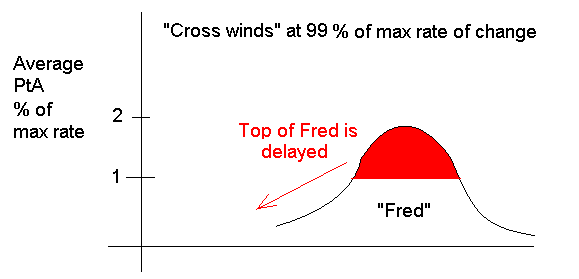
Fred encounters “cross winds” at 99% of the maximum rate of change. The top part of Fred is delayed by this:
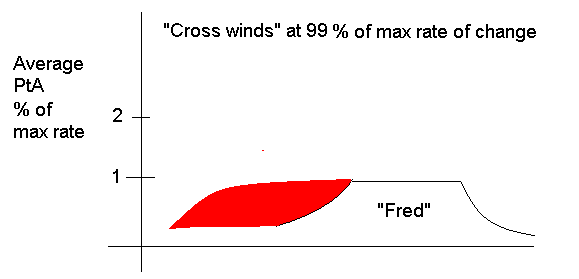
This changes the shape of Fred to this:
To me, once the cross winds are past, all the Affectance in Fred travels at the same speed, and so the bit that was delayed never catches up to the original position again. However, RM claims that Fred returns to the original shape, because on Nov 27, you wrote:
How does Fred “remember” the original shape, and how does Fred revert to it?
Saying “Fred gets compressed” actually makes things harder to understand…
Let’s look at my question again. Fred starts off like this:
Fred encounters cross winds of 99%, so this is the situation:
How can Fred be compressed? That raises the average Potential-to-Affect above the maximum rate of change, so it can’t happen. The red part of Fred must be delayed. Instead of being compressed, Fred is being stretched out, so Fred can slip through the cross winds.
My point is that once Fred is stretched out, the shape should not revert back - there is no way for the delayed bits to catch up.
I think that you are still thinking in terms of Fred being much like a photon, but remember this pic?;
A photon would more relate to that lower LEFT corner, “Reality of Local Potential”. But the issue that you are addressing only fits into that lower RIGHT corner, “Maximum Variation Between Points of Potential”. So we are talking about literally the smallest form of existence there is and probably 1000 times smaller than a typical photon. The limit that we are discussing occurs thousands of times within tiny peaks all within a single “photon”. We are talking about something that Man could never empirically observe, but must merely logically deduce.
And also, you seem to keep thinking in terms of Fred being a hump where the peak of the hump is the issue. The issue is the change rate, the “rising”, not the peak height. It is an issue of how fast the edge is rising, not how high it eventually reaches.
In that pic, “Fred” is encountering a presumed constant point of congestion and delay. Such a thing is all but impossible in reality because nothing could ever manage to get that idealized and certainly not remain that way during “Fred’s passing”.
Note that by the time Fred has passed, he doesn’t quite look the same. He got distorted a bit. But in the real world, not so presumptuously idealized, there is constant chaos randomly distorting each and every instant of that idealized scenario. Thus in reality, good ole Fred will end up looking much like he did before, merely slightly delayed. Distortions are typical on that level, but irrelevant.
Some of the wording of Rational Metaphysics (RM) has been confusing for me, and I think we are finally getting to the bottom of it.
We have been looking at a collection of Affectance called “Fred”. On Nov 26, you wrote:
To me, this suggests that Fred undergoes a compression change and then a decompression change. That’s two changes. I could understand the first, but not the second.
In your last post, you gave a much clearer idea of what happens to Fred. I would summarize it as a one-time change. That change is only to the parts of Fred that slope too much. That change happens progressively from the front to the back.
I can cope much better with the description in your last post. Since there is only one change, Fred does not need to “remember” his previous shape to return to it.
It may seem pedantic. I think saying there is one change instead of two is a big difference in the wording. I much recommend the more recent wording on this one.
I think I better understand the interaction between “cross-currents” and Affectance.
Well, I still don’t think you are getting it exactly. Those short red lines are the “compression of Fred”. After that point, Fred merely returns to going as fast as he could and just as fast as he was before. He need not remember anything.
But enough of this. Since you have raised the issue of maximum rate of change a number of times as something dubious, I am trying to see what I can put together as an explanation without getting too much into mathematics. The issue touches on the cardinality of infinities and thus mathematics, but it is really founded on logic.
In any ontology, there can be only one concept for each defined word or term. If someone says that there are an infinite number of points in this 1 meter length then he cannot also say that there are only an infinite number of points in his 2 meter length. In standard English, “infinite” merely means “endless” and that is fine is most cases, but when dealing with logic and mathematics, one cannot say that infinite set A is equal to 2 times infinite set A. That issue leads into the cardinalities of infinity.
In the following pic, the term “infA” represents “a particular infinite number of points arbitrarily named A”. And infA != 2*infA.
I am fairly certain that you would have questions concerning that pic and its consequences, but I’m not sure which come up in your mind, thus I’m not sure what else to include and explain. This is the issue of maximum rate of change which is also the same issue as maximum rate of propagation.
I have some knowledge of infinities in mathematics. The integers 1,2,3… are called a countable infinity, where as real numbers are an uncountable infinity. Some some infinities are different to other infinities.
I was a bit unsure what you meant by the formula in this:
Did you really mean to put the ! in - which means factorial in mathematics. For example 3! = 1 x 2 x 3 = 6. For you to write infA ! you are meaning an infinite number of points multiplied by themselves. No quite sure if that is what you meant.
As for the diagram, I need to be reminded about the meaning of “tic” and “toe”. Then I will ask what do the words “infA steps in Change of Potential = 1 tic”. Do you mean the collection of infA is a collection of 1 tic values? Or do you mean that the entire InfA collection represents only 1 tic?
You seem to be saying quite a bit in a short space here.
The “!=” means “Not equal” in logic lingo and since I can’t make the crossed out equal sign on here, I just used that one instead.
The second one. It is defining both InfA and also one tic (of time or change). One toe is then being defined as the amount of distance propagated by a change and having the same number of increments as one tic. Thus the maximum propagation velocity is one toe per tic.
Although that might seem arbitrary, it actually isn’t. In effect, it is declaring that in the RM ontology, the smallest increment of anything is determined by the division of the smallest unit of time divided by infA. And since there can only be one definition for the base meaning of infinity, the smallest length cannot be divided by any more than that base, infA. You cannot divide one tic by (2*infA), else it wasn’t one tic.
So in a more common scenario, a wave traveling at its maximum unimpeded velocity, for a length of 20 toes will always take exactly 20 tics of time. And I mean 100% exactly to any number of digits. That propagation velocity is what causes all things in the universe to have the relative sizes that they do. Size is directly related to affectance propagation velocity.
And I just realized that the pic didn’t explain that the maximum change rate for PtA is 1 PtA/tic. That gives measureability to PtA with relation to time and distance. I’ll have to stick that into the pictorial.
Max change/propagation;
A change of 1 PtA requires 1 tic of time and can only travel 1 toe distance.
I am thinking of changing that one note in the pic to;
InfA steps
of Change
in 1 PtA
= 1 tic
Now I have edited that pic in that post.
What I haven’t done is translate those units into meters, eV, and seconds. And I suspect that physics would have a hard time coming up with a precise enough definition for a second or meter such as to make that translation accurate. In the long run, physics will have to either accept the tic-toe units or merely create their own labels based on the same concept. Time and distance are not conceptually independent.
I have no problem with Rational Metaphysics (RM) defining it’s own units. My problem is that I don’t understand the definitions yet.
Let’s start with some basics. What do “tic” and “toe” stand for?
Then we have the concept of infA - defined as:
So we have no idea about InfA, except it’s an infinite number of points.
One tic is an InfA collection of changes. I assume that is a unit of time.
One toe is an InfA collection of locations. I assume that is a unit of distance.
RM defines:
So this defining a change propagating to different locations, rather than the change in one particular spot.
To me all these definitions don’t really say anything yet. Whatever the unit of time a tic is, it’s made up of an infinite smaller bits. Whatever the unit of distance a toe is, it’s made up of an infinite number of smaller distances. So we don’t really know anything about how much a tic or a toe is.
By defining the max rate of change as one tic per toe, that is assuming that a maximum rate exists already. I don’t see any logic proving it must exist yet.
So I’m very surprised by these definitions. There must be more to it.
Units for time and distance. How was that not obvious?
But now you know that both are made of the same number of points, “infA”. This is very relevant to the mathematics and the understanding of why there must always be a maximum rate. And as far as the propagation versus changing in one spot, a potential cannot merely vanish into nothingness. If it is reducing, it must be going somewhere, propagating. Thus the speed that it propagates tells you how fast it can be reduced. If it has a maximum propagation rate, then the source has a maximum change rate.
No. It is by defining the tic and the toe by the same process, using the same standard (required for any ontology), and thus we immediately have a maximum combination understood, “maxtoe / tic = 1”.
Another way to say it is, “if 1 infinitesimal is the smallest change that can be made and 1 of the same size of infinitesimal is the smallest distance that can be traveled, then the smallest change at the smallest distance defines the propagation rate.”
There are multiple ideas in Rational Metaphysics (RM) that need debating.
You wrote:
We agree there is a maximum propagation rate “c” for the speed of light. Debatable Idea 1 is that a source has a maximum change rate. I still think of the example of a single photon hitting a point in space. The incoming photon can have an unlimited amount of energy. The speed of the photon is limited, but the amount of energy delivered is unlimited. To me that means a source does not have a maximum change rate.
You claim that I don’t know what a photon is. I counter that RM only claims to know what a photon is. I think the example of a single photon is a good one.
You also wrote:
There are multiple ideas here that I want to debate. Idea 2 is that there is a smallest change. Why should there be one? A photon can be of arbitrarily small energy. I don’t agree that there is a smallest change possible.
Idea 3 is that there is a smallest distance that can be traveled, and again I do not agree there is one.
Idea 4 is that the infinitesimal is the same for change and distance. RM defines these two as the same, but I do not agree that the infinitesimal is defined in either case or could be considered to be the same. Simply defining the two infinitesimals as the same is an assumption in itself.
So far, your case for a maximum rate of change has started with at least 4 ideas that are very debatable to me, and I think you’ve got a very difficult task to argue their case. As usual, I think there are assumptions involved in what RM is saying.
Well this discussion is going just where I thought it would.
I have only casually mentioned what a photon is in RM. I have not defined it for you. Thus you do not know what an “RM-photon” is. But actually you don’t know what a physics photon is either, but that is irrelevant because we are not talking about physics.
And the “c” speed of light is equally irrelevant because again that is an issue for physics, not RM. Even the word “light” hasn’t been defined in RM. Again you are trying to argue about RM using physics as the holy standard. That is about like trying to argue physics using astrology as the holy standard.
Stick to RM and logic.
How do you find the smallest number? You divide 1 by infinity. In mathematics that is called “dx” or “dy” wherein the “d” refers to “delta”. It is what is used in calculus and it is multiplied by infinity so as to get 1 of whatever. But how do we know that was really the smallest number? We know because we defined it as such merely without telling you.
In QM they did something different and defined a smallest length as the “Plank Length”. How did they decide that one? Because the Plank Length is not infinitely small. What Plank did was use thermodynamics as the holy word of God along with a few other “laws of motion” and discovered that if those premises were true, then there must be a calculable smallest distance and time. And then because they calculated a smallest length and time, IF thermodynamics was true, they declared that it is true that there is a smallest length. And that is where all of this weirdness in QM, that we agree is nonsense, is coming from. In reality, Plank had just proven that thermodynamics was not holy. He disproved their premise.
QM is based on (as axioms) the “laws of thermodynamics”, which is why they have absolutely insisted on calling it the “Law of Thermodynamics” even though everything else is just a theory. And like so much of QM, that law has been proven incorrect many times, even by them, to the point that now certain technology depends on it not being true. But of course, they still teach and insist on it being true and absolute (while constantly rewriting it so as to make it true). They require it to maintain the authority of their Church.
RM doesn’t depend on any such observable theories. RM is strictly an issue of definitional logic. Thus in RM, the “smallest distance” is the mathematical variety much like the common “dx”. But in RM, mathematics is extended a little so as to include the cardinalities of infinity. Because of that, RM cannot really use the vague term “infinity” as a number (which it never really was. It merely meant, “endless”).
In RM, you must choose your “fundamental infinity” so that other levels of infinity do not lose their meaning in vagueness. That fundamental infinity is called “infA”. It is chosen merely to be a fundamental value for whatever you might be interested in at the time. You can take a 1-meter rod and divide it by infinity to get infA or you can take a 1-mile stretch and divide it by infinity in order to establish your infA. But once established, you cannot alter it during the same argument. It becomes a definitional premise.
Another part of creating an ontology is creating the dimensions. In RM, three of those dimensions concern time and three concern distance. So for each length, I can declare an infA as the smallest distance that when multiplied by infinity (in standard math), I will get 1.
But how do I know that each dimension is going to have the same smallest distance? Why should the marks along the x-axis be just as far apart as those on the y-axis? Maybe it is longer going forward than it is going sideways? How would I know? It is simple. We define them as being similar in that regard. A dimension is merely a definition issue. You define the characteristics so that the dimension is useful to your ontology. Thus each length dimension is given the same “dx” length as its smallest measure; “dy” and “dz”. God didn’t make it that way. WE did. It is a natural declaration merely for sake of our ontology and our mind.
But now what about time? Why would a time unit have anything to do with a length unit? Well, we have to declare an infA or a “dt” related to the time dimensions such that “dt * infinity” will give us 1. Why wouldn’t I use the same “infA” in order to do that?
Actually, it could be arbitrary. I could make the time dt equal to 2 dx’s. Would that really change anything? It would change the numbers that I got, but it wouldn’t change the logic one bit. There would still be a fixed relationship between a smallest change in time and a smallest change in distance. I chose that relation to be “1” just to keep the ontology mathematically simpler. Once declared, I am not free to change my definition of infinity, “infA”, throughout the argument for the same reason that you can’t premise an argument with a definition of an apple and then change to a different definition in the middle of the argument. So no matter what I use, there will always be a fixed relationship between an infinitesimal of time and of distance. I can arbitrarily choose it once, but then it must remain fixed throughout.
So in RM, if you divide 1 by infA, you get the infinitesimal that represents the standard dx, dy, dz, and dt (but in RM there are actually 3 "dt"s, not only one, but I don’t want to get into that right now).
To sum it up, in RM “infA” is to always represent “the standard infinity” (or “fundamental”). Every dimension can be divided by that same infA in order to get “an infinitesimal” for each dimension. If I am to make the smallest change in potential (thus giving us “time” and a “dt”) within the smallest distance, “dx”, then dx/dt will always equal 1. But what that means is that the greatest distance any change in potential can travel in dt time, is dx. And since dx/dt is the measure of velocity, the fastest propagation is 1 “dx/dt” or 1 toe/tic.
Of course in mathematics, the “dx”'s and such are variables. I am just using them as a standard infinitesimal here.
In your last past, Rational Metaphysics (RM) claims that InfA is analgous to dy and dx in calculus logic.
The difference with calculus is that it starts with a formula for y = x squared and uses that to derive that dy/dx = 2x. In this case, you have defined dy and dx but you have no guiding formula to be able to say dy/dx = 1.
The whole discussion on InfA and 1 toe/tic demonstrates that both are assumptions. I can proceed on that basis.
And that exemplifies why I have been leaving math out of this. They start with y = x to declare that “the TIME derivative of y”, dy/dt = “the TIME derivative of x”, dx/dt.
They say nothing about what dt is equal to (the infinitesimal time/change step).
Math and Science would do itself a great favor by declaring a “Standard Infinitesimal” (as they do with all other units of measurement).
They are both declarations of definitions. There is no assuming.
That is why he put you in charge of Science and Math.
And congrates.