The difference is actually that I understand the difference whereas you do not.
Then how about talking about RM rather than your straw men?
No we aren’t. We are talking about your imaginings.
Note that you have yet to mention a single premise either from before or the more recent refresher post other than to say that “affectance exists” (after I had to correct you about the difference between PtA and Affectance).
To make any headway, you have to show where something I have said contradicts something else that I have said. None of your speculations of what must be true otherwise is relevant.
Again, no it isn’t a “logical” question.
No. We can say either way. There is no “which is the one from before”. There is no “one from before”. There are merely two resultant congestions. You could make them green and orange.
No RM IS sure. RM is sure that neither is identical to what either of the original was. And that what “passed through” was the affectance from each through the other. That affectance then re-initiates the forming of a new particle from the affectance that passed through. By the time the new particles have fully formed, the original affectance tidbit wavelets have already gone away. Affectance travels much faster than particles.
Let’s review just Problem 1: Identity of the particles, and what Rational Metaphysics (RM) says.
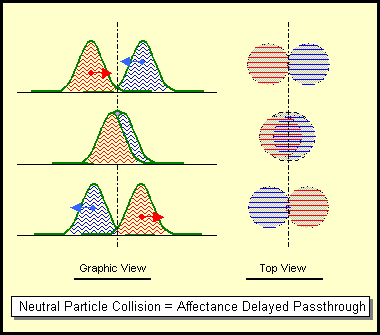
On August 21, you posted this diagram:
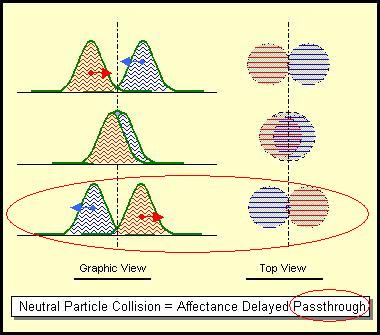
You also wrote this in that post (my underline):
In your last post, you wrote about the “after” particles:
RM now claims that the affectance congestion merged and re-formed into two new particles instead of two masses passing through each other.
So the errors in the original diagram are as follows:
Firstly, the colors of the “after” particles are wrong and misleading - they are new particles. By using red and blue, this incorrectly implies the same particles are still there.
Secondly, RM has agreed that we cannot put a marker on affectance, and so we cannot say for sure that the affectance always traveled in the same direction. RM assumes and even defines affectance as never changing direction, but there is no way to verify or prove that in this example.
So the word “Passthrough” is an assumption, not something demonstrated or proven by the diagram. It is possible that the affectance congestion “bounced off”, just as it is possible the affectance congestion “passed through”. It is also possible that there is a mixture.
To clear this up, we need these things:
(a) New colors for the “after” particles - I like your suggestions of green and orange.
(b) Instead of the word “passthrough” it should say “merge and re-form particles”. That new phrase is consistent with what RM is now saying.
(c) Replace this phrase:
with this:
As you say, it is very important the account of RM is fully accurate, especially if you do publish this some day.
This is an important clarification, because it shows how critical the assumption about affectance never changing direction is. That idea is critical to how this collision is understood, and challenging that assumption throws up new possibilities.
Should I write the book in English or Chinese? Wouldn’t that depend upon my target audience? And even if I choose “English words”, don’t I have to then choose which English words? And if I choose pictures, don’t I have to then choose which pictures? And don’t all of those depend upon with whom it is that I am trying to communicate?
Communication is not a perfect transaction of thought. There is an entire school of how to manipulate communication so as to cause communication to occur in a preferred manner rather than in the manner intended by the originator. It is called “media” (meaning mediator or manager of communication, standing in the middle between two parties such that each hears only what you, the mediator, allows).
Do you remember me telling you that one of the prime services that you are providing to me is the service of letting me know what words and/or pictures do the job of communicating the right ideas to people like you?
During the process of discovering what words or pictures best suit your mental manner of reading and learning, I have to guess at words and pictures and then find out if you misunderstood them. If I see that you have, I try to find better words or pictures to match your mindset and manner of reading. During that time, what I say changes, not in intention, but merely in wording so as to improve communication; “look at this picture. Well, okay, try this picture…”
People who are not charitable to what the author was trying to say rather than what he might have said by their interpretation, misread the author, often thinking that he was simply wrong. I can take anything that anyone has ever written and make it appear as though it was wrong merely by taking the words too literally. That is called being “pedantic” and “adversarial”.
When someone isn’t trying to understand, they will almost always MISunderstand.
In physics, what is a “mass”?
Note that I had said that "to the physicist, it appears as though the two ‘masses’ have bounced off of each other"
But I have learned of you, that you think in terms of everything being constantly identifiable. That mindset is a little hard to communicate with concerning many things without serious misunderstanding taking place. That is why I need to say something and then hear what you thought that I said. After hearing what you thought I meant, I often have to change my wording, or in this case, change even the colors in the pictures.
“wrong and misleading” and “incorrectly implies” TO YOU.
That is why I stopped long ago. You implied no misunderstanding until you got married and then quite suddenly, every single word I had said was “incorrect and misleading”. First, you cannot really tell me what is incorrect. But you can certainly tell me what is misleading TO YOU. But you hadn’t been doing that until suddenly everything was totally “wrong” in your mind.
So in any book, I now know that if the book is to be written for someone like you, I must be careful to not imply that just because the affectance has passed through, anything identifiable as a “particle” must have a new color to it, else you will think that I meant something more than I said.
No. Again, you are not reading what I am writing. I stated that direction is inherent in affect.
In order to have affect, there must be two items of some kind. The inherent direction of affect is the direction indicated by the positions of those two items. You cannot have two items without having an inherent direction involved. That doesn’t mean that the direction is a singular vector. You could have one item in the center of a circular item. In that case, the direction would be a 360 degree spread of directions. But there is always a direction of some kind.
Thus by the very definition of “affectance”, direction is implicit. It is not an “assumption”. It is there by definition.
There is nothing to be verified. It is true by definition. If you define a square as having four corners, do you really have to have Science go verify that it really does? There is nothing to verify but whether you might be looking at one.
And even beyond that. I told you from the beginning, that nothing can be verified as true or real until AFTER the entire ontology has been understood, THEN one can go find out if it fits reality. You just keep trying to prove it wrong before you even know what it is.
Again, a matter of the definition of affect and its implicit direction. Demonstration has nothing to do with it.
It is possible to proclaim that the “congestion” bounced off. But that is more misleading than saying that it passed through. But either can be proclaimed because it is a matter of epistemology, not physical reality. It is more misleading merely because it is impossible that the affectance itself bounced off.
And thank you. As I said, such is one service that you are providing.
It is only the wording that must be clarified. There is no actual RM understanding that you can fault. But until you understand what the wording needed to be for sake of that understanding, there is no arguing that will make any sense.
I can accept that the introductory material on Rational Metaphysics (RM) is a first attempt to communicate new ideas, and not to be taken in a legalistic way. I can also accept that more of RM needs to be described before the whole theory can be compared to reality.
What I have discovered in this recent debate is the critical step for me in the RM picture of physics.
We start with Potential-to-Affect and when that changes there is Affectance. I’m fine with those as starting definitions. You also wrote:
The concept of direction to Affectance is also fine, and I like the example of a 360 degree spread of directions. I’m not sure about a maximum rate of change, but let’s leave that for now.
The critical step that makes me uncomfortable is the idea that Affectance never changes direction. It’s something your refresher post on Nov 12 did not cover.
This is the idea that I am challenging. If Affectance can change direction, then the Affectance congestion can change in unexpected ways. This means the whole collision diagram no longer makes any sense - there are too many possible outcomes for the congestion.
That means that the idea of Affectance never changing direction is a necessary part of the whole description of particles in RM in physics. All your work on RM in physics depends on this.
The problem is that Affectance is something like a million times smaller than a photon. We will never see it to be able to verify that Affectance does not change direction. So to me, it has to be an assumption when we make a statement about such a minute entity. I know you claim RM has defined Affectance as something that has not changed direction. I am saying that definition is as assumption dressed up as a definition.
Since that idea underlies all of RM in physics, if ever there is a slight discrepancy between RM and reality in physics, then this idea has to be a suspect in the investigation.
I know there is lots more on RM I have not seen yet. I am finding I am still thinking a lot about the small bits I have seen.
For example, I am thinking through the idea of Affectance changing speed. My current understanding is that Affectance can travel at different speeds. It clearly has to pause when it encounters an area of the maximum rate of change. After that, does it then resume the same speed as before? If so, how did it “remember” the original speed? Can Affectance change to another speed (other than pausing)? RM is very complex, and I am slowly grappling with the implications.
I am traveling to another city tomorrow, so I’ll be back the next day.
Thank you. That constitutes a very significant change in our exchange.
Well that one is extremely important, so even if you don’t understand why right now, don’t forget that one. That is the very most fundamental concept that wasn’t realized and thus kept Science confused for 200 years.
Well, you might be giving it more significance than it deserves, but perhaps not. Questioning it isn’t a problem for me. I know that I never explained the details to you. But I had to get you down to the point of examining actual RM concerns before I attempted to continue. And I have to be guided somewhat by your questions. If I were to try to tell of every detail without your questioning, both you and I would be overwhelmed before I even got this far.
Emm… do you realize that the electric charge potential has never, ever been seen, nor can it ever be seen? The only evidence of it existing is the logical deduction derived through postulations from experiments. It can never be directly seen, yet ALL of science believes it is there. The truth is that they defined it to be what was causing a specific effect. And then because the effect was demonstrated, its defined cause has no choice but to be there. They didn’t understand why it is there. That wasn’t their concern at the time. They just saw an effect and gave its cause a name, “something is attracting these things together. Let’s call it ‘electric potential’”.
There could be no doubt of them being right because they merely gave a name to a cause to an already observed effect. And all I am doing is filling in the rest of the story that they didn’t realize at the time. My “PtA” is their “electric potential”. But you don’t know that yet. That will become more than evident later.
It travels (again by definition) as fast as any change of potential can possibly travel. We know that it cannot travel at infinite speed, or “instantaneously”. That is all we need know at this point, that it is not infinite. But it gets just a little bit complicated as to what percentage of change of speed occurs and for what reasons. We haven’t gotten there either.
Potential changes as fast as is possible, which is not infinite. It need not remember anything. It changes (thus being “affectance”) as logically possible, regardless of any history.
I was working with your exact words and diagrams from August 21, because that’s the first time I learned about the “pass through” claim, and I wanted to return to that exact point. It can be revisited later with more information, and I’m glad it has not been forgotten.
I am fine with unseen concepts. We’ve never seen gravity either, and we all accept it exists. I also have talked about the Theory of Elementary Waves (TEW) assuming there are elementary waves existing in the universe that we can’t see.
So I can accept the definition of Affectance being something too small to see. The problem is the idea that Affectance does not change direction. How can Rational Metaphysics (RM) know that? We’ve gone from a very simple basic concept to something with a very definite behavior. I see no reason why that “constant direction behavior” can be proven or observed directly. To me, it’s a necessary assumption, because without it the RM description of particles falls apart.
Does Affectance ever get used up? I am thinking that if the Potential-to-Affect (PtA) in one point is low, and some Affectance arrives, then a lot of the Affectance gets “used up” in raising the low PtA. Does the Affectance eventually go to zero and disappear? If it can, could this happen inside a particle?
We know that light travels as fast as it can in a medium up to “c”, so there is an observed entity that behaves in a similar way to Affectance. That makes the description of Affectance speed changes easier to understand for now.
The issue of a maximum rate of change is another problem with me, because I am not sure we live in a universe where there are limits to change. Gravity seems to have no upper limit, and there appears to reason for a limit to the gravity waves coming out of a rotating black hole/colliding black holes. Gravity seems very closely associated with Affectance, so I’m very dubious about there being a maximum rate of change.
I also don’t see a maximum energy or minimum wavelength for a photon, so an incoming photon can deliver an unlimited rise in energy when it hits something. Again, I’m not seeing evidence that our universe has a maximum rate of change. It may be another necessary assumption for RM, unless you can find a way to convince me otherwise.
Okay, since that one issue has come up so often in your mind, let me see if I can settle that, perhaps without pictorials.
Back to the definitions involved; Affect == to cause change. PtA == Potential-to-Affect; the ability to cause change, the ability to affect. PtA is what is being changed. Affectance == the field of changing of PtA.
Now if a change is being enacted by a PtA at point A onto a PtA at point B, then a direction of the changing is established, from A to B.
Then it gets a little more complicated when you realize that point C must also have a PtA (every point has a PtA value that is being changed). The PtA at point C is being affected by the PtA at point B. But since A affects B which affects C, through time, A affects C. And of course there would be a D, E, F, and so on. That means that any affect that A had on B must eventually, through time, get to every proceeding point along the line (the direction) that extended from A to B.
We know that it cannot ever stop in that direction because every point is affected by every point around it and thus every point along that line is being affected, through time, by every other point along that line. There is nothing to stop the affect that began at point A from getting to a point 10 million points down the line and beyond.
When we talk about affectance having a direction, that is what we are talking about, the chain of affect upon PtA to PtA to PtA along a line or direction.
But then things get even more complex when we realize that at the same time, the PtA that was at point A doesn’t merely affect point B, but also every other point surrounding point A. Thus every point of PtA affects in an infinite direction in all directions. But again, this is through time and thus the amount of PtA changing at any one point is the result of how long it took for affects to get to it from each other point. Mathematically, this is where it gets into Vector Field Analysis if you want to get precise about how much affect will be at which point and at what time.
An analogy would be a solid block of springs that are all connected or a solid block of rubber. No matter what point gets affect, every other point in the block will eventually be affected. But remember every analogy has its limits. It isn’t a perfect analogy.
Now as far as the changing disappearing, realize that for every increasing of PtA, there is a PtA decreasing. But due to the time involved, it is the changing itself that propagates, the affecting, not the PtA. So even though two adjacent PtA begin to become similar, the changing through time is passing by and thus they can’t ever stay identical. The PtA at every point must keep changing merely because through time, a changing that was at a distance will eventually reach that point and it is coming literally from all directions all the time.
In that regard, affectance is similar to the “elementary wave” concept. And that is the first thing that I mentioned months ago. The concept of having waves (of one type or another) was already established in RM so the elemental wave concept in that one regard wasn’t a stranger to me. The big difference is that RM affectance waves are anything but sinusoidal and also they are physically real entities with physical affects at every point, hence “affectance waves”. RM also explains (defines) why they are there and what they are, thus they are not a theory or speculation, but a defined ontology. They are not there to try to explain something else witnessed, but they are there because existence cannot be existence without them being there. They are a necessary consequence of existence requiring affect (again by definition of existence).
The vector field analysis shows that the total amount of changing will always be the same regardless of how fast any portion is taking place. And that is why “energy is conserved”. Affectance is what physics calls “energy” - “the ability to do work” or “the ability to cause change”. Affectance is merely more exactly defined and understood. Energy was a speculation from observations mixed with definitions. Affectance is pure definition and logical consequence, not requiring observation until it is time to compare the end results with physical observation.
Yes. “Light” is merely bundles of affectance traveling somewhat unimpeded and thus the two concepts are nearly identical. Affectance is merely more fundamental. The speed of light is defined by the speed of affectance in the form of “photons”. And such speed of propagation is directly conjugate with the speed of changing or affecting. The rate at which PtA can be affected determine how fast point A can affect point B and C and so forth down the line, the “propagation speed”, or the “speed of radiant energy”.
If there were no limit to the speed, light would travel instantly. But more importantly, all affects would instantly take affect throughout the entire universe. There would be no such thing as time and thus all PtA would be identical instantly because every PtA would instantly balance against every other PtA through the universe. Thus the universe would not exist at all.
So you can be most certain that you live in a universe wherein change has a limit in rate. But again, the vector analysis would show that it is mathematically impossible for every point to be affected by every other point because each affect must change a closer point before it can get to each other point. Each point can’t affect the next until it gets affected by the last. Thus time has no choice but to exist.
What RM cannot currently tell you is what that maximum rate of change would be. Such a measurement is merely a comparison of a known change to another change. Since RM is entirely about the concepts at this point, there is no known measure to compare anything to. There is no “Rosetta stone” with which to translate the units of measure.
In order to get that resolved, I would require a better computer, programming, and mathematics so that when RM developed a hydrogen atom, for example, comparisons could be drawn between the size in meters of an observed atom and the one produced by Jack, the metaspace program. Any one well defined and accurate comparison would completely lock all RM measurements into meters and seconds.
And in addition, once that is done, there is no more need to actually build and measure anything in order to know in advance exactly what is going to happen even more accurately than any $10 billion collider could measure. Jack is far more accurate than any attempt to observe a nuclear reaction. At that point, RM supersedes Science, its speculated theories, and its measurements.
I don’t know where you got that idea. Gravity most certainly has a rate of propagation. You don’t think that if a huge planet instantly appeared 10 million miles from Earth, all of the Earth would simultaneously shift? It would take time for the instant existence of the new planet to be felt by the Earth. And I can tell you that the effect would propagate at a rate almost identically to that of light. Any difference would probably be too small to measure.
Infinite properties, by definition, cannot exist. Infinite means “no end”. So if anything exists, its properties cannot ever be infinite, else it wouldn’t have that property. Infinite energy means the infinite, unlimited, ability to affect the universe. An infinitely small wavelength is zero wavelength. Zero wavelength means that the PtA at that point is both high and low at the same time and in the same location. By definition, that isn’t possible.
All I have to know in RM is that the rate of change is not infinite. If it is not infinite, then it is definite. End of story. I do not need to know what the value might be. I don’t even need to know if it is always the same. The entire universe could be increasing and decreasing its rate of change maximum, we could never know and would never care.
Good point about the speed of light - that is one limit in our universe. I will cautiously allow for the possibility of there being a limit to the rate of change at a point. I am not convinced that one limit guarantees the other, although you have more to say on that later.
Rational Metaphysics (RM) may have over-done the definitions a little bit. Affectance going in all directions is an ambitious choice. I will await more on how this ties up with observations.
It’s clear to me that RM Affectance is different to the elementary waves in the Theory of Waves (TEW). Elementary waves in TEW are sinusoidal, and are always there, whereas Affectance is completely chaotic - there is no dependable rising and falling. There are lots more differences, such as the TEW magic markers and that idea that particles follow elementary waves in TEW. So I am convinced RM and TEW are too different to ever be reconciled.
I am not sure what the next step in RM is. My list of assumptions remains the same for now.
When I talked about Affectance going in all directions, I was referring to your words:
So whenever A affects B, A is also affecting all the points surrounding A. That is what I meant by Affectance going in all directions. That is ambitious, because it does not allow for some change to be in single direction only.
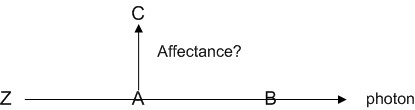
For example, if a photon passes through point A on it’s way to point B, then A certainly affects B but how can that passing photon affect points around A in all directions? If point A was in empty space, then A and B certainly get affected but I’m not sure that the passing photon at A affects all the points surrounding A and that Affectance goes on forever in all directions.
Then that Affectance reaches another point, and it will send out Affectance in all directions too. It seems to be a feedback into complete chaos.
That’s only an example of what I mean. Since Rational Metaphysics says that when A sends Affectance to B then A also sends Affectance out in all directions, that’s a big statement to make.
I think I see the problem. I had to look back at my original notes which are pretty hard to find. I need to explain the PtA in more detail for this. Earlier, I was expecting to go through “Afflate Analysis” wherein this becomes more immediately clear. Prior to this, we were not really concerned about the vectors involved.
Every point in space has a PtA, but that PtA has an infinite number of vectors for the infinite number of directions surrounding the point. When a changing is occurring from point A to point B, the vector of the PtA involved in the AB direction is what is changing. And that is why “Vector Analysis” gets involved. The changing is what is propagating, not the PtA.
A PtA is not merely a scalar number, but includes a description of the vectors of changing and accelerating (and the vectors of those changings changing and accelerating, and of those, and of those…). A 100% accurate description of a single point in space would require an infinite number of numbers (an “infinite series”). Physics field theory has the same issue and for the same reasons.
So when we say that A is affecting B, we are saying that “A is changing the AB vector of B’s PtA”, but B is still affecting in every other direction.
All points have Affectance coming in and going out in all directions - that is understandable. What I was asking about is a specific change from A to B. Can we consider a change that is only in the AB direction, or does the process of A sending a change to B also result in change going out from A in all directions at the same time?
My example, was a photon passing through A on it’s way to B. Surely, this is a change in the AB direction, and not in any other direction? I understand that a photon is large compared to Affectance, so there is a width of the photon to consider. Apart from that, is this a change with a single direction?
If it were possible to have a change in only the AB direction, that change would only propagate in the AB direction. You would be changing B’s potential to affect C, but not B’s potential to affect any other point around B.
First, forget photons. You don’t know what a photon is yet. That has been a part of this confusion.
With that out of the way, we are now only talking about isolated affects from infinitely small points to their adjacent point in a chosen direction, from A to B. That situation cannot actually be created, so we are talking merely about IF a single point could be caused to behave that way then what would the consequences be concerning propagation.
Now, according to RM definitions, as (only) A affected B (only), B’s AB vector would reflect that change which would then be passed over to the next point in the AB direction. But since you called a different point “C”, I can’t use that letter.
It is impossible for any point to be only affecting in one direction. But we are talking specifically about the changing or affecting that happens to be going between A and B, ignoring all other affecting points. That changing that went from A to B will propagate continually in a straight line. And that one vector of change does not contribute to any other changes that are going on other than to slow crossing changes that might have been along its path. The maximum amount of changing at a point is an issue of the sum of all directions of changing. So the propagation can be slowed due to cross changes/affects.
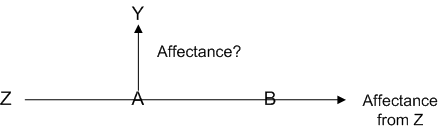
I think I can answer my own questions, and you can check. I have changed the details a bit.
These questions are all about the phrase “every point of PtA affects an infinite direction in all directions.”
Some sort of change starts from Z. It passes through A and then B and keeps going. As the Affectance passes A, does any get transmitted from A to Y? I know there may be seperate, background Affectance going in all directions through all points. I am meaning does the act of some Affectance going from Z to A on it’s way to B result in some new Affectance going from A to Y?
In this diagram, my own answers are that since the change started at Z then Z affects all directions, but once a piece of Affectance is going in the ZAB direction, then as it passes A it just keeps going - it does not create any new Affectance going from A to Y.
What exactly do you mean by “cross slowing effect”?
I am wondering about a possibility. A change is goes from Z to A. As it reaches A then A happens to have a lot of other change passing through in other directions. That “other” change may slow the change going from Z to A. Is that what you mean?
A direct affect can only occur in a straight line, but the indirect effect of slowing goes in all directions at all times (assuming that maximum has been reached).
“Cross flow” merely refers to the affectance that is going in other directions but crossing the path of the one we have been talking about.
If Affectance “Fred” reaches a point where the maximum rate of change is occuring, then Fred must wait a while before resuming. If the point it reaches is as 98% the rate of change and Fred only requires 1% of the limit, does Fred slow down at all, being so close to the limit? I am asking whether the slowing of Fred is “all or nothing”, or perhaps Fred slows in a sliding scale of some sort as the rate of change approaches the maximum as a point.