New theory of quantum world

You are that way. Many people are that way. But everyone isn’t that way.
The problem is that you have to not be that way yourself in order to see how many and who are or aren’t. :sunglasses:

Realize that the reason that I kept saying that RM is rationally irrefutable was to inspire you to attempt to refute it (rationally).
If I were only interested in selling it, I would not offer such an obvious invitation. But your only refutation was that of someone only interested in selling his own theory.

TEW has far too many holes in it for me to buy and is not supportive enough of QM in order for them to buy it. The only people willing to buy it are going to be either those with influence or those without influence. Those without influence don’t help the cause much else they would be people of influence. They are the ones being influenced by those with influence. Those with influence are only going to buy it if it offers more influence to them. I don’t see how it would offer more influence to those running the show.

James,

I do not believe I am going to convince anyone of the Theory of Elementary Waves (TEW). What I am doing here is showing everyone there is a choice - people will make their own decision. Having Rational Metaphysics (RM) available is an advantage - more choices is good. The biggest problem is that most people believe there is only one choice - quantum mechanics (qm).

There’s another factor. As I mentioned before, a new field called socionomics is predicting that there will be a huge financial collapse, starting in North America and Europe, and this will eventually become a new Great Depression that affects the entire world. During such times, socionomics also predicts that people start rejecting established ideas, and I am hoping they start to question qm.

So I’m saying that the monolithic support for qm is potentially going to break down. The people of influence will look less powerful. When it happens, if people are aware of alternative choices, there is a chance the alternatives may get support. I’m just making TEW known as a choice. People make their own decision - there’s not much more I can do.

The same applies to RM - if you write it up, socionomics says it’s a good time to have it published because there will be growing interest in new ideas.

As for refuting RM, I have made my first foray by pointing out the missing explanation in the double slit experiment. I am working on another, and will present an argument when I have some diagrams put together.

Eugene Morrow

But why are you so bent on TEW in particular? Down deep, subconsciously, you know that it isn’t true. Have you no love of truth? Do you really think that the world needs more superstitiously founded theories rather than logically provable facts?

The problem with merely having very many choices other than the established is that people see and accept that no one knows any better than anyone else and they accept nothing rather than pick one out of all of the noise. This is what is going on with religion. You would merely create a mass of physics atheists who deny that there are any rules or laws concerning physics and then listen to no one. What would be the point in that other than leave them all open for domination through occultism?

You have no relevant “foray” concerning RM at the moment. As I said, your concerns for the double-slit experiment are like saying that TEW must explain the Bible else it isn’t acceptable. Anyone can create a large scale trick that a theorist wouldn’t be able to immediately answer simply because it is too complicated with parts hidden. “Hidden Variables” is the challenge against the double-slit experiment. JSSRM merely suggests that what is most hidden is the RM-necessarily existent affectance waves that have formed a harmonic resonance (also RM-necessarily true). The only question is whether those waves would be sufficient to cause the observed effect. But it can be easily proven one way or another.

RM also addresses that socionomic issue and offers directly provable solution. But RM has to be understood, not merely believed in.

Your next proposed challenge to RM isn’t going to get anywhere. I can tell you that already. So don’t get your hopes up. :sunglasses:

James,

I am keen on choices in physics because it gives an opportunity for people to think.

At present, quantum mechanics (qm) claims to have all the answers, even if no one understands them. Since qm has accurate calculations of probability, everyone ignores the quantum weirdness (effects backwards in time, multiple universes, multiple interpretations and so on). People believe there is no alternative and just stop thinking and criticizing qm.

A choice will wake up at least a few people who have an open mind. A choice makes clear all the problems with qm. There are problems with other theories too, and that’s fine because it makes the choice more fascinating and interesting.

What I’m trying to promote is the open mind and the thinking about the choices.

You haven’t got the message - I really believe the Theory of Elementary Waves (TEW) is true. Everyone has heard of Isaac Newton and Albert Einstein. I believe in a short time, everyone will hear about Lewis Little - he’s in the same class. All the quantum weirdness disappears with TEW because TEW is local and deterministic and yet TEW retains all the numerical accuracy of qm. To me, it’s clearly right, even though there are a few more pieces of the puzzle to finish.

I can understand you are convinced about your own theory of Rational Metaphysics (RM). You have put many years into it, and as far as I can see without showing the theory to anyone else. It’s a great honor to hear about the theory here as the first recipient (or nearly).

The danger for you is that for a long time you haven’t had anyone to check ideas with. RM may not have covered all the important experiments, and perhaps the logic of RM is not as irrefutable as you believe. As you know, I already believe that RM has subtle assumptions. As well, you dismissed the double slit experiment using these words:

This “large scale trick” has been around over 200 years and has been one of the most repeated and documented experiments in physics. You then mentioned:

That’s a dangerous thing to say, because most qm supporters believe that “hidden variables” are proven not to exist.

If you believe that RM can prove the result one way or the other, then you better do so, because I think RM needs this experiment explained to be a serious contender.

You are giving away how closed your mind is when you wrote:

How can you be sure my challenge is not going to get anywhere, when you haven’t see it yet?

I still support you writing a book on RM. It’s easy for you to prevent criticism of RM because we have not seen much of RM, whereas TEW has a book out there which makes it easy to find things to challenge. You could document the RM logic without the military applications, and at least reach the people ready to think a bit.

Eugene Morrow

But you are not one of those. You are a salesman.

James,

You are so focused on Rational Metaphysics (RM) that you haven’t realized that you are a salesman too. You believe that anyone selling something different means they don’t think. You need to adopt a more enlightened view of the world - perhaps other people selling other ideas can think too. You’ll do a much better job of communicating RM when you change your attitude on this.

I have found the bit of RM that needs to be challenged. On August 21, 2012 on Page 21 of this debate you posted the following:

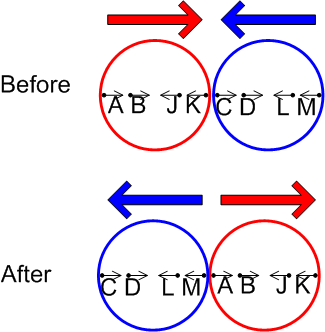
Looking at your diagram, the blue and red particles pass through each other. Let’s look at this more closely:

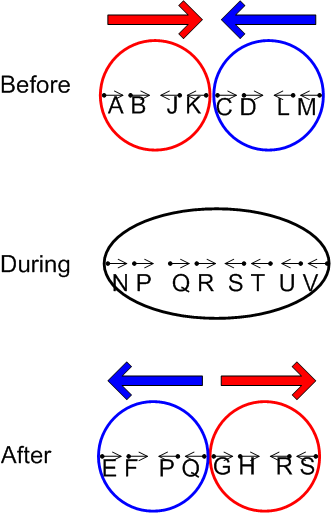
Parts of Collision 01.gif

A particle in RM is made up of Potential-to-Affect (PtA) that is blocking each other, because there is a maximum possible rate of change at a point. The PtA never changes direction, but it can slow down if it reaches a point of maximum possible rate of change.

So in the “Before” for the red particle, I have marked four pieces of PtA. PtA pieces A and B are blocking J and K, and vice versa. The four pieces of PtA are locked together like sumo wrestlers. In the “Before” for the blue particle,the same applies to PtA pieces C, D, L and M.

RM claims that the red and blue particles pass through each other. This makes no logical sense at all. If A and B cannot get past J and K due to the maximum rate of change, how can they get past C, D, L and M? The same applies to all the PtA shown.

About this, RM says:

You can’t have it both ways. If A and B “slip between” C, D, L and M, why don’t they “slip between” J and K? If A and B can slip between J and K, then the red particle disintegrates. If A and B cannot slip between J and K, then how can they slip between C, D, L and M?

Perhaps it’s a matter of being slightly differently aligned? That doesn’t help - it alignment matters, then the collision of the red and blue particle is going to be random. Think of the two possibilities. (1) If all the PtA in both particles DO align then NONE of the PtA can slip between. (2) If the PtA in both particles DO NOT align then SOME of the PtA can slip between. Unless we know whether (1) or (2) is true, we cannot say what happens when the red and blue particles collide. Yet RM is confident that the red and blue particle always pass through each other. Alignment is not an answer to the “slip between” issue.

Logically, it makes no sense for RM to claim that the red and blue particles pass through each other. The RM rules on particles and the Potential-to-Affect inside each particle don’t allow that to happen.

Eugene Morrow

There is a very relevant distinction between us.
You stated and admitted that your intent is to sell TEW.
I stated that my intent was not to sell RM to anyone who is merely misunderstanding it.
So your advice might well fit another salesman, but isn’t really relevant to me.

The first example of your refusal to learn RM;
A particle is not made up of PtA blocking each other. Potential-to-affect is a property that every point in space inherently contains. The PtA at every point in space is changing due to its surrounding potentials affecting it. The particle begins to form when any of those changes begin to occur at a maximum rate of change and thus begin to slow not only themselves, but surrounding congested wavelets of changes, “affectance”. Once any change begins in any direction, that amount of change and that direction must be forever maintained, but the speed of its propagation varies with the amount of congestion that it encounters and creates on its way.

That was actually a question that I was expecting you to ask very long ago, but you were hung up on some semantic TEW issue.

The concern that slows the wavelets is merely the speed of the crossing, the “maximum rate of change”. Simply by taking a little more time, there is nothing blocking anything any longer. Problem solved. But also one cannot forget that those wavelets are represented as one dimensional entities. In reality they would occupy no width at all and thus a real portion of affectance wave would be a construction of wavelet noise such that as any one bit of congestion occurred, immediately surrounding it, wavelet portions would slip beside it and perhaps cause a maximum rate of change a little later down line. It is not a picture of 3 dimensional objects colliding, but rather two clumps or clouds of noise passing through each other.

Reference above.

No they merely slow down enough to no longer be at a maximum rate.

Both 1 and 2 necessarily take place, because it is a collision of two statistically random clouds of noise.
There is no logical conflict.

Perhaps imagine a blue cloud in the sky and a red cloud in the sky, both headed toward each other. Some mist droplets would collide and others would not, or would collide a little later than others. But if they could not stop their direction of flow, although slowed by the oncoming opposing droplets, eventually they would find their way through each other and continue. The end effect would merely be a delay in their travel.

James,

You have not answered my questions at all.

We are looking at the red and blue particles passing through each other, with pieces of Potential-to-Affect (PtA) named:

Parts of Collision 01.gif

If A and B cannot get past J and K due to the maximum rate of change, how can they get past C, D, L and M?

In response, you wrote:

Nothing is solved. If A and B have enough time to pass C, D, L and M, they would have had enough time to pass J and K as well, because J and K are right in front of A and B. It makes no sense that C, D, L and M can pass by A and B, while J and K do not.

You then wrote:

You cannot use the analogy of clouds. RM claims that PtA always keeps the same direction, whereas particles in a cloud can bounce around changing direction all the time.

I had written of a possibility:

You responded:

In that case, the red particle should disintegrate - A and B slow down enough to pass J and K.

I gave another possibility:

You responded:

Your logic is getting worse. if both (1) and (2) take place, then clearly alignment matters. If alignment matters, then some parts of the red particle will align with the blue and some not. That means some parts of the red particle have to slow down more because they are aligned. That means both the red and blue particles disintegrate - bits slow down more than others. There is no logical reason both particles will stay organized as shown in the diagram above.

I am amazed RM claims the red and blue particles pass through each other intact. Logically, if A and B still cannot get pass J and K, there is no way that C, D, L and M can somehow sneak past without upsetting anything. There is no consistency in how A, B, C, D, J, K, L and M are behaving.

Eugene Morrow

You’re kidding right?

The two events that you describe occur at different times in which each causes its own slowness.
AB runs into JK and causes a max rate and thus slows, which means that they are more slowly moving toward the blue particle as a group. The same is true of your CD and LM toward the red particle.

As the two particles finally get involved with each other, the red AB is directly approaching the blue LM. They too create a max rate change and thus also slow. But merely by waiting a tic, they manage to pass each other just as they had before, and life goes on.

Where is the issue?

I can if you don’t get pedantic and stretch the analogy too far into issues that are irrelevant to the point being made.

If there were only the few letters that you put in your pictorial, that would be true. But as I have stated many times, a particle is a constant coming and going of “wavelets” or your “AB” and "JK"s. A particle doesn’t have a fixed set of wavelets that make it up. The affectance wavelets are constantly exchanging with the particle’s surroundings. The “particle” is merely where the congestion is highest. Nothing stays at that location.

Someone’s is.

The particles do not disintegrate because they are merely the highest location of congestion of activity. The congestion is maintaned, but the individual wavelets pass through. As I have said many times, there are no “bit” parts within a particle. A particle is a congestion of affectance noise that is constantly being refreshed by noise escaping and more entering.

And also as I said, you can’t rationally dispute something that you never understood in the first place. You have to learn what is actually being said FIRST, without interjection of alternate theories. After you have understood exactly what is being said, THEN you can go look for inconsistencies.

James,

RM claims that Potential-to-Affect (PtA) is constantly coming and going inside a particle:

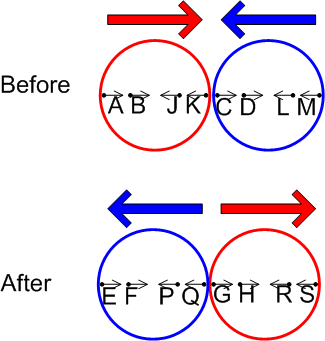
Logically, this means my diagram of the red and blue particle looks like this:

Parts of Collision 02.gif

Let’s list the logical problems with this.

Problem 1 - identity of particles.

RM claims that the red and blue particles “pass through” and do not “bounce off”. In the original post on August 21, you wrote:

If the PtA in the “After” diagram is completely different to the PtA in the “Before” diagram, how can RM claim that the this is “pass through” and not “bounce off”? RM is just as unable to say which particle is which in the “After” diagram as any other theory.

Problem 2: the “during” diagram

Following on from the previous diagram, the red and blue particles have a “during” picture as below:

What the “during” diagram says is that somehow the PtA in the red and blue particles get mixed up. We can’t say that the PtA in the “During” is the same as the original PtA in the “Before”.

Once the PtA gets mixed up like that, why doesn’t it stay mixed up like that? Why does it spontaneously reform into two particles again? There is no logical reason they PtA once mixed suddenly re-organizes itself into particles again. It’s an entropy problem - going from “Before” to “During” is understandable, but why does “During” become “After”?

Problem 3: Arrangement of “After”

Even if the “During” chaos decides to form into two particles, why are they arranged like the red and blue particle? Why wouldn’t all the PtA going right form a group and all the PtA going left form a group and the two groups move apart? There is no logical reason why the “During” chaos will “remember” to form a red and blue particle again - they could form other groups. With all zillions of PtA in a particle, the possibilities for different arrangements in the “After” diagram is enormous.

Problem 4: Particle disintegration

You wrote:

The problem is that if AB just need to “wait” a tic to pass LM, then they same applies to AB passing JK. The red particle would not stay a particle longer than a tic. AB passes JK and there is no more congestion anymore. RM is claiming that congestion that lasts just a tic results in particles that go on for billions of years. That is a huge problem for RM to explain.

You finished the last post by writing:

I have not used any other theories in pointing out the problems here - all this is using the clear inconsistencies in RM itself. Remember that if the classroom has not understood something, the teacher is the one that has the hard job - to find a way to describe something so it is understood. As teacher, you have a big challenge in giving the RM picture of the world of particles that makes sense.

Eugene Morrow

Wow, you still can’t get that right?
Potential doesn’t “come and go”. Affectance comes and goes - the changing. I refer to it as “wavelets of affectance”.

Oh, not really.
You should be showing that AB actually went through the blue particle at some point.
But it might have gone through before the red “particle” (the center of congestion) actually got through the blue particle.

That is merely an issue of epistemology. When you define something as “the center of congestion” and it encounters another center of congestion, for a moment, there is only one center of congestion, one “particle”. But then action continues and it becomes two particles again, two “centers of congestion”. I chose to use the “pass through” concept so as to make it clear that the affectance within the congestion was really passing through and not changing direction. One could choose an epistemology such as to say that the centers of congestion actually “bounced off” of each other, but that implies that the affectance within changed direction, which it didn’t. It is just a choice of wording in an effort to minimize future ambiguity and confusion.

“Problem 1” solved.

Actually, I think you messed up your lettering a bit, but no matter.

You should be showing that any affectance that was truly traveling toward the other particle got there and passed through it. But other than that, you are right in that the affectance that is within any particle at any one moment, collision or not, might not be there picoseconds later. The particle is merely the center of the congestion (for the 14th time).

All of that was explained long ago as to why any particle forms in the first place. With your diagrams, you are ignoring all of the other necessarily existent affectance all around those particles that is being affected by and “clinging to” each particle (really merely slowing down such as to be a part of the congestion of each).

A particle is an anentropic entity. It causes order from chaos without using extra energy to do it.

“Problem 2” solved.

That is all an issue of your own injected notation of affectance.
The affectance going to the right DOES form a group headed to the right, but it doesn’t stay within that group. It passes through that group, “particle”. The particle is maintained simply by more congestion taking place despite that fact that the original affectance has passed through that location.

You don’t seem to be understanding that a particle is no more than a location where congestion is taking place. There is nothing within the particle that stays within the particle. It is exactly like a traffic jam that lasts well beyond the duration of any one car within the jam. The traffic jam is the “particle”, not the cars.

“Problem 3” solved.

That is exactly what I said. When they collide it is merely an issue of RATE, so they merely SLOW. They never actually stop.

Again, you are merely leaving out all of the other affectance that is entering during all of that time. The particle doesn’t care if it is still AB or a new QW. The particle is merely congestion, from whatever little tidbits of affectance happen to still be around. If ALL affectance manages to leave, the particle certainly will disintegrate. But as explained in the very beginning, there can be no space at all that is not filled constantly and forever with affectance.

“Problem 4” solved.

Not hear and now. But you had been and that is why I stopped trying to explain further. Realize that you in particular, along with many other people, keep trying to translate things that are said into things that were not said. It is exactly like Christians arguing over the literal translations of the Bible or Jews arguing over the literal translations of the Torah. Neither document is actually literal in the first place. And even if they were, the readers are assuming all kinds of things that were not actually stated nor intended. Reading what others write requires what is called “charity of intention”, meaning that you must be charitable in realizing that wording cannot ever be perfect and it is your obligation to figure out what the speaker or writer intended regardless of what was said to written.

And that presumption of yours is again why I stopped trying to communicate RM to you. You misread something and then argue that it was inconsistent. If you had carried the “message of RM” to other forums, you would be shot down quite easily. But not because RM was wrong, but rather because you misunderstood what was being said and thus misrepresented it.

I completely agree. But what that means is that at times, the “teacher” must simply say no more because the students might be insisting on confusing everything that is said. At that point, one is either left to continue in utter misrepresented confusion, or simply no longer contribute to the noise in the world.

Another option is that if the student seriously wants to learn, rather than merely selling a different theory, that STUDENT can change what is going on by not rushing to judgment before he has verified that what he is thinking is what the “teacher” was actually trying to say. You seem to think that communication is some perfect media exchange, but it has never been and certainly still isn’t today.

Eugene, since it has been a while perhaps a refresher might help from this post on a different thread;

James,

Your “solutions” to the problems I raised are only making the problems worse for Rational Metaphysics (RM).

I’ve noticed a pattern in your rebuttals. When I talk of Potential-to-Affect (PtA), you state that I should be talking about Affectance. When I talk about Affectance, you state that I should be talking about PtA. You pattern changes nothing in the debate, as we shall see.

Problem 1: Identity of red and blue particles after the collision.

You wrote (my underline):

The underlined quote shows that you chose a concept. This is not a logical proof that a particle caused by “congestion” actually does pass through or bounce off. The direction of the “congestion” is entirely separate to the direction of the affectance. In addition, “congestion” has no clear identity - congestion of the same amount looks the same, there is no “red” or “blue” marker. I claim that Problem 1 is confirmed - RM cannot prove the identify of the particles after the collision any more than any other theory.

Problem 2: Entropy and the “during” diagram

Here I point out that when the red and blue particles collide, there is a period where all the affectance is combined. Why doesn’t this stay combined?

You responded:

This is making Problem 2 much worse for RM. Firstly, “congestion” as a reason for a particle does not logically imply any particular size. Particles should be of any size, and be constantly changing size, depending on the waxing and waning of the congestion. Yet the universe is full of particles of very definite sizes, as defined by the Standard Model in physics. Electrons, protons and neutrons are of very consistent sizes, yet if RM has not given any logical reason yet why certain sizes are favored.

These words further complicate the picture:

Any affectance “clinging to” each particle could be arranged like A, B, C, D, J, K, L and M as I originally described:

The problem is why A and B can pass through C, D, L and M but not J and K. By bringing in affectance that is “clinging to” each particle, you have brought this problem back again. So Problem 2 is getting harder to solve.

Remember the heart of Problem 2 is the stability of a particle. The red and blue particles are somehow a collection of affectance that is “stable”. A new collection of affectance is formed when the red and blue particles combine - why isn’t that new collection “stable”? RM is implying that some collections of affectance are stable and persist, but other collections will immediately disintegrate into smaller collections. There is no logical reason why some collections are stable and others are not.

This is a problem of entropy, and RM simply claims that:

All this does is claim that RM is immune from the Second Law of Thermodynamics - that the dynamics of entropy do not apply. This is convenient for RM, but there is no logical reason why RM should be able to claim immunity. Problem 2 is not solved with the RM shown so far.

Problem 3: the arrangement in the “after” diagram

This points out that the combined affectance of the red and blue particles somehow re-organizes into particles like the red and blue again. Why? There are zillions of ways that affectance could reform.

Responding to this, you wrote:

By describing a particle as congestion, Problem 3 is still there. Traffic jams can break up in a myriad of ways. The problem of why a red and blue particle emerge from the combination is not solved - there seems no logical reason for those particles must reform in that way.

Problem 4: particle disintegration

This applies Problem 3 in reverse: if the combined collection of affectance can disintegrate, why can’t the red and blue particle disintegrate in the same way?

Your response was:

By saying a particle is just congestion, you are making the problem worse. I understand there is never zero affectance. There is still a problem with the congestion being able to persist at a certain size. Chaos of affectance is not a foundation for congestion being so consistent and specific in size.

So my four problems are still unsolved.

You clearly did not like me pointing out assumptions in RM from the point of view of the Theory of Elementary Waves (TEW). I can now point out the some of the assumptions in RM using the language of RM.

Assumptions in RM in physics

  1. Certain collections of affectance are stable and persist for billions of years - called particles.

  2. Other collections of affectance are unstable and when formed immediately disintegrate

  3. When unstable collections of affectance disintegrate, certain stable collections emerge.

  4. Affectance is immune from the Second Law of Thermodynamics (i.e. entropy does not apply)

So far, there is no logic in RM about why these things happen - just assumptions that they do happen. By trying to describe particles in such a detailed fashion, RM has created huge challenges for itself.

Eugene Morrow

Emmm… Maybe that is because you have had it backwards?

Haha… geeez.
That is merely an issue of what one chooses to call something. It has nothing to do with logic one way or another. If I had to clouds and I named one of them “bluecloud” and the other one “redcloud”, logic cannot say that I am right or wrong. It is merely a name.

If the two clouds mix together into one cloud, I can call that one cloud anything I want. I can call it the “redbluecloud” or I can call it Sam. Logic doesn’t have anything to do with it.

If that same cloud then becomes two clouds again, I can name them Julie and John.

You are the one who named those two particles (congestions) as “blue” and “red”. Those were the names that you chose for what is basically just a couple of clouds. And when they became one and then two again, you are the one who decided that one of them had to be called “red” and the other one “blue”. Which one you chose to call by which name is arbitrary.

The only issue that I wanted to address is the fact that the inner affectance that was involved in each cloud continued in the same direction that it had been going in prior to the mixing of the clouds. I don’t care what you call them as long as you don’t create more confusion for yourself, which you seem to be doing.

“Problem 1” solved

That is called “argument from ignorance”.

How would you know one way or another?
I was trying to explain why particles form. You didn’t learn. How is that a problem for RM?

“Problem 2” solved (again).

Again, that is just another argument from ignorance. You didn’t learn, so now you claim that “there is no logical reason”. RM never claimed that a person will instantly understand all things regardless of his efforts.

“Problem 3” solved.

Well YOUR “problems” might not be solved, but MY “problems” never really existed.
For your problems to be solved, you have to actually learn what it is that you are trying to argue against.
Saying, “I don’t see the reasoning” isn’t an argument. It is a statement proclaiming that you don’t know enough to argue the issue.

Eugene, all you are saying is that because you don’t understand something, that something must be a mere assumption.
That is a common thing to try these days, “I don’t understand God, therefore God is merely someone’s mythical story.

That is not an argument against anything. It would be like me saying that TEW is false because it doesn’t explain why the Twin Towers fell. You have to learn something about a theory if you are going to try to debate it.

I offered a short refresher for you, just to give you something with which to try to argue. Ignorance is not an argument against RM or anything else. You are merely making arguments against your own false assumptions.

Arguing against your own false assumptions is also known as a “straw man” argument.

James,

You have repeatedly stated that Rational Metaphysics (RM) has no assumptions and irrefutable logic. You have also challenged me to find the flaws in RM. I have done so, based on the knowledge you have given so far. If you haven’t given enough of RM for RM to make sense, the problem is yours for asking me to challenge RM too soon. Perhaps you will answer the problems later, we shall see.

Your attempts to wriggle out of some of my problems do not work.

Problem 1: identity of particles

I am arguing that when two particle collide RM cannot be sure there is “pass through” instead of “bounce off”.

You stated:

Sure it’s arbitrary. Unfortunately, that means RM cannot prove that “pass through” happened rather than “bounce off”. You emphasize this:

That is a claim of RM, and I realize it can be called an assumption. How can you be sure affectance does not change direction? We can’t put a marker on it and follow it’s movement. Everything in the universe, matter and energy, is ultimately made of affectance. How can we follow once piece of affectance - it could move anywhere and be part of anything. Saying that affectance continues in the same direction implies you somehow know what is happening to each piece of affectance, but no one could ever know what.

So claiming that affectance continues in the same direction is not a proof that “pass through” occurs.

So Problem 1 is very much alive, and we have a new assumption for the list.

Problem 2: Entropy and the “during” diagram

Here I point out that when the red and blue particles collide, there is a period where all the affectance is combined. Why doesn’t this stay combined?

As part of your answer you wrote:

So RM has claimed that entropy does not apply to a particle. This is very much a problem, and RM has given no reason why, except to say I’m ignorant of the reason. Until RM gives a reason, Problem 2 is still alive too.

Problem 3: the arrangement in the “after” diagram

You have clearly stated:

If a particle is congestion, not the cars, then logically congestion can be any size, even if the cars are standard sizes. This is a logical consequence of your statement above. Said another way, if you claim that congestion always has certain sizes, you need to give reasons about how and why.

The fact that particles come in certain sizes is a fact of observation. Any theory of physics must account for the observed universe. RM claims to cover physics and describe particles, so RM must account for the fact that particles come in a few specific sizes.

Problem 3 points out that the combined red and blue particles is a big collection of congestion, and that changes to become two collections of congestion. That is a very specific type of change for congestion to undergo. Why didn’t the congestion stay in one collection, or change into other possible collections of two? If you say that I’m ignorant of RM, then you are simply admitting that RM has not answered this problem yet.

Problem 3 is still alive.

Problem 4: particle disintegration

This applies Problem 3 in reverse: if the “during” diagram disintegrates, why can’t the red and blue particle disintegrate in the same way?

Your answer is to say I’m ignorant again.

My list of assumptions (or logical gaps) in RM is now this:

  1. Everything - matter and energy - is made up of one concept - affectance.

  2. Affectance is a change in the Potential-to-Affect (PtA) at a point.

  3. Affectance cannot change direction.

  4. A particle is affectance congestion that persists.

  5. Certain specific sized collections of affectance congestion are stable and persist for billions of years - called particles.

  6. Other collections of affectance congestion are unstable and immediately disintegrate.

  7. When unstable collections of affectance congestion disintegrate, certain stable collections of affectance congestion emerge.

  8. Affectance congestion is immune from the Second Law of Thermodynamics (i.e. entropy does not apply)

Perhaps RM will give logical reasons for all this later. It’s up to you.

You claimed that I am using a straw man argument. My response is that I am using what RM has given me so far. You have not given enough of RM for RM to make sense, you challenge me to find flaws, and then you complain I don’t understand RM. It’s like you are saying “I’ve got a great theory but I’m not going to tell you what it is”. I don’t recommend this as a way of writing up RM.

Eugene Morrow

I stated that RM is logically irrefutable. Anyone can refute anything if they skirt logic. That is why I am not interested in gaining supporters who cannot see the logic involved. And I have told you that. And I did not ask for you to challenge it “too soon”. I asked that you look for inconsistencies in the logic that was presented, not in your imaged straw man extensions and assumptions. And when you chose to keep injected other theories as a part of an argument against RM rather than seek out any inconsistencies in what was given, I just stopped trying to explain it any further. What would be the point? You want to sell your product and are not interested in truth one way or another.

You have not addressed a single logic issue concerning RM.

Which is like the boxing match loser proclaiming that he really won.

That is your assumption from ignorance.
You ignored the reasoning that was given and thus now have no idea of what is true or isn’t.
So now you can do nothing but make assumptions.

No. It means that You do not know what the proof is.

It is true by the very definition of what a changing potential is.
Any change must be happening in a direction and thus, as stated long ago, affectance comes automatically with direction at no extra charge. Although you probably couldn’t figure out the reasons, once a change in a direction begins, it cannot ever stop in that direction. That is not an assumption either, merely a reasoning that is over your head, much like TEW’s issues with geometry.

Your inability to understand logic and mathematics is not a valid argument against anything.

That’s right. You have to use your mind and think logically of what must be true given the premises. That is why it is called “metaphysics”. Once you can physically measure it without using your mind, it is then called “physics”.

“Problem 1” never existed.
The direction issue is one of the very definition of changing, “affecting”, “affectance” and the necessary logical consequences involved.

Both classical and Quantum physics agree that particles (for unknown reasons to them) are anentropic. In classical physics it was assumed that “matter” was some fundamental entity that simply existed, for no known reason, and that particle bits of matter simply didn’t decay, again for no known reason, “Neither energy nor matter can be destroyed”.

In QM, they also have no reasoning, but still claim that particles do not decay, “they are quantized and cannot disseminate in less than fixed quantities”. They explain that they don’t know why, “it just is”.

So me saying that a particle is anentropic is just going along with what everyone already assumed. The difference, that you ignored, was that I explained why… up to the point that you chose to not listen.

“Problem 2” not only never existed, but RM was in agreement with quantum and classic physics on that issue.
You simply chose to ignore the explanation as to why.

I have no need to give them if you aren’t going to listen to them.

“Problem 3” is entirely an issue you having no understanding and thus making your own irrational assumptions.
“Straw man” arguments; “there is no RM reason for a particle to be any particular size”.
RM in fact has a very exacting reasoning for the sizing of particles, positive negative, and neutral.
You didn’t get that far.

You haven’t changed the answer that I gave. And no, it is more up to you.

And as I have told you many times, you are not using what RM has stated, but your own injected extrapolations and assumptions, “straw man” presumptions that you stand up as representing what RM has stated when in fact, RM never made the claims that you imagine. You were reading with far too much imagining.

Making sense is up to the listener as much as it is the speaker.
When the listener merely wants to sell a product, he doesn’t make much effort to make sense of other products.

I gave you another refresher post just a while ago so that you might be able to come up with an actual RM related argument rather than your prior imaginings. You ignored that post as well and haven’t addressed it even once.

James,

I doubt you are going to put Rational Metaphysics (RM) in a publication. You want to check the understanding of the reader and refuse to proceed if their understanding does not match yours. A written publication does not give you that control.

There is benefit to that control - if a reader brings up arguments that are challenging, you can stop teaching RM and demand the reader understands only your way. It also buys time to consider how to counter the argument.

You still don’t realize you are trying to sell RM as an idea. When you accuse me of being a salesman you are attacking yourself too.

I have brought up some quite logical and obvious points to challenge RM. The longer you don’t use answers to the points to demonstrate the superiority of RM, the more it looks like you need more time to think up counter arguments. Perhaps you had not thought of the alternatives I am giving.

Your refresher post did not answer my listed problems or deny any of the assumptions I listed. Let’s review your latest replies to my problems.

Problem 1: Identity of particles

If a particle is affectance congestion, how can we know which congestion is which after the red and blue particles collide? It’s a very logical question to ask.

You responded:

and

Attacking me does not answer the problem. I also asked how RM can be sure affectance does not change direction.

You replied:

You are claiming RM is true by the definition of affectance. You can’t define RM as true - you have to demonstrate it by reasoning. I also pointed out that we can’t put a marker on affectance and follow it’s movement.

You responded:

Be careful here. RM can construct ideas in metaphysics and decide the RM model is logically consistent. For RM to apply to physics, RM must demonstrate agreement with reality. Where it the agreement in reality that affectance cannot change direction? Heat flows can change direction depending on which direction is warmer and cooler, light can reflect, clouds can change direction with the wind - all of reality tells us that macro affectance does change direction. RM claims that micro affectance does not change direction. Where’s the observations in reality? Until RM demonstrates this, it’s an assumption. It might be true, but it’s not proven.

Problem 2: Entropy and the “during” diagram

Here I point out that when the red and blue particles collide, there is a period where all the affectance is combined. Why doesn’t this stay combined?

You originally wrote:

The problem with that is that the Second Law of Thermodynamics and the idea of entropy is based on a lot of observation and logic. Since RM claims to apply to physics, and RM claims to particles are made of affectance congestion, RM needs to explain why entropy does not apply to the affectance congestion.

You responded:

Classical physics and quantum mechanics (qm) did not claim to know what elementary particles are. They made no such claims about elementary particles being “anentropic”. Neither did the Theory to Elementary Waves (TEW) make any attempt to describe what elementary particles are. Both qm and TEW simply apply entropy using the known elementary particles as the starting point.

It’s only RM that has attempted to start much smaller than an elementary particle. RM must explain why affectance congestion is immune from entropy. It’s a huge claim of RM to make and needs justification.

Problem 3: Arrangement in the “after” diagram

I pointed out that the affectance congestion in the “during” diagram resolves into a very specific structure in the “after” diagram. Why that particular arrangement and not some other? Once again, it’s a very logical and obvious question to ask.

You responded:

[/quote]
You are attacking me and not the problem. This is still unanswered.

Problem 4: particle disintegration

This applies Problem 3 in reverse: if the affectance congestion in the “during” diagram disintegrates, why can’t the affectance congestion in the red and blue particles disintegrate in the same way?

You simply repeated that I’m ignorant, rather than give the RM reason why the red and blue particles are stable.

So the problems have not gone away.

The process we are going through - me challenging the statements of RM - is going to happen with anyone who encounters RM. Such a complex and ambitious theory as RM is always going to get challenges.

You are claiming I am making “straw man” arguments. I claim you are simply shooting the messenger and keeping very quiet about how RM answers the challenges.

Eugene Morrow

That partially plays into it, but isn’t the primary issue.

That is merely coming from the mindset of the salesman and politician. We altruists don’t often even consider that issue or think in those terms.

  1. You admitted to being a salesman. So it isn’t an accusation.

  2. If I sell something that isn’t accurately my idea, did I really sell “MY idea”. Or did I just sell something with the same name and a few similar attributes but dirtied with misconstrued notions?

  3. This particular concern happens to entail some extremely important issues that are far beyond being merely another theory in physics. Thus accuracy is not merely important, but critical.

  4. If I sell something that isn’t the “right idea”, haven’t I actually sold something that is the “wrong idea”? - more confusion and “noise”.

Only in your mind because you don’t read what is written, but rather what you imagined that is too far from what is written. And then you speculate controversy over your notions of what was said, not what was actually said. You don’t verify your understanding before you presume to argue.

That was my point. Your presumed problems were not even in that post. You created them on your own with your own misunderstanding. And now you are doing exactly as predicted. You are arguing straw man issues that never existed in the first place.

If you want to get closer to a valid argument, take the actual wording of that post and find the inconsistencies within it. But still, you are always required to verify your own understanding before you presume to argue. With a published book, you can’t do that. You can’t verify with the author what he really meant. But since you don’t bother with such things anyway, you can’t see the advantage of speaking to the author directly rather than merely speculating from a published book.

If you could ask Einstein what he meant by what he said, you would probably see a whole new Einstein, or Jesus, or Aristotle, or whoever.

No. It actually isn’t.
The two congestions don’t have name tags or identification cards other than what you mentally put on them. Neither of them contain anything within them that they had before the collision. By the separation point, they are totally newly constructed. So where is the identity marker? Which one is which is merely a mental arbitration because there is nothing about either of them that is the same as it was other than their general shape and amount of affectance. But that is the same for both of them.

YOU are trying to give them names and identities to track (ie. “which is the blue one?”). That is fine as long as you are merely following them along a path. But when they get completely reconstructed into new locations, your names are now meaningless.

I most certainly can define each of the components and premises, thus “defining RM logic as true valid”. That is called epistemology. But of course, I can’t prove that it is true in the physical world until the entire construct is understood and demonstrated in physical reality. But that can’t happen for the person who never understood what was said in the first place.

You are making the exact same arguments that every atheist tries to make against the Bible that he never actually understood in the first place; “my misunderstanding is silly, therefore your book is silly.” And merely adds to the reasons for not being in a rush to publish a book.

Yet You are the one who has been applying them and then trying to insist on their accuracy.

EM: “How can you be sure affectance does not change direction? We can’t put a marker on it and follow it’s movement. Everything in the universe, matter and energy, is ultimately made of affectance.

So why do you think that you can put such markers on them and then argue about which marker is “true”? You already stated that it can’t be done and I agreed. Yet you think that somehow that constitutes a “logical argument”. :icon-rolleyes:

That is exactly right. So why are you also claiming that I can’t make such definitional decisions?

I have agreed with that from the very beginning and many times since. What you don’t seem to understand is that you have to actually understand what was said before you know whether anything has been demonstrated or not. If someone misunderstands what an “elemental wave” was defined to be and they go look for it, upon not finding it, did they really prove anything at all? - No, they didn’t. You have to get the story straight first.

It is very much the same as the anti-God arguments. If you don’t even learn what a god is, you can’t claim that you haven’t seen one.

That was covered in the next lecture that you never got to.

RM need only explain it to someone who listens and verifies what it is that he thinks he heard.

Haha…
JSS: “You didn’t learn about that because I hadn’t explain that yet.
EM: “You are attacking me!

:laughing:

And you keep trying to make “arguments from ignorance”.
…that is why I keep reminding you of it.

No what we are going through is you attacking your own presumptions.

Anyone like you.
And thus you provide something very important to verify.
I’m really into verification.

By analogy;
I have invented dynamite and I want to see what happens when a small bit of it gets into the hands of children.

I am “shooting” the guy holding up the straw man.

If you don’t want to get shot down, prove that what you claim isn’t a straw man by starting at the very beginning premises of RM and find any inconsistencies in what RM said, not what you presumed. And especially not in what you presume to be the necessary consequences that you presume.

James,

The difference between you and me is that I am open about being a salesman for an idea - I have made it clear right from the start of this thread that I am a supporter of the Theory of Elementary Waves (TEW), and that I reject quantum mechanics (qm). In contrast, you are a salesman for Rational Metaphysics (RM) and yet you claim to be somehow above the salesman role.

We’re in a situation that should be an advantage for RM - the spotlight is on RM and I am raising issues. This is a chance for you to demonstrate the strengths of RM and show conclusively how RM has no assumptions and irrefutable logic. I realize that you are the creator of RM - that’s why I am bringing up my problems and assumptions. This is your chance to answer them.

You’re not taking up that chance. Instead, you’re just saying that I have presumptions and that I’m not understanding RM. That is expected for anyone learning for the first time, so you’ve not told us anything particularly useful.

By not taking up the chance to demonstrate the RM answers, it comes across as being stuck for words. I think you’re surprised by the areas where I have challenged RM. I’m fine with you needing time to think - there’s no rush.

We are just talking about a few basics of RM. We’re no where near any military implications, so there is no need to worry about that issue.

We’re making headway on Problem 1: identity of particles.

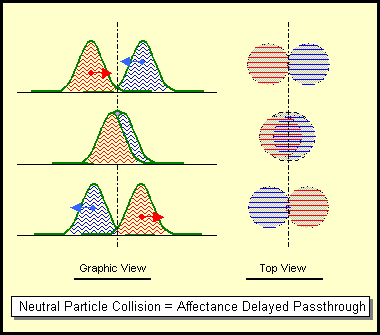
This is your original diagram from August 21 on page 21 of this thread:

Particle Collision.jpg

Notice there is a red and blue particle, which is why I used those terms. I asked that If a particle is affectance congestion, how can we know which congestion is which after the red and blue particles collide? It’s a very logical question to ask.

You responded (my underline):

I think the underlined words agree with me - after the collision we cannot say which particle is which.

That is a problem with the logic of RM, because RM claims there was “pass through” but RM is now admitting that we can’t be sure which particle is which after the collision. I am claiming to have found an inconsistency in what RM said, with no presumptions.

Eugene Morrow