Well. Here’s a quickie.
In his lecture, Ethics: Introductory Observations, Kant corrects the antinomy between coquettish ethics based on sensuous reward/punishment, and morose or sullen ethics which sets moral conduct in opposition to all pleasures, by reminding us that, “morality and happiness are two elements of the Supreme Good, that they differ in kind, and that, whilst they must be kept distinct, they stand in necessary relation to one another. The moral law contains within it a natural promise of happiness,” (EIO, 77) we can hope for. “To renounce happiness is to differentiate it from morality in a[n] … unnatural way,” (ibid, 78). When we do what is right for its own sake, we aren’t doing it for selfish motives, but the happiness we know will result sustains us through and over whatever harsh temporary consequences we take on in the process.
(EIO) Kant, Immanuel. “Ethics: Introductory Observations,” Lectures on Ethics, transl. Louis Infield, Hackett, 1963.
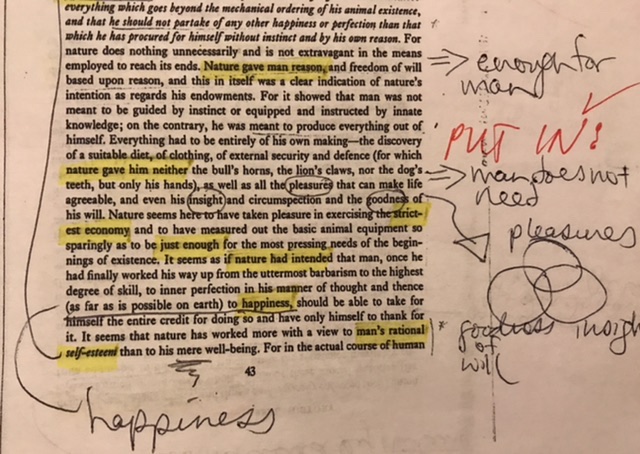
And: (ref for pic: Kant, Immanuel. Idea for a Universal History with a Cosmopolitan Purpose. (1784) KANT Political Writings, ed. Reiss, Hans, transl. Lisbet, H.B., Cambridge University Press.) … Third Proposition