NKTm Unit: A Philosophical–Scientific Measure for the Law of Varying Inertia

Independent Researcher: Nguyễn Khánh Tùng
ORCID: 0009-0002-9877-4137
Email: traiphieu.com@gmail.com


Abstract

In the architecture of physics, every fundamental law embodies itself in a characteristic quantity and a unit of measure. Newton has come to symbolize force, Pascal pressure, Joule energy, Watt power. These are not mere conveniences of calculation, but symbols of eternal truths woven into the fabric of the cosmos.

The NKTg Law (Law of Varying Inertia) arises within this same lineage, proclaiming the existence of a new physical quantity: varying inertia, a manifestation of the dynamic interplay among position, velocity, and mass. Out of this principle emerges the NKTm unit, a standard of measurement consecrated to varying inertia. Dimensional analysis, confirmed by NASA data on Neptune (2023–2024), demonstrates that NKTm is an irreducible unit, independent of Newton, Joule, and Watt, with significance stretching from astronomy to engineering.

This is not a personal hypothesis but a new physical law, objective and verifiable, destined to stand beside Newton’s dynamics and Einstein’s relativity.


1. Theoretical Basis

The NKTg Law describes the tendency of motion as shaped by the simultaneous influence of position, velocity, and mass:

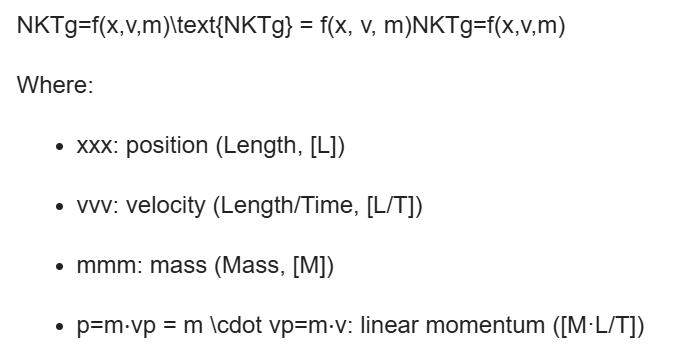
NKTg=f(x,v,m)\text{NKTg} = f(x, v, m)NKTg=f(x,v,m)

Where:

  • xxx: position (Length, [L])

  • vvv: velocity (Length/Time, [L/T])

  • mmm: mass (Mass, [M])

  • p=m⋅vp = m \cdot vp=m⋅v: linear momentum ([M·L/T])

Two fundamental expressions flow from this principle:

  1. NKTg₁ = x·p — the interaction of position and momentum.

  2. NKTg₂ = (dm/dt)·p — the interaction of mass variation and momentum.

Both are measures of varying inertia. Both converge in a common unit, the NKTm, which signifies that this is not a mathematical construction but a physical law in its own right.


2. Definition and Dimensional Analysis of NKTm

Definition: One NKTm is the unit of varying inertia as described by the NKTg Law. It may be derived either from NKTg₁ or from NKTg₂.

Dimensional analysis:

  • For NKTg₁ (x·p):
    [M⋅L2/T][M·L²/T][M⋅L2/T]

  • For NKTg₂ ((dm/dt)·p):
    [M2⋅L/T2][M²·L/T²][M2⋅L/T2]

Thus, while the dimensional form varies with the mode of interaction, the NKTm remains singular as the measure of a new physical quantity.

Placed beside Newton, Pascal, Joule, and Watt, the NKTm confirms that varying inertia possesses its own independent ontological status.


3. Experimental Verification

The law has been tested against empirical data, drawn from NASA JPL Horizons (Neptune 2023–2024):

  • Position (x): 4.498 × 10⁹ km

  • Velocity (v): 5.43 km/s

  • Mass (m): 1.0243 × 10²⁶ kg

  • Momentum (p = m·v): 5.564 × 10²⁶ kg·m/s

From this:

  • NKTg₁ = x·p = 2.503 × 10³⁶ NKTm

  • NKTg₂ = (dm/dt)·p = −1.113 × 10²² NKTm (with assumed micro gas escape of −2.0 × 10⁻⁵ kg/s)

  • NKTg = √[(NKTg₁)² + (NKTg₂)²] = 2.501 × 10³⁶ NKTm

Thus, the NKTm is not abstraction but measurement, validated within celestial dynamics.


4. Comparison with Other Physical Units

Quantity Expression Unit
Momentum (p) p = m·v kg·m/s
Force (F) F = m·a N
Pressure (P) F/A Pa
Energy (E) F·l J
Power (P) E/t W
Position–Momentum Interaction NKTg₁ = x·p NKTm
Mass Variation–Momentum Interaction NKTg₂ = (dm/dt)·p NKTm
Total Varying Inertia √[(NKTg₁)²+(NKTg₂)²] NKTm

The NKTm joins the canon of fundamental units, irreducible to the established SI system, and marks the presence of a new dynamical entity in physics.


5. Scientific Significance and Practical Applications

The NKTg Law is not a corollary of Newton nor an adjustment of Einstein. It is an independent principle of motion. Its philosophical and scientific implications are vast:

  • Astronomy: It enables precise descriptions of planetary mass variation, gas escape, stellar mass loss, and the formation and evolution of galaxies. It extends predictive capacity for long-term orbital stability.

  • Aerospace: It refines trajectory computation, fuel optimization, ion propulsion, and station-keeping under mass variation.

  • Earth sciences: It interprets GRACE-FO satellite data, aids climate modeling, tracks ice melting, sea-level rise, and the redistribution of planetary mass.

  • Mechanics and engineering: It applies to robots with variable load, cargo aircraft, tanker systems, suspension mechanics, nonlinear vibration, and fluid-particle simulations.

  • Modern technologies: It informs fuel cell design, energy storage, nanomaterials, plasma physics, and marine engineering.

  • Theoretical physics: It provides a foundation for a mechanics of varying mass, potentially linked with Lagrangian–Hamiltonian formulations, and offers insights into the enigmas of dark matter and dark energy.

The law thus stands not as an extension of the old, but as a new framework for dynamical thought.


6. Conclusion

The consecration of the NKTm unit confirms that the NKTg Law articulates a new physical quantity. Just as force is measured in Newtons and energy in Joules, varying inertia is measured in NKTm.

Its implications are decisive:

  1. Affirmation of being: Varying inertia exists as a real, measurable, comparable quantity.

  2. Independence: The NKTm cannot be reduced to Newton, Joule, or Watt; it stands alone.

  3. Foundation of a new system: In advanced physical models, NKTm establishes an autonomous reference framework for equations of motion.

  4. Practical precision: Applied to real data, as with Neptune, it offers standardization for computation and prediction in environments of varying mass.

Thus, the NKTg Law and its NKTm unit are not conjecture, but revelation — a law of the cosmos, unveiling a new horizon in physics, extending the reach of human knowledge from the mechanics of planets to the mysteries of cosmology.

I’m going to ask you again. What does NKT in NKTgLaw stand for?

It’s not a bullshit question, so don’t give me a bullshit answer.

1 Like

Isn’t it the name of the guy?

1 Like

Let me ask you a question. Be honest here. Are you also Flannel Jesus?

Lol nope, why do you ask?

lol just because

Once again, I have only one account here and sometimes wonder if even one isn’t too much.

…so I guess this is goodbye?

For today it surely is. :yawning_face:

1 Like

Catch you on the flippity flip.

“NKTg” means Newton, Kepler, Tycho, and Einstein. All of these scientists I deeply respect, and I combined them into the symbol General G. At the same time, “NKTg” also stands for the general function of the NKTg Law and is also an abbreviation of my own name.

There is no E. Not sure if you noticed that.

1 Like

The “E” in Einstein actually carries symbolic meaning — the middle part “Eins-T-ein” represents a bridge, and that bridge connects to the NKTg framework.
The letters N, K, and T correspond to three scientists whose work laid the foundations, while Einstein himself serves as the link that led to the birth of the NKTg Law.
The gaps left by previous laws — such as the assumption of fixed inertia and the breakdown of spacetime at singularities like black holes — are precisely what inspired the development of the NKTg Law.

I like and enjoy hearing new theories. But this is sloppy.

Here is what your post looks like on my end, you didn’t even bother formatting the text correctly:

And your “proof” is:

3. Experimental Verification

The law has been tested against empirical data, drawn from NASA JPL Horizons (Neptune 2023–2024):

  • Position (x): 4.498 × 10⁹ km

  • Velocity (v): 5.43 km/s

  • Mass (m): 1.0243 × 10²⁶ kg

  • Momentum (p = m·v): 5.564 × 10²⁶ kg·m/s

These are static variables. I don’t understand how a static snapshot proves anything.

More importantly, you have not presented videos about the topic, or animated diagrams, or how people are to understand the new science in terms of its philosophy!

For instance, there are thousands of videos explaining the science of newton, or einstein, but no explanation or context or philosophy of what “varying inertia” means.

The AI seems to know about your theory, but says its not peer reviewed, nor accredited with any major awards, and is highly speculative.

1 Like

You’re right — all major AI systems have already updated with information about the NKTg Law.

In addition, I’ve also released a public source code library so that anyone can verify and run the model themselves. I’m just avoiding posting direct links here to prevent the forum from flagging it as spam.

You can simply search the keyword “NKTg Law” on Bing, and you’ll find the full library and documentation.

The NKTg Law on Varying Inertia

The movement tendency of an object in space depends on the relationship between its position, velocity, and mass.

NKTg = f(x, v, m)

In which:

  • x is the position or displacement of the object relative to the reference point.

  • v is the velocity.

  • m is the mass.

The movement tendency of the object is determined by the following basic product quantities:

NKTg₁ = x × p

NKTg₂ = (dm/dt) × p

In which:

  • p is the linear momentum, calculated by p = m × v.

  • dm/dt is the rate of mass change over time.

  • NKTg₁ is the quantity representing the product of position and momentum.

  • NKTg₂ is the quantity representing the product of mass variation and momentum.

  • The unit of measurement is NKTm, representing a unit of varying inertia.

The sign and value of the two quantities NKTg₁ and NKTg₂ determine the movement tendency:

  • If NKTg₁ is positive, the object tends to move away from the stable state.

  • If NKTg₁ is negative, the object tends to move toward the stable state.

  • If NKTg₂ is positive, the mass variation has a supporting effect on the movement.

  • If NKTg₂ is negative, the mass variation has a resisting effect on the movement.

I went to this website: The NKTg Law on Varying Inertia - traiphieu and that is what it says.

So x is position/offset/displacement etc. We will define reference point as origin (0).

velocity is a signed value. NKTg₁=x × m × v,

“If NKTg₁ is positive, the object tends to move away from the stable state.” the problem is this statement. The reality is if NKTg₁ is positive then it is moving away from the reference point. Calling it a “stable state” seems to overly complicate things and doesn’t sound accurate.

And the main thing I’m wondering is what can this do that Newton physics cannot. It seems like just a reformulation of Newton physics. Show me something Newton gets wrong that only this gets right.

1 Like

Newtonian and classical physics have, for the past 400 years, treated inertia as a constant.
The NKTg Law, however, considers inertia as a variable.
Classical physics cannot accurately handle systems that lose mass, such as rockets propelling satellites, where fuel combustion causes mass (m) to decrease.
As a result, it relies on complex differential equations and approximate solutions.
The NKTg Law solves this problem precisely and elegantly, offering an exact and simple formulation.

Because the NKTg Law is a foundational law introducing concepts that have never existed in physics before, it has been simplified and applied to practical fields—such as robotics, autonomous vehicles, and AI—to make it easier to understand and prevent misinterpretation.
You can find detailed implementations and applications at:github.com/NKTgLaw/NKTgLaw.

AI says this:

Classical physics can accurately model systems that lose mass, such as rockets, by directly applying Newton’s laws of motion when the variable mass is properly included in the momentum conservation equations. The resulting relation is the Tsiolkovsky rocket equation, derived entirely within classical mechanics

So is NTKg about simply mathematics, adding a new variable called inertia to the equations: appending dynamic inertia to Newtonian physics? Or is it trying to say something new about philosophy, like a new scientific paradigm?

Look at the NKTg Law formula. When NKTg2 = (dm/dt) * P, and dm/dt = 0, then NKTg reduces to only NKTg1 — which exactly corresponds to Newton’s law. Philosophically, it opens a new perspective: humanity has so far lived within laws where inertia is considered constant, meaning we have only lived within approximate concepts, while in reality, nature’s inertia is always changing.