[size=115]
[/size]
Or in the Plutonic words of Hannibal,
[size=115]
[/size]
Or in the Plutonic words of Hannibal,
Hedonistic Metaphysics is typically characterized by the nihilistic Detachment from nature, from life and reality as it is.
The flux of Becoming abstracted into a ‘law’, a ‘god’, a ‘logos’, a prime ‘Unmoved mover’, etc. have become literal substitutes, substances, and substrates For Reality.
This life-hatred for change, experienced as painful, as suffering, and the desire for the minimization of this pain in the form of a changeless absolute singularity is the basis for the baptizing the abstraction of such an absent absolute, a moralized “imperfection” as Perfection, as Good, as Higher Truth.
This cowardly acceptance on Faith that needs to moralize life by hedonistically experiencing it via the lens of existential pleasure/pain is thus clearly a self-hatred too.
The FRAUDULENCE and the Dishonesty void of an Intellectual Conscience like VO-Humanarchy models exemplify is only one more Nihilistic mutation that began with Judeo-Christianity and morphed into Secular Humanism via Marxism as recently shown here.
One cannot Attack such Nihilistic hedonistic Ideals enough, when the mutating virus begins to permeate through the very fabric of our reality.
Philosophy cannot become a BARTER for mutual beneficialism.
We live in an age of diminishing accountability.
All are now excused from the consequences of their actions, allowing men and women to become uninhibited.
They cleanse the ideal from its reality, and call it “Freedom”.
Narcissism and schizophrenia are psychological byproducts of modern western lifestyles.
Being kept in a cocooned environment, where all error in judgment is excused and even promoted, the mind begins feeling invulnerable, and reality irrelevant, because it has very little implication in everyday existence.
The environment is dominated by man made artifices and reality is excluded or selectively allowed entry.
This is when the mind becomes self-absorbed, overconfident, fearless, convinced that its world is the only world or, at least, as probable a world as any other; it begins gaining an untested sense of self-esteem and a false sense of empowerment, eventually resulting in total disconnection from reality.
The mind has now been encased in its own conceptions, placed in a box, and given that it is sheltered against anything that might correct its delusions, it becomes lost in itself: arrogant and demanding…increasingly self-absorbed and self-referential.
The individual begins living in its own world, or one given to him, and since it is a pleasant world, full of of positive to it messages and flattering contexts, it abandons itself to the hedonism.
It will defend the other’s right to exist in his/her own little world, if it does not disturb his/her own.
Intellect has been hedonistically displaced and replaced by Intellectual-Posturing.
With the hedonistic need for Minimal Disturbance and Maximum Performativity [HM:PO] saturating human reality, we may surmise a Shift, a Terminat-ion from Organic Individuality as the sum of all past nurturing to an era of Inter-Viduality.
Hannah Arendt takes the German word Interesse in the Heideggerian sense of “openness to the world”, an attitude of relating, to the word “interest” in English that is loaded with a pecuniary value. Interesse in terms of da-sein, a being-open there, now… is according to Arendt being Pre/pared to the accept life without fear or feeling threatened.
As Henk Oosterling points out in an interview on this aspect of Arendt, while interest is “profit or return on investment… calculation, anticipation and speculation”, Interesse is a “relational Skill”, and how one responds to a circumstance. It is “generosity towards the possible”; an openness to the ambivalence of life…
"Inter-est can be understood as an ontological dynamic of forces, since force is a tensional vector that is per se in between.
Inter-est is the ontological dynamic of network logic. Both are mobilized by connectivity. There are certain values that articulate inter-est. Being in-terested as an Inter-vidual is not the basic value; it’s the formative attitude in which values can be actualized. In being interested, you open up to other people. I’m interested in you, you’re an interesting guy, so we’re going to talk and do something together, and then suddenly you do something that offends my basic values: you appear to be a racist, for instance. Then my inter-est meets its limit, and I have to decide whether I want to open up again and give you the possibility to reconnect or to be formal and indifferent. So inter-est is a kind of space/time that you’re prepared to step into, but within this interval – the Japanese call it ma: the in-between – basic values regulate this relating. In that sense, Inter-est isn’t a value but an attitudinal exposure in which values can be actualized." [Oosterling]
The production of such “Generous, network-logical, context-setting inter-relational” Performative “Inter-viduals” pretty much sums up the “excess” and the “overflow” of VO/Humanarchy, and what they mean by Perfection or ‘Love of life’.
The embrace of the ambivalence of life through Performative skill-sets in which pre-set postive values can be actualized or responded to “most Efficaciously” is dubbed Life-affirmation.
Neil Postman in ‘Technopoly’ remarks on the Performative,
Network-logic a.k.a Performativity a.k.a. Libertarianism is a hedonistic mutation of the Judeo-Christian morality of measuring value and of evaluating quality on the basis of Minimal Disturbance and self-gratification towards attaining that paradise of the reality-cropped epicurean garden now revalued as self-perfection, or excellence or the Higher Good, etc.
HM:PO of ‘network-Logos’ is a communal-Ritual.

Institutionalization is the ritual, the practice, the tradition, that is repeated, not because it refers us to some perceptible world, but because it (inter-)Media-tes us to ‘reality’ via a group.
If Sloterdijk posits immunological Spheres between the “Individual” and the Heideggerian Dasein circumventing any direct relation to the world, I say, there is a further Intra-Spherical in-fraction between the Ritualized “Inter-vidual” and the Sloterdijkean immunized sphere-of-being.
What I appreciate about Satyr’s comprehensive and seminal work is this Neptunian critical Pre/Occup/ation and vigilant logistics of borders, membranes, filters - “Traffic”.
[Neptune is civilizational Sanity, Pluto is cultural Sanitariness
From Neptunian Membranes to Plutonic (re)Membrance is the Janus-blink, hyphen between civilization and culture].
Traffic-posts are Totemic poles [freud] that regulate the dream-time of civilizations, and the embeddedness of its aboriginal hopes - the “Being-in” is here, or you are De-luded, out. [ludi-crous].
Being-in-spheres is already a subtle neptunian being-in-between - What act-ualizes “borders”-as-such.
Our positions on etiquette have become ritualized.
Our categories and how we feel about them are ritualized.
Our thinking is ritualized…made rigorous.
When speaking of philosophy we must go through the appropriate ritualistic avenues, using the precise terminology and the right deference to the priests of philosophical discourse in our time.
The idea of “rigorous philosophy” had acquired, for most, this ritualistic style to it.
What was considered “serious” was what made the idea complex, using the words the authority figure used, and trying to remain true to him, rather than true to some conception of the world around us.
Ideas were not simplified, but were ritualistically made elaborate, to make it appear like something more was occurring than an exploration of the immediate, and the sensually perceived.
Concepts no longer refereed us to a shared sensual world, but, via some priestly figure, to some detached, transcendental, point, with little reference to the world.
The obsessive commitment to all-inclusion, and to politeness, facilitating the first, has also taken on a ritualistic angle.
Most do not know why more is better, nor why not hurting another is preferable than being honest, but they hold both as being true, because not doing so would exclude them from the order the shared ritual has placed them within.
Thinking is contained within parameters, and lowered to the lowest, of all possible lows, point of communion.
This point is inevitably animalistic, because the term “human” refers to a sexual practice and has no meaning outside of it.
But, as ritualization has detached us from the original purpose, the meaning is lost in some repeated, mystical definition, which none can defend, but repeat automatically.
The illusion of transcending the base is preserved by repeating the mantra and then placing it in a symbolic, controlled, environment, where the concepts are given new labels, turning them more complex than they are.
Like all rituals, the repetition, offers this sense of order, within the chaos of the world, and the individual by adhering to this order, and perpetuating it, feels relief from the unpredictable unknown.
Once ritual has acquired a normalizing aspect, it repeats without having to adhere to the original intent.
In church worshipers go through the motions but have no idea what they mean, or what they are supposed to symbolize.
In open societies, modern ones, homosexuals may try to become normalized by this repetition of a common ritual, such as marriage.
The ritual has lost its original intention, its purpose, and is now repeated as part of becoming part of the social norm.
Lesbian and Gay marriages tend to diverge along sexual lines.
Lesbians are low key, monogamous, emphasizing loyalty, as one would expect from the female sex, with its evolutionary background.
It may have lost its original intent, but now adopts substitution, remaining true to the genetically programmed behavior.
Gay, as in male homosexual unions, tend to be more open, promiscuous, mostly for show and for economic and social reasons.
Male, homosexual unions, rarely have a reproductive element, and if they do they remain sexually open, essentially offering a stability from which the couple can continue living the typical gay lifestyle.
Pop-Culture emphasizes the elements required in reproductive unions, selling the idea that homosexuality can be just as normal as any other relationship.
The Inter-vidual is all about the Inter-face.
Inter-facial Traffic is Ritualized Judeo-Christianity codified into Performative Covenants since the middle-ages of its Trinitarian dogma of “courtesy, chivalry, and civility”:
More comprehensively documented here.
Ritual is a question of stabilizing or eliminating Disturbance [HM:PO].
Why some do not or cannot participate in a manner the majority finds appropriate and “positive”?
Since all minds take themselves and their own experiences and understanding as a starting point, the notion that someone may not care to be liked or to be a part of their group seems odd.
Entrenched in mass psychology, for it being appreciated and accepted by as many people as possible is the highest of all goals and so to display behavior that prohibit this seems ill or a psychological dysfunction they cannot relate to other than ascribing to it a motive they can comprehend, and one which is most often true: the desire for attention.
Of course the other possibility of someone holding onto positions they would find insulting and hurtful and the uninhibited drive to express these positions is alien to their common sense.
That someone would find participating within a group who share ideals this mind detests as being vile and difficult, is also incomprehensible.
They cannot understand how less can be more or how quality can be preferable to quantity, to the point where one would rather go without rather than settle for the mediocre and the base.
For them to be appreciated and validated IS to be good, to be virtuous.
But we can already see the effects of fragmentation in reaction to increasing uniformity. Those who resist or who stand opposed or who offer an alternative to the common n uniforming principle of the majority must be slandered, shamed and explained in the most degrading ways so as to explain and make virtuous their own inability to think outside the hedonistic box.
Anyone who disturbs their common peace must be someone who resents their “happiness” and anyone who rejects their soothing laments must be someone who is envious of their common love, or a narrow-minded bigot of “Human Progress”.
It is always those we hate that defines who we are, and this is also so with groups and sueprorganisms.
We are, in effect, who we refuse to be or who we do not wish to be like.
When mass participation is the goal then the level of discourse is reduced to the point where the majority can follow it and are not overly disturbed or insulted by it.
The natural corollary to this is Obfuscation and reverting to the sanctity of ‘profound mysticisms’ and ‘secrets meant only for the initiate’.
This reduces what topics are permitted to be explored seriously but it also forces upon the participants a self-censorship.
The prohibition of seriousness is founded on the concept that some ideas are “self-evident”, since either the majority have agreed upon them in some ambiguous form, or one is expected to show the “maturity” and “wisdom” of accepting and submitting to things on “faith” and higher sentient powers.
That these concepts are taken as being a “given” makes them unapproachable and unexplored; most parroting them with no real understanding of their promises.
This also sets-up the potential to ridicule or slander anybody who dares to differ in this regard.
This leads to a form of lynching where the many fearing to be exposed to ideas they cannot deal with or forced to defend their own “self-evident” position which they have little to no understanding of, settle for this mob rule where all are protected form their own simplicity while claiming the upper-hand in the domain of morality.
The lowering of the quality of discourse by using moralistic and emotional methodologies built upon the premise of communal unity, communal identity, Christian morals, now evolved into humanitarianism, inhibit any honest and lucid and direct exploration of reality.
All must be filtered through the human prism of shared interests where the lowest shared interest is the most valuable one, because upon it an entire edifice of unity is maintained.
Anyone who dares cross these lines of shared weakness faces condemnation, mass assault, character assignation, mocking, casual dismissals and the usual methods of defensiveness which are reinforced by the fact that they are shared and common and that they serve a common goal which is sometimes implied but never stated outright.
The only forms of debate or conflict permitted within the hedonist masses are only those which deal with the justifications and structures their communion will take, and the mutual benefits to be gained, never dealing with the need and the foundations and the reasons why this communion is necessary at all. As such, all dialogue is restricted to subjects and approaches which are deemed appropriate and so always remain entrenched within communal limitations: thinking within the box.
All of this is an aspect of feminization as it is firmly rooted in the necessity for social cooperation and the superstructures (institutions, states, churches) this evolves into.
What is already pre-set is a social etiquette based on the desired outcome of mass participation (more is better) - the victory of quantity over quality), respect for all and their ideas and ideals (relativism pushed to its absurd nihilistic conclusion) - no matter how stupid and ignorant they might be - and a repression of any opinion which might even hint at an insult or a hurtful conclusion against anyone.
They quickly find themselves unable to defend what they cannot doubt or have ever explored, considering their positions self-evident, when they
are conveniently soothing and flattering and hopeful and forgiving.
The modernistic moral code of “live and let live” need not be uttered.
Nobody likes anyone who makes them rethink what they hold as being sacred particularly when they’ve invented a lifetime on its certainty.
Politeness is, of course, a form of self-censorship, a bowing down before the threat of social ostracizing.
Who, but a madman would stoop to that level of turning a blind eye to all the possible social repercussions of disrespecting anyone in the group.
The premise is that no matter how much of an idiot the other is, he deserves and should be offered the minimum of respect expected by all and deserved by all.
It does not matter if this respect lends credence to stupidity, making it confident and loud, when it should be made to cower and to remain silent, because the potential dangers for allowing stupidity the illusion that it is making sense, pales in comparison to the possible hurt we may all face if civility crumbles.
Where would we be, truly, if everybody spoke their mind?
The motive here is not to attain some higher level of discourse and to raise individuals, those who can, above the mediocre…but it is to comfort, aid and protect, the many who must be included into the fold and made to feel cared for, loved and respected.
The direct consequence of this peer-pressured form of mind control is that all social interactions and the process of Philosophy fall into a level of hypocritical politeness and dullness, approaching the edge of utter stupidity.
Politeness is modern jargon for ―censorship.

Armor = A technology, necessitating a technique.
One has to learn, to be trained, in the practice of acting with a full metal armor surrounding him.
The most sophisticated types appear as a single exoskeleton, but they are always made up of parts/pieces, connected together in conspicuous ways so as to create the illusion of a singular whole.
Where each plate connects with the others friction is produced, as no matter the sophistication of the fitness the connections is never perfect.
Armor protects the hidden wearer.
When all wear armoring the armor becomes a second-skin.
It’s advantage is that it is more malleable, more easily updated, altered to follow fashion trends, decorated with material that is of the same kind as the metal armor itself.
Once the armor becomes a second-skin, adorning all, the flesh and blood is forgotten…in time denied presence.
The technology, the garments, the shell, is the organism.
What the skin and bone was is no longer.
Although the armor must fashion itself according to the organisms general shape, its genetic form, it need not remain true to it completely.
Appendages can be made to appear larger, others can be hidden beneath a smooth plate, coloration can be anything expressing a desired effect.
And because techniques and technologies can be purchased and worn, a uniformity of appearance begins to take shape…one only restricted by the buyers purchasing power.
The armor becomes a product of purchased innovation. It implies the wearer’s qualities, when in fact it only represents his/her wealth, which may, or may not be a result of his/her qualities.

The armor offers the wearer a sense of indestructibility.
He gains in confidence what he loses in sensation. The metal, misconstrued as the skin itself, feels nothing.
The wearer is detached from the world. He can now endure what his real skin could not.
He feels brave…invulnerable…aloof.
Very little touches him because very little actually does. He is sheltered behind a contraption, a contrivance, peeking through holes in the face-plate.
His image is a technique, made for him, by the expert manipulation of metal.
When he purchased the armor the wearer, the Knight, purchased the experts technique, directing him to construct the image he wanted to project.
With such a plated monster, no subtlety will get through.
The blows must be crude, hard, and fast.
He can only feel the world when it reaches a level that can touch his skin via the armor plating.
When trying to talk with a Knight raise your voice…otherwise he will not hear you inside the reverberating chamber of the head-piece, where his own smell and his own breathing dominate.
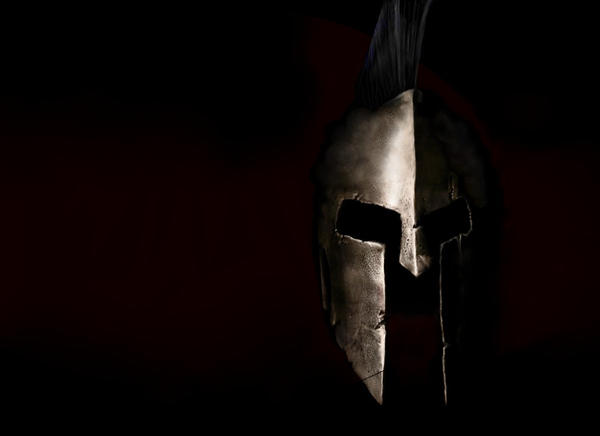
The (K)Night is essentially in the dark.
The sun strikes his outer-shell, but his skin is forever covered in darkness.
Only through the helmet slits does a very limited amount of light enter.
He feels life secretes to him a special truth.
The (K)Night’s mission begins.

Beneath the armor woman, man, black, white, disappear in darkness.
A general form remains…which can also be manipulated, by contracting the flesh, accentuating parts, hiding others…uplifting the individual inside adjustable metal boots.
His feet never touch the ground. He floats on metal, feet unsoiled.

Man becomes the shaper of his own reality, by taking control over the word.
Man becomes the shape-shifter, the doppelganger.
And what is shaped more easily than flesh, but inanimate matter: plastic, fabric, metal.
To take control is to pull away, to dislodge.
The word is detached from the phenomenon, becoming purified…a holy word.
Sacred being what is unsoiled by the earthly, the base, the primal = enlightened, made light, placed on a pedestal, on metal boots, for instance, as if floating above reality, detached/detaching from it.
The skin feels, but behind the metal it is numbed - the metal is an added padding, a thickness.
Sunlight does not burn it…it only heats its surfaces.
The word is its own definition, in the same way God was defined as the Creator of Himself, and of the world.
A solipsistic nihilistic innuendo - the end of the causal chain.

A word refers only to the mental abstraction - abstraction being a form of detachment, simplification/generalization being the cutting away of dimensions.
Dictionary offers a general outline, just as the Bible does.
Both are taken literally, rather as representations, an art-form…just as the armor and the arks are taken as literal additions, extensions of the human embodying them.
The human becomes spiritualized, the behind the scenes, the masks, animating energy - the ghost in the machine, in thearmor, the contrivance.
Behind the word, emotions.
The word refers back to human abstractions, or, when it dares, to human emotions. A hint at the primal.
But, now, the emotions are stripped of their worldly utilities, the reason they evolved.
They becomes expressions of the divine, which is always masked, armored, hidden, in the dark.
The noumenon comes to the forefront, as does the armor. The phenomenon, is hidden, distanced…placed into lethe, forgetfulness: covered, concealed.
The armor is human contrivance. It is the new apparent.

Armor was a reaction to the bow and arrow, the crossbow.
When anyone could fell a fighter from a distance, or massacre a group of formidable warriors by striking them with quantities of arrows from a safe distance, the armor became inevitable.
Arrows are metaphors for karma, directed by words.
Your fate, your reputation, your destiny, now determined by gossip, distant hidden voices whispering (shaping arrow heads, finding rocks), and flinging them to injure from a safe distance.
The armor protected the wearer from these words.
A karmic wall.
The metal shell was a detachment, a barrier, a discriminating possibility.
It kept the rabble out.
The warrior did not have to be a good fighter…because he was a walking talk; a Frankenstein, shuffling towards the other, untouched by arrows, by the masses throwing rocks from the shadows.
Like Frankenstein he was made up of many different parts, all connected artificially, creating a monstrosity.
The quality of the technique was judged by how well it emulated the human form, how it made the observer forget that there was an intervention artifice between the eye and the moving spirit.
Against words a linguistic defense; an iron clad rhetoric - rigid, detached, artistic but unaesthetic, anesthetic.
Two types of modern warfare emerges - dialectics.
One was used by the commoner, who found stones, or could artificially manufacture multiple arrow-heads to fling at the other from the safety of a detached distance, amplifying his weakness into a arrow-pointed force.
The other used a more refined from of distancing: the outer shell, detaching himself from words, creating an alternative space within space/time.
Both compensate for a lack of artistry.
Both types of “fighters” compensate for an absence of fighting talent.
Both uses distance, when warrior approach and engage, using the weapon, the artifice, the word, as an extension of their arm: a surgical instrument.

To expose your body is to expose your flaws to the other’s gaze.
To expose your mind is the same thing.
Many in our time confuse the issues.
They think that they can go straight to the defensive protection, without first building up their reputation on the battlefield.
Like children who play the superhero, they use acting to pretend the outcome without going through the intermediate stages.
This makes them ridiculous, if not more transparent to eyes that do not fall for the ploy.
The image of the cowboy, gunslinger, of few words, with the squint, and the steady gate, is part of this persona.
The yapping dog, growls, to insinuate damage on his foe.
His “bark bigger than his bite”… and the silent dog uses the demeanor of the dangerous hound, who does not make a sound before the kill.
The second is a more intelligent approach, but no less a defensive one, if the intent is not to engage the other but to avoid engaging him.
How does one determine if the stoic, silent, attitude is genuine and not a pretense?
Well, the other will give-off cues, “tells,” as in poker, but if access to those cues is limited, or one lacks the sensual acuity to perceive the details, then, again, time fills in the gaps.
How?
Patterns.
The repeating regularity and its predictability is what a pattern is.
But to perceive patterns you must have experience, in time, with the phenomenon.
A pattern is revealed in time.
The smaller the time-period is, the more acute the senses and the more sophisticated the data-processing must be, to perceive the pattern – if there is one at all.
The simpler mind needs more obvious patterns over longer temporal durations to perceive.
Immediately we realize why remaining silent is cleverer.
By limiting your actions you limit the data you give-off, which may expose a pattern about you.
The one who does not say much, intentionally, is hiding something, or is attempting to restrict the patterns he is displaying to the other, so as to reduce his vulnerability to him/her.
If in a long period of time the other has never displayed anything that would warrant care, or that would justify the intended effect of projecting power by insinuating it, then the other is exposing himself as a fake.
A fighter who refuses to enter a rink, for instance, can justify it, for a short time, by implying indifference to the weakness of the opponents, but if he prolongs this method he increases the pattern of his non-participation.
The absence of patterns becomes a pattern itself.
If there is no precedent to fall upon, the ruse is exposed.
In our time of bullshite, and of pretentious infantile social practices, the tactic of acting out a method without having to pragmatically show evidence to back it up is becoming the norm – reducing human interactions to childish theater.
The act is imitated, after watching popularized mythologies, or it is deferred, using an other’s substantial infamy, to paste over, one’s own absence of substance.
With no performance to fall back upon, the actor falls back on a collective memory. The pretender pretends, by adopting the attitude, what he lacks in himself, riding on the coattails of icons with the prerequisite emotional baggage.
The myth becomes the precedent, and he takes on the role of its most current appearance.
The modern infantile mind, remains retarded, stunted in developmental stasis, because it can now pretend to know, without knowing, and it can pretend to be formidable without having to be formidable beforehand, and it can pretend to understand, by using a few carefully selected words, without actually understanding – in our information age this is not a difficult thing to do.
If and when, pressured to display this implied insight, it will, again, defer, refer, and/or, remain as terse or “mysterious” as possible, because to speak your mind is to reveal your mind; it is to uncover its qualities.
To remain economical is to cling onto your garments, a bit embarrassed about what they conceal.

Inter-facial atmo-Sphere, Air/Conditioning.
Erving Goffman’s book ‘Interaction RItual’ that I’m currently on is simply superb. Some relevant excerpts:
Christian Trinitarianism: Chivalry, Courtesy, Civility - is a Censorship - an “Ef-Face-ment”: