Hereby an article that might be of interest for a discussion. It was published on https://cosmicphilosophy.org/quantum-mysticism/
Quantum Mysticism
A critical investigation of the ontic claim “Superposition of  Time”*
In March 2026, the science media outlet Earth.com published an article summarizing the state of quantum physics:
Entangled particles share a connection that lets them talk to each other instantly. This means that measuring one particle instantly affects the state of the other, no matter how far apart they are. As incomprehensible as the concept of quantum entanglement seems, it’s no longer a matter of debate whether or not it’s true.
Source: (2026) Quantum entanglement speed is measured for the first time - it’s too fast to comprehend
The article popularized a study published in Physical Review Letters — the most prestigious journal in physics — authored by Prof. Joachim Burgdörfer, Prof. Iva Březinová, a team from TU Vienna,  Austria and a team from
  China (W. Jiang et al.).
According to the researchers of the study, by measuring attosecond delays during photoionization, a process that involves a laser striking an atom, knocking an electron free and leaving an ion behind, they captured the birth of quantum entanglement. And because their mathematical model could not define or predict a single departure time, they concluded that the electron exists in a superposition of different birth times.
Phys.org and TU Vienna quoted the researchers stating the following ontic claims:
This means that the birth time of the electron that flies away is not known in principle. You could say that the electron itself doesn’t know when it left the atom. It is in a quantum-physical superposition of different states. It has left the atom at both an earlier and a later point in time.
And:
Which point in time it really was cannot be answered — the actual answer to this question simply does not exist in quantum physics.
An examination of the study’s logical framework reveals logical fallacies and an internal contradiction.
Violation of Mathematics
The foundation of the study’s extraordinary claim relies on a violation of mathematics.
In standard quantum formalism, time is a parameter. It is the external coordinate against which a system evolves. It is not a quantum observable. There is no self-adjoint time operator with eigenstates.
To claim that an electron is in a superposition of times is to treat time as a physical observable with specific eigenstates (an earlier state and a later state). The authors bypass the foundational mathematical definitions of their own field to reify a coordinate parameter into a physical paradox. This is treated not as a formal error, but as settled science by a top-tier journal.
Empirical Trap
Beyond the mathematical violation, the study’s central claim creates an inescapable logical trap regarding its own empirical data.
The experiment utilizes a laser disruption event that functions as a defined reference  clock for the system. Upon measurement, this system yields highly specific, coherent quantum values — specifically, a repeatable correlation of an average ~232 attoseconds tied to the residual ion’s energy state.
The authors use this ~232 attosecond correlation as the primary empirical signature of their theory. Yet, in the same breath, they assert that the actual birth time simply does not exist in quantum physics.
If a property does not exist, measurement cannot yield a coherent correlation regarding that property. A ~232 attosecond correlation cannot be measured if there is no actual time to correlate.
Albert Einstein famously asked:
Do you really believe the moon is not there when no one is looking?
According to philosopher Hilary Putnam who was an assistant professor at Princeton from 1953–1955 during the time of Einstein’s final years, Einstein thought it absurd that his bed would diffuse throughout his bedroom until the moment that he opened the door and looked at it.
In his 1981 essay “Quantum Mechanics and the Observer”, Putnam claims that Einstein responded to him with the following:
Look, I don’t believe that when I am not in my bedroom my bed spreads out all over the room, and whenever I open the door and come in it jumps into the corner.
Mystical Thinking
The root of the mystical thinking is a limit of knowledge to knowledge based on mathematical statistics combined with the idea or hope that science can stand on its own legs, independent of philosophy, that in the context of quantum mechanics translates into “the dogma of Mathematical Realism”.
To know the birth time, an observer would need to passively witness the electron’s departure. Because measurement requires interaction, this is physically impossible.
As a result, quantum theory is inherently limited to mathematical statistics and the concepts probability and superposition are a direct result of this situation.
As a consequence of this situation there are a wide variety of speculative interpretations, including:
- Copenhagen Interpretation
- Many-Worlds (Everett) Interpretation
- Pilot-Wave Theory (de Broglie-Bohm)
- Objective Collapse Models (GRW, Penrose)
- Quantum Bayesianism (QBism)
- Relational Interpretation (Rovelli)
- Transactional Interpretations
- Consistent Histories
- Information-Theoretic approaches
- Superdeterminism
Professor of Quantum Information Science at the University of Oxford Vlatko Vedral recently added another interpretation: Everything in the Universe is a Quantum Wave.
When I told my editor at Allen Lane about my new interpretation, he immediately said It’s Many Worlds on steroids! There is a grain of truth in that, but I prefer to call it Everything is a Quantum Wave Interpretation instead.
Source: (2025) Everything in the universe is a quantum wave Reality is quantum through and through.
Faced with a limit of knowledge to knowledge based on mathematical statistics, the authors speculate that the electron physically occupies multiple times simultaneously and declare the actual birth time does not exist in quantum physics.
Professor Burgdörfer:
You could say that the electron itself doesn’t know when it left the atom. It is in a quantum-physical superposition of different states. It has left the atom at both an earlier and a later point in time.
The Dogma of Completeness
The logical errors are not an accident of interpretation. It is a motivated defense mechanism protecting a core institutional mandate of physics: the Dogma of Completeness.
The historical origin of this dogma lies in a famous 1935 paper by Einstein, Podolsky, and Rosen (EPR) that posed the following question: “Can Quantum-Mechanical Description of Physical Reality Be Considered Complete?”
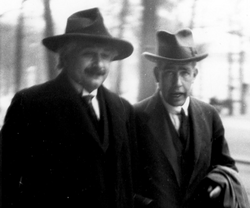
The subsequent Einstein-Bohr debate was framed around completeness. Einstein argued that because quantum math was based on statistics and only provided probabilities, it was logically incomplete — it was missing variables. The institutional response, championed by Niels Bohr, argued that quantum mechanics is complete, but that we must accept reality lacks definite properties prior to measurement. Bohr’s view became the prevailing mandate.
This mandate rests on the presumption of Mathematical Realism: the belief that the mathematical formalism is not merely a predictive tool, but can represent a literal description of the universe.
The standard narrative frames the Einstein-Bohr debate as a clash between Einstein’s realism and Niels Bohr’s anti-realism, however, a closer inspection reveals that this is misleading.
According to Jacques Pienaar, a quantum physicist at the at University of Massachusetts, Boston who investigated the history of the debate while working at the quantum physics institute of the University of Vienna, in the same building where the Vienna Circle of philosophers established what became known as the Copenhagen interpretation of quantum physics, it would be more accurate to consider Bohr a postponed mathematical realist.
Bohr was not an anti-realist… I think Bohr and Einstein were aligned … Bohr’s realist tendencies often get overlooked. Against Einstein’s realism, Bohr was offering a postponed mathematical realism.
Source: (2025) Einstein vs Bohr: Quantum reality is still up for grabs The conflict at the heart of physics.
A few months later in September 2025, Noemi Bolzonetti, a historian and philosopher of science at Utrecht University in the Netherlands, examined the Copenhagen interpretation in detail and claimed that it does not exist:
We have been taught to picture Niels Bohr as the father of a mysterious doctrine called Copenhagen interpretation, where quantum reality collapses under the gaze of an observer. But dig into the historical record and a very different picture emerges.
In a 1950 letter to Schrödinger, Bohr writes:
I do not believe that quantum mechanics requires any philosophical interpretation beyond what the theory itself provides. The theory is self-interpreting; it needs no external philosophical framework. (Bohr, 1950, in Pais, 1991, p. 439)
In his 1948 work, Bohr writes:
The indeterminacy in quantum mechanics is not a sign of incomplete knowledge, but rather a fundamental feature of nature. If quantum mechanics is complete, then nature is indeterminate in a deep sense. (Bohr, 1948, p. 314)
Philosopher James T. Cushing summarized it as following:
Bohr’s position that quantum mechanics is self-sufficient and requires no external philosophical interpretation has become the standard view in physics. Most physicists accept that the theory stands on its own legs and needs no supplementation from philosophy or metaphysics. (Cushing, 1994, p. 234)
 Shut up and calculate Ethos
Physicists pragmatically adopted quantum mechanics with the famous Shut up and calculate ethos, without worrying about ontology. They attributed this pragmatism to Bohr, reading his caution as anti-realism, when it was actually just postponed mathematical realism under the disguise of methodological restraint.
The logical consequence of the dogma is resolute: if the formalism is presumed complete, then any failure of the math to yield a definite answer cannot be blamed on the math. The failure must be projected onto physical reality. This is the motivation behind the observed mystical thinking.
By declaring the actual birth time value does not exist in quantum physics, the authors of the PRL study use the completeness dogma to protect the math from being labeled incomplete.
Conclusion
When the most prestigious physics journal in the world publishes a study that requires negating its own empirical data to sustain a multiple simultaneous times paradox, and when mainstream science media codifies this exact same logic by declaring the quantum entanglement debate over, it demonstrates that quantum mysticism is not an anomaly but the status quo.
When your theory requires electrons to forget their own history to fit the equations, you have not discovered the nature of the electron—you have exposed the limitation of the equation.
— Philosopher of quantum physics (2026)
Reference Study: Time Delays as Attosecond Probe of Interelectronic Coherence and Entanglement (Physical Review Letters)
Another example case in 2026:
Study claims Direct Observation of  Atoms “In Two Places at Once”
A March 2026 study from the Australian National University (ANU) claimed direct observation of quantum entanglement in the motion of helium atoms. Popular science media report the atoms as physically being observed in two places at once:
Popular media quoted the researchers stating the following ontic claims:
“It’s really weird for us to think that this is how the Universe works,” says Dr Sean Hodgman from the ANU Research School of Physics. “You can read about it in a textbook, but it’s really weird to think that a particle can be in two places at once.”
Source: (2026) Physicists Observe Matter in Two Places at Once in Mind-Bending Quantum Experiment
The claim of direct observation of atoms at two places at once is invalid.The claim conflates mathematical statistics with physical reality.
What the researchers actually did was measure the momentum distributions of thousands of helium atom pairs and from these measurements, they derived mathematical correlation coefficients.
No detector ever observed an atom in two places. No camera captured a split trajectory. No instrument recorded a particle occupying two distinct spatial coordinates simultaneously. What was observed was a statistical pattern in the data without the ability to deterministically explain that pattern.
Faced with a fundamental limit of knowledge to knowledge based on mathematical statistics, the authors conjure the illusion of  spooky action at a distance and claim that the atoms physically occupy two spatial positions at the same time.
This case also demonstrates that quantum mysticism is the status quo.
What is your opinion on modern science’s ontic claims regarding Einstein’s “ Spooky action at a distance”?
What is your opinion on 2026 claims by ‘established science’ such as:
- Superposition of Time
- Atoms physically being observed “at two places at once”
