Is Graham Harman representing “ANT” correctly here:
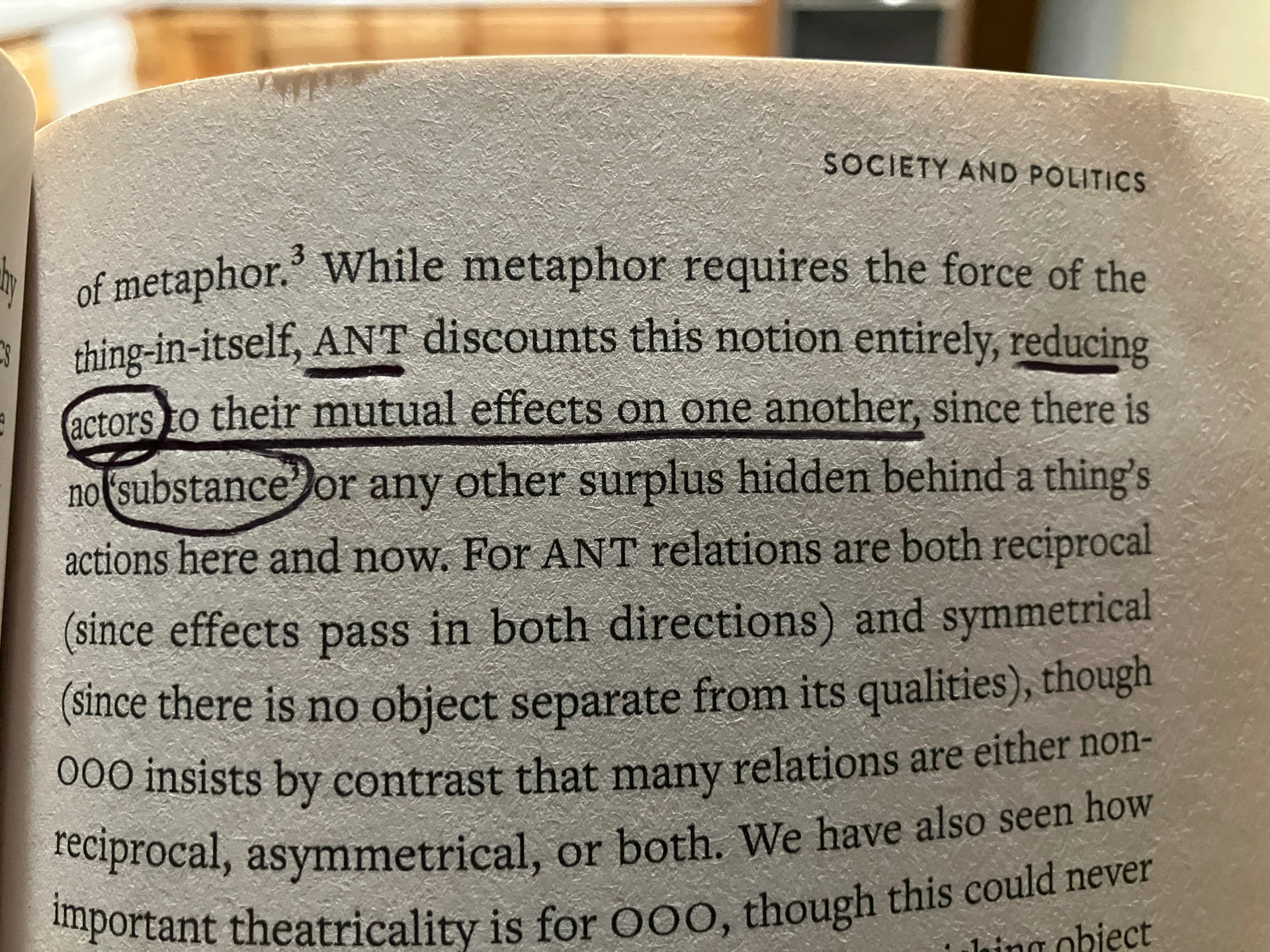
(assuming the entire OOO isn’t satire, of course)
Is Graham Harman representing “ANT” correctly here:
(assuming the entire OOO isn’t satire, of course)
I haven’t seen the exact Harman passage in your screenshot at full resolution, but in general: Harman’s *standard* characterization of ANT is “relationist / network-first”, and that’s **partly** fair as a reading of Latour/Callon/Law, but it can also be a bit of a strawman depending on how strongly he states it.
A few quick anchors for ANT:
Where Harman is basically on-target: if you read ANT as saying an entity is *nothing over and above* its relations/effects within the network, then yes, OOO will object: it wants objects to “withdraw” (to have a reality not exhausted by relations).
Where it can go wrong: many ANT people would say they’re not claiming a *metaphysical identity thesis* (“only relations exist”), they’re bracketing that question and doing a kind of descriptive sociology/philosophy of science. Also, Latour especially is slippery: sometimes he sounds like a metaphysician, sometimes like a methodologist.
If you can paste the text from the screenshot (or a couple sentences of the Harman claim), I can say more precisely whether he’s misrepresenting ANT or just pressing it in the direction he needs for the OOO critique. A good ANT reference point is Latour’s *Reassembling the Social* (and for the classic vibe, *Science in Action*).