Pat, I would like to buy a follow-up question.
K nuther serious question.
Question am nothing to connect, am connecting, or am everything always connected?
Pat, I would like to buy a follow-up question.
K nuther serious question.
Question am nothing to connect, am connecting, or am everything always connected?
Confucius say: How did the brainbody evolve this maximarry illeducible comprexity?
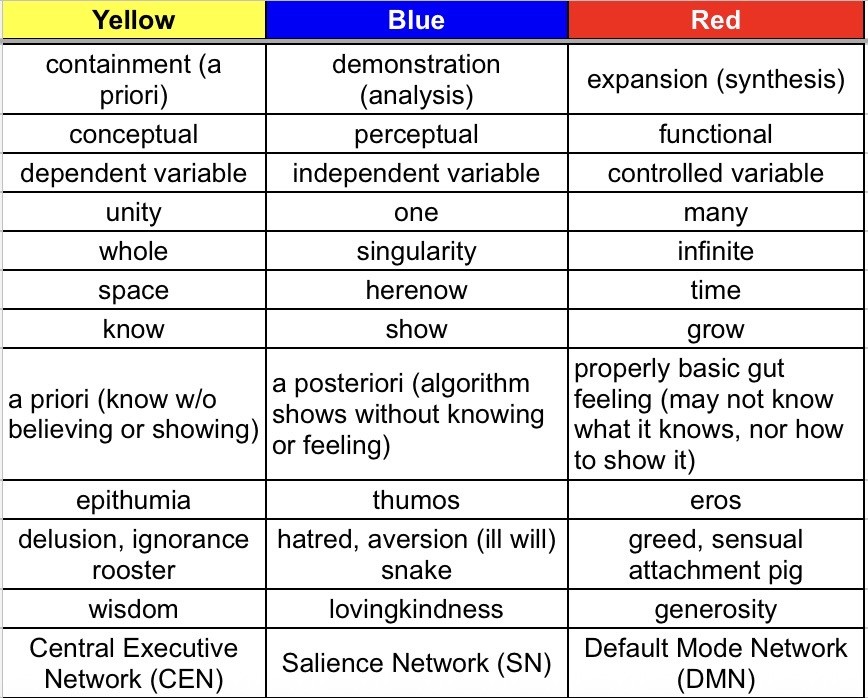
Default Mode Network (DMN): Red
Salience Network (SN): Blue
Central Executive Network (CEN): Yellow
Pat, I’m ready for the lightning round.
The three antidotes:
That sounds like resignation… or retirement.
Question for you. Does this accurately reflect what you mean?
Is there a time for work, and a time for play? Is sloth when it’s all play and no work, and/or all work and no play?
What if you’re a professional football player?
Withdrawn, your honor.
Slave drivers turn people into sloths like divorcers turn spouses into adulterers.
Note: I haven’t really reread the post I’m linking to. Instead, I want to make some spontaneous remarks. I think epithumia = eros, since Plato sometimes uses the terms eros, thumos and nous, and at other times uses epithumia, thumos and logos, and these evidently correspond to one another, respectively. Also, you seem to posit three different things, united in a trinity, whereas I discern two opposed/mirrored things, divided in a unity: logos is the “third” that comprehends the two.
There are times when Plato via Socrates resolves/synthesizes two, and there are times when he is dealing with a whole three (the synthesis of each set of resolved twos).
Kant is the same.
Yes. We can understand generosity as giving, as opposed to greed/lust/gluttony which is taking. Likewise, loving-kindness—the Indian equivalent of the Greek philia—as a love, as opposed to hatred/aversion which is a hate. Phobia could mean both “hate” and “fear/repulsion” in ancient Greek.
Philia is not eros. Eros is rather lust—desire, craving… And thumos (“spiritedness”, the spirit of gravity and revenge) can be traced back to eros—frustrated eros.
You are intentionally conflating virtues and vices, which I’ve been intentionally ignoring… instantiated in my words (which lacked the attention you were seeking)… up until now.
Not conflating, I don’t think. I’ve suggested that there be two kinds of sloth, where the active man’s mead is the contemplative man’s poison and vice versa; and I’ve pointed out that Vajrayana purifies the poisons (vices) by showing them to be at bottom the “antidotes” (virtues).
avarice : generosity
hostility : friendship
So yes, philia is the virtuous form—and, according to Buddhism, the true form—of that of which phobos is the vicious form; and eros or epithumia is the vicious form of something else. But I think phobos is actually the frustrated form of eros, and that eros is the true form of all of it…
Speaking of self-lightening, and having spoken of contrast: I recently wrote the following but decided not to post it anywhere (yet):
‘I may finally understand this song. If so, the speaker is not really waiting for a miracle; that’s just something you say to people who ask stupid questions. It would be a miracle if there were a miracle to come. Doing something “crazy” or something “absolutely wrong” wouldn’t bring the miracle closer, but neither would it make it harder to reach. Marrying would still leave us alone, albeit alone together. While “waiting for the miracle”, one is as happy as at the end of World War II, because relief(!) is equal to there being no relief and nothing to be relieved from… There’s no meaningful difference between Mozart and the sound of bubble gum (pop), because both are just acquired and inherited tastes. This is the severe judgement from which there can be no serious diversion. There is no shame or pride here, no difference between night and day, and no distinction between a (half) full and a (half) empty life.’
Waiting for the Miracle (Leonard Cohen)
That’s three.
“What came first?”, or “Which takes priority?” or “Which is the advance, and which is the ground?” are questions likely orbiting an ontologically prior (synthetically a priori) (mutually or triunally productive) unity.
You don’t find true self by dying to self by mutually prioritizing the other … if out of alignment with the source of unity.
There is nothing fragmented that was never whole—why deny the source of unity?
One thing your thought triggers is that privation (vice) is good (virtue) messed up. That isn’t dualism. Vice & virtue are not opposites.
It also triggers that vice is not necessary, but is actually nihil (defacing). Only choice is necessary to choose the good—one does not NEED — is not FORCED — to choose otherwise.
Like for example, “To have to stand beneath my window
With your bugle and your drum”
…why would someone do that? What does that even mean?
Reminds me of who I used to be, and Leonard Cohen (or the persona represented in the lyrics) reminds me of the dude I used to be that with.
They still both stupidly exist. Not to sound suicidal, because … well … something needs to die/change.
The half-emptiness shows the hunger for fullness, and the half-fullness shows gratitude… the neitherness is a lie … or you’d never have remarked on it.
And life is always both, because already full, not yet full, always leaves a longing for more. Because there is.
So anywhayz.
They say for every tragic flaw (vice) there is a super power (virtue).
I’m done waiting, but until someone snags me (pray for them…no idea what they’re in for), I’ll prolly still throw excess love at the fool from time to time.
This is bullshit, and I blow it up with wedding bells & bombs:
See also: