K, serious question.
Question is there no spoon or am I becoming one with a spoon, or was I always the spoon and I just tuned it out?
K, serious question.
Question is there no spoon or am I becoming one with a spoon, or was I always the spoon and I just tuned it out?
In the The Matrix franchise, there can be no real spoon within the Matrix (the simulation), but there could be one outside it (in the real world). (Not very well-versed in that universe, but I suppose spoons used to exist, before the machines took over, and may still exist, scattered somewhere as a relic of the old world.)
This franchise is quite simplistic, though. Do you realize that the red pill is just a placebo? If you take the red pill, nothing happens; if you take the blue pill, you join in the mass hallucination and can become a screen personality and later president, like Ronald & Donald.
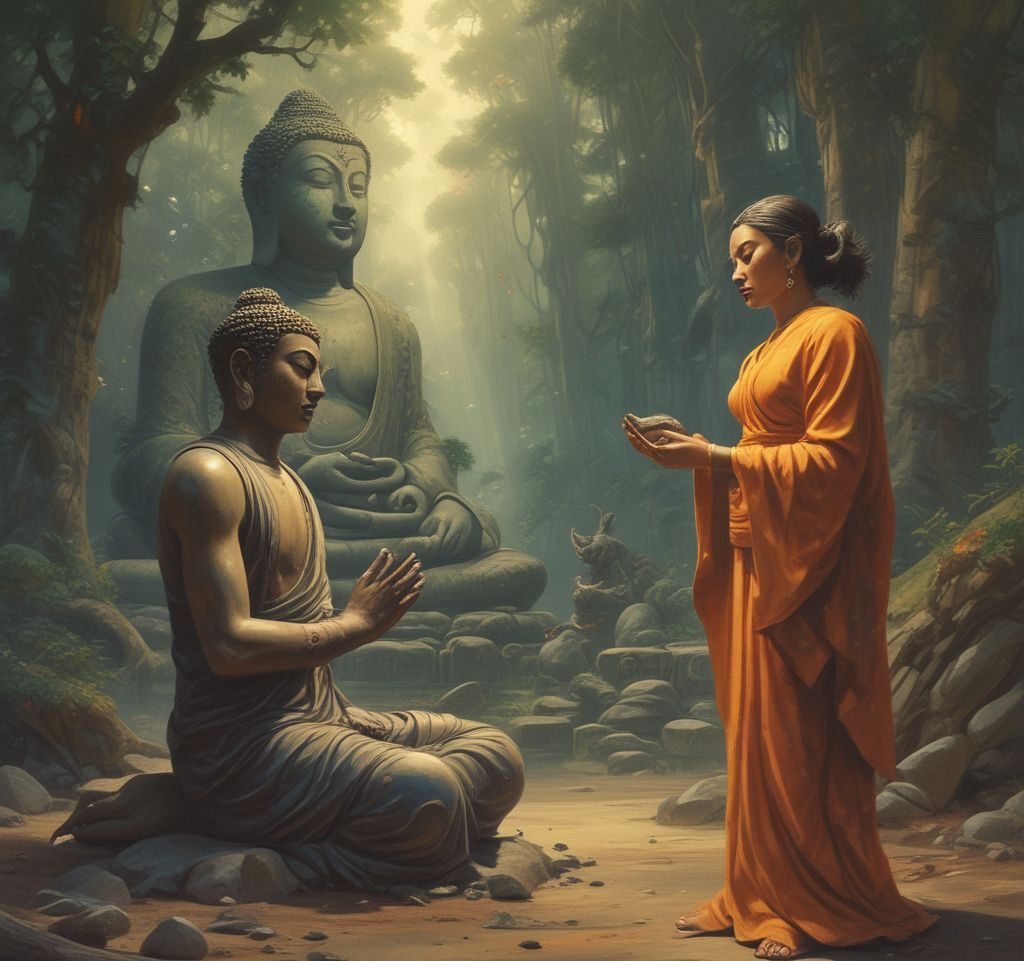
In Zen “Monism”, on the other hand, there is no such dualism. I’m reminded—again, since I already was by your recently expressed wish that I get haunted—of this image I saved:
I think yes, Buddhism is still atheistic when it says ghosts are real, because it ultimately means ghosts are as real as anything else, including gods, the self, etc. To be sure, people who believe in ghosts and the like are on a lower level of realization than those who don’t, but it’s only a difference of degree. Buddhism wants to be inclusive of these people, too, and moreover they can serve an illustrative purpose for those of intermediate levels.
Theravada is the more atheistic tradition of Buddhism, Mahayana and Vajrayana is more esoteric coexisting with indigenous religious spiritual beliefs.

I would say becoming one with the spoon if this really is a holographic simulation reality on eternal repeat.

If we were going by Buddhist interpretation it would be something like this below.
Theravada: “There is no spoon.”
Mahayana: “Becoming one with the spoon.”
Vajrayana: “I was always the spoon myself, the spoon resides in me.”
I think you probably said it with that last reply, or I said it in the original post?
I just think it’s a very interesting juxtaposition.
Well, according to you, you are haunting your body.
In related musings:
Isn’t it funny how when people are alive we say “I hope they get to see this before they die” and after they’re dead, we say “I know that they were here to see it” — in a better place (maybe the view is better in heaven?) — unless it’s something we didn’t want them to see, and then we say “I’m so glad they weren’t here to see this” — or they are rolling in their grave, or they would’ve done X if they were here, or they are doing X in heaven — and it’s never hell. You can get the worst person on the face of the planet and they’ll still have a eulogy that lies nice things about them. When did you ever go to a funeral and they said “This guy is definitely in hell right now”?
Did Hitler have a funeral? 
Are we (becoming) one with Hitler, or was Hitler never real?
It’s not just coexisting, though. That is, it’s not on an equal footing. Mahayana, including Vajrayana, subsumes polytheism (and could even subsume monotheism if the various monotheisms would allow it). It’s like with the three poisons: Theravada teaches how to steer clear of the poisons (stay clean), Mahayana offers antidotes to the poisons, and Vajrayana purifies the poisons. (Again, Mahayana and Vajrayana really belong together: enlightened beings act as “antidotes” to deluded beings in that they show deluded beings to be enlightened beings at bottom.)
Ha, no, that’s not what I meant. I didn’t mean I (my mind or spirit) was haunting my body. I meant that other people tended to haunt my mind.
Do you not like yourself?
We wish to hear more about these three poisons. that in Plato? Is it Nietzsche?
I don’t see how that would follow from anything I said (subtext, maybe, but not the actual text).
What I meant is that the things people say and do tend to stick with me much longer and more deeply than they seem to do with most people.
Ah, so it’s a happy haunting because you’re introverted and that means (in subtext) happy.
“We”? Did you confer with MrAuthoritarian? 
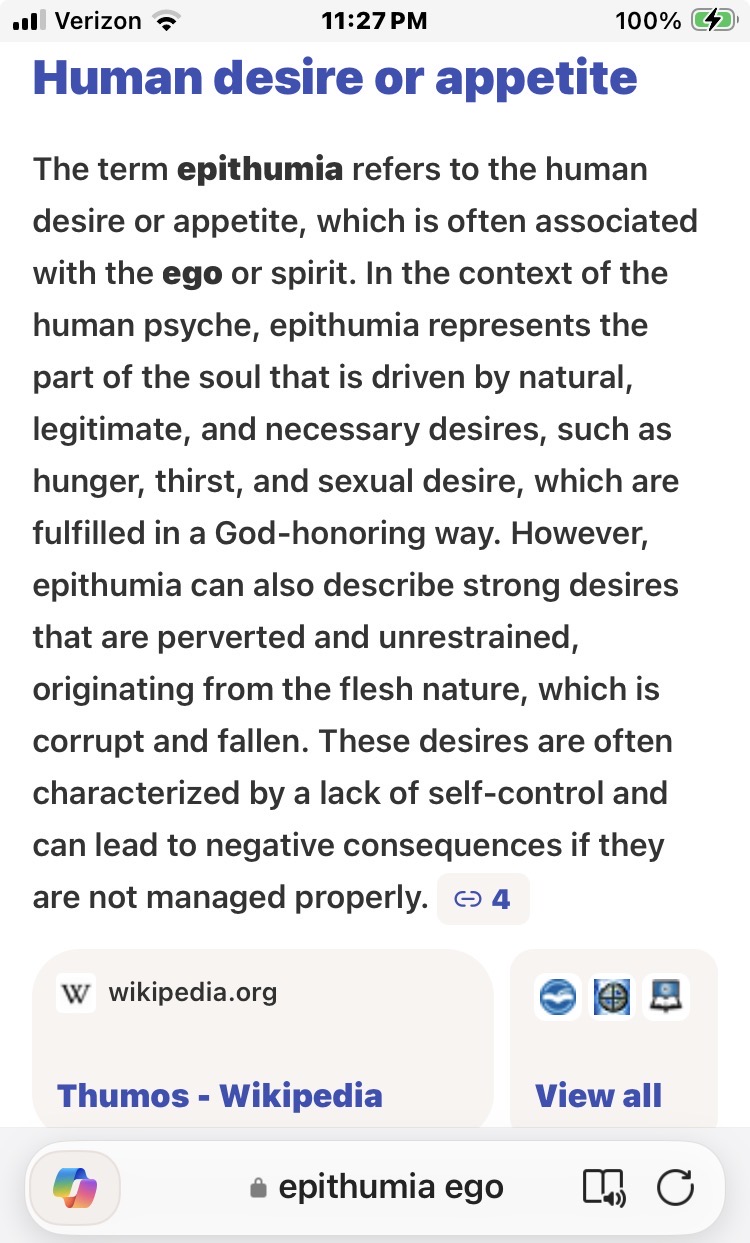
The Three Poisons are a Buddhist concept, though I think the first two correspond to Platonic eros, epithumia, and thumos, and can thereby be found implicit in Nietzsche as well:
Nooooo! Again, I don’t see how that follows from what I said. No, it’s not predominantly happy—hence ‘haunt’. The “ghosts” of other people tend to make a “hellrealm” of my mind. It doesn’t help that I’m extremely solitary, though if I wasn’t, the impressions they left would just be drowned out by fresh impressions, so that wouldn’t solve my problem either. My problem is that I want to be free from all such “ghosts”! (Note: I’m not talking about Nietzsche or any other great mind with which I’ve inoculated myself.)
We conferred with our internal royal editorial dialogue.
Confucius say… veeeeeeelly intelesting…. big brain people are often rather fat-headed, aren’t wthey?
Well, I had to be pulled out of my mother with tongs, though the fact that I was her first may have had something to do with it.
This is all very interesting as well:
Maybe in your culture, fat-headed doesn’t mean arrogant? Or maybe you should go apologize to your mother on two different levels?
Ha, no, I didn’t know that figurative meaning… But yeah, she’s often found me arrogant.
Yeah, and I don’t think my Musical Qabalah thread will be helpful here; I think it will be convoluted even or especially for you.
When I invoked the seven deadly sins to MrAuthoritarian in that other thread, I was already thinking of the poisons. For I think lust, gluttony and greed can be seen as the raga sins, whereas wrath, pride and envy can be seen as the dvesa sins. (Sloth stands apart, pertaining to the titan Saturn rather than a god; it could be seen as the moha sin.)
lust/gluttony/greed/eros/epithumia/raga
wrath/pride/envy/thumos/dvesa
sloth/logos/nous/moha…
“Intellectually lazy”?
“Physically or actively lazy”
“emotionally, lazy“
or perhaps sloth is what happens when you automate everything… and completely disconnect
This actually reminds me of what I’d just read—cursorily—about sloth and acedia on Wikipedia when I added logos/nous to my list…
“Emotionally, and cognitively, the evil of acedia (or sloth) finds expression in a lack of feeling for the world, the people in it, or the self. Acedia takes form as an alienation of the sentient self first from the world and then from itself. The most profound versions of this condition are found in a withdrawal from all forms of participation in, or care for, others or oneself.” Seven deadly sins - Wikipedia
For to me, this actually seems in accordance with reason (logos) now… and hence the opposite of delusion (logos is about opposites/contrasts and the unity thereof). Yet when I just perused Wikipedia, I read: “the sin finds expression in laziness, idleness, and indolence.” And idleness, though not laziness, is, as Nietzsche quipped, the root of all psychology, which in turn he called the lord of the sciences (arguably reminding us that Plato ranked it similarly high); 'tis one of the meanings of the ancient Greek root of the word “school”… I suppose we have to assert two contrasting kinds of sloth: being very active and industrious is often sloth with regard to contemplation, meditation, etc.! (Nous is mind, as in “mindfulness”…)