Carl, stick with the 2 train analogy and please do as I asked and DON’T use one Lorentz equation to represent the 2 trains together. Avoid presumption.
you should have a;
t =
ta’ =
tb’ =
and associated parameters. Be mindful of your use of x for each train and the fact that the train clocks were set to be identical even when B was still behind A by 10 meters.
Now work out what each clock would read by the time A reaches the station (not B) using separate equations, please. That will be shorter than these other arguments.
Well Carl, if you haven’t done the 2 train thing yet, don’t bother. The quick numbers I used in my head seemed to work out with only one clock, but I went ahead and did the 2 train scenario, and it still won’t work. As long as you are using x as a coordinate for both objects, but keeping t the same, then obviously it isn’t going to work. In effect, you are saying that one object went a different distance in the same amount of time, so of course it isn’t going to read the same. You have to set t0 back to where ever the clock you are measuring started, else in concept, you are calculating dt to be different for each item.
So, I’m back just saying that either x was intended as a single object coordinate only, you are expected to know to relocate t0 for each item, or the equation is simply wrong. Considering that he chose to vary distance rather than velocity, the equation isn’t going to work out in the long run anyway even if it didn’t have this problem.
This actually makes me want to explore the question of the two trains deeper, specifically because it is the exact same as having multiple clocks on the same train. You had claimed that we needed to use x at the center of the train, even when calculating a clock that isn’t at that point. Now, you’ve done the math to show that using two trains, and each clock at the center of its own train, moving at the same speed, they will show the same dilation as if they were one train.
(This, by the way, can be seen by a simple thought experiment. Say there is a wall such that the observer at the station can’t see what’s carrying the clocks. To that observer, it seems that two clocks are moving along carried by something on the other side of the wall. It can’t affect his calculation of their time and distance transformations, though, if they’re carried by one train or two, because he has all the information he needs to calculate the transformations when he can’t see the platform or platforms carrying the clocks)
(I will leave aside the possibility that the equations are wrong, because as we’ve discussed, if they are wrong, it is not shown by this thought experiment, and so this thought experiment creates no paradox within SR.
However, the possibility that I’m employing them wrong is one we should consider. So, turning back the clock (pardon the pun) to where I last fully employed the equations to show that there is a difference in time.
The way you are asking for the equations to be used is to use xT instead of xB to calculate tB’. But you still not shown anything that suggests such a strange use of the terms. The timer B has an x, t, x’, and t’ coordinate (xB, tB, xB’, and tB’, respectively). Why wouldn’t we use these coordinates when employing a transformation equation that refers to them? In particular, why would we use some other point’s x coordinate?
I wasn’t questioning whether the 2 train was the same as the one train. I was suggesting that if you use the 2 train, you will spot your error that the one train model makes easier to miss.
If you use Lorentz merely to calculate a single item, everything probably works out fine. But you can’t plot 2 moving clocks on the diagram because the equations will only be accurate for one at a time (if even that). When you calculate one clock then go for another on the same train, you are using t0 to be the same for each which is causing the calculation to be saying that both clocks started at t0 but one went further than the other. It isn’t exactly like that, but it is skewed in that direction by the term (t - vx/c^2). The equation and diagram were only intended to calculate one item along its path. You really should be saying, “this item went from this t0 to that x1 and this other item went from its other t0 to that other x2”.
I suspect if you use v’ in that term rather than v and probably make the v^2 term in the factor into a v * v’, then it all might work great.
The choice to dilate length is actually the killer for making other things make sense at the same time. That was how they got the simultaneity problem. Einstein said that he still had a problem with the synchronization of clocks that he couldn’t figure out. When you dilate distance rather than velocity, bending and folding physical space, a lot of things won’t work out even though the one you are focused on seems to work fine.
That’s just not true. The equations map an entire coordinate system onto another entire coordinate system. The equations relate an infinite number of (position,time) coordinates onto another infinity of (position,time) coordinates. When we talk about a “line of simultaneity”, we are talking about every point along some line from x=-∞ to x=∞ for a given time. Every point is considered and dealt with by the equations.
If it weren’t the equation would be specifically limited, or better yet expressed so as to limit x and t to some arbitrarily chosen origin. There is no such limitation placed on the equations.
What does it mean to go from a time to a position? All values of x exist for any given value of t. There is no sense of traveling from a t to an x. An example would be saying that a particle went from 4:00 to 100 feet.
Again, the Lorentz equations aren’t using ∆x and ∆t, they’re using x and t coordinates. We’re not using the distance traveled by the clock, we’re using its instantaneous location at an instant in time. The equations map that location and time to the location and time measured by a moving observer.
Btw, Einstein defined time by saying that it couldn’t be defined as anything but “the hands on a clock turning”. That is an imprecise way to define time.
Distance is the “measure of relative position”. Velocity is the “measure of change in relative position”. Time is the measure of relative velocity. Time dilation is the “measure of change in relative velocity/motion”.
That is why you change the velocity, v’, rather than the distance, x’.
Yes, “A coordinate system”. Not a coordinate system that works for multiple items, just “A coordinate system”.
Yes, for a single observer of a single item (at a time).
Oh but it IS limited. It doesn’t work for anything too close to the speed of light.
It meant that you use the t0 to be the origin t0,x0 for one item, then you use t0 to be the origin t0, x0 of the other item separately. The equation only makes sense when the observer is at t0,x0. That means that what he is observing must start from t0, x0. That means that every item must start of t0,x0. I can understand how Einstein fell into that trap, but it is still merely a mind game.
They ASSUME ∆x and ∆t by ASSUMING the observer is always at t0,x0 and all items began from there.
The equation is merely incorrect. You have to find v’, not dx’. No big deal.
Sorry for the delay in responding. I have not been keeping up with the posts and some of this may be redundant.
The places where I thought that I saw 3 reference frames are in the following drawing:
ARRG!!!
I cann’t seem to copy your drawing, but it is near the bottom of page 14 of this thread.
And there was a reference to what looks to be your personal web site, which references a moving frame and another frame drifting away from some observer, but I can not find that now.
As a personal note, at one time I questioned whether or not the observer in the moving reference frame would see the rest frame as moving at a rate of –v, when the observer in the rest frame saw the moving frame as moving at v.
To be honest I do not understand your v and v’ comments, but I thought that someday soon I should derive the Lorentz transforms, and let you make appropriate comments.
v’ is not a frame versus another frame. That would just be the same thing in reverse.
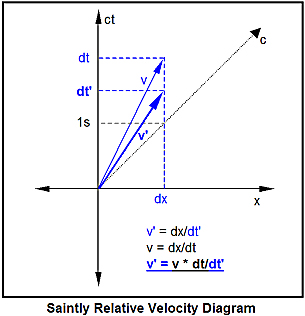
v’ is what velocity the mover “thinks” he is moving due to his time dilation
v’ = dx/dt’
We know that dt changes with respect to mover or non-mover. But that means that either dx must also change or v must also change merely to stay with the very definition of velocity. So if we assume that dx does NOT change and the mover were to measure his travel distance by his own watch, then he would get a different v. His slower watch would produce a faster measured velocity, v’. Don’t confuse what “really is” with what anyone would measure. They measure by their watches and their watches change.
The only diagram that I see on page 14 was the relative velocity diagram showing what a station might measure as the velocity v and what the train might measure as v’. The “c” line is just representing a light ray for reference.
V’ being measured by a slower watch is necessarily different than -v.
What does that mean? If something is ten meters ahead of something else, and x is in meters, then we can put one thing at x=0 and another at x=10. Are these not Multiple “items” in the same coordinate system. And do the equations not offer a map to their coordinates in the other system?
What I expected you to come back with is, “we have only one equation and 2 unknowns, so we can’t solve for that.”
No doubt Einstein ran across that point too, but he cheated. He said, “well, we know what the velocity is. It is v, therefore…” But we DON’T know what the velocity is according to the mover because we would have to know what time dilation he experienced OR what velocity v’ he measured in order to find the other. So Einstein just assumed one so as to calculate the other. In the station-frame scenario, we simply do not have enough information. We have to use an alternate axis to discover more information.
The diagram we are talking about displays where things would be at any particular time for each moving frame. But as you mentioned yourself, it does NOT tell us the delta time, dt. It doesn’t show us how much time dt’ has passed between one point and another for each item, but rather merely the change in frames or how much time has passed from 0 to one point. But if you take the time for one point and subtract out another point in time, you do NOT get the delta time, dt.
We know that each item on the train experiences the same delta in time. But the diagram/equations directly imply that each item would have a different delta time depending on where it was in the frame. That is what is causing the problem. The equation is only good for whatever is moving from t0, x0 out to another point and that can only be one item.
Actually you can see that if you take an equal amount of distance traveled but once close to the t0 and another far from t0. You get 2 different delta times for the same delta distances. That directly says that you have a changing velocity.
Umm… we know exactly what the speed of the train is in the train’s frame. It’s 0. Time dilation doesn’t enter into it; the definition of the train’s frame guarantees it.
I’ve never been talking about ∆t. I’m talking about the difference between a time coordinate as measured by the train and the same coordinate as measured by the station. That is not ∆t. It is not change in time. There is no motion between t and t’.
No, it isn’t. It’s good for every point in the x,t plane that has a corresponding coordinate in the x’,t’ plane, i.e. it is good for every coordinate in the x,t plane. If we know where a clock is at a given time, we can calculate where it is measured to be by some observer in another frame in relative motion to the first, and what time it is measured to read.
t IS dt from 0 out to t, silly. So yes, you have been. You just didn’t know it.
You are still confused. Look at the time difference calculated between an object that went from -10 x to 100 x at 0.5c. Then look at the time difference of an object that went from x = 0 to x = 110 at 0.5c. You know that they have to have traveled the same amount of time and for the same distance. But look at what the equations tell you.
Object A
for v = .5c and x = -10
ta’ = (t - -5/c)/sqrt(0.75)
	at x = -10, t = 0
		ta' = (0 + 5/c)/sqrt(0.75)
		ta' = [b]0.192580(E-07)[/b]
	at x = 100, t?
		t = 100/(0.5c) = 6.67117(E-07)
		tb' = (6.67117(E-07) - 50/c)/(sqrt(0.75) = 5.7774(E-07)
		tb' = [b]5.7774(E-07)[/b]

thus the delta t', dt' =
	dt' = tb' + ta'
	dt' = 5.7774(E-07) + 0.19258(E-07)
	dt' = [b]5.9699(E-07)[/b]
Object B
for v = .5c and x = 0
ta’ = (t - 0/c)/sqrt(0.75)
	at x = 0, t = 0
		ta' = (0 + 0/c)/sqrt(0.75)
		ta' = [b]0.0[/b]
	at x = 110, t?
		t = 110/(0.5c) = 7.33829(E-07)
		tb' = (7.33829(E-07) - 55/c)/(sqrt(0.75) = 6.35514(E-07)
		tb' = [b]6.35514(E-07)[/b]

thus the delta t', dt' =
	dt' = tb' + ta'
	dt' = 6.35514(E-07) + 0
	dt' = [b]6.35514(E-07)	[/b]
Time dilation between Object A and B
td = dtB’ - dtA’ = 0.3851602(E-07)
Why is there a time dilation between 2 objects on the same train??
No, it isn’t. We can talk about objects at time t=-1, is that “from 0 out to” -1? What if an object doesn’t exist at time 0? Say we had a bubble that forms at t=-5 and pops at t=-4. Or say we have an event like a flash of light, which spans no time, but happens at a non-zero time, time t=5. None of these could possibly be “dt from 0 out to t”. If the equation meant ∆t, it would call for ∆t, and not just t. t is a coordinate.
You assumed in your problem that the distance traveled is different, so clearly the time is going to be different. If you plug in consistent values, the equations work out.
at x=-10, t=0, with v=.5c
t’ = (1 / sqrt(.75)) * (5 / c)
How did you know it was at t = -1 unless you counted out from t0?
No I didn’t. Now you are ignoring your own preaching that t is a coordinate, not a time difference value, dt.
Object A is never at coordinate “t = 110”.
All you did was to use it the way I was saying that you have to use it to make it work. You stopped using t as a coordinate and used it for a time difference (“tA = 110” and “tB = 110”).
So make up your mind. Is t a coordinate or a time differential?
The same way I know it’s 8:19 without counting back from 9:00?
But really, the definition of t=0, or t=-1 or whatever, is arbitrary. We’ve chosen to label a point in time t=0, so there’s no particular reason we need to count from it to anywhere else. This is a thought experiment, we’re arbitrarily assigning things to points anyway. If we used ∆t in the equations, if a train started at t=-5 and moved along x until to t=0, when we tried to calculate t’ at (0,0), we’d use ∆t=5. That’s obviously not the case, because t=0=t’, as part of the construction of our coordinate planes. In addition, if we had arbitrarily chosen to look at the train starting at -6 instead of -5, we’d have to use ∆t=6, even though its starting point is arbitrary and doesn’t effect the time or distance transformation.
Yes you did. Regardless of why you did (which I’ll get to), you used two different distances, and that’s why you got the difference in time. When you don’t use different distances, and thus use a consistent passage of time, you calculate a consistent passage of time for both clocks, contradicting your assertion that there’s some fundamental problem with calculating the distance and time coordinates for things not at (0,0).
It is a coordinate. When solving for the coordinate of t given x1, x2, and v, you use ∆x. The equation that relates time, distance, and velocity uses change in distance and change in time, but the Lorentz equations do not. If we had started the scenario at t=-10, we would have to add -10+∆t to find out the coordinate. The appearance of using ∆t for the time coordinate comes from the fact that we started at t1=0, so t2=0+∆t=∆t. In this case, the two happen to be the same, but when they disagree we must use the coordinate.
This is clear from the decision to use x=100 in the Lorentz equation for the first clock, even though ∆x=110.