So if the timers were set to be identical, I can calculate that they will still read identically at the station’s ∆t. Why would the station frame “see” them flash at a different time from each other?
Because simultaneity is maintained within a frame, but not across frames. When you set them to go off simultaneously in one frame, you set them to go off at different times in a frame moving relative to it.
1 Like
That has been your assertion. The math shows otherwise. Use the math.
The math is right here, in Einstein’s own words: bartleby.com/173/9.html
“Are two events (e.g. the two strokes of lightning A and B) which are simultaneous with reference to the railway embankment also simultaneous relatively to the train? We shall show directly that the answer must be in the negative.”
If you want more detail, you can find it here: fourmilab.ch/etexts/einstein/specrel/www/
“So we see that we cannot attach any absolute signification to the concept of simultaneity, but that two events which, viewed from a system of co-ordinates, are simultaneous, can no longer be looked upon as simultaneous events when envisaged from a system which is in motion relatively to that system.”
I don’t see how you can maintain this fiction that there is no mathematical proof of the failure of simultaneity in SR when it is something discussed in every book and article that introduces the theory. It makes you look unreasonable to the point of insanity. Do you have any excuse for your behaviour?
1 Like
Every time we’ve done out the math, my assertions have proven correct. I asserted that the equations show that there is relativity of simultaneity, and the math showed that they do. I asserted that the equations work for any coordinate in the frame, and the math showed that they do.
“if the timers were set to be identical” in one frame, we know from the math I’ve provided repeatedly that they can’t also be set to be identical in the other thread. I can copy and paste that math again if you’d like.
The fact that both timers experience an equal change in time in both frames does not influence the fact that they were never simultaneous in both frames.
Only when you misuse the math by using it one way to support your claim of dissimilarity and another to support your claim of similarity.
Then use the math in the same way and prove it. Else you are merely saying that "despite what the math shows, we know that the station will see differently because SR says so. So we change the usage of the math to make it show what SR claims".
Use t only as a coordinate and show me that the train will not have a time dilation between its clocks. And use t as a coordinate and show me that the station will not see them flash at the same time.
And don’t say, “I have”, because using the same equation, you have used t as a coordinate in one usage and a ∆t in the other. Do I have to cut and paste that for you?
Object A is NEVER at coordinate t = 110. But ∆t = 110.
If you want to use ONLY coordinates, then;
Could you point to the math that you think shows otherwise? I presented the use of the equations some pages ago that showed that the equations show a relativity of simultaneity, to which you responded that the equations can only be used at (0,0). Most recently, I presented math that shows that you can use the equations at points other than (0,0), and you seem to be claiming that these results are somehow contradictory. The most recent math doesn’t show that the two clocks are simultaneous, it shows that their change in time is the same. So if the both read 4:00 in one frame, they will read, say, 3:59 and 4:01 in another frame. After a certain amount of time has passed, say 5 minutes, they will read 4:04 and 4:06, and still not be simultaneous. If you have math that shows otherwise, it’s on you to present, all the math so far supports the relativity of simultaneity.
Yes, you do. Because that never happened. ∆t between t=0 and t=110/.5c (not 110, I never used t=110) is 110/.5c, but using t=110/.5c in the equation isn’t using ∆t, it’s using the coordinate t=110/.5c. As I said earlier, “in this case the two happen to be the same,” but that doesn’t mean that we’re using ∆t, we’re using a coordinate of t that happens to be equal to ∆t because of how you set up the problem.
I don’t understand what you’re going for here. Again, I never used t=110, I used t=110/.5c. And I don’t see why you are adding t0 to the end of the equation for t’. What demands that? If we’re only using coordinates, we’re given t and x, and we’re looking for t’, we don’t need to know some other earlier value of t at which we arbitrarily chose to calculate t’. It doesn’t factor in, specifically because we’re using coordinates and not ∆t.
“t is a coordinate”. “110/.5c” is a measured time, a ∆t from 0 to t.
Object A was at -10 at t = 0. So as t went from 0 to 110, Object A was going from x = -10 to x = 100, NOT from x = 0 to 100.
If you are going to use coordinates only, then you have to add what clock A was already reading when it got to x = 0, just as I showed you in my equations. Else you are saying that Object A only went from x = 0 to x = 100.
Sorry, I shouldn’t have put t0’ after your t’ equation, only after your ∆t equation. I edited it. Look again.
Ahh… scratch that. I misunderstood your ∆t equation.
But the point still stands. You subtracted the t0’ rather than adding it.
110/.5c is both a coordinate and a measured time. Because you stipulated that t0=0, and t0+∆t=t1, we find that t1=110/.5c. If we had begun from t0=-10, the coordinate for t1 would be -10+110/.5c. If we had begun from t0=10, the coordinate for t1 would be 10+110/.5c. You’re assuming that because t1=∆t in this specific case, we must be using ∆t in the equation. But we aren’t. The calculation to find the coordinate t1 from t0 and ∆t is implied, but it must be carried out.
Why? What the clock is reading at x=0 is arbitrary. Why not add t’ for a million different points between x=-10 and x=100? They all have a corresponding t’.
This addition is unnecessary. Again, you seem to be carrying over assumptions that may hold if we were using ∆t, but are irrelevant since we’re using the coordinate t.
EDIT:
Again, why? ∆t=t1 – t0, which I’ve already indicated. Adding t0 again gives the value of ∆t + t0, which isn’t what we’re looking for.
EDIT: What point still stands?
You subtracted the t0’ rather than adding it.
If you add the additional increase from x = 0 to x = 100 to t0’, you end up with the total ∆t.
Your ∆t is the difference between when A went from -10 to 0 and when it went from 0 to 100.
You don’t care what that difference is. If you had started at -100, you would have ended up with ∆t = 0. If that is too confusing, try it with -100 to +100 for A and 0 to +200 for B.
You ADD the t0’ amount to the rest of t’ to get the final amount of ∆t.
I edited the post. Reread it.
What? Why? ∆t, the change in t, is the difference between t1 and t2, not the sum of t1 and t2. Why are we adding them?
Only if you add them. 100+(-100)=0. 100–(-100)=200=∆t
You are finding the total ∆t for A alone.
∆t = dt1 + dt2, assuming it is in 2 parts.
But that is only ∆t for A = ∆tA = the total change in clock A
You then find ∆tB and subtract those to find the difference in the changing of the clocks.
Replicate what you just did with the equations using those values and subtracting as you did before.
It isn’t. It could be, but the way we calculated it, it wasn’t. It was in one part, from -10 to 100. 100–(-10)=110
I can’t just arbitrarily replace the starting and ending values of time. They are related to x by v. I will replace the starting time with -100, because it will illustrate the point.
At x0 = -10, t0 = -100, with v=.5c
t0’ = ϓ (-100 – (-10).5c / c^2) = ϓ (-100 + 5/c)
at x1=100, t1 = -100 + 110/.5c = -100 + 220/c
t1’ = ϓ ((-100 + 220/c) – (50 / c))
∆t’ = t1’ – t0’
∆t’ = ϓ ((-100 + 220/c) – (50 / c)) – ϓ (-100 + 5/c)
∆t’ = ϓ (((-100 + 220/c) – (50 / c)) – (-100 + 5/c))
∆t’ = ϓ (-100 + 220/c – 50/c + 100 – 5/c)
∆t’ = ϓ (220/c – 50/c – 5/c)
∆t’ = ϓ (165/c)
For the other clock,
at x0 = 0, t0 = -100
t0’ = ϓ (-100)
at x1 = 110, t1 = -100 + 220/c
t’= ϓ ((-100 + 220/c) – (55 / c))
∆t’ = t1’ – t0’
∆t’ = ϓ ((-100 + 220/c) – (55 / c)) – ϓ (-100)
∆t’ = ϓ (((-100 + 220/c) – (55 / c)) – (-100))
∆t’ = ϓ (-100 + 220/c – 55 / c + 100)
∆t’ = ϓ (220/c – 55 / c)
∆t’ = ϓ (165 / c)
YOU used 2 parts, as did I. But you subtracted the parts instead of adding them. You found the difference between the parts. We don’t care what that difference might have been.
No no. There is no -10 in this example. I said use -100 INSTEAD OF -10.
And you only have to do it for A. By that time, you should see the problem.
I used two points. ∆t: the change in time between two points.
I’m not writing it out again. What are you trying to prove? Every time you’ve asked me to do out the math, I’ve done it and it’s proved you wrong. I could do it out for a thousand arbitrary points and it would give the same result. What are you looking for?
You jump from one problem to another, so I have to point out each problem you create. That is why.
As I said, do what you had done using -10 to +100, but instead use -100 to +100, as I asked. We are talking about the x-axis.
Doing something I didn’t ask you to do is NOT my issue, but yours.
I did the equations and found different results than you did.
Alternatively, use the equation post that I made and edit it to point out what error you think that I made. That will probably be a longer session, but we might get to the point.
This is a diagram to go along with my equations so you can see what I see.
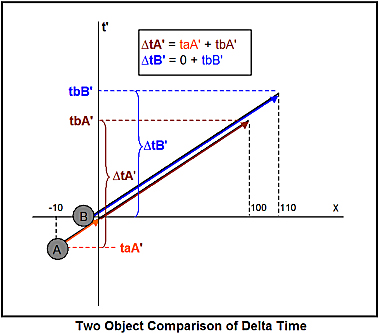
Well, it’s an interesting place to visit…
Why is there a t’ time axis and a x axis together? Shouldn’t it be the x’ axis? And if it is the x’ axis, then the lines of motion should be straight up and down.