Because we are looking at what t’ will be for objects as they go along the x-axis.
Right now, we don’t care about x’ versus x.
Because we are looking at what t’ will be for objects as they go along the x-axis.
Right now, we don’t care about x’ versus x.
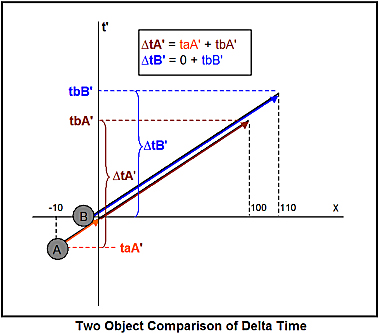
OK. So you are using t’ as a coordinate axis. Given what you have drawn, the delta t’ for A must be the distance between taA’ and tbA’. This is the distance between tbA’ and the origin plus the distance between the origin and taA’. That is, delta tA’ = (tbA’ - 0) + (0 - taA’) = tbA’ - taA’.
So your diagram highlights four events, that we can suppose corresponds to two different objects. At time t’ = taA’, we begin to track the motion of one object, A. At a later time, t’ = 0, we begin to track the motion of another object, B. At later time t’ = tbA’, we stop tracking the motion of object A. At later time t’ = tbB’, we stop tracking the motion of object B. We can identify four events: aA and bA, the beginning and ending of motion for A as far as we are concerned, and aB and bB, the beginning and ending of motion for B as far as we are concerned.
So far, we are not given a velocity. All we have is a relation between the time coordinate assigned to the motion of an object in one frame and the position assigned to the x coordinate from another frame. A velocity, properly assigned, is assigned for a specific frame and relates the time coordinate for that frame to the spatial coordinates of that frame.
Here is the set-up of the scenario: “Look at the time difference calculated between an object that went from -10 x to 100 x at 0.5c. Then look at the time difference of an object that went from x = 0 to x = 110 at 0.5”
So let us assume that in the t,x frame, the velocity of these objects is v=0.5, the object A travels from x = -10 to x = 100, and the object B travels from x = 0 to x = 110.
Let us assume that the events identified in the diagram above are meant to refer to these start and end points in the scenario set-up. (At this point we may be wondering about the appropriate slope and placement of lines on the diagram, but that’s not particularly important.)
At this point there is no t coordinates assigned to the events. I am going to assume that the t coordinate assigned to the earlies two events is t = 0. This means that the time assigned to the later events must be t = 220 (given the assigned velocity).
What does this mean for the t’ and x’ coordinates of our events?
The relevant Lorentz transformations are given by:
t’ = ϓ(t - vx)
x’ = ϓ(x - vt)
where, ϓ = 1/(1-v^2)^1/2 and units chosen so that c=1.
In this particular scenario, ϓ is approximately 1.1547 .
So for the event aA,
taA’ ~ 1.1547(0 - (0.5)(-10)) = 5.7735
xaA’ ~ 1.1547((-10) - (0.5)(0)) = -11.547
So for the event bA,
tbA’ ~ 1.1547(220 - (0.5)(100)) = 196.299 [Please ignore superfluous significant digit here and below.]
xbA’ ~ 1.1547((100) - (0.5)(220)) = -11.547
So for the event aB,
taB’ ~ 1.1547(0 - (0.5)(0)) = 0
xaB’ ~ 1.1547((0) - (0.5)(0)) = 0
So for the event bB,
tbB’ ~ 1.1547(220 - (0.5)(110)) = 190.5255
xbB’ ~ 1.1547((110) - (0.5)(220)) = 0
So our delta tA’ = 196.299 - 5.7735 = 190.5255 . Our delta tB’ = 190.5255 - 0. So we see that, in our second reference frame, the same time has passed between the events associated with our objects.
Interesting is the invariant interval, ds^2 between the two pairs of events. dsA^2 = - dtA^2 + dxA^2 and dsB^2 = - dtB^2 + dxB^2 in any reference frame used for the temporal and spatial coordinates.
Given the significant digits used in ϓ, these are effectively equivalent, as we expect.
Wrong.
tbA’ doesn’t have any 220 associated with it. You are making one of the same mistakes that Carleas made.
Object A is never at coordinate x = 110.
t’ for the taA segment is from x = -10 to x = 0 and coordinate t = 0
t’ for the tbA segment is from x = 0 to x = 100 and coordinate t = 100/.5 = 200 {assuming your c = 1}
t’ = ϓ(t - .5x)
t = 100/.5 = 200
tbA’ = ϓ(t - .5x)
tbA’ = ϓ(200 - .5*100)
Also his and your other mistake;
You ADD the tA components, not subtract them;
tA = taA + tbA
tA = 196.299 + 5.7735
Why would you subtract the orange from the brown? That is a meaningless number.
===============------------------------vv
James, we need to use more than one equation to solve for ∆t’.
-We need to solve for the time coordinates, because we are given starting and ending position coordinates and velocity, but only starting time coordinates. For this we use v=∆x/∆t. (Because we’re using ∆x, we find that ∆t=110/.5c; ∆x is 110 for both A and B).
-Once we’ve solved for ∆t, we find the coordinate by adding ∆t to the initial time coordinate (starting time + change in time = ending time).
-Then, we can use the x coordinates (given), and t coordinates (from v=∆x/∆t and t1=t0+∆t), to solve for the t’ coordinates for each using the Lorentz transformation. Coordinates in, coordinates out.
-Then we can find ∆t’ by ∆t’=t1’-t0’.
We do this for two objects A and B over the same time and distance interval but with different starting points, and we find that ∆tA’=∆tB’.
That has been the case each time we’ve done the math, and if you follow these steps it will always be the case for any starting points. I encourage you to find a situation where it’s not the case. The math that you’re showing now, which you’ve shown before, is still using two different elapsed times in the t frame, so of course you’re finding two different elapsed times in the t’ frame.
You claim to be using a two step process, but I honestly cannot fathom why you would do that when it’s very straightforward to measure the whole thing at once. You keep insisting that a measurement of t’ at x=0 is somehow relevant to its measurement at x=100, but it isn’t. It doesn’t matter. It’s ust be dividing ∆t into ∆t1 (from -10 to 0) and ∆t2 (from 0 to 100). But then ∆t=∆t1+∆t2, and t1=t0+∆t1+∆t2=t1=t0+∆t. What does all that matter? Perhaps you want to calculate ∆t1’ and ∆t2’, and then add those together, but again, why not just solve for ∆t’ more directly?
Even despite your claim, your equations show no such thing. You’re just calculating one ∆t for ∆x=100 and the other for ∆x=110.
What does that show that the current situation doesn’t?
I really recommend that you take the time to really make sure you understand something before you reply. “220” refers to a time coordinate, not a spatial coordinate. The relevant equations is: t’ = ϓ(t - vx).
There is no taA segment. There is the aA event and there is a time associated with that event in any given reference frame. In order to produce a segment, we need two events. This is why I referred to things very specifically in my post. Regardless, this mistake in labelling is not a serious mistake.
The problem with doing things this way is that you are using equations that are designed to find coordinate locations with incorrect coordinates. In your scenario, we begin at time zero and we go forward for 220 units. This is the only way that an object can get from x = 0 to x = 110 at half the speed of light. It is only over 220 units of time that an object can get from x = -10 to x = 100.This means that we stop tracking the two objects at the time coordinate t=220. If we are describing these two objects in the same initial coordinate system and we want them to start at the same time and end at the same time, then we have to assign those start (and end) events the same time coordinates in that initial frame.
If we were taking two segments and adding them together, then adding is appropriate. However, as I explained above, we are taking to points and determining the distance between them in order to get a segment length. That requires subtracting the coordinate value of one point from the coordinate value of the other in order to arrive at the segment length between the points. This is basic geometry.
If you really want to add two segments, then we have to do this:
Find t0A’, the point where A crosses the x axis.
t0A’ = ϓ(20 - (0.5)(0)) = 23.094
We can now figure out the length of the two segments: ∆ta0A’ and ∆t0bA’ = ∆tabA’
|23.094 - 5.7735| + |196.299 - 23.094| = 17.3205 + 173.205 = 190.5255
So if we break this down into the two segments requested, we get the same result.
Uh-huh…
Carl, have you ever heard the term, “cross checking”?
The reason it is a bad idea to have secret agendas and forced mindsets is that by merely repeating what you have been told and forced to do, the group merely repeats any errors that slipped into the game without any way to realize that they have. That is how self-dilution gets created in a mind and religions. Merely repeating the exact same thoughts or procedures, merely repeats an error and it might correct for a type of error of perhaps mis-adding or such, but it doesn’t correct for misconception errors.
In math you find such errors by deriving the same conclusion in a totally different way. You find the misconception errors by getting someone who thinks in entirely different terms (hint hint) and have them rebuild your thoughts from scratch, NOT doing them in the same way that you do. If they come up with different results, you know something is wrong and you have to then examine BOTH ways to find where an error in reasoning might have taken place. If there is no logic error in either, then you know to look for a third way or realize that a more basic concept is simply wrong.
In today’s Science, if you do not do things “as we do”, you will not be allowed to publish. That exclusion process has already caused a self-deluding path to develop. It is a blindness that need not have been intentionally caused. SR is one of many results of such a self-deluding process of exclusion. “If you will do it our way, you will always get the same results that we get.” Well, Duhhh.
Science’s demand for independent repeated experiment is only half of what is required to verify conclusions. It must allow for alternate thinking that reaches down to the most basic concepts in Science, else it merely deludes itself. But they reserve that right for only those who they first approve - “us”.
To know you are right about something, get someone who doesn’t really want it to be right and have them show their logic to cross check from a different angle entirely.
Not true at all and I just showed exactly why it isn’t if you would bother to examine mine as I have yours and Phys’.
All I did was exactly what you demanded had to be done. I bothered to do it “your way” to verify. But when you did the “same thing”, you didn’t do it the way that you demanded, you did it the way that I said you have to do it 3 WEEKS ago.
In those equations, you use “t = x/.5c = 110/.5c = 220/c” but note that you have placed x = 110 for object A. Object A never got to x = 110. So the only way for you to use that number is for you to be saying, “well dx total is 110, so I’ll just use dx, rather than x and calculate dt. Then I’ll use dt in the equation instead of the coordinate t.”
Now if you do that, things will be fine, but you directly insisted that such was never to be done. You are hypocritically defying your own preaching. The result is that you are self-deluding when it comes to ensuring that SR appears to be right when it comes to relativity of simultaneity. Because when considering the simultaneity issue is when you go back to insisting that t is ONLY a coordinate", even though when examining the train’s own simultaneity issues, you insist on “blindly doing it your way so anyone will get your same result”, which is different than what you preach for simultaneity across the frames.
I foresaw that you were going to claim “it is different for cross a frame”, so I set you up by doing exactly what you said must be done, but applied to only one frame. NOW you say, "OH NO, you can’t do that. When we are talking about one frame, we use t to be a total relative measure, NOT a coordinate
And note that even though I repeatedly attempt to examine your work and follow your ways, using your diagrams, your equations, and your methods, to see what might be amiss, you never bother to use mine. I show you exact equations and numbers. You turn around and insist on only doing it YOUR way. Even if it wasn’t self-deluding to hold to such a behavior, it is at least impolite.
James, all that you are doing is violating the rules of mathematics. If you want to build your physics on that, good for you. However, you can’t expect anyone else to do that.
If you want to measure the distance between two points, then you have to compare the two points, not two different points.
Phys, I have shown ALL of my work concerning the issue. You have failed to show me ANY error in “rules of mathematics”. But as usual, you merely throw out accusations.
I told you exactly what you are doing, just like Carleas did.
Here is one: you are treating coordinates as if they are segment lengths. While it is true that the absolute value of a coordinate value gives the segment length between a point at zero and a point at the coordinate, this is not necessarily relevant to determining other lengths. Your attempt to add two segments ends up adding the segment that you want to an extra segment, the one between 0 and the point you want. Now you may be under the mistaken understanding that the segment that you want includes the segment between 0 and one point, but it obviously does not.
Here is another: Nobody ever said that object A got to x = 110. You have made up this fantasy. All we said is that we tracked A until a certain time, the time it took for A to get from x = -10 to x = 100. That is 110/0.5 = 110 units along the t axis. Because the motion of A starts at t = 0, the end of this motion must be at t = 100.
Does this repetition of your problems make it clearer?
Yes, you and he made an acusation. Neither of you has shown where that took place. “Show me the actual evidence in detail, as I did with your errors.”
That is exactly what my argument was in the beginning. YOU and Carl have been saying that “we MUST use ONLY coordinates so we can see a simultaneity issue between the train and the station.”
All you are doing is saying that we must do it as I said that we must 3 weeks ago. But when it doesn’t come up with a simultaneity issue, you switch arguments.
I showed you exactly where you did that and even highlighted it in red. So now you are just lying (again).
What you said there, that I placed in blue, is exactly what I said that you must do. Carl and YOU said, “No. It is always just a coordinate”. But what you just showed and stated was NOT a coordinate, but a delta in time or distance.
The dark red is simply wrong. A starts at t = 0 as does B, but neither stops at t = 100, but rather x = 100 for A and x = 110 for B.
The repetition of your problems makes you totally transparent.
And you STILL haven’t shown a single error in the math of mine.
But for a while you refused to use the Lorentz transformations. You still refuse to use them properly. You must realize that only you and your methods come up with a problem.
Yes, you highlighted in red a part of a calculation that was indicating a time coordinate, not for an x coordinate.
You do realize that object x travelled 110 units, right?
We used that knowledge from the t,x frame to determine the coordinates in the t,x frame. Then we use the Lorentz transformations to take information from the one frame to determine the coordinates in the other frame. Then we use the coordinate values in the new frame to determine distances in the new frame.
The dark red is simply wrong. A starts at t = 0 as does B, but neither stops at t = 100, but rather x = 100 for A and x = 110 for B.
[/quote]
You are right. t = 220, as I used in my equations.
I used them exactly how you and Carl insisted on using them and THAT is when the only problem came up. I didn’t care if you used them before Carl said that you have to use them only as coordinates, which then leads to the problem. YOU want to switch around how you use them to create the fantasy you want.
Not hardly. You just fell into that ego trap. I pointed out when Carl put an x = 110 into an equation for t, “t = 110/.5c”. That means that he used x = 110 for Object A. Object A never got to coordinate t = 110/.5c nor coordinate x = 110.
Yes, you used a delta value for t then proposed to insist that we can’t use a delta value for t, “t is only a coordinate[unless we want it to be a delta]”.
What problem? If I use them how I do, I get the spacetime interval to always be the same, I get the same time for both clocks, and I get no paradox. As far as I can tell, I’ve got smooth sailing.
You, on the other hand, can’t seem to make things work out.
I notice that you ducked answering my question about how far each object travelled. I suspect this is because to answer the question is to admit that you were wrong and you are seriously proof-texting this thread worse than any fundamentalist. Object A travelled from -10 to 0 and then from 0 to 100, that’s 110 units. You said that each object moved 110 units along the x axis at a speed of 0.5 units and that each object began its movement at time t = 0. This means that the amount of time that each object would move is 110/0.5 = 220. This is why “110/0.5” appears in Carleas’ equations and why “220” appears in mine–in both cases in the “t” part of the equation, not the “x” part of the equation. That you keep trying to deny this is pretty sad.
[/quote]
t is only a coordinate. I have never used it in any other way. We use t to find a delta t value.
Yes until you state what the “station sees”. At that point, you and Carl switch from t being a delta to t being “only a coordinate”.
You just used t as a time differential, a “delta”, NOT a coordinate.
You JUST DID again. Do you even know what a “coordinate” and a “delta” ARE??
Like I said before, this conversation is beyond your education, Phys.
Yes until you state what the “station sees”. At that point, you and Carl switch from t being a delta to t being “only a coordinate”.
[/quote]
Hunh? All we did was us the t coordinates to find the relevant delta t and the t’ coordinates to find the relevant delta t’. What would you do?
What are you talking about? We used the difference in x and the velocity you gave us to figure out a delta t in order to find out the relevant t coordinate. What would you do?
You keep behaving as if I am new to this game and that I didn’t need to use SR to pass classes in graduate school. Yet somehow you are the only one in this thread who cannot get the mathematics to work out.
Phys, besides messing up your quotes, you just proved beyond doubt that you don’t know the difference between a delta and a coordinate. A “delta” is a difference. A “coordinate” is a number on a line without reference to any other point other than 0. “dx” refers to a delta or “difference”. “x” alone usually stands merely for a coordinate. The difference between 2 coordinates is a delta, “dx”. “∆x” usually means the same as “dx” if your not using calculus or differential equations, in which case “∆x” means a change in x whereas “dt” means an infinitely small change in x.
The time dilation for any given velocity is a constant. That means that every dt’ for any equally separated points along the x-axis must be the same.
dt’ for x = -5 to +5 (“dta”) must equal dt’ for x = 100 to 110 (“dtb”).
If L == our Lorentz factor;
If you calculate dta for x = -5 to x = +5 giving a dx = 10 at v = 0.5, you get;
dt = 10/.5c = 20/c
dt’ = L(20/c - .5*10/c) = 15L/c
So your dta’ = 15L/c
If you calculate that x at 110 is only 10 from x = 100, thus dx = 10. And then say,
dt = 10/.5c = 20/c
dt’ = L(20/c - .510/c) = L15/c
And thus dtb = 15L/c
Time dilation = ∆ta - ∆tb = 15L – 15L = 0
All of that is fine and works well. No problem because we used “dx”, rather than x1 = -5 and x2 = +5.
BUT, if you use ONLY coordinate values for your dta and dtb and calculate;
at x = -5, t?, v = 0.5c
dt1 = -5/.5c = -10/c
dt1’ = L(-10/c - .5*-5/c) = -12.5*L/c
And;
at x = +5, t?, v = 0.5c
dt2 = +5/.5c = 10/c
dt2’ = L(10/c - .5*5/c) = 7.5L/c
∆ta = dt2 – dt1 = 7.5L/c – -12.5L/c = -5L/c
While;
at x = 100, t?, v = 0.5c
dt1 = 100/.5c = 200/c
dt1’ = L(200/c - .5100/c) = L150/c
And;
at x = 110, t?, v = .5
dt2 = 110/.5c = 220/c
dt2’ = L(220/c - .5110/c) = L165/c
And then look at the delta for those;
∆tb = dt2 – dt1 = 165L/c – 150L/c = +15L/c
Time dilation between 2 clocks on the train = ∆ta - ∆tb = -5L/c – 15L/c = -20L/c
Thus you end up with time dilation between the clocks on the same train.
So you CANNOT use “ONLY coordinates” to calculate time changes with Lorentz for more than one item.
Lorentz means;
dt’ = (dt – vdx/c^2)/(sqrt(1 – (v/c)^2)
For a single item starting at t = 0, x = 0, dt’ and dx’ will be the coordinates for t’ and x’ anyway. When you use that in school, you will get the right answer anyway.
=================
So get out of mouth mode and into mental mode and backup a month and again look at the train clock situation;
Each clock and timer on the train is set to be identical to each other even though they are separated along the x-axis. t’ is what the station frame sees as the time reading for any clock on the moving train for any given t.
As the center clock moves from x1 to x2, you get a delta, dx. That dx is the same for every item on the train. That is what defines it as a single frame. So dx for each timer and the centered clock is identical, by definition of them being in the same frame.
So now, using Lorentz properly;
dt’ = L(t – v*dx/c^2) for ANY dx.
And that is what the STATIONS SEES as the time reading for ANY synchronized clock on the train.
So because the timers and clocks were synchronized, when it sees the centered clock read 4:00-t, it ALSO sees the timers read 4:00-t and it sees BOTH flashers flash at that moment. There IS NO SIMULTANEITY issue.
Lorentz won’t help. So leave Lorentz out of it and get on with resolving the REAL Paradox challenge (that so far hasn’t even been addressed).
How did I show this? You still have not said how you would determine what a specific time coordinate is given only a difference in distance and a speed.
Here’s a more basic question that might find one of your math problems: If an object moves from x = 10 to x = 100, what is ∆x for that object?
I would be interested to see how you came up with this, this this seems acceptable for now.
I don’t really see why that would work.
Well, let’s do some algebra with the real Lorentz transformation. We will set c=1 for convenience.
First, we remember that the transformation for time for a single point is this:
t’ = ϓ(t - vx)
So we have two events: object leaves x = -5 and object arrives at x = 5. We have a velocity: v = 0.5. We do not have any time coordinates associated with these events. However, we can assume that the time coordinate of these events is arbitrary and that as long as we preserve the velocity in the t,x frame, we can choose whatever starting time we want.
So I’ll choose that the object leaves x = -5 at t = 0.
This means that the coordinate locations in t,x for our events are (0,-5) and (20,5), because it takes 20 units of time to cross the 10 units of the x axis at the given velocity.
In this particular scenario, ϓ is approximately 1.1547 .
This means that the locations in t’,x’ are:
Object leaves x = -5
t’ = ϓ(t - vx) = 1.1547 (0 - (0.5)(-5)) = 2.88675
x’ = ϓ(x - vt) = 1.1547 ((-5) - (0.5)(0)) = -3.8453
Object arrives at x = 5
t’ = ϓ(t - vx) = 1.1547 (20 - (0.5)(5)) = 20.20725
x’ = ϓ(x - vt) = 1.1547 (5 - (0.5)(20)) = -3.8453
The distance along the t’ axis for these two events is 20.20725 - 2.88675 = 17.3205
We can calculate a time dilation factor of some sort for this as 2.6795.
We could determine a general formula. Let’s use “1” to designate the start and “2” to designate the arrival.
So distance along t’ axis, dt’ = ϓ(t2 - vx2) - ϓ(t1 - vx1) = ϓ(t2 - t1 - vx2 + vx1) = ϓ(dt - vdx)
In this scenario, dt’ = ϓ(dt - vdx) = 1.1547(20 - (0.5)(10)) = 1.1547(15) = 17.3205
Let’s do the same for these locations with the actual Lorentz transformations.
This means that the locations in t’,x’ are:
Object leaves x = 100
t’ = ϓ(t - vx) = 1.1547 (0 - (0.5)(100)) = -57.735
x’ = ϓ(x - vt) = 1.1547 (100 - (0.5)(0)) = 115.47
Object arrives at x = 110
t’ = ϓ(t - vx) = 1.1547 (20 - (0.5)(110)) = -40.4145
x’ = ϓ(x - vt) = 1.1547 (110 - (0.5)(20)) = 115.47
The distance along the t’ axis for these two events is -40.4145 - (-57.735) = 17.3205
dt’ = ϓ(dt - vdx) = 1.1547(20 - (0.5)(10)) = 1.1547(15) = 17.3205
Well, it works… but it seems that actually going through the actual coordinates in t’,x’ works as well.
Well, let’s just stop there, since this isn’t the equation for dt’. Follow the right equations as laid out above, and we see everything works out. We see here that the problem is that you are using the calculation for dt’ incorrectly when actual coordinates are given.
But this is not correct. You can either use “dt’ = L(dt – vdx/c)" or "t’ = L(t – vx/c)”. You can’t mix and match a coordinate transformation and a delta transformation. If we do things correctly, we see that we remain with relativity of simultaneity.
So it seems that we are back with Lorentz transformations, as SR, having no problem with this overall scenario.
I didn’t see the need. It is a dumb question.
I don’t have any math problems. I’m not the one saying that synchronized clocks won’t be in sync.
90. So now why do we care?
It is the same thing you and Carl have been doing all along. But I accept that you don’t see how it works.
That’s hardly “real” Lorentz.
“time dilation of some sort”???
The time dilation = 17.3205/20
Only because you changed them to dx and dt.
Again, you merely do it as I originally said that it has to be done (using dx and dt) yet both you and Carl have declared that it can’t be done that way. “t is a coordinate [in the Lorentz]”.
Just more of your BS. Phys, I don’t know who you think you are fooling by inventing equations and then claiming that yours are “real” and we don’t have to look at mine because they are “incorrect”. All you are doing every time is exchanging the coordinates for a delta, just as I said you have to do (about 20 times now).
More BS. It is exactly what you just said yourself;
“WE” don’t mix them. YOU and CARL mix them.
And you have shown absolute no simultaneity issues.
You can and no doubt will continue to try to fake your way through discussions and maintain your fantasies. You may have been able to fake your way through your school (if you even graduated), but it isn’t going to work on me.
Relate all of this to the actual numbers of the actual OP scenario or just drop it entirely.
James, look at the equation for velocity:

Now look at the equation for the Lorentz transformation:

What I’ve said repeatedly, and have never violated when demonstrating my work, is that the Lorentz transformation equations call for a coordinate, and only a coordinate. I’ve also said that, if x and t were intended to be ∆x and ∆t, they would have been written that way, as they are in the equation for velocity.
Because in your example we are not given the starting and ending coordinate (which we need to solve the Lorentz equations), we must calculate them, using an equations that explicitly calls for ∆x and ∆t. I never said ∆x and ∆t are useless, or that they are never used anywhere, only that the Lorentz equations do not use them. And they don’t.
Look at the example where I solved for ∆t’ starting with the coordinate (-10,-100).
This case is illustrative because it starts at t0=-100. As a result, t1 = -100+∆t ≠ ∆t. This lets us distinguish ∆t from t for all the points we’re concerned with, so it’s easy to see that ∆t is not being used in place of t in the Lorentz equations. When we started at t0=0, t1 = t0+∆t = ∆t, which makes it less clear which value we’re using (using either gets the same results). In the equations above, using ∆t in place of t would yield a different answer.
Well, you keep criticizing Carleas and I for using the most obvious procedure to do this. I am interested in how you would determine a time coordinate given only a spatial distance and a speed.
We care because whenever someone else uses the same reasoning, you get upset and angry at them. Previously, you argued that ∆x should be 110, since you seemed to claim that we should be adding the coordinate values to get the distance.
I see what you were doing now: you were confusing two different transformations.
Why not? Is it not what one finds in every special relativity textbook? Is it not what one finds on the relevant wikipedia page when the page hasn’t been vandalized?
If that’s what you want to call “time dilation factor”, then fine. I can’t see why it matters for this.
Were you able to follow the algebra?
No, what we object to is your mistake in mixing an equation with delta values with an equation without delta values. We also object to you mistaking our use of equations without delta values for equations with delta values. These are things that one must pay attention to.
I am not sure what you mean by this. In the standard Lorentz transformations, we transform from one coordinate system to another in order to get particular coordinate values in the new system. We can use a similar transformation to calculate temporal and spatial distances in a new frame, but we do not use the same equations and we do not mix the equations up.
Do you deny that the equations that I used are exactly the ones one finds in every textbook and other reference for the Lorentz equations? Which one is wrong?
Well, that’s just crazy talk. You wrote, “dt’ = L(t – vdx/c) for ANY dx." That is a mixture of two equations, "dt’ = L(dt – vdx/c)” and “t’ = L(t – v*x/c)”. Do you deny that the equation that you used is a mixture of the two equations?
If you meant to use some other equation, then what equation did you mean?