The Actual Gospel Of Jesus Christ is a “Gospel of Jesus’ Likeness”
What it means to be saved and what it takes to be saved is summed in the following two verses:
“I have been crucified with Christ;
it is no longer I who live,
but Christ lives in me.”
-Galatians 2:20
___________________________________
“If we have been planted together
in the likeness of His death…”
-Romans 6:5
____________________________________
Let us analyze Galatians 2:20.
“I have been crucified with Christ…”
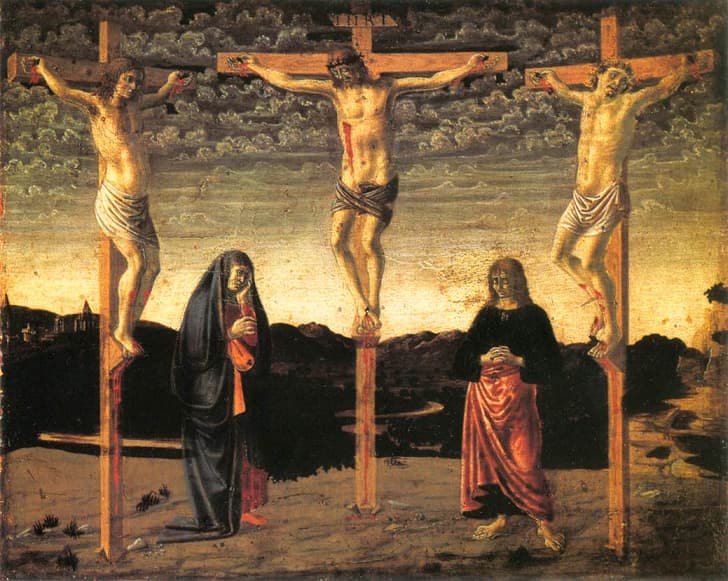
Using logic:
1. Have you, born two thousand plus years after the death and resurrection of Jesus Christ, been physically crucified with Christ? As in, nailed by wrists and shins to a wooden cross and suspended from the earth as Christ did…at the same time Christ was crucified?
2. Was anyone upon the same cross atop or below Christ as He was crucified, so that there were two bodies, one atop the other, on the same cross?
3. Was there anyone on either side of Christ save the two thieves?
When it comes to the literal, physical meaning of Galatians 2:20, the only humans of every other human that shall ever exist that can claim to have performed the literal meaning of the verse would be the two thieves (the Bible gives no indication of the existence of others crucified on either side of the two thieves).
4. Paul was not physically crucified with Christ though He was alive at the time of Jesus’ crucifixion and had heard of it, if not attending it. He certainly would not claim to have been “crucified with Christ” in the literal, physical sense given Paul was still physically alive while Christ had died, resurrected, and ascended to Heaven.
Given no one other than the two thieves can rationally claim to have been “crucified with Christ” in the literal, physical sense, what did Paul mean by stating He “was crucified with Christ”?
Using Logic:
Given Paul was not physically crucified with Christ, and a person born two thousand years in the past or future cannot rationally claim to have been crucified (if not crucified), much less time-traveled two thousand years in the future or past to be crucified on the same cross as Christ or adjacent as were the two thieves, what does it mean for someone not to have been literally and physically crucified with Christ to have been “crucified with Christ”?
1 Peter 2:24 gives us an answer:
“He Himself bore our sins in His body on the tree.”
A cross is made of wood, and the wood to make a cross for crucifixion comes from a tree, thus there is no need to mince words or play a game of semantics in regard to Peter’s statement. It is evident from the straightforward manner in which Peter stated 1 Peter 2:24 that Jesus Christ did something other than physically die upon the Cross, unlike the two thieves. What part of Christ, then, was involved when “He Himself bore our sins in His body on the tree”?
In what part of Christ’s body did our sins reside? In the liver? The spleen? His lungs? His heart?
Or was it that part of the body that is the mind, given it is generally believed, George Berkeley’s Idealism notwithstanding, that the mind is within the physical body?
So we approach the crux of the truth: salvation is not merely good deeds done to please God to get into Heaven. Salvation has something to do with one’s mind, specifically, Jesus’ mind and what is occurring within it in regard to how Jesus’ mind determines the nature of one’s mind, and the nature of one’s experiences between birth and death.
Those not saved do not have this isomorphism between one’s experiences and the goings on within the mind of Jesus Christ. It’s that simple.
1 Corinthians 2:16 states: “But we have the mind of Christ.”
The mind of a person usually isn’t thought to be have anything to do with the mind of another person, such that the other person in terms of their inner and outer, external experiences are what they are because of what is within the mind of the first individual. But we see in various statements in the New Testament that one must do things “through Christ” or “in Christ” or prayers are given “in Christ” or “through Christ”. In concert with the logic afforded by 1 Corinthians 2:16, things are “in Christ” in the sense of the things that are outwardly and externally performed by humans outside the mind of Christ are re-enactments of things occurring within Christ’s mind, and this is what is meant for something or for things to be “in Christ”:
“And God raised us up with Christ and seated us with him in the heavenly realms in Christ Jesus..”
-Ephesians 2: 6
And:
“For we are God’s handiwork, created in Christ Jesus to do good works, which God prepared in advance for us to do.”
-Ephesians 2:10
That is, in order to please God, everything must be done in Christ or through Christ. Thus in Galatians 2:20 when Paul states, “I no longer live, but Christ lives in me”, he is not being metaphorical or figurative: this is the actual, true nature of being saved, is to replicate the goings on in the mind of Jesus Christ, to replicate or re-enact that which He Himself experienced in the form of YOU within His mind while either dying upon the cross, or in the three days prior to His resurrection.
Thus the true, actual Gospel of Jesus Christ is not an appeasement of God through good works, nor the self-controlled cleansing of one’s own mind through Freudian suppression of bad thoughts and desires, but it is a “Gospel of likeness”, i.e a Gospel of re-enactment of the goings on within the mind of Christ. From our perspective, we have no idea what is within the mind of Christ (unless it is revealed through vision by means of the Holy Spirit), thus comes the finishing remark of Galatians 2:20:
“…the life I live in the body,
I live by faith in the Son of God,
who loved me and gave
Himself for me.”
That is, one must have faith that one replicates the experiences of Jesus Christ, and that one’s existence and experiences are a replica of the goings on within Jesus’ mind, whether in the form of 1 Peter 2:24, or in the holiness that comes through Him, albeit in the trappings of this form of His death, through the Spirit of God.
It is this “identical twin-ism” of experience that is the mystery of God, the hidden answer behind everything. Simply having this concept, in itself, is akin to holding the key to a door without fitting the key in the lock. One fits this key in the lock by desiring and asking God to grant one the Holy Spirit, that one’s experiences (which in terms of sin are, if predestined to be saved; though this isn’t a “James Bond”ian “license to sin”, but a preliminary to one becoming more and more sinless as one continues to replicate the experiences of Jesus during the three days prior to His resurrection, as opposed to His experiences while dying on the Cross) replicate those of Christ’s, that the content of one’s mind and those of Christ’s are interlocked, rather than separate, unrelated things.
END