Seems like a lot. Let’s see how it goes.
So we’re debating monopolies, not socialism, unless you understand all regulation to be socialist. In that case still, Im only in if it is nominally about regulation, rather than socialism, as I do not consider regulation to be socialist per se. If you do, you’ll have to argue for this.
On top of what I already said:
Antitrust legislation developed 1890 through 1910 split up major monopolies, with that it secured the White House as executive primacy, also introduced some quality control, a base level of quality for things like beef and other foods, and reduced prices by reinvigorating competition.
This was followed by Americas primacy in the world. Despite the clear logic, Im not knowledgeable enough to be 100% certain of a direct causal connection but if it didn’t help, it sure didn’t hurt.
From end 1970s the antitrust policies were abandoned. This was accompanied by both an economic boom in electronic and financial sectors but also with expatriation of a lot of physical industry, massive conglomerates are free to settle wherever, aren’t bound to the land like smaller companies are. I think that the breakup of the antitrust policy is a direct cause to disappearing of US manufacturing base the lowering of food quality, and the enormous rise in medicine prices as well as increasing state-driven compulsions to consume medicines.
The main sector that has remained stateside under the monopoly-based economy is computer technology. The top five companies of this sector now encompass half the US economy and is a dominant political power. Together they employ about 1.7 million people in the US. Of these Amazon takes the lions share, 1.1 million. Just some statistics to contemplate.
Alright I’ll leave it at that.
Edit no Ill continue a bit.
My favored model is free market capitalism. I argue that a monopoly driven economy is not a free market. It is dominated by things that have nothing to do with market forces, namely such things as lobbying for privileges, price fixing, elimination of competition through buying legislation rather than competition.
Also I figured, because of the deregulation and loss of manufacturing, probably the national debt began to rise about the same time, late 70s. So I looked it up.
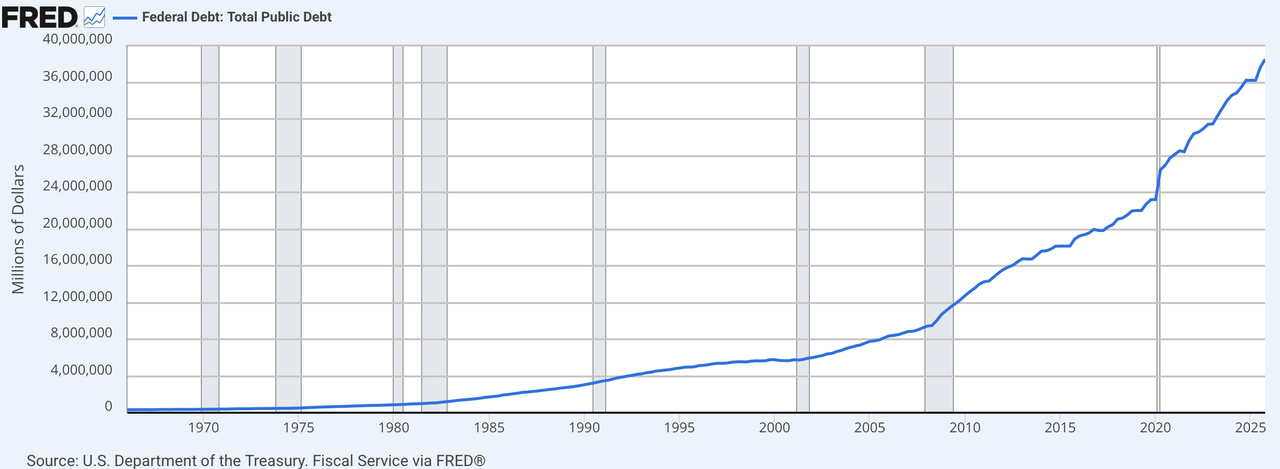
So basically I see a bit of economic regulation, quality control, securing of the possibility of competition, and especially market based pricing, as a task of the government just as vital as other types of legislation keeping a basic social order. For the aforementioned reasons but also very basically if the government doesn’t regulate, the government gets bought. I know it’s always bought to a certain level, thats the nature of power, but since Im in favor of a free market, I am in favor of containing the degree to which government is owned by private interests.
So at the root of a free market economy that stays free is a secure nation under secure governmental branches.