As an Occam’s razor user, I go further and say that this is actually a fact, not a hypothesis. This is the nondual / Advaita / Zen view of the self, as the AI also mentioned.
The hypothesis is actually our Western view, that the subject and the object are separate. I’ve been pestering people on philosophy forums to try to come up with just one convincing evidence for this hypothesis, and imply that nondualism is wrong, but I don’t think anyone has been able to do so.
A few minor issues:
This is (probably) a rather futile exercise though, as we can never directly experience the external world. We are always limited to our minds, our perception is indirect, we only experience the representations of the external world, in addition to experiencing imagination.
The self is part of the stream, but imo we should also be cautious with going with Buddhism all the way. Because the human self is not just any kind of self, the human self is self-aware. A handful of species show signs of self-awareness on this planet, while the overwhelming majority do not.
I don’t think Buddhism addresses the issue of self-awareness very well. Humans DO have an additional psychological “identification/control mechanism”, that then generates the ego. The ego does exist, but it isn’t what it seems to be. The ego is illusory. And unless we cut out a sufficiently large chunk of our brain, the ego will always resurface.
They aren’t separate, they are continous. This is extreme speculation territory, but maybe some kind of higher-dimensional quasi-seperation could still be possible though, but it would be imperceptible to our 4-dimensional perception. Quantum mechanics raises questions, “our end” of the world always seems to behave one way, and then elsewhere that always changes.
But in that case the separation could be dynamic. The boundary could be inside the mind. The boundary could be at the edge of the mind. The boundary could extend outside the mind. This could change all the time.
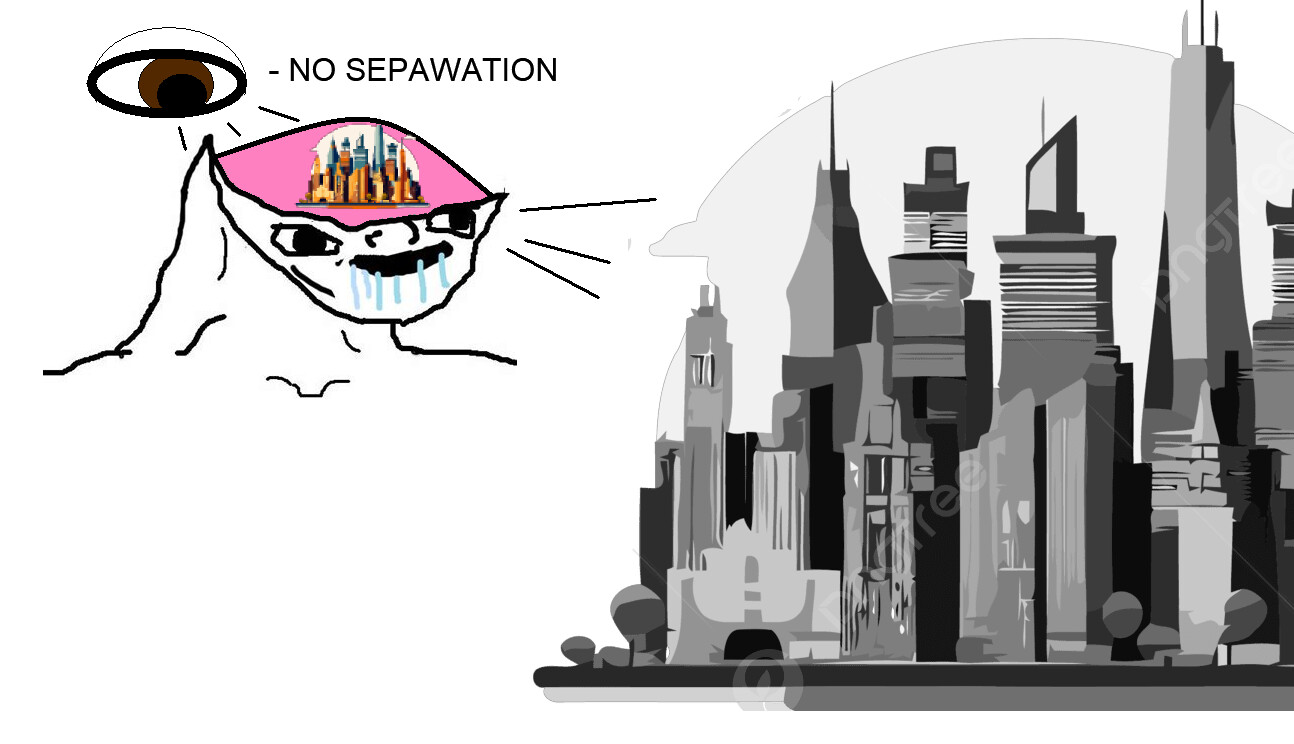
 I think I’ve only ever seen one other person on philosophy forums who was both a nondualist and an indirect realist, like me. I’m perfectly used to not being understood. And this guy seems so fragile, it would be cruel to insult him back more.