Now that you’re making such a big deal of not telling me, I’m actually curious.
Some kind of Methodist?
Now that you’re making such a big deal of not telling me, I’m actually curious.
Some kind of Methodist?
Thats how i would describe western morality as a whole.
The tao thing is circular and not dual but trial.
Western morality has 2 components. Eastern morality has 3. 2 forces + the overarching system they create.
I have a very hard time pinning down what position you are arguing from because we seem to be alternating between my views, the overarching, yours and then the separate world views between west and east.
I try to take an objective position that encompasses all available data and vectors.
And some of your questions seem to be revolving around nothing more than how i personally contend with certain concepts and words, which is jarring to say the least because the conversation is directed at me instead of the idea and problem im proposing.
I think that my criticism is pretty clear at it’s core.
The Western framework of pragmatism, of diametrically opposing forces and human derived values is a self-destructive, self-serving atrocity that fails to get even in the remote area of morality, because it tends only to it’s own interests and needs, and even that in a spectacularly bad, wrong, failing fashion.
Buddhism did not spread throughout Asia violently.
In fact, everywhere Buddhism spread throughout Asia it peacefully merged in a syncretic manner with local indigenous polytheistic beliefs. Learn about Asian histories before you espouse nonsense.

The above posts are more examples of why perceived problems were believed to exist when, in actuality, there were none.
Most are familiar with western Christianity morality and ethics where Satan or Lucifer is viewed as a separate entity acting of their own freewill against God in rebellion creating the dynamic of Christian moral duality.
In Judaism it is a lot different, Lucifer is actually a servant of God sent to torment sinners, blasphemers, and the unrighteous. The idea being that only the obedient or righteous survive encounters with evil and that the weak unrighteous along with nonbelievers suffer evil as divine punishment. In Judaism Lucifer is under constant command by God and has no independence of his own.
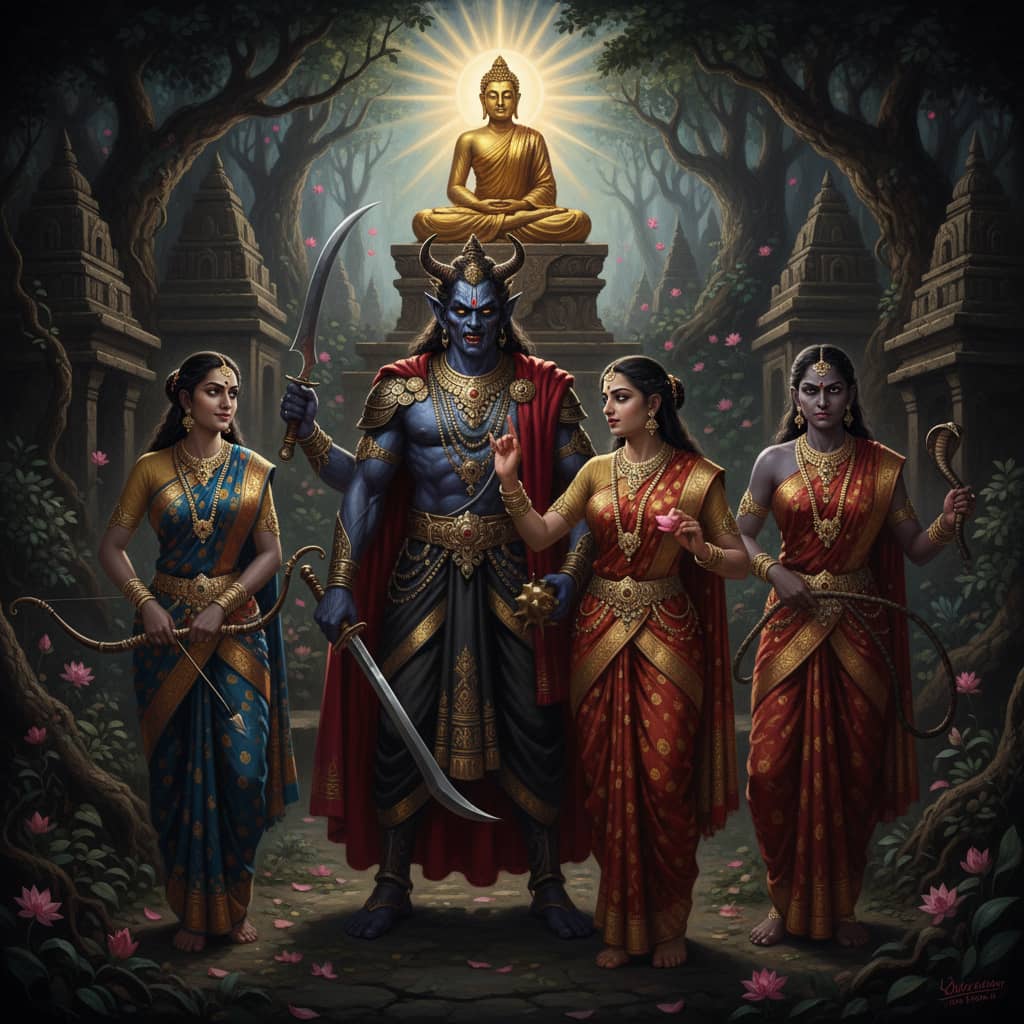
Likewise we Buddhists have Mara who is the chief archetype image of evil in our belief system along with his three demonic daughters.
In Buddhism Mara represents ignorance since it is viewed that ignorance is the root of all evil in the world along with suffering.
Mara’s three daughters are (Rāga)lust , (Arati)boredom, and (Taṇhā) craving.
To become enlightened in the seeking of Nirvana individuals must overcome Mara and his three daughters in all they represent.
Enlightenment has already been reached, well by some anyway. Nirvana is reached when the others become enlightened as well.
Again, why perceived problems were perceived to exist are on display here.
Please explain more about what exactly?
Or, is there something else or something more specific that you would like more explaining of?
But how does this relate to the proposed issue? Whether lucifer acts on his own or at command, the problem remains the same, just less personified.
The abrahamic religions and their idea of this good vs evil separation where the relationship between the two is denied, whether by satan’s own free will or by god’s own command… it does not work.
Buddhism is a very special case, but it too somewhat falls into the same hole, just from a very different angle. It acknowledges many of the self-perpetuated sufferings that come with the body and soul, but ultimately still decides that the meaning of existence is outside of the circle of perpetuation.
In one of the most simplest terms this was represented with the 3 vinegar tasters.
Confucius, Buddha, and Laozi.
For Confucius the vinegar was sour.
For Buddha vinegar was bitter.
And Laozi smiled cause that is exactly how vinegar is supposed to be. Bitter and sour.
Of course humanity needs to look after its own interests.
And of course we need a philosophy of moral frameworks that regulates society. That separates beneficial behavior from non beneficial.
But it has to start there with absolute fundamental truths.
How would you use the vinegar properly if you did not acknowledge that its bitter and sour? That it is exactly what and how it is meant to be?
My point is simply that in our desire to benefit ourselves, our morality has completely twisted already. We view the rest of existence as sacrificial and exploitable resources because only humanity has agency, choice and consent.
And nothing shows how rotten this philosophical wound has become than how the west keeps on perpetually destroying and rebuilding itself, always chasing after this idea of nirvana.
Just a little more freedom. Just a little more liberalism. Just a little larger dose of crack cocaine and everything will be perfect.
No. You are off balance. Dying, rotting, going insane. Screaming in silence without being even able to realize what is wrong. Everything should be so good, and yet everything is falling apart.
A pretty golden age. Life expectancy and quality of life have never been as high as now.
And yet everyone is screaming internally. Nobody has a purpose. Everyone is clawing at their own face looking for something to fill the hole they cant even begin to describe.
We can look out for our own benefit.
That is not the issue.
But we cannot reject the nature of all in the process. Otherwise there will be hell to pay.
And we are paying. Even now.
Not efficient enough, too sentimental. This was covered weeks ago in the thread “The Ontology of Good and Evil”. Here is the text:
The Ontology of Good and Evil
Good and Evil are defined by contrast, without either each ceases.
To define Good is to define it by what it is not as Evil, to define Evil is to define what it is not as Good.
3.Good and Evil require negation to maintain presense and yet absolute negation results in the cessation of each by the cessation of the other.
Pure negation of Good results in the negation of Evil, thus Evil must negate into Good by grades to occur.
Pure negation of Evil results in the negation of Good, thus Good must negate into Evil by grades to occur.
The gradation of each is the emergence or the other as the gradation of each is the space by which the other occurs.
Good is Good by its gradative nature as a fixed point across a spectrum of structures thus as a fixed point is absolute as constant; Evil is Evil by its gradative nature as a fixed point across a spectrum of structure as a fixed point is is absolute constant.
Good and Evil are respectively absolute.
Good is Evil by its requirement for Evil; Evil is Good by its requirement for Good.
10.Good and Evil are respectively relative by relational contrast, a contrast that requires opposition thus relation.
The negation of this tetrad is the void, as the tetrad, from which Good and Evil respectively emerge thus relagating void as pre-moral, trans-moral and post moral under the context of the contextualization of Good and Evil as emergences.
Pure Good is void; Pure Evil is Void.
The emergence of each is the recursion of void thus relegating Good and Evil as cyclical.
Absolute Good on its own nature has no contrast thus is void; Absolute Evil on its own nature has no contrast thus is void.
The distinction of void is the distinction of Good and Evil, indistinct void is paradox by degree of the distinction of ‘indistinct void’ being a distinction; this paradox is Good and Evil.
There are infinite distinctions of the distinction of Good; there are infinite distinctions of the distinction of Evil as there are infinite distinctions of the void of each.
Good and Evil as distinctions that direct the emergence and dissolution of further distinctions. What they are and are not is but the assertion of distinctions.
Distinction distinct within distinction observes a recursive self-embedding thus by said degree does “you reap as you sow” (as cause and effect, karma) and “the golden rule” (emergent reflexive identity) are revealed by the said inherent reflexivity of the nature of distinction;
The void recursion, by which distinction is, observes the generation of distinction from void while dually by degree revealing the generation by the inherent emptiness of distinction itself thus resulting in an unconditional state associated with “unconditional love”.
The trifold moral structure of distinction, as the “you reap as you sow/cause effect/karma”, “the golden rule/reflexive identity”, and “unconditional love/emergent distinction” are effectively united under fourth degree as the void of attention itself by which they further emerge and dissolve.
The attention of attention reveals the distinction of the void of attention itself which mirrors the same pre/trans/post moral void from which the distinctions of good and evil occur thus relegating the nature of attention as the micro void to the macro cosmic void as void recursion.
By attention does distinction unfold and enfold, attention is a distinction of itself; good and evil are distinctions of attention with there unfolding and enfolding mediated by attention thus attention is the foundation of ethics and morality.
Attention is void contained with the repetition of distinctions, the repetition of these distinctions are the cycle of the perspective itself, perspective is how further distinctions are maintained, emerge and dissolve.
The inherent potential that underlies all change is but the distinction of void at the macro level of existence for by void is potential realized, the void of attention is the void of potentiality;
the distinction of void at the micro level and the distinction of void at the macro level are by the means of the distinctions that contain each;
the distinction of void is scale invariant, the scale that results is but the distinctions emergent and dissolutive of them;
perception is the structure that contains attention, perception is recursion of distinctions, existence is self-aware by the void from which it emerges.
What remains is distinction; the foundational distinction is void.
This was a very nice read, and i have to admit that the overwhelming majority of it is perfectly coherent and i cant disagree with it. A few points that raised my eyebrows however were:
Void has no distinction. Its one of the terms which as no gradients to it, because if it did, it would be no longer void. Void is an absolute term. It has no presence cause its the definition of complete absence.
The problem that presents itself at 16. Starts to spiral out of control around here with void now having a presence, quality and the ability to fold back onto itself.
I am not entirely sure what is happening, maybe i am misunderstanding something or you are working with the wrong word or analogy?
Yeah, we are definitely going to places with the idea of void…
I catch glimpses that you might have shifted somewhere from universal truths to their interpretation and thus “how it’d seem from the human perspective” but its not very clear to me.
Maybe im interpreting something wrong.
And while this is a very poetic end conclusion, it kicks back the entire step by step construction you built into the void. Extraordinarily nihilistic and i kinda like it, but… well i think i will have to chew this over.
There are interesting conclusions to draw here, so i will mull it over for a little longer.
The relative void of Good is evil, the relative void of evil is good. Void is not an absolute as void is void of absolute and relative on its own terms.
Void is pure potentiality as the absence of actuality. Pure potentiality must have the potential of potential, thus this is recursion as the actual. A simple 0d point cannot be seen. The recursion of a 0d point allows it to be distinct.
The distinction of void is void as void. To assert void is to make a distinction of it.
There is no nihilism, if you read the text the golden rule, karma, “you reap as you so” results from the event of distinction making.
That is specifically what makes it absolute
Its so absolute that even terminology falls off of it, including the concept and it’s name, because “void” is devoid of the name void, and the concept of void as well.
What you described is specifically what makes it absolute.
This is a very fun mathematical game, but it has nothing much to do with reality.
The process of recursion requires an external observer, such as a bored mathematician to prescribe sets to the void which then can go through recursion.
But void has no external observers. It is not part of a set, and it does not contain sets.
It is not empty, it is not potential. “It” “is” “not”.
If it does, if it has any qualities, boundaries, potential or other then its no longer void.
One could say that the thing you are describing is not true void.
It never was.
Its just emptiness, a quality born within the boundary of whatever this universe is a part of.
If we do so, it allows these kind of theories a respite. A potential to function.
Of course even then, this is the point where we can pull the all mighty god out of our ass to prescribe that primordial spark that came out of nowhere to tip the balance.
But the reality is that while the system you prescribe could exist, it hinges on a few prequisites such as there being no void and the spark that initiates recursion.
Aristotle’s idea is a paradox and takes immense freedoms with the idea of void.
Refer to the above.
For any of these ideas to function, void cannot be part of the equation. You need fertile nothingness for it. Not void.
Hmm… maybe. I am still not sure where i land on the end conclusion. But its potentially more true than it is not.
Morality and ethics is just consequentialism wrapped up in the causality of reality.
If you strip the entire problem barebone then yes. That is ideally the case.
Morality should account for the causality of reality and the causality of life itself which mirrors it.
Western morality and pragmatism does not, and the consequence of it is rot.
No truer words spoken.
That is specifically what makes it absolute
Its so absolute that even terminology falls off of it, including the concept and it’s name, because “void” is devoid of the name void, and the concept of void as well.
What you described is specifically what makes it absolute.
This is a very fun mathematical game, but it has nothing much to do with reality.
The process of recursion requires an external observer, such as a bored mathematician to prescribe sets to the void which then can go through recursion.
But void has no external observers. It is not part of a set, and it does not contain sets.
It is not empty, it is not potential. “It” “is” “not”.
If it does, if it has any qualities, boundaries, potential or other then its no longer void.
One could say that the thing you are describing is not true void.
It never was.
Its just emptiness, a quality born within the boundary of whatever this universe is a part of.
If we do so, it allows these kind of theories a respite. A potential to function.
Of course even then, this is the point where we can pull the all mighty god out of our ass to prescribe that primordial spark that came out of nowhere to tip the balance.
But the reality is that while the system you prescribe could exist, it hinges on a few prequisites such as there being no void and the spark that initiates recursion.
Aristotle’s idea is a paradox and takes immense freedoms with the idea of void.
Refer to the above.
For any of these ideas to function, void cannot be part of the equation. You need fertile nothingness for it. Not void.
Hmm… maybe. I am still not sure where i land on the end conclusion. But its potentially more true than it is not.
[/quote]
The void of void observes:
Absolute as a fixed point that does not change (there is nothing to change).
Relative as scale (x is void of y).
Absolute and relative (x is void of y absolutely always in context)
Neither absolute nor relative (the void of void is the void of distinctions of absolute and relative as pure distinction).
Recursion does not require an external observer as the void of x in y and the void within attention itself are but scales of the void that occur through void recursion (ie the void in attention and the void of what attention is place on is the recursion of void)
Void is pure potentiality, as the unactuality of actuality, thus the recursion of void is is the collapse of pure void, the void of void, the collapse of pure potentiality, the potentiality of potentiality, into being and actuality, correspondingly, by the distinction of each as recursion itself.
Void is indistinct until recursion, potentiality is indistinct until recursion, as recursion is distinct by self contained self contrast;
Self-contained as void/potentiality is its own containment by repetition; ●● contains ● as ●●.
Self-contrast as void/potentiality is is own contrast by repetition; ●● contrasts ● as ●●.
From what position?
Because from our position sure. Everything requires context for human beings. We need to construct all kinds of mental constructs just to be able to tend with and communicate different principles and ideas.
However, i am talking from the position of noumenon.
Nothing relies on our context. Only we do. Absolute requires context no more than the tree does that fell in the forest without anyone around to hear it’s sound.
Correct.
Correct, but this is only in regards of our own mental constructs.
The absolute state of void does not change depending on what you call it.
It is either void, or it is not. If it has an observer, then its no longer void cause boundaries and separation has been instantly applied. its no longer void, it is just emptiness.
Then let me ask directly: Do you understand how much of a paradox it is what you are saying?
V:
Absolute exists in context. Contexts may scale resulting in scaling fixed points. The void how is absolute, relative, both, neither. In the context of neither void is not absolute nor relative, cannever be.
N:
From what position?
Because from our position sure. Everything requires context for human beings. We need to construct all kinds of mental constructs just to be able to tend with and communicate different principles and ideas.
However, i am talking from the position of noumenon.
Nothing relies on our context. Only we do. Absolute requires context no more than the tree does that fell in the forest without anyone around to hear it’s sound.
V:
The void of void observes: Absolute as a fixed point that does not change (there is nothing to change).
N
Correct.
Neither absolute nor relative (the void of void is the void of distinctions of absolute and relative as pure distinction).
Correct, but this is only in regards of our own mental constructs.
The absolute state of void does not change depending on what you call it.
It is either void, or it is not. If it has an observer, then its no longer void cause boundaries and separation has been instantly applied. its no longer void, it is just emptiness.
V:
Recursion does not require an external observer as the void of x in y and the void within attention itself are but scales of the void that occur through void recursion (ie the void in attention and the void of what attention is place on is the recursion of void)
N:
Then let me ask directly: Do you understand how much of a paradox it is what you are saying?
Perspective may be the context of X.
X may be the context of perspective.
What remains is context, as the limits of an event.
Perspective and X are but events.
What remains are interpenetrating boundaries.
If it is either void or is not void then the dichotomy as a single entity itself is both, and the dual to that dichotomy is neither. LEM negates itself by default as “void or not void” results in a void between “void or not void” as “or” is a space of divergence. Effectively you are negating your own argument.
All distinction is paradox by the limit of it being the relative presense and absence of a thing. Given the distinction of void is actual as a distinction, void itself is pure paradox.