The original philosophical problem of Good and Evil - A comprehensive critique of western morality

Since morality, and the fight against evil keeps resurfacing ad nauseam, i will try to explain the blind spot of classic western “linear” morality.
I am not decreeing something here. I will describe a problem through raw neutrality (or at least i aim to do so), and i welcome everyone to tackle it as they see fit.

So without further ado, western idea of morality prescribes the following:

  • Good and evil are mutually exclusive categories with a permanent line between them
  • Good is ontologically superior. Evil is destructive but lacks the power to create
  • Good and evil are not complementary or necessary partners
  • It rejects the idea that good and evil change based on time, place, or personal perspective
  • Human choice is the bridge between the two. Humans have the freedom to choose, while nature has no choice or agency
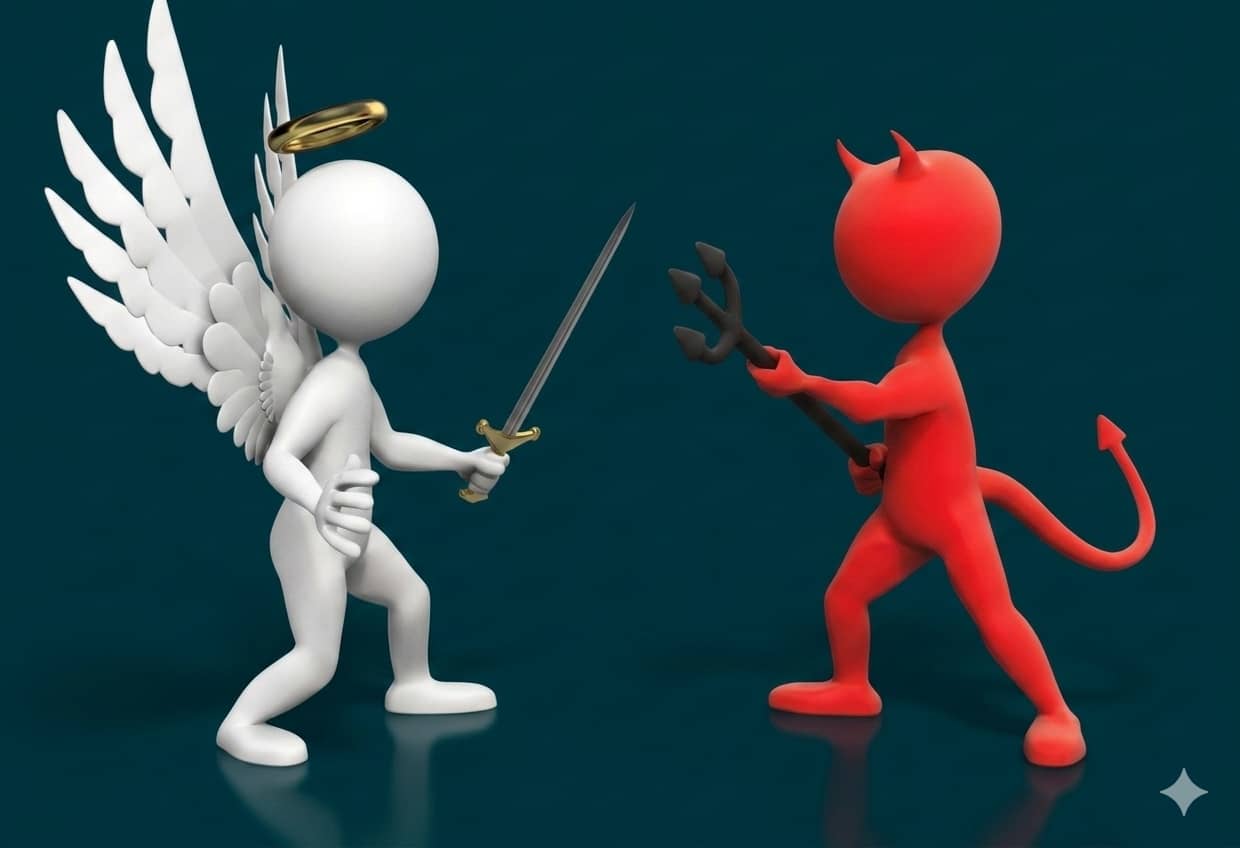
The fundamental issue with western idea of morality and good/evil is that its human derived and human conduct/choice is it’s measure.
There is a side story here with how (since its prescribed by humans through human value) it would create the obvious issue of “no man stands above another” which western morality cheats by outsourcing their own values to god, specifically christian values, in order to tilt away from “we cannot tell you how to live your life” to “but here is my dude called god who is the owner of this reality and he absolutely can tell you”. However, this is largely offtopic here and now.

The system works if the only goal is to prescribe the direction of social interactions and to guide what is good and bad conduct, but the framework its using for doing so utterly abuses the larger existential implications and creates massive blindspots in it’s own framework.

This is what brings us to the question of what is good and what is bad in it’s truest sense:
In it’s primordial form good and bad is simply presence and absence.
The lack of need, and the need to fill the lack.
Good and evil
Life and death
Is and is not
Yes and no
1 and 0

This primordial description is valid, because it fits into nearly all systems going forward:

  • It works in physics where one state is high energy and the other is in low
  • It works in psychology where one state is sated, at peace and the other is in need, forced to seek
  • It works in sociology where one state is a high trust society of unified values and customs, while the other is one that is fractured and seeks the points by which it can connect and form
  • It works in biology where one state is has no stressors which would motivate it to move and change, where the other is internally “motivated” by stress to satisfy it’s needs
  • It works in economy where in one state the house/business/we is fully solvent, abundant and sustainable, in the other its collapsing, cant be sustained, has a deficit
  • It works in metaphysics where good is static and bad is the engine that moves all
    and so on and so forth

It is no exaggeration to describe this as one of the most fundamental laws of this reality and universe. There is nigh nothing in it that would go against this formula lest we tread into the quantum realm of theoretical physics.

Some eastern philosophies tend to this. Such as taoism which describes the relationship between these forces or states

The eastern philosophies do not deny the idea that good and evil are in a fundamentally connected relationship. Not only because one would lose conceptual meaning without the other, but because only together can they form a coherent system.

When someone with a western idea of morality looks at yin and yang, they see two opposing forces fighting eachother. What escapes them is precisely the relationship between the two: The circle. That the two compose the one.
And the one is the moral foundation for eastern philosophy. The one is the circle. The tao.
Even the western idea of evil is considered to be a beneficial part of nature and existence, as long as it fulfills it’s role within the tao, like how death makes room for new life.

This brings us to the fundamental problem with western morality.

Western morality does not ask how the universe works, how nature works, how all things work.
Western morality asks a different question: Given free will, how should we conduct ourselves?
It is deeply pragmatic if nothing else, but its a complete catastrophe in it’s execution precisely because it does not contend with anything except itself, it’s human derived notions and how human beings feels about things.

When you try to extrapolate western morality onto any larger framework, it breaks and kills everything. INCLUDING itself.
I will bring a specific example that models this issue. Just one. The problem of liberalism.
Western society views more and more freedoms as a net positive, pushing everything more and more towards “good”.
More prosperity, more benefits, more wealth, more rights, more freedoms, more more more more more more everything. And its clearly failing. The system is falling apart. Human beings, human ethics, human values, human everything is in decay despite everything being better.
And western morality cannot even conceptualize the problem, because it cannot describe it within it’s own framework that it goes against the nature of all things. But even in doing so follows the same path of the circle: It perpetually destroys and rebuilds itself, always chasing that unattainable moral good it desires, always failing and destroying itself in the process just to try and fail again.

In conclusion:

This has been the source of many debates on this forum to no end. I wrote all of this down in order to touch upon one of the most fundamental failings of western morality, society and philosophy and it’s worst offender: pragmatism.

The 19th century American branded notion of “lets reject the quest for absolute cosmic truth or objective metaphysical reality” and simply go for “the value, meaning, and truth of an idea are determined entirely by its practical consequences and usefulness in human life”

I acknowledge that a human moral framework needs to account for human needs as well.
Questioning that would be insane.
But i hope that what i wrote highlights that the western framework for determining good and evil is so antithetical to the nature of everything including that of humans, that it cannot result in anything other than destruction.

Since i have been writing this for a couple of hours now, alternating between writing and looking/comparing different concepts and terms, im pretty sure that i missed a lot, so i might come back and edit things based on feedback if there is any. For all intents and purposes, look at this as a conversation starter.

1 Like

Do you realize that you have supplanted “good” with beneficial? In the above:

What is good? What fulfills its role within the tao.

What is bad? What disrupts the balance in the tao.

1 Like

What good and bad mean is exactly what is and what is not desireable (or, as you put it, beneficial).

The question is only ever what best fits in one category and what in the other, if in either.

Balance? Compassion? Piety? Desire? Beauty?

No. Evil is viewed as not beneficial in the western framework. That was the lens through which i said:
Even evil is considered to be beneficial within the eastern framework.

Correct. Which means that everything that is considered evil in the western framework, aka death, pain suffering, etc, has a beneficial role within the tao.

Correct. And the western idea of “evil” does not disrupt it.
Tao REQUIRES the western idea of “evil” in order to maintain balance.

Then you don’t mean “evil.” You mean “what Western tradition considers evil.”

As a general reply to yours, I point out that you are not proposing that the idea of Good as what is to be always sought and Evil as whata is to be always avoided is a mistake, but that Western Tradition has attributed them to mistaken notions.

You believe in Good and Evil. You just disagree with what you call Western Tradition on what constitutes one or the other.

Greek tradition has tended to make of the individual the ultimate good. This is because it has found the individual person to be the source of most value.

I believe this is unique.

I thought that was clear from the 20 times i have said that i critique the western system, but fine. Im editing it.

I fail to properly comprehend the point you are trying to make, but it sounds like you entirely mistake my position.

My point is this:

You are saying that both Good and Evil are needed, when what you really mean is that Good and Evil are mistakenly attributed. You still believe, as everyone, that Good is needed and Bad is undesireable in an objective sense.

You don’t mean “the evil of pain is needed.” You mean “pain is not evil.”

This seems so completely beside the point.
I stated that the system has a clear requirement for functioning, and the western framework clearly breaks (at least some) of those requirements.

To try and inject here that i simply mean that the system functioning is good and the system not functioning is bad… what does that have to do with anything?
I am at a complete loss here.
Like… in both directions. Did i argue for this, or against this at any point?

I made an observation, and now you want to label the observation within a moral frame work. Oooookay? I guess…? I have no idea for what purpose.
I completely fail to see the point you are trying to make.

Specifically, that when you say “evil is needed,” it fails to operate. What you mean is “things that are considered evil by some are not evil, and, in fact, are needed.”

Killing, let’s say, is not evil unless it disrupts the balance of the tao.

This is doing such a number on me in 40 degrees lol… okay let me try to unpack this.

“Killing, let’s say, is not evil unless it disrupts the balance of the tao.”
Yes, according to the eastern values that is correct, but killing is considered to be bad according to western moral values. →

“What you mean is “things that are considered evil by some are not evil, and, in fact, are needed.””
And now you are asking me which foot i am standing on.
The western or the eastern.

What if i said that i stand on both?
What if i said that killing is bad (evil), but its not only an unavoidable, but outright required act in order for life (or the system, or tao) to keep on going? →

I more or less see (i think) what you are trying to do, and yes: You can move around the descriptors of good and evil in order to describe specific outcomes in and out of specific frameworks such as west and east, but that is… kinda entirely beside my point?

The point is that western moral values are non functional. And i describe in as to why.
What i think about what is the preferable outcome is kinda completely moot here, dont you think? And in both direction? Because lets say i agree with you and i say that the system (tao) functioning seamlessly is good, and it being broken is evil.
Uhh…
What does that have to do anything with the fact that western morality is still flawed in it’s execution of building a functioning framework?

EDIT: Maybe i should wait with responding. Im literally becoming incapable of thought due to this heat.

I wasn’t. But, now that you mention it, you are not really standing on both. You are proposing a clearly objectivist, linear, binary Good and Evil structure, and then using “evil” to refer to something your structure does not actually deem evil.

The problem is that i cant tend to or address the deeper implication of what you assign to your words.
In fact, i have laid out about 4 separate layers and i have a hard time guessing from which you are arguing from any given moment without being specific.

What is your position? Do you want to take the position of a complete onlooker and assign moral values from that distance? I.e. take note of the tao and call it’s seamless function good, and discord and breakdown bad?

I really dont like the way you are telling me what i believe. It actually really confuses and gaslights me because i keep on checking if that was something i actually said or implied and if so where and how.
Like what im stating being objectivist, linear and a binary good and evil structure… compared to what on earth?
If my position is objectivist, linear and a binary good and evil then how the f would you describe the western world view where even the relationship between good and evil is denied?

You are making statements, and i lack every and any understanding of where they are coming from, what they are being compared to or what they are based on.
This does not work. You need to lay out your argument in detail cause i cant tend to it like this. I read it and im like… nice thats the complete opposite of how i would characterise my position.

Well, the whole tao thing. It’s pretty clear, objectivist, linear and binary.

It doesn’t get too much more straightforward than this.

It may sound like I am not interested in your critiques and overall proposals. I just want them seated in a clear, reasoned base. That is how I understand things. My position is traditionalist Greek philosophy.

Budism, which has a similar rhetoric, spread through Asia by merciless slaughter and ruthless stamping out of non-Budism.

This is because, behind the “we have transcended evil,” there is “but 'tis evil to go against our project.”

Disturbing the balance is de facto evil. But much more thoroughly than, say, Christianity, which at least admits of human frailty and imperfection before God. The Sanctity of Tao, Buda, and Social Wellbeing can be attained in life: the more ruthlessly must all opposition be stamped out.

The unattainability of Catholic moralism was what kept Catholics human all that time. Protestants were already a step toward fanaticism.

That is also what is endearingly Human about @Ichthus77 : she may be a Protestant, but definitely with a Catholic bent.

1 Like

You should stop pontificating about the various denominations as if you know what you’re talking about. …just saying.

…this is why I am silent on the matter.

:slight_smile:

You will recall that I have never asked you.

1 Like

Haha why is that funny?

“If explained that, it wouldn’t be funny anymore, would it?”

Captain Rhetorically Obvious

What?