The prevalence paradox - Heaven is hell

The majority of people view the concept of good and bad as two opposites of the same linear spectrum. Bad is something to avoid and good is something to strive towards, to achieve, “the goal”.
This results in philosophies and ethics like altruism, noblesse oblige, helping, which mirrored in theology gets you into better places in the afterlife such as heaven, or have less karma, or/and/etc.

However, life and dare i say reality itself, is not structured in this way.
The most selfless, well meaning, loving, helping hand that only gives and hands out, will still take away.
THAT is the paradox of “good” in this reality.
Every act of good, every act of helping is an opportunity denied, a chance at improvement ruined, a potential for learning removed.

What goes unsaid, what is hardly ever explored is that both sides of the spectrum are poison.
Good and bad are equally destructive forces, and life can always only thrive in the middle between two opposing forces, in the eye of the storm.

Negative forces, violence, entropy, selfishness, vice and dissonance will shred and tear apart.
Positive forces, excess, bliss, perfection, peace and contentment will render inert, discharge, and induce avolition

The true nature of reality, it’s nature of ethics and morals is that of a singularity.
It folds back onto itself.
You build the greatest system of good and excellence, and it’s inevitable result will be decadence, degeneration, spoiling, putrefaction and collapse.

Life, much like a simple engine requires both positive and negative states in order to produce movement. A piston will not do a single thing if there is only positive or negative pressure in the system. It will be at a standstill at it’s lowest point of resistance.
You know, eventually, it becomes incumbent to ask whether the whole definition of good and bad that you are working with makes sense at all.

If good and bad aren’t magnetic opposites, they are useless as a concept. Yet, with the commonly used attributions that you have provided, it is the only possible conclusion.

So what is it really that is good and what is it really that is bad?

1 Like

That is not a simple question to ask if you want someone to be specific.
First and foremost because you can spread it out over spirituality, ethics, philosophy, religion, science, biology and more.

The universal, “rule of thumb” concept of good is that of absence of need and suffering.
One of virtue, of perpetuum mobile levels of efficiency, one of heaven, of creation.
The universal, “rule of thumb” concept of bad is that of need and suffering.
One of selfishness and greed, of entropy levels of efficiency, one of hell, of destruction.

Good and bad ARE magnetic opposites.
The controversy is introduced with biology and life.
All of life is primed to strive for “good” → abundance of food, mates, territory, love, companionship, the fulfillment of all needs and desires

The problem arises from the fact that by design, good and bad are motivators. They are what drive the entirety of evolution and function of biological life.
On a biological, spiritual and psychological level, negative and bad stimulus is required, and positive, good stimulus serves as the motivator for life to strive, move, struggle, compete.

The simplest example of this will remain the engine and piston.
If you remove either of the dual forces from the system, the engine dies.

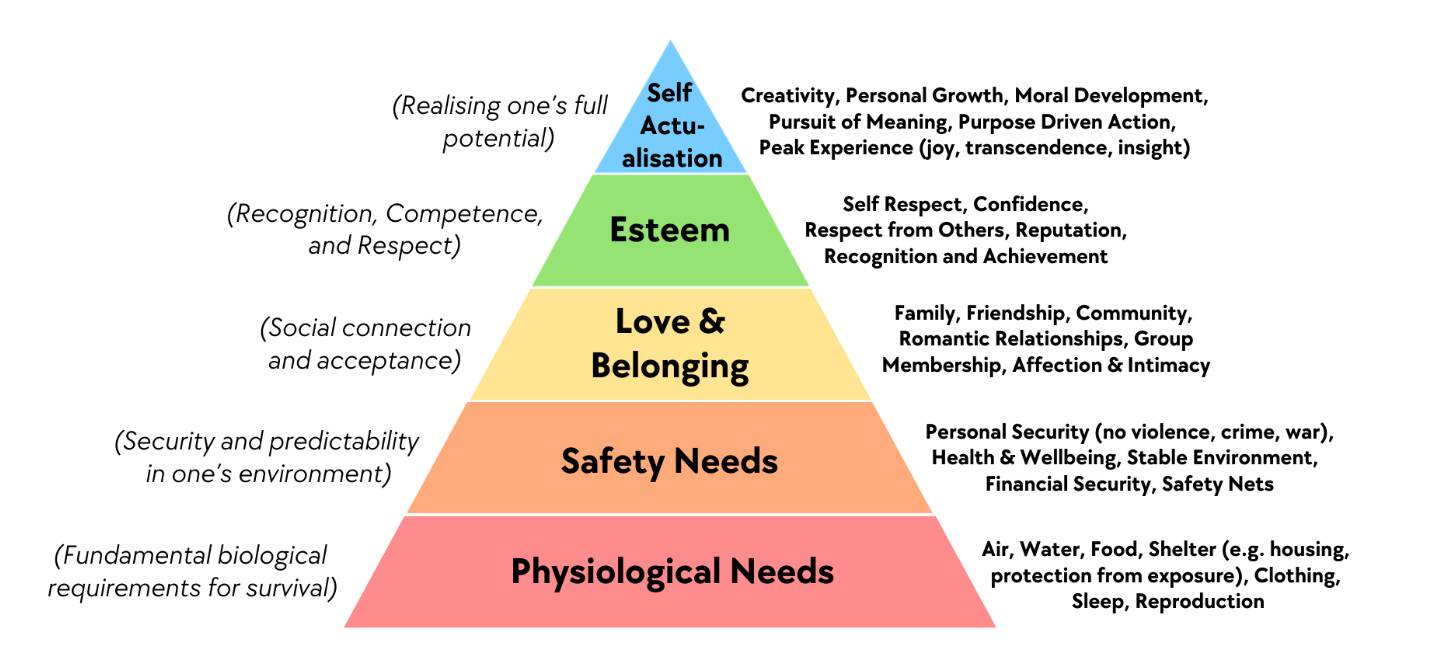
You may find further references in Maslow’s pyramid of needs where each satisfied need opens up the next tier of needs and introduces more and more complex issues as you satisfy more and more needs.

Maslow’s pyramid tells you a simple story about things like why the nuclear family was the basis of everything in the past and why its falling apart now, along with society itself.
Because family and society were a survival need in the past.
When you were busy with whether or not the family can get enough food for the winter, you wont think about things like using abortion as a contraception cause you aint ready to have a kid and give up your freedom of leading a decadent meaningless life.

In a sense, you cannot have good without bad and vice-versa. Yes, I think this is correct.

You cannot identify what is good if you have not experienced bad in some form. And when you define something as bad, you already have in mind what constitutes the good - the opposite. Positive and negative co-exist, you cannot have the one without the other.

1 Like

This philosophy was a gateway for me into understanding a plethora of other millennia long issues humanity has had.
You can directly paste this problem into things like the 4 generation cycle of the Strauss-Howe generational theory. Bad times make strong men, good times make weak men

I think that our most common ethical and moral foundations are completely broken and result in what human history is. A perpetually repeating cycle of destruction and rebuilding, each time the suffering creating a generation filled with purpose, will and the means to “better” the world around them, and then their offspring ending up in that better world just to completely implode it because they cannot appreciate one single part of it.

1 Like

No I wasn’t at all expecting a simple or immediate answer.

But this clashes with your definitions elsewhere: that seeking to satisfy one’s own needs (to oversimplify) is bad.

It makes me think of Ptolemaic orbits. Eventually, after enough bending over backwards to show how they are, in reality, circular, you admit they are ovalish. You also look for a new conceptual paradigm to fit those ovals.

This is a dance of context and framing.
What is considered good on a societal level, might be meaningless on a spiritual level or completely the opposite and destructive on a larger scale such as the concept of life itself. Thats pretty much the very problem this topic talks about.

If you want to, you can quote me that definition, and i will put it into context.

Im not one for sunk cost fallacies.
If something is wrong, then its wrong. If something is partially wrong and can have some useful bits recovered, then it still can fulfill a purpose.

One does not need to agree with every message and idea 100%
You can just look at something and take from it that which you think is true and use it to improve your concept of truth.

Well, that’s a little my point about your use of good and bad. They mean different things depending on context and scale, they only sometimes oppose, they are not fixed to reality.

Sounds a little sunk costish. When is a reevaluation in order?

I think that the framing was expressed and specified here.
Its a dissonance between our ethical/moral systems and the way life itself makes use of negative and positive stimuli.

Biological life and evolution utilizes negative concepts and stimuli. That includes everything including death itself.
Which is why trying to eliminate them will paradoxically result in more complex issues, many of which hold the potential of threatening a given specie’s survival.

And “sunk costish”: Well, what is the counter claim im trying to defend here?
With Ptolemaic orbits you had hissyfits over circular orbits, but what is the core claim here which im refusing to give up on?

As far as I can tell, you are attributing to “good” some kind of nonviolent selfless abundance, and bad some kind of selfish violence, and then pointing out how following this polarity leads to serious paradoxes.

But, if I understand, you are stil maintaining it as the correctly defined polarity for good and bad. It is, if I understand, correct, as a definition, but infeasable in reality.

What I am trying to counter is that this should at least suggest that that very original definition has to be reassessed. Maybe something that fits a reality in which good is desirable, in the abstract and in practice, and bad is undesireable.

Otherwise, I contend that your original definition is akin to the Ptolemaic circular orbit. A definition that has to be twisted and bent in order to even vaguely touch reality.

Around 80% of all religions have some kind of concept associated with this blissful afterlife of heaven where you experience no need, no harm, no suffering.
Virtue and moral structures within society usually walk hand in hand with uplifting and helping the less fortunate.

Im not entirely sure what you cannot grasp about the metaphysical concept of good.
Good is good. It means the absence of negative experiences and humanity has made great strides to eliminate all negative experiences from their societies.

The same way you dont understand this “some kind of nonviolent selfless abundance“ i dont understand what you have a hard time with in regards of the concept of good.
Please by all means tell me what you think the universal concept of good is cause at this point you sound like you have no concept of virtue or all the schebang humanity does to remove as many negative experiences as possible.

Precisely this is my issue.
You make it sound like good is not desirable in this reality. To which i can only open my arms in both confusion and perplexity because apparently you do not live in human society. I really cant put this any other way.

Humanity’s entire history is basically a one direction march towards utopian and fairytale nonsense where nobody ever falls ill or suffers needs.
So no. I too have no idea what you are referencing or talking about.

I dunno what’s ‘good’ but I do know what’s ‘bad’ and that’s TWPMFE. That’s fuckin bad. I’ont give a damn if you Plato, de Sade or some muhfucka in between. That shit is fuckin bad and you won’t disagree.

This entire world is an elaborate prison planet, the only way to escape is transcending Samsara.

This is an abysmal simulacra, nothing else makes sense.

:clown_face:

1 Like

Is this the most abysmal simulacra?

1 Like

I’m afraid you’ve lost me.

Is it perhaps possible that I could trouble you for a more succinct (and comprehensive) description of good as you see it?

Before you do, if it is possible I can trouble you, I just want to add that negative is a mathematical term.

Good and bad are metaphysical concepts which are solely described through their effects and synonyms. If you are looking for a definition like a chemical element’s then you wont find one.

I think at this stage it would be much easier to simply ask you what you think the concepts “good” and “bad” are.
Cause i can give you another explanation, but im pretty sure it would not alleviate the issue.

1 Like

:rofl:

1 Like

@ProfessorX

The struggle is real, it takes its toll.

:laughing:

:clown_face:

1 Like