I stumbled into this topic because I mentioned a conversation I had with my daughter about ghost stories her classmates were telling at school. I continue it for the same reason I studied philosophy and law and spend hours each week arguing on the internet.
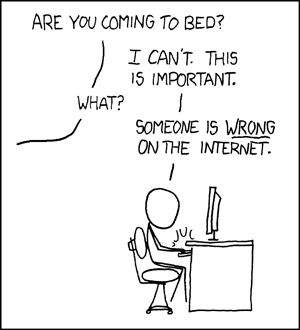
Dramatic reenactment of my entire adult life:
However, it’s easy to underestimate how important the belief in ghosts is. As I mentioned above, I’m convinced that part of what motivates this conversation is that the existence of ghosts is tied to other beliefs that have larger direct effects on the world (e.g. religion, the afterlife, etc., and by extension morality and the good life).
So while I don’t need a particularly good reason to discuss a topic at length (c.f. this 1834-post thread on flipping coins), I do think it would meaningfully improve the world if a lot fewer people believed in ghosts.
I take as evidence in favor of this approach the radical successes of enlightenment liberalism. Replacing dogma with debate led to rapid developments in science and culture – not uniformly positive, but significant improvements on net.
And it absolutely extends to people I disagree with. I respect people who are out there trying to convince people of their beliefs even if I don’t share them. I’m the atheist who invites the Mormons in for tea and to talk about faith.
And I think this goes to your point about rogue waves and ball lightning: the people who were skeptical of ball lightning and rogue waves were right to argue against them, even if they turned out to be wrong about the existence of those things. The skeptics demanded evidence, and eventually they got it.
I’ve learned a lot about my own mistakes in trying to convince others that they’re wrong.
In my paradigm, people have experiences they call ‘ghosts’, and the only evidence for them is the testimony of the experiencer. Is that true in your paradigm? If not, what other evidence is there?
How do we know if we are actually disagreeing about our description of the world? How much of our ostensible disagreement is about differences that don’t make a difference? One reason for starting with definitions is to identify how our different conceptions of the world ‘cash out’, i.e. how the world would look different if one or the other of us were correct. But if there are no differences of that sort, our disagreement looks purely semantic – you call it a ‘ghost’, I call it a ‘hallucination’, and it makes no difference.
What is the falsifiable moment that convinces you about reflecting or emitting light?
Since there is no holotype, what is the referent other than a collection of falsifiable avenues? And if it’s just that, what remains to be disproved after all the avenues are disproved?
What do you mean by “relate to the environment of the observer”? Like people experience them as being ‘in’ the environment, as opposed to staying in the same place in the visual field as they move their eyes (like an afterimage would)?
I don’t necessarily mean literal predictions, more like how well our model of the world aligns our expectations with how the world actually works. A model that better aligns with how the world works is just a better model. And modeling the future is a good test of alignment, because the future wasn’t used as a basis for the model.
If not that, then what?