Literally you cannot leave us hanging on that.
I’m guessing if it’s the Library of Alexandria, it will be fragments of the true Torah or true Gospel mentioning a certain “MHMD”. That or a formula for prime numbers.
Spill.
Literally you cannot leave us hanging on that.
I’m guessing if it’s the Library of Alexandria, it will be fragments of the true Torah or true Gospel mentioning a certain “MHMD”. That or a formula for prime numbers.
Spill.
I’ve got a few ghost stories. I’ve seen the silhouette of a demon the size of a cranefly, it rushed at me while l was in bed. Only later, with the advent of internet, did l discover this:
That’s what l saw, same front profile, but entirely in silhouette
That’s an “L”, not a “I”
I understand the sentiment, and I’ve appreciated our exchange. This thread started off a bit frivolous (my fault), and I’m glad it found its way to epistemology and philosophy of science. I’d say it’s pushed me in places I need be pushed.
The discussion has started to crystallize some of my beliefs-about-belief. I have a renewed appreciation for Kuhnian incommensurability and paradigm shifts, because I keep coming back to those concepts as I consider the disconnect. I need to think more about how they interact with the Bayesian epistemology I’ve come to take for granted.
For me, whittling away pieces of the concept of ‘ghost’ quickly becomes strong evidence for the non-existence of ghosts. That seems clear to me, because of how the concept of ‘ghost’ relates to other concepts (e.g. substance dualism, cognitive bias). My confidence in rejecting ghosts is supported by my confidence in related beliefs. But someone who disagrees with me on related concepts would – rationally – reach a different conclusion. The belief or non-belief in ghosts is in fact overdetermined by the context of related beliefs.
This also explains the tone of some of the conversation, which surprised me. I think of rejecting ghosts as similar to rejecting fairies or goblins or unicorns, and in my paradigm it is. But I think in other paradigms it’s actually more similar to rejecting souls or God or the afterlife. If I’d thought of it that way, I might have opened the topic more delicately (I’m probably giving myself too much credit, I’ve made similarly blunt arguments against those things; at least I would not have been surprised to have offended people).
I still find this claim weird, so I thing I either don’t understand it, or use the word ‘disprove’ differently.
Are ghosts special in being impossible to disprove, or is the claim “X exists” impossible to disprove for all X?
I agree this would be a problem, but it isn’t the argument I am trying to make. I would phrase it, X is a common definition of ‘ghost’, and X does not exist. I agree it should not extend beyond the definition.
There’s a language problem in talking about proving or disproving the existence of thing like a ‘ghost’, of which we don’t have a holotype to anchor the discussion. We need to define ‘ghost’ up front in order to get anywhere. It’s not presuming the nature of a phenomenon to lay out a working definition of what I’m talking about.
I acknowledge the risk that that kind of argument can become a motte-and-bailey fallacy, and I don’t think I’ve done that. However, as I note above, I do think that disproving the thing I’ve defined has broader implications, so I agree I should be careful.
But, do we actually agree that “X does not exist”, where X is the definition I gave in the OP? If not, then your objection would seem premature. If you prefer, we could discuss that without using the word ‘ghost’, to avoid the implication that we’re disproving anything more than the X the definition points to.
The problem there is the same can be said about anything ineffable. Say like Tao, in which Lao Tze starts a book by saying “The Tao that can be written about is not the true Tao”, and then continues to write a book about it. You can even go on and prove it’s false any and all that is written after the first sentence (or even the first sentence too), and you still have not showed that the Tao doesn’t exist.
I think that you can group the same line of questioning in ‘does the ineffable exist?’ The ineffable, the unmeasurable, whatever is impossible to conceptualize and so on…
For verbal arguments or discussions or for determining how to research the issue. But in general I don’t think we need to. I understand that here we re discussing the issue in a philosophy forum, so defining things can make a lot of sense, and generally fits this type of discussion. But in every day life one has no need on either side or even gradations of beliefs or openness to the idea, to decide the ghost’s ontology.
It’s more important when we get to convincing people, which is not really necessary.
It might be necessary if you thought thousands of Chinese people were sneaking over the border into the United States and they look fit and professional and a bit scary. Not Chinese Canadians that is. Probably a poor example, but it’s the first came up. There the witnesses may well have strong motive to convince people.
I don’t think corporeal and non-corporeal are stable sets, either one. Just as I don’t think physical and material are either. The latter two are expanding sets, that have ended up including anything considered real (in science) regardless of qualities. Both technology and what is considered real and what the real is like change. So, I can’t even weigh in. This is related to my X was ruled out by theory and ideas of what is physical can possibly be, but then turned out to be real and theory had to change examples.
Above this, you gave philosophical reasons for your position on ghosts. You did not, to any acceptable scientific standard, disprove them.
One thing I think you fail to appreciate is how bold, and how bold it was percieved to be, for you to go from “I don’t believe they exist” to “I have disproved them.”
Those have different standards. I would not bother arguing with you about which belief is most correct.
Remember back to when you said, possibly annoyed, that God’s direction of evolution is structurally undisprovable. I’m not saying ghosts are, or even that God’s direction of evolution is. I am reminding you of an alternate where “X not being disprovable” bothered you less.
My advice is to take a different lesson from all this. When you have a world view, and specially when you think the case for it is extremely thorough and considered, any suggestion that something contrary to it cannot easily be disproven is annoying. If you can keep a handle of this annoyance and its source, it might give you a generally clearer view in life.
I might also go back at the scientific arguments I have made, with this idea in mind, and find a more subtle, more complete question than “is X then disprovable?”
This is another way that paradigm does weird things in evaluating a truth claim, i.e. how specific attributes are embedded in a larger ontological structure.
In my paradigm, I am rejecting the existence of a specific thing based on its claimed physical attributes; an ineffable ‘ghost’ is ontologically distinct from the physical ‘ghost’.
In your paradigm, it seems like the physical ‘ghost’ is an expression of the ineffable ‘ghost’, and trying to disprove the physical attributes is like saying I have been filming my mindless physical labor for years and never once captured the Tao.
I dunno. I think prediction cuts across paradigms, and a paradigm that rejects physical ghost phenomena will make better predictions, regardless whether the physical phenomena are conceived as an ontologically distinct thing or as an attribute of something bigger.
This is another fundamental disagreement. If someone is mistaken, I think it’s quite important to convince them that they’re mistaken; if I’m mistaken, I think it’s quite important that my beliefs be set aright. I see mistaken beliefs as similar to viral infections: they can injure the holder directly, weaken them to other injurious mistaken beliefs, and be spread to others.
See, this is why defining things is important: it enables communication. If my definition is meaningless, it just fails to do the job.
Let me ask a different but related question: can ghosts be photographed? I don’t expect your answer is a straightforward ‘yes’ or ‘no’, but I think it will help move towards effective communication.
No, above this you laid out how you would “pursue a scientific study of the ghost phenomenon”:
And that’s what confused me. I get that you reject my methods, but you seem to be saying that there is no method that could disprove ghosts. I don’t find the suggestion “annoying”, I find it confusing.
I note again that you agreed that I have successfully disproved any proposed referent of ‘ghost’ that would include the attribute of emitting or reflecting light. Am I wrong to think that suggests that many other proposed referents are similarly disprovable in principle?
Is the claim just that we can always come up with a referent of ‘ghost’ that is immune to disproof? Is that not the “residue of possibility” I mentioned above?
There are plenty of claims that I reject that are not disprovable, but they don’t look anything like the claims about ghosts I’ve targeted here.
If they’re interested in the discussion, but to me there needs to be something else underneath present. Not just the urge to correct. Something proto-affectionate. Behavior is diggers, if someone’s behavior is causing harm and affects others, then perhaps I don’t need that something underneath, but otherwise, nah. I mean, you’re really gonna try to correct people about ghosts? How does that reach the top twenty or hundred beliefs that need correcting? in today’s world or earlier ones? There were people who corrected the rogue wave experiencers, the ball lightning experiencers and so on.
What about the belief that we need to correct other people’s beliefs that we think are false? How can we empirically demonstrate this improves things and limit what beliefs we go after? Doesn’t this belief encourage people who have beliefs you dislike and think are incorrect to correct others? The Evangelists? say. I’m sure you can think of other examples. Or is the rule if you share epistemology with me, they you should correct other people’s beliefs? Even if I can’t be sure it causes harm - and how do we track that using scientific methodology?
I wasn’t reacting to your definition in specific, just those words: corporeal, physical, material and the related forms of those words.
I don’t know. I’m not sure how much this would sway skeptics even if they could, especially nowadays, but in any case I don’t know. My belief in ghosts involves no photographs. I think I have long ago seen some photographs, but I don’t think they would have convinced me if I hadn’t believed.
If you change the title of the thread to reflect the specificity of any falsifiable theory you develop around ghosts that you succesfully falsify, then yes, no objections.
“I disproved ghosts.” No you did not. I suppose as a lawyer, you have the attitude that if you can disprove enough avenues, it effectively amounts to disproving the whole.
But science has been bit in the behind far too many times to accept even much more stringent standards.
For the phenomenon ghost, that is, some kind of entity that can be felt and has an effect on the environment of the observer, I do not think you can falsify it. Maybe you can find the falsifiable moment for me for that broader category. My approach would be to simply detect its statistical likelyhood. That’s as good as it gets. “Do ghosts exist? Probably not.” And that’s after extensive and exhaustive statistical analysis with several years of refining and developing theory.
Probably the reason nothing even remotely like that has ever been done is that, for people that don’t believe in it, it would make little difference even if it did exist and, for people that do, they don’t need your fancy proofs.
That kind of money is spent on phenomena that either deepen understanding of currently hotly pursued physics theories, or ones that have some kind of significant profiteable potential for engineering purposes. These two are progressively uniting anyway.
Consider, for example, that one of these fancy autogenerated software systems would be primed to intake a good 3 month’s, heck, a full year’s worth of data gathering and refining, and give you a conclusive statistical solution in a matter of minutes. Solved for eternity.
But the timeshare on those things is comparable only to early IBM machines, and probably overshadows even them.
To add one last thing, these are all considerations for given mechanics of ghost.
The fact that feeligns of ghost exist and relate to the environment of the observer is unquestionable. Already simply on this level, ghosts exist.
Frankly, the only real valid question here is “what are ghosts,” and this is still an abysmally complicated one to answer. Because of the sheer amount and complexity of imagineable possibilities.
I think one famous example of this is blood types. They were effectively falsified by only working sometimes. There was no accounting for when it didn’t. They decided to keep trying and, only by postulating positives and testing against them, did they prove that what seemed falsified was just lacking a subtlety, the RH factor.
I’m sorry, but I think there are no paradigms (LOL) so I can’t follow you. Now without joking: I have no paradigms.
I’m not saying the physical ghost is an expression of the ineffable ghost. I said that if ghosts exist, ghosts are not physical as your freezer. You perceive them, as you perceive a daydream, and most people since they perceive it, attach it to a place just because ‘everything has a place’.
I don’t care for predictions, I think they’re illogical. Plus, the end don’t justify the means, so a better prediction doesn’t justify your choice of paradigm (or lack of choice, or lack of paradigm)
I agree with you that criticism and correction is very important, fraternal and in good will, in contrast with any of its lacks.
I think one issue is that it presumes we kinda know ontology to the bone. We will not find other…it’s hard to even come up with a word here. I also think there may be a blend of subjective and objective here. That there is a real external something but it needs not an observer, per se, but the participation of an experiencer, so whatever we are looking for ‘externally’ may well be incomplete. Now, that’s not my position on the ontology of ghosts. I mention it to say that we may well be in the middle phase of finding out odd ontology (not nearly got it all wrapped up) and the natural laws may not be laws but time bound habits with regular anomalies. Again none of this amounts to proof, I just think grounded humility would keep one from thinking one has proved them non-existent.
I don’t see the problem. A falsifiable theory is a very straightforward thing. If certain conditions are met, it is not falsified. If not, they are falsified.
I stumbled into this topic because I mentioned a conversation I had with my daughter about ghost stories her classmates were telling at school. I continue it for the same reason I studied philosophy and law and spend hours each week arguing on the internet.
Dramatic reenactment of my entire adult life:
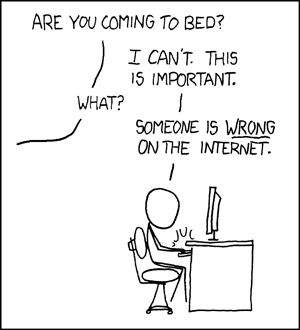
However, it’s easy to underestimate how important the belief in ghosts is. As I mentioned above, I’m convinced that part of what motivates this conversation is that the existence of ghosts is tied to other beliefs that have larger direct effects on the world (e.g. religion, the afterlife, etc., and by extension morality and the good life).
So while I don’t need a particularly good reason to discuss a topic at length (c.f. this 1834-post thread on flipping coins), I do think it would meaningfully improve the world if a lot fewer people believed in ghosts.
I take as evidence in favor of this approach the radical successes of enlightenment liberalism. Replacing dogma with debate led to rapid developments in science and culture – not uniformly positive, but significant improvements on net.
And it absolutely extends to people I disagree with. I respect people who are out there trying to convince people of their beliefs even if I don’t share them. I’m the atheist who invites the Mormons in for tea and to talk about faith.
And I think this goes to your point about rogue waves and ball lightning: the people who were skeptical of ball lightning and rogue waves were right to argue against them, even if they turned out to be wrong about the existence of those things. The skeptics demanded evidence, and eventually they got it.
I’ve learned a lot about my own mistakes in trying to convince others that they’re wrong.
In my paradigm, people have experiences they call ‘ghosts’, and the only evidence for them is the testimony of the experiencer. Is that true in your paradigm? If not, what other evidence is there?
How do we know if we are actually disagreeing about our description of the world? How much of our ostensible disagreement is about differences that don’t make a difference? One reason for starting with definitions is to identify how our different conceptions of the world ‘cash out’, i.e. how the world would look different if one or the other of us were correct. But if there are no differences of that sort, our disagreement looks purely semantic – you call it a ‘ghost’, I call it a ‘hallucination’, and it makes no difference.
What is the falsifiable moment that convinces you about reflecting or emitting light?
Since there is no holotype, what is the referent other than a collection of falsifiable avenues? And if it’s just that, what remains to be disproved after all the avenues are disproved?
What do you mean by “relate to the environment of the observer”? Like people experience them as being ‘in’ the environment, as opposed to staying in the same place in the visual field as they move their eyes (like an afterimage would)?
I don’t necessarily mean literal predictions, more like how well our model of the world aligns our expectations with how the world actually works. A model that better aligns with how the world works is just a better model. And modeling the future is a good test of alignment, because the future wasn’t used as a basis for the model.
If not that, then what?
sounds like intuition
I think liberal debate of ideas is different from setting out to correct other people’s false beliefs. I am sure it is a motive for many parties, but I actually think things work better when the goal is precisely exploring together, even if one has one’s standpoint clear from the start. On this topic, for reasons mentioned in earlier post I don’t think the title of the thread is demonstrable at least not now. It’s also less collaborative than some titles might have been. Also I think you are implicitly arguing:
Rational criticism helped secular liberalism emerge.
Secular liberalism produced benefits.
Therefore correcting beliefs produces benefits.
But this bundles together many variables:
scientific method
political institutions
economic changes
literacy
industrialization
legal reforms
pluralism
technological progress
and there’s a specific type of interaction happening here. You’ve decided to treat the issue as proven. You start with a blanket statement. You’re not reacting to people coming here and trying to convince others there are ghosts. In fact, there are plenty of issues here where people are trying to convince others X is the case. Of course, I am sure you have responded to those, but here you are opting to take the offensive.
I think the harm argument is speculative.
I think the correcting argument is speculative. Discussion, sure. Being allows to be skeptical, of course. Being free not to accept other people’s beliefs, sure. But I am not sure what the correcting attitude is really about.
They were right given their models and experiences not to be convinced. They were wrong to tell people that it was really just their emotional reactions confusing them. There was little humility and the pattern slows down new information.
After some of the people condescended to, and irrationally dismissed, were dead. You are respectful in general, but your certainty and telling people what is really going on, I think, lacks humility. There’s a way to present this as a non-experiencer. It’s more of a ‘I don’t see a reason to think your accounts are correct or I don’t have enough of a reason.’ This may seem subtle but I think it is important. Of course if an overbearing person expects you to belief, then stronger reactions may well be justified.
But how much of this was people exploring themselves and with their like-minded and how much were missions to correct people about their beliefs? I’ve also heard your intuitive sense the believing in ghosts is not good, but should this also have empirical evidence? I can see skeptical exploration and also resistance to being convinced - though I have really seen anyone - not that I’ve read all posts - arguing to convince you ghosts are real. But the decision to correct people, that would seem to need more justification.
it makes no difference until that social moment you tell someone what their experience really was.
I certainly don’t expect my experiences to convince you, but you to think you know what my experiences really are and you opt to correct. I know it’s not exactly in the same sense, but above you say the disagreement may well be semantic. Well, then it doesn’t really matter or as you say it makes no difference.
Perhaps I am power sensitive. Once Christianity had enormous power and used this to correct people. In fact it oftent old them that the ghosts were not ghosts but demons. So, there was pressure then, even, not to talk about having seen ghosts. You might be seen as consorting with demons. Yes, they often did this with violence which you obviously don’t. But now the dominant paradigm in the West is technocratic and people are often told they are irrational if products. policies and conclusions about what is real, good and effective systematically correct people. It is vastly better that correcting people is through discussion. But it is not just through discussion. There are social pressures and marginalization. I suppose I have a more live and let live attitude. I also don’t know what the hurry is. I certainly could have missed threads where people were arguing they can demonstrate ghosts are real, but in the absence you went ahead and made a metaphysical claim in that absence.
So, my reaction is a kind of call for epistemic modesty, rather than, however polite epistemic domination. Your arguments make claims about what is really going on in other people’s minds. I can see this in a resisting someone who thinks they are proving ghosts exists. Well, I have other explanations. I consider X, Y and Z what is really happening. In that instance you are dealing with a converter making metaphysical claims and claiming to be able to demonstrate them.
Here you’ve set the debate going and any believer is faced with, for some reason, saying they can prove ghosts do not exist and then some mind reading. Disbelief is one thing, active dismissal with mindreading is something else. I know that my sense of what was really happening is correct. It’s too much I think morally. It’s not disconnected from my epistemological concerns or my sense that you are acting on unjustified (at least so far) fear that believing in ghosts is harmful.
I suppose my general reaction is that society would be better if people took the third option. It’s often like it’s binary. I believe or demonstrate your are wrong. There’s that nice middle ground. I don’t believe, I don’t think there’s enough or any evidence beyond experiencers. I don’t believe it.
That seems to fit extremely well with liberalism acceptance of pluralism.
“A X type ghost can only be said to exist if the ghost phenomenon is accompanied by Y description of light-emitting or reflecting object in the immediate vicinity and inside the duration of the phenomenon.”
This is what I am trying to tell you. In law, this generally works, because there is a somewhat predictable and small range of possibilities left, and a cap on time and resources to call the case.
Innocent people still go to jail. It’s simply the highest practicable standard.
In science, #1, you can’t know beforehand just how much is left after you have falsified X amount of avenues. #2, that one avenue that’s left might really be and has historically often been the one. #3, for all your plans and ideas for the future, you have really only falsified one drastically narrow and limited avenue. Just 1.
I mean that the very fact of a claimed phenomenon inside any given environmental context constitutes already a correlation.
Something’s gone wrong with the thread if it’s like this now. It’d be good to see it split into subtopics, otherwise there’s no hope of reading any of the thread anymore.
Actually, take that back: it’s fun to dive into a random position in the conversation.
Can we do that or can we adjust the model so that the measurement relationships are better accounted for? That’s not the same…