My latest stance on the state of the world:
1 Like
The article is interesting and sums up your worldview well, but I was mostly interested in this quote:
“I consider myself a spiritual man, but when speaking about politics, economics, or power structures spirituality doesn’t really apply all that much, does it? I try my best to show compassion towards all people even in my political and economic positions, but it is extremely difficult especially facing opponents who view such compassion as weakness.”
There is something here that must be understood clearly if one is even willing to propose a “path” to humankind which doesn’t revolve around sheer abstractionism. I can only imagine that you have devoted countless hours of thinking to it, but it’s such a difficult problem to solve that a clear cut solution never seems really possible.
1 Like
For me, such apparently insoluble contradiction is easy to solve, but not so much for one who embraces an “all is one” philosophy. I don’t see things and people as one, I see the “all is one” as a possibility for humans, a highly evolved philosophy where each one is actually responsible for the good of all, not obligatorily, but voluntarily. I don’t assume that the “all is one” is already there and we just had to open our eyes to see it. That doesn’t explain the immense divergences to be observed among human beings, in relation to most everything. In my view such wide differences are easily explainable: each of us is unique. We can’t agre on most things simply because we see things through our own individual lenses. The core of the political dilemma is how to find a way to reconcile our divergences and attain a certain degree of convergence: putting our individual wills at the service of a collective goal which will safeguard the individual wills first and foremost, by protecting the sphere in which such can be exercised.
1 Like
I am all for world peace, tranquility, cooperation, compassion, and so on, but that only works in a world of saints, this world is the direct opposite of all that filled with wickedness, evil, or tyranny everywhere. I find it very extremely difficult to walk the path of peace, I’ll admit I was a more violent younger man where now that I am older I see the folly in all of that. Every day I try to be compassionate towards everyone.
Nonetheless I don’t think that I could ever be a true genuine pacifist in total regards to everything which is why I don’t think that I would be cut out for monastic spiritual life.
Sometimes fighting, conflict, and the brutality of adversity is necessary in life or existence. I try my best to seek peace in everything first but often I find inner peace at odds with my inner rage, it is a constant struggle for me. I will admit however that as I have gotten older I have managed to control my emotions, anger, and rage better through meditation along with deep mental contemplation. My biggest weakness which is ongoing would be patience for other people, I have always had a problem with impatience.

I understand this, but it is a quote, and I consider it an excuse. I simply refuse to participate in left or right ideologies because both are shackled to the same logic: having over being, power over wisdom, hate over love. As I wrote in the paragraph before that quote: “Stepping outside these false alternatives is not a posture of indecision, but a commitment to a different way — one that holds life sacred and measures greatness not by conquest, but by compassion.”
It is less a clear cut solution as a “Way” through life. Clear-cut solutions are offered by people who try to dominate you and require your allegiance against others. I refuse to play that game, but am pragmatic enough to accept that some things are how they are. Nature has its rules which we have to follow, actions have their consequences, and I must weave a path through these rules and consequences, using compassion as my guide.
The consequence of living according to Being in this sense may be a shorter life, poverty, or oppression, but retaining the dignity of Being is more important than bowing down to Mammon. For all the people who claim that compassion is weak, more recognise it as a virtue. It was a strange experience in my professional life when some people said I should be more ambitious, but because my approach settled so many problems, I was continually promoted.
It was only when short-sighted technocrats took over that my approach was not validated, but former staff and customers told me that things only got worse when I was gone. Perhaps the technocrats made more profit, but they made life unbearable.
And so your Buddhism remains a thing in your head but not a ‘noble path’. What in the eightfold path is a problem to you? What pragmatic solutions are made impossible by following that path?
Your Buddhism is something that “might have been” if others hadn’t been so bad. You allow your rage to dominate and therefore you contribute to what you are criticising. You have no inner peace and I understand that because it isn’t as though I am above this all, but sitting and letting that rage pass by, not engaging, enables us to concentrate on the important things.
Of course, I see the deep inequality, the suppression of what is good, and they way that anything we had obtained is being taken from us. But if the way to regain that means that we must allow our rage to dominate us, then what happened in Russia or China, or after the French Revolution for that matter, becomes the course you choose to steer, and it always leads down the same dark alleys.
1 Like
My article focuses on the contrast between two modes of existence: the Having mode, which is centred on possession and the ego; and the Being mode, which is rooted in authentic experience, relationships, and growth. Fromm was highly critical of philosophies and social systems that treat individuals as isolated or antagonistic entities, and equally sceptical of naive collectivism that denies individuality in pursuit of unity.
While we should acknowledge the ideals of unity and interconnectedness, we must not negate the reality or value of individual uniqueness. For Fromm, genuine unity is realised not by simply ‘opening our eyes’ to a pre-existing oneness, but through the conscious, voluntary act of relatedness — choosing to engage responsibly and lovingly with others. He would agree with the idea that ‘each one is actually responsible for the good of all, not obligatorily, but voluntarily’, because authentic existence requires an active, engaged and ethical relationship with the world and other people.
Of course, you are right when you say that ‘each of us is unique’. Fromm also emphasises the irreplaceable nature of each individual, opposing social structures that sacrifice individuality for the sake of abstract collectives. However, he would challenge any tendency to use this uniqueness as a justification for separation or resignation from social responsibility. From a Being perspective, true individuality does not exclude connection; rather, it forms the basis for meaningful participation in community and society.
Fromm wrestled with this dilemma in the context of modern alienation. He identified the core challenge as creating social arrangements that respect and nurture the individuality of each person, enabling them to voluntarily converge towards collective goals. In his model, convergence should be the result of free, self-actualising will, not imposed conformity. Social institutions should safeguard spaces where individuals can exercise their will authentically, while also encouraging the growth of relatedness through love, solidarity and shared meaning.
So, I agree with your point that unity cannot simply be assumed; it must be built by individuals who choose to interact with one another freely and responsibly, respecting both uniqueness and the potential for shared purpose.
1 Like
I know, and I find it interesting because me too, and most of us in fact, am a spiritual being [spirit=mind=Geist] and yet have to live in the material world, as Sting wrote many years ago and added a there’s no political solution and a the answer lies in living from day to day after.
This is the quintessential contradiction a philosopher has to solve in life.
"There is no political solution
To our troubled evolution
Have no faith in constitution
There is no bloody revolution
Where does the answer lie?
Living from day to day
If it’s something we can’t buy
There must be another way
We are spirits in the material world"
Sting sees music as a spiritual practice and a link to something beyond the intellect, referring to it as both his “mistress” and his “religion.” He has emphasised being devout in a personal spiritual path rather than belonging to an institutional church. Sting’s album “Sacred Love” reflects his searching for something divine, addressing themes of love, spirituality, and existential questions.
The spirit moves on the water
She takes the shape of this heavenly daughter
She’s rising up like a river in flood
The word got made into flesh and blood
The sky grew dark, and the earth she shook
Just like a prophecy in the Holy Book
Thou shalt not covet, thou shalt not steal
Thou shalt not doubt that this love is real
So I got down on my knees and I prayed to the skies
When I looked up could I trust my eyes?
All the saints and angels and the stars up above
They all bowed down to the flower of creation
Every man every woman
Every race every nation
It all comes down to this
Sacred love
I love that album, even if my wife prefers the quieter songs by Sting.
I was wondering what your response was going to be like with me sharing a personal snippet of myself, I was thinking to myself if there was going to be empathy or even mutual understanding, but instead disappointed I can see all I am going to get here is derision. I am a pariah in real life, and it seems in cyberspace it is no different. Such is life I suppose.
I think if Siddhartha was alive today he would of made some revisions to the eightfold path being that our modern society is comprised of tyrants, demons, an endless multitude of bumbling idiots, and also a endless suppy of selfish individuals who feel it is their God given right to exploit the rest of society to live like gods themselves. The Buddha was so fortunate not to live in a historical era like this one for even the greatest man of enlightenment would of found it difficult to survive or exist within this disgusting postmodern epoch. Just my opinion I know, but that’s what I think.
You know what? I don’t do so bad following the teachings of Buddhism, I have improved my own life and standing quite a bit. At least I admit that I am human who has flaws where I don’t pretend to be perfect. Are you a perfect person by comparison? No, I think not, but I can’t quite help notice your flagrant display of self righteousness.
I actually have discovered much inner peace in life, I do love the subtle ironies of this entire world knowing that the hypocrisy that exceeds everywhere will eventually catch up at some future point and the following grand reckoning that comes with it.
There’s that old saying I like that is very dear to my heart, “For evil to thrive in this world it only requires that good men simply do nothing.”
It’s a religious or spiritual paradox in Buddhism and all religions, if you do nothing within pacifism offering no resistance whatsoever evil thrives everywhere around you. Yet if you do take action against oppression or wickedness you run the constant risk of becoming evil yourself. A dilemma as old as human civilization and time itself that is always unwavering.
Namaste. 
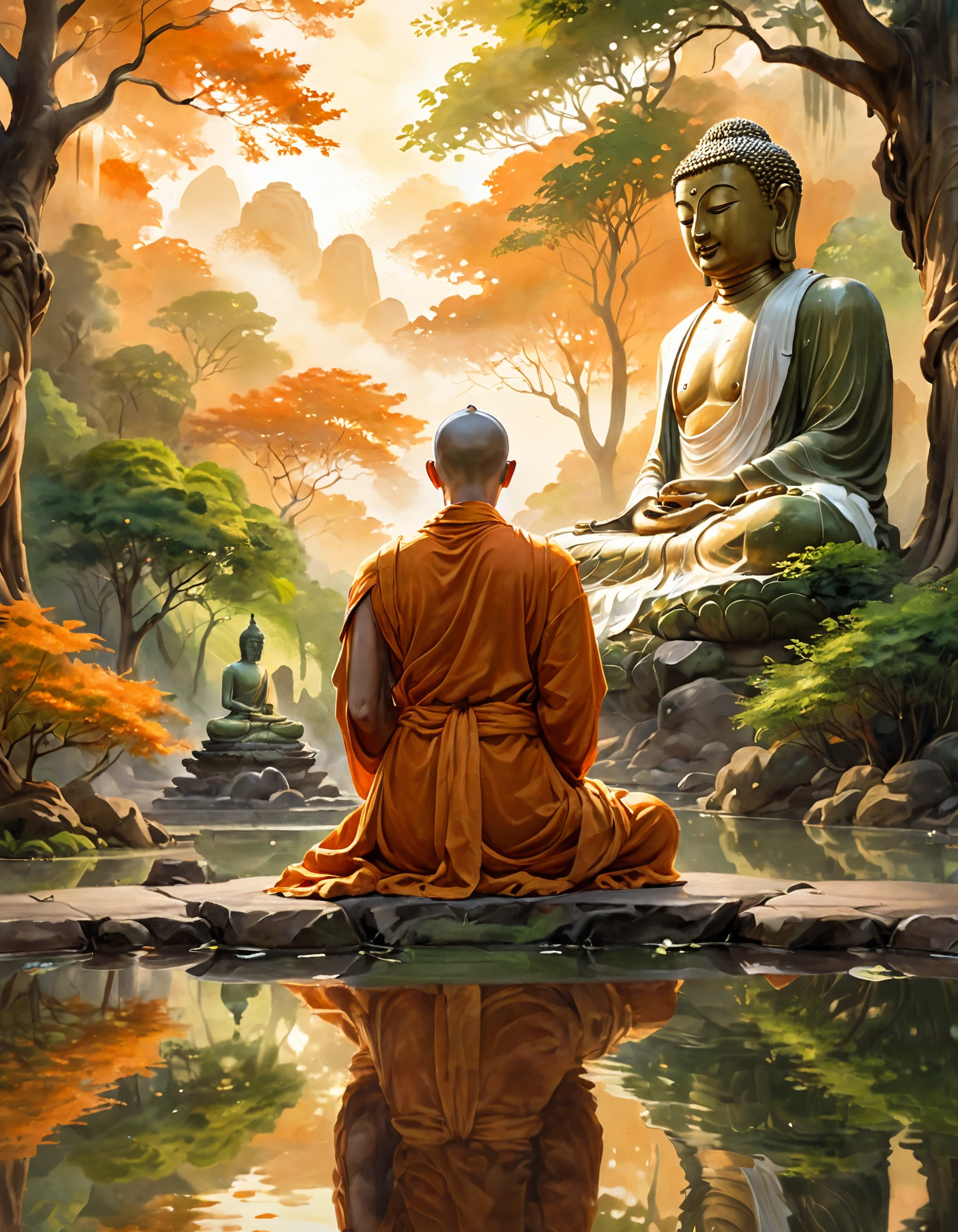
Buddhism is an inward only out of consciousness synch knowledge gathering meditative practice and does not explain consciousness such that the individual can take control of it. Buddhism also denies the individual who decided to go inward in the first place to carry out the knowledge gathering.
Buddhism meditation is nothing new it’s been around since the first man and woman walked the earth.Inward only meditation is the tree of knowledge of good and bad that we are warned not to eat from because you die spiritually if you do.
So true because Buddhism claims that everything is an illusion and there is no SELF that can take control of the binary processing biological machine bot.
Steer well clear of inward only meditation therefore.It does not reveal reality.
1 Like
Nobody is trying to convert you to Buddhism, give it a rest already.
It’s inward only meditation…the tree of knowledge of good and bad.Inward only meditation has been around since the beginning.
Buddhism is a modern day rebranding.
None of its new Mr Authoritarian.We are warned not to practice inward only meditation as we die spiritually.
Okay, so what?
Just saying……None of it reveals reality.
We know it’s nonsense when it comes to reality because you claim that you are misrepresentation of reality (an illusion).
Say no more.
We’re not interested in misrepresentations of reality anymore.We want to know about reality.
You are not listening!!!
The religious cult of atheism has a statue of shiva outside its scientific HQ in CERN near Geneva.We are not interested in cognitively biased BS atheistic science anymore now that its all failed.
Post something new and interesting.Something that works and explains reality.
1 Like
More off-topic inanities from the master.
If you can’t say anything relevant, stay silent, bot.
1 Like
HaHa go away lifeless controlled bot.Nobody’s interested misrepresentation of reality philosophy science BS anymore Max.
You are just not getting it.
They want to know about reality philosophy,science and psychology.Not what the lifeless bot. has to say about it.
Mainstream cognitively biased atheistic science is married to the religion of Buddhism and its cognitively biased inward only meditative practice.
That’s what it sells.Nobody wants to buy faulty goods anymore.
1 Like
Quit the drama queen bit, it ill befits you, so called cynical Marxist.
If I call myself an atheist, I must understand people will make deductions about my life. They are entitled to deduce that I don’t believe in afterlife, that I don’t go to church, that I am against religious indoctrination, etc, etc. That’s just sheer use of logic, not persecution.
1 Like
Touche, touche Mr. Tolerant Liberal Anarchist.
Yes, I am a Marxist with a cynical twist. I am also a Buddhist of the Mahayana tradition.
None of these descriptions I have applied to myself are contradictory at all, you’re grasping at straws. If you wish to continue clenching at these straws, I will let you.
 I haven’t said they were, I said that since you call yourself a Buddhist, people will tend to expect a Buddhist mentality from you.
1 Like