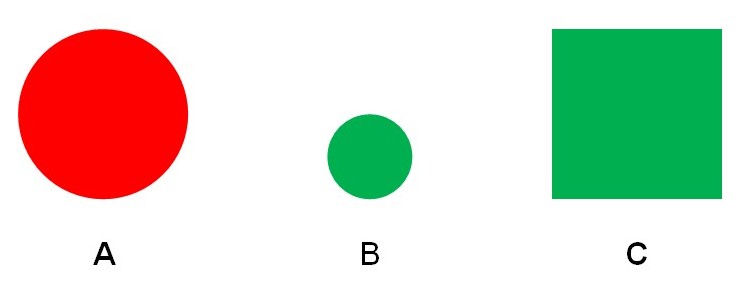
[]A and B resemble each other (they’re both circles). We’ll call this resemblance ‘R1’.[/]
[]A and C resemble each other (they’re both 3cm x 3cm). We’ll call this resemblance ‘R2’.[/]
[]B and C resemble each other (they’re both green). We’ll call this resemblance ‘R3’.[/]
[]R1, R2 and R3 resemble each other (they’re all resemblances). We’ll call this resemblance between resemblances ‘RR’.[/]
Now, what I don’t get is this:
[]Why can’t RR be a multigrade relation that holds simultaneously among the group R1, R2 and R3 (rather than a diadic relation that holds separately between the pairs R1 and R2, R1 and R3, and R2 and R3)?[/]
[]Why can’t the resemblances between which RR holds include not only R1, R2 and R3, but also RR itself?[/]
If these possibilities were granted, we’d have one particular arch-resemblance (RR) and no need for any further particular resemblances or any universal resemblance to avoid an infinite regress.
What? I don’t think so. RR is a RRinger. Resemblances don’t “resemble” each other. That just doesn’t make any sense.
Are differences all different from each other? Or do they resemble each other?
This is the road to madness.
Russell’s point is a minor one, here. And no, it’s not a very good argument, for “It will be useless to say that there is a different resemblance for each pair, for then we shall have to say that these resemblances resemble each other” is nonsensical. We are not forced to say that these resemblances resemble each other because we have just said that there is a different resemblance for each pair. In any event, resemblances don’t resemble each other. Russell should know better. he put forth his theory of types but sometimes forgets to employ it.
I think i read that passage not too long ago, but I usually ignore the inevitable nonsensical passages in Russell.
Shades of color, and the potential shapes, can “vary”, as can forms, but likeness is a state of mind and how we organize thought. This is a process of sorting truths, not a truth in itself.
If RR were a universal, R1, R2 and R3 would be instantiations of it. The possibility I’m entertaining is that they’re its bearers. And since it’s a multigrade relation, they can all bear it together, so it needs to occur only once.
Provided we accept that things usually resemble each other in some respect and to some degree, I can’t see any problem with treating resemblance as real:
[]A and B perfectly resemble each other in respect of their shapes.[/]
[]A and C perfectly resemble each other in respect of their dimensions.[/]
[]B and C perfectly resemble each other in respect of their colours.[/]
(The exception to ‘usually’ would be where we’ve analysed a property into its simplest parts. So we could say that two objects resemble each other to some degree in respect of their shapes, dimensions, colours, etc. And we could say that their colours resemble each other to some degree in respect of their hues, saturation, etc. But we’d have to say that their hues simply resemble each other to some degree.)
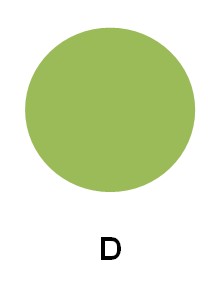
Now take a fourth shape:
[]B and C better resemble each other in respect of their colours than B and D.[/]
[]B and D better resemble each other in respect of their colours than B and A.[/]
What’s the problem with this?
Remster
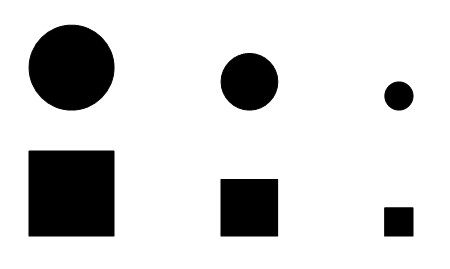
PS (to Faust) You say, ‘Resemblances don’t “resemble” each other. That just doesn’t make any sense.’ There’s no way to respond to this. Russell and I think we understand it. You’re telling us we don’t. Stalemate. Having said that, would you really insist that it doesn’t make sense to say that the resemblance between the first three shapes below resembles the resemblance between the second three shapes?
Resemblance can be real enough without being useful for the purposes to which Russell puts it. I have a real preference for chocolate chip ice cream. So what? A and C have the same dimensions as long as you measure C from side to side and not corner to corner. I’m not denying the resemblance - I’m just saying that the simplest of shapes lend themselves to these comparisons, but even in dealing with such shapes, some of this is arbitrary.
As to our stalemate - my point is that anything can resemble anything else. Anything physical, for instance, resembles any other physical thing in its “physicality”.
Oh, then I agree with you. But what has this observation to do with the possibility of using the relation of resemblance to avoid commitment to universals, which is the subject-matter of this thread?
Well, maybe. But vapidity never entailed falsehood.
Well, yes - but I also just employ a different usage - or, said another way, give a different account of what a “true” universal is.
Russell is paradoxical, here. He’s all about set theory - about seeing math and logic generally as set theory. He should know that universals apply only “across” sets - apply only to sets. And sets are what we make them. His apparent realism in this passage doesn’t really make any sense.
Properties can resemble each other, if we say they do. Different shades of “white” resemble each other. If you are looking at a large and very “complete” swatch book of paint colors, you can reasonably claim that each color resembles the next, and even the next several. But somewhere along the line, if you continued this process of comparing one color to the next, you have to draw a line, or you’d be claiming that fire engine red resembles royal blue. What does that mean? That they are all members of the set of colors?
Okay.
I just think that the problem is simpler than you seem to be making it.
I’m happy to embrace the conclusion that everything resembles everything else in some respect and to some degree, including fire-engine red and royal blue. What I’d say is a matter for arbitrary (or, rather, pragmatic) decision is which respects are to count as relevant and which degrees are to count as sufficient for the purposes of defining our general terms. So, for example, fire-engine red and royal blue perfectly resemble each other in respect of being members of the set of colours, but their hues are too far removed from each other for it to be useful for us to have a colour term that covers both of them.
To be honest, I didn’t really want this thread to be about interpreting and evaluating Russell, despite the way I set it up. This was supposed to be the focal point of my initial post:
What I wanted to find out is what people made of the ideas that resemblance is a multigrade relation and that at least one resemblance is a bearer of itself. (There are other examples of multigrade relations, such as the relation of being among, and there are other examples of properties that are bearers of themselves, such as the property of being a property.)
I don’t think you commented on the multigrade relation bit. Apologies if you did — perhaps you’d be willing to quote yourself.
As for the resemblance between resemblances bit, all I had to work with was ‘That just doesn’t make any sense’. What sort of response did you expect? I edited the postscript of my reply to provide an example for you to comment on, but I think you’d posted your reply to my reply before I posted the edit.
Well, it’s the same thing - to say that resemblances resemble each other and to say that properties have as a property the property of being a property.
Of what use is that? I’m just not seeing it.
Properties are not only what they are, they are what they are not. Red, blue, hard, soft, wet, dry - these make sense only in context. My coffee cup is hard only compared to another material. What is the property of being a property not?
As before, it gives us a way of explaining general terms without resorting to universals. That’s useful for anyone who wants to explain general terms without resorting to universals.
But I’m puzzled. Before you were saying that resemblances don’t resemble each other because that doesn’t make sense. Now you’re asking of what use it is to say that resemblances resemble each other. Which is it to be?
Among other things, it’s not the property of being an object or the property of being a quantity.
i have a couple more characteristically un-erudite questions - the first is for both of you:
A)What is so bad about using universals?
the second is for Remster:
B)If it’s possible to have the property of being a property, how do you avoid an infinite regress of potential properties (the property of being the property of being a property, etc)?