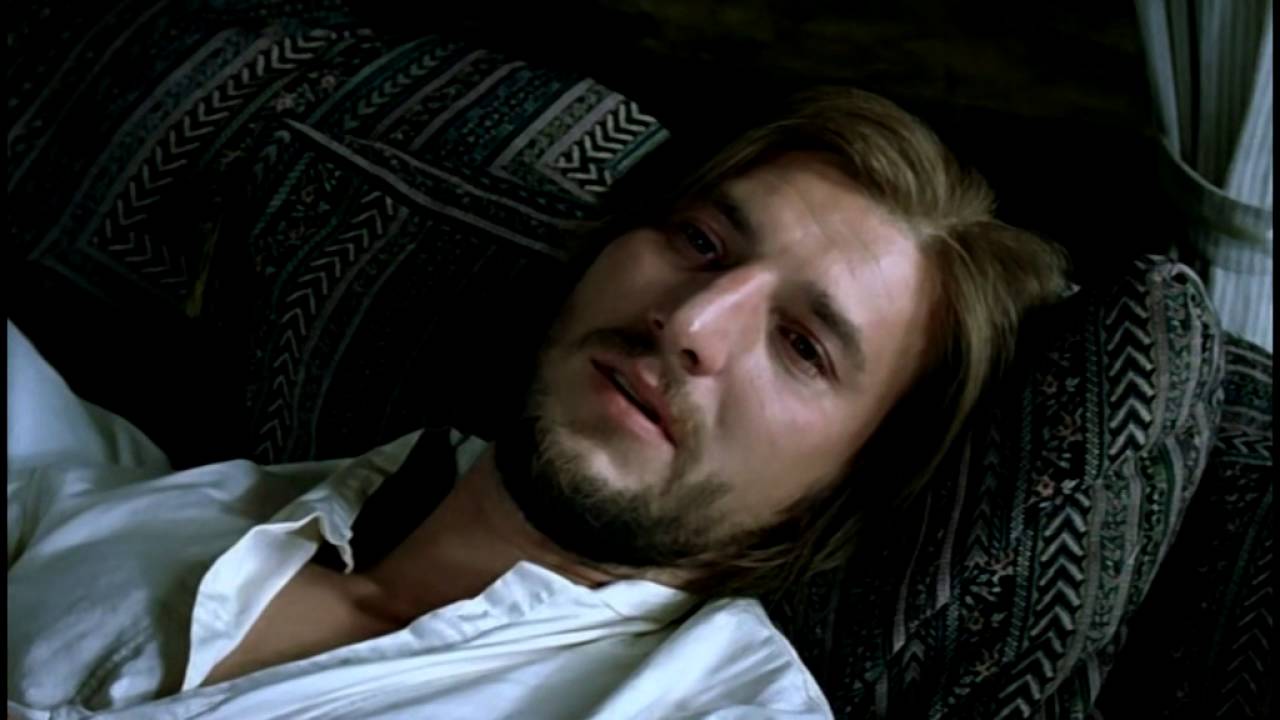
Why Bazarov had to die

Some literary characters, like some books and some very special people, never leave us. They found a way to win a space in our hearts and our imagination, because they represent something that complements or enriches our experience in this world.

And if at some point we must invariably say goodbye to these people, these characters who fascinate and enrich us, something in them always remains. The more our experience grows, and our self undergoes transformations and mutations that differentiate it increasingly from what it was when we met that special person, the more distant and opaque the memory becomes. But whenever we return to them, seeing a photo or rereading the book in which we met them, our memory is revived, and we realize that we need these special, unique beings, even if only as a mere reminder of the possibilities of human experience. Or as a reflection of a side of ourselves which we need to deal with and overcome, sooner or later.

Evgeny Bazarov is one of those characters.

He belongs to the long list of tragic heroes in Russian literature, but his tragedy unfolds differently than that of a Tarass Bulba, a Raskolnikoff, a Judas Golovlyov or a Levin. Bazarov had no grand philosophical or religious ideas to offer humanity; he neither claimed to be a savior nor wanted to be saved.

He was a nihilist.

He was part of a movement in Tsarist Russia that rejected all established notions of religious and societal norms as sterile old-fashioned traditionalism which wasn’t dead just because the backwardest strata of Russian society still insisted in adhering to it.

In 19th century Tsarist Russia, Nihilism was a multifaceted movement that encompassed philosophical skepticism, scientism, revolutionary tendencies, and a rejection of the traditional values of the conservative strata of the population. It was characterized by a belief in materialism, positivism, and rational egoism, while rejecting metaphysics, sentimentality, and aestheticism. This movement gained prominence between the 1860s and early 1900s. Turgeniev’s Fathers and Sons, published in 1862, was timely directed at criticizing and analyzing this critical moment in Russian history, but not in an overly judgemental way. Turgeniev is known for the sensitive, balanced and likable way he treats his characters. He’s not interested in shocking his readers, but rather in presenting them with a picture of a situation and let them judge of its worth by themselves. He is rather a painter than a judge of people’s characters and actions.

He clearly understood that Nihilism in Russia emerged as a response to the rigid social structures and authoritarian rule of Tsarist Russia. It represented a rebellion against the existing political and social order, a legitimate rebellion, albeit anchored in violent action sometimes, being then met with even stronger authoritarian resistance. Nihilists embraced materialism, believing that only the physical world and its phenomena were real. They also adopted positivism, emphasizing scientific knowledge and empirical observation as the basis for understanding the world. They rejected traditional morality, religion, and metaphysics, viewing them as outdated and oppressive. While not all nihilists were revolutionaries, like the ones described by Dostoevsky in Demons, the movement did overlap with revolutionary groups and contributed to the broader revolutionary movement in Russia. Some nihilists engaged in radical actions, including terrorism, as a means of challenging the existing regime. The aforementioned Dostoevsky book treats exactly of one of the most notorious terrorist acts of Russian nihilists, the assassination of a student by the nihilist Sergey Nechaev. Russian Nihilism was also seen as a conflict between generations, with younger nihilists rejecting the values and beliefs of their elders. It’s in this specific context that Turgenev’s Fathers and Sons must be regarded. It’s the quintessential generational conflict book. In response to the traditionalist and pacifying approach of Turgenev, the writer Nikolai Chernyshevsky wrote his popular novel What Is to Be Done?, which had a wide influence on the revolutionary movement in Russia, influencing even Marx himself. It’s clear then that far from being just a juvenile call for rebellion against authority, Nihilism was part of a turning point in Russian history, part of what would culminate in the great Revolution of 1917.

While Bazarov is painted as to represent the most prominent characteristics of Russian nihilists, his nonchalant demeanour indicates he’s not one who would go to the lenghts of a Nechaev, killing his opponents. In fact, he did not have a system to propose, instead he adhered to a simple and honest lifestyle where he pursued his favorite interests, science, medicine, without strictly adhering to any kind of established versions of truth. He does not believe in anything transcendental or metaphysical, his worldview is anchored in the coldest facts of life, which leads him to assume a rather cynical and cold relation to people, which are all too ready to lose themselves in abstraction and irrational thoughts and feelings. He sums up his position by saying he repudiates “everything”. Ie, he denies everything that has been accepted as fact up to that point in time. Including literature and poetry, all kinds of sentimentality. In a certain sense, he is an earlier version of Camus’ Mersault (The Stranger), for he lives naturally and without giving himself airs of importance or pretending to care about dead formalities. This attitude results in his becoming rather antisocial, since almost all people around him adhere to such formalities in spite of their obvious vacuity. He becomes friends, or rather, he is befriended, by one Arkady Nikolaevich Kirsanov, a son of a rich gentleman called Nikolai Petrovitch Kirsanov. The story itself begins when Arkady, having just graduated in St. Petersburg, comes home for a visit with his friend Bazarov, to whom he demonstrates an almost worshipping devotion.

We are soon introduced to Arkady’s father, who could be seen as the embodiment of the fossilized nobleman against whom nihilists were engaged in fighting. But Nikolai Petrovitch was not a nobleman, but a noble man, ie, he was noble in the truest sense of the term. He treated his servants well. He helped his declining brother. He tried his best to understand his son. And he welcomes Bazarov in his home even knowing the young man’s views goes against everything he believes in life, trying not to pass judgment before understanding the puzzle the Nihilist represents. Nikolai is obviously used by Turgeniev to make a point against those who deemed all kinds of aristocratic, wealthy landowners like himself as a backward élite which prevented and hindered the further advancement of people and social equality. Nikolai is almost idealistically portrayed, but through him the author is making a point: not all things and people in the “ancien régime” which Bazarov fights against are despicable or worth annihilation. We can’t obviously pretend that all landowners in Russia were like Nikolai. But the simple existence of one like him serves to bring into question this indomitable urge to deny a whole order of things based on what most, not all, of its representatives, supporters and enforcers are or do. Nikolai is essential to the plot by offering Bazarov not an opponent, but an antipode. If the latter’s worldview is based on the assumption that all of the establishment he fights against is worthy to be smashed to smithereens, Nikolai comes to show that there was some nobility in it, that nobility is possible. Not theoretically, but in practice, as it is through practicing what he believes that makes one realize Nikolai is not imbued with the typical conceit and prejudice of his peers. He is against all pomposity or primness. He treats others with kindness, but not as a sign of affectation or as a nod to the dead rituals of strict formalism, no, he does it because that’s what he feels like doing. He sees no reason why he should act otherwise.

And that’s why his conflict with Bazarov does not happen through fights or duels, verbal or physical. Instead, we are offered a confrontation between the results of their two antagonistic worldviews. Nikolai is loved and understood by all people around him, because his demeanor begets nothing else. Bazarov is inevitably misunderstood by all, including his best friend Arkady, who can’t actually cope with his level of bluntness. One scene is particularly memorable. The two friends are having a conversation and Bazarov, as the perfect provocateur that he is, tries to push Arkady to the limit, in order to assess how far the young man is going to take his rejection of old-fashioned notions of social rules, including his respect for his old-fashioned father. It’s in this moment that Arkady realizes that he and Bazarov are not the intimate friends he thought at first. He barely knew the guy he chose to worship. And he understood Bazarov’s line of reasoning leads to a dead end, like nihilism itself. The one thing Arkady can’t take is a frivolous attempt to diminish his father, whom he deeply loves and admires, before his eyes. He then ends up making a choice, and he obviously chooses his father’s worldview instead of Bazarov’s, which he then sees as a passing fad, and which Turgenev himself identifies as more than typical adolescent rebellion against the establishment, but also as something its proponents can’t properly define or understand. So, in the case of Arkady, he gives up, in the case of Bazarov, he ends up entrapped by his own logic.

If Bazarov is the quintessential rebel, Arkady is the typical follower. He follows someone blindly until the moment he realizes the one he worships is leading him to a dead end. His passion for nihilism was really a fad, like his passion for anything else would be. His final breakup with Bazarov happens when he falls in love with a girl and gets married, signaling he wants to lead an old-fashioned life, like his father. Bazarov understands and gets sick at realizing Arkady is just another conformist, like most others. He also understands how utterly alone he is in the world.

A rather interesting part of the novel is the conflict between Bazarov and Nikolai’s brother, Pavel Petrovitch. Contrary to his brother, Pavel is aristocratic, elitist, in the most intransigent meaning of such words. He obviously enters into a collision course with the nihilist. He sees Bazarov as the embodiment of everything that’s wrong with the younger generation. Bazarov, of course, hates him and sees Pavel as little more than a hypocritical sycophant living at the expense of his brother. In the novel, Pavel is obviously meant to represent a counterpoint to Nikolai. The would be gentleman and the genuine noble man who acts nobly because that’s how his character is made, that’s how he feels he must act. While Pavel is formalistic, ritualistic, fossilized if not in deed at least in his worldview, fearing social change as the one thing that would imperil his prejudiced vision of himself the most, Nikolai is natural, informal, and his every act of nobility is not something forced, but comes naturally to him, as second nature. He lets his brother live with him as long as he wishes, for the latter is decadent and would starve if not for his brother’s aid. As a result, Pavel worships Nikolai, but cannot emulate his brother’s unaffected demeanor, clinging to his obtuse notions of aristocracy to his last breath.

The main feminine character in the book is Anna Sergeyevna Odintsova. She is a rather independent feminist woman with an intelligence and wit far broader than could be expected of her female contemporaries. She becomes friends with the two nihilists and Arkady becomes predictably enamored of her. Bazarov at first fights the fascination she exercises upon him, sworn enemy of romanticism and sentimentality that he is. But despite Arkady’s obvious infatuation with her, she really becomes interested in Bazarov, whose boldly independent behavior amazes her. She sees him as a kind of male reflection of herself, accustomed as she is to be surrounded either by worshippers or by people who thoroughly misunderstand her freedom of mind. Then the inevitable happens and Bazarov finds himself blindly and helplessly in love with the powerfully attractive woman. But here is where the true drama in the story resides: for all the admiration for his brave independence she can nurture, she cannot love him as a man. Bazarov himself first reacts to his passion cynically, then ends up succumbing to it, admitting the cold reality of what he is experiencing, to the utmost surprise of every fiber of his being. He is madly in love, something which appeared as completely unimaginable to him before knowing Anna, certain as he was that love itself was something unreal and fantastical, clearly explainable in scientific terms. But helas, no, he wasn’t simply willing to make love to Anna and then leave her behind. Like a man would naturally do. No, it was definitely something deeper than carnal desire that affected him.

Through his love for Anna, he was enraptured by the ineffable.

Now, much can be said about the ineffable, it’s the safe territory of Christians, mystics, religious people of all kinds. It’s that space in human experience not explained or explainable by cold-blooded rationalist science. It’s the realm of the unexpected, the arbitrary, the contingent. No matter how many countless pages on the subject of love you may read, the phenomenon itself remains unexplained. It belongs to the realm of the ineffable, yes, just like faith, but with a significant difference in relation to the latter. For love appears when an individual human being gets to know another individual human being, both as physical, as real as they could be, and the mere presence of such a being is further, definitive proof, for the heart if not for the mind, that a higher kind of feeling exists than mere animalistic attraction bent on reproduction. Whereas faith is a blind belief in something nobody will or would, ever, see, touch, feel, love is materialized in the shape of the be-loved object, all too carnal, all too real, all too human. Whereas faith is intuited, love is felt, felt with each fiber of one’s being. That’s one reason why love is way, I mean way, more powerful than faith. It’s really the deepest feeling a human being seems capable of feeling. And when one’s engrossed with such a feeling, when one’s enthralled by its energy and time consuming charm, everything else loses significance except for the possible conquest of the object of love. It starts with an infatuation, soon becomes an obsession and ends up either leading to a man’s greatest sense of fulfilment in life or to his greatest act of despondency. For when the subject realizes the grander, nobler, more fulfilling kind of love is possible, ordinary, fleeting sexual atraction loses its meaning or appeal. The more fascinating the love interest, the more vapid, uninteresting, unattractive the other people appear to the lover’s eyes, most specially those who are easy or free to “get”. This is why the man madly in love can come to the point of despising all other women, even to the point of becoming a celibate for life. The be-loved one is a unique being, whose charm is unique, and the circumstances surrounding the love story are also unique. In fact, falling in love is fall prey to the enchantment of a unique, unrepeatable human being. If such a person was ordinary, just like any other, we would not have anything more than the average “mating” encounter bent on making a family and having children. No, the love story goes much further than that. And that’s why Bazarov at first can’t understand it, and fights hardly against what appears to him as a complete rebuttal of his solid materialistic worldview. But one day he stops pretending and in what is the most poignant moment of the story, confesses his love for Anna only to find out it is doomed to be unrequited. At that moment, his life is finished. He can’t cling to his nihilism any longer for, despite all its revolutionary fervor, it fails to account for the possibility of love. And since he can’t cling to what was up to that point his lifeline, and knows he will never have Anna’s love anyway, no matter what he does, he ends up as a man in front of an abyss. Only, an abyss of his own creation.

Bazarov’s death remains as one of those unforgettable passages in Russian literature, in which there are so many of them. He dies because of a simple cut during an autopsy of a typhus victim. At those times, any kind of disease could prove fatal. But he was already dead before dying. His worldview had collapsed. His relationship to his father and mother by the end of his life adds a further touch of melancholy to the story. His parents can’t understand him anymore than any other person around him, but he loved them in his own way. Anna visits him in his deathbed and it’s then he makes his final revelation to her, his fear of dying. He feels that, by dying so young, and because of such an insignificant reason, his whole life has been futile and he, who regarded himself as an independent, extremely rational kind of superman, dies madly in love with a woman who can’t love him and despite all his love for science, his knowledge is entirely useless in preventing his early death. Which could be related to a death desire sprung out of his depressed spirits, anyway, something that would make him utterly careless about anything.

Bazarov had to die, then, as a victim of his own worldview. Obviously, like all great Russian literature, Fathers and Sons is open to many interpretations. This is mine. Bazarov had to die as a martyr for an extremist worldview which fails to give an individual a real sense of fulfillment and any other purpose than destruction itself. When Bazarov tells everyone he is against “everything”, he means “everything held as sacred by others”, not literally everything, as he’s still a practioner who cares enough about his job. His nihilist position could be better understood by reading the (in)famous Cathechism of a Revolutionary from Nechaev, in which the author posits that the nihilist revolutionary must have only one end in sight: revolution, revolution at all costs. Including one’s own life and the lives of others. Life itself becomes a liability when one is possessed by such an urge to destroy. A liability one’s ready to get rid of at any moment. In this sense, the two crucial factors that lead to Bazarov’s defeat are his encounter with Nikolai Petrovitch, who is, as I said, the genuine noble man, and his falling in love with Anna, who represents everything he never imagined to find in a woman. These two characters personify the denial of his worldview. If he’s bent on destroying the old social order because all of its members are corrupt, Nikolai shows him this can’t be an irrefutable truth. There can be something not rotten, something not worth destroying, in a world which generates a man like Nikolai. And if he is a sworn enemy of sentimentality, Anna reveals to him a side of himself that is not dead, just buried under a facade of sceptic indifference. This confrontation with what seems to him at first the most logical and reasonable course of action for a man is too much for his ego and his manly pride. If Nikolai was like his brother Pavel and Anna was just another woman, he would have just confirmed his beliefs. Instead, Turgenev forces him to a confrontation which he cannot stand, which he doesn’t have the moral fiber to stand.

Bazarov then becomes an early symbol of this philosophical position which has been puzzling people for at least 160 years now.

AND WHAT IS NIHILISM, AFTER ALL???

A more important question would be: how are we supposed to offer an answer to nihilism?

One cannot affirm to seriously subscribe to a philosophical or religious system of any type unless one can successfully address the topic of nihilism. It is that fundamental.

Nihilism is the denial of any ultimate meaning for [the human] life. By denying such ultimate meaning, it also reduces life to its most superficial, apparent, material aspects. Since there are no ulterior significance to anything a man does, all beliefs based on the assumption that we are here to serve a grander purpose than mere survival are fake, flawed, mendacious. Nihilism then throws men in a world where they are little more than animals, and only because they can think and rationalize, what animals can’t, at least not like men do. But, essentially, men are all animals and nothing more than that. Yet nihilism goes further than simply denying anything beyond the mere animality of human beings. By seeing through all belief systems and declaring they are all null and void, just a bunch of high-sounding words, nihilism forces the advocates of such belief systems to make a case for their validity, ie, to prove they are not mere sets of formulae, rites and regulations for life. And it happens that such a demonstration is not possible, at least not definitely or unquestionably. A theist, for instance, will answer nihilism by saying he “feels” the presence of God in this world. But he will, invariably, ends up his defense of his position by saying one needs faith to “feel” or “see” God. Faith is precisely what the nihilist cannot have. Then the theist fails to convince him. And the case of the religious person gets even more complicated to justify when the nihilist realizes he, the believer, despite his faith in the supernatural, in the grander scheme of things, still does, basically, the same things he, the nihilist, does to survive. So, the nihilist argues, men are all equated in their adherence to the meaningless mechanical life of animals. If they happen to believe they serve a higher purpose than mere mechanistic animal survival, the nihilist points out the hypocrisy of their position, as he finds them always engaged in the same basic activities as he, ie, doing their utmost to survive one more day, clinging to life as if ignoring that there’s nothing more to it than a lot of sound and fury signifying nothing.

It would be reckless to simply dismiss nihilism as a teenage fad, as it certainly was for Arkady Kirsanov. Nihilism penetrates the very core of the human condition to declare that at their essence, all things, especially those related to human actions and intentions, are null. Cioran resonated with this well when he said that he who deeply examines the essence of things will find himself, at the end of his journey, face to face with empty depths, and will yearn for the ornament of appearances (A Short Story of Decay). And there is great sagacity in this insight, and it has a liberating quality. Cioran himself even says in another passage of the same book that the greatest human joy is knowing that all our acts are vain. We can’t simply close our eyes and pretend we don’t understand what the nihilist is saying. There’s a disturbing degree of depth to what he asserts. To begin with, when one asserts that the core, the essence of things, is empty, null, one is declaring something obvious to anyone who understands that human existence is nothing without the action through which it is externalized and instantiated. This is what existentialism translates as “existence precedes essence.” We human beings are nothing separate from the action through which we substantiate our lives, our existences. Thus, for example, a sentence like “men are good by nature” is meaningless. Because it assumes that men can “be” something independently of any action on their part. Of course, “men are evil by nature” is an equally absurd statement. As for the phrase “men are selfish by nature”, although it can also be charged with attributing a non-existent “nature” to men, appears to rational eyes as more justified, precisely because it is anchored in the perception of how men usually act, not on a value judgment about how they should be.

Thus, it is clear that nihilism delves deep and strips away the very nature of things. The system, or rather the nihilistic attitude, unmasks human illusions in an incredibly stinging way. In the novel mentioned in this essay, this is evident in the confrontations between Bazarov and Pavel Kirsanov. The young doctor is unapologetic in demonstrating how deeply Pavel anchors himself in his fossilized notions of nobility and dignity when, in practice, he gives no indication of what he believes, being a parasite who relies on his brother for everything, utterly useless, not even being able to work and earn his own living. By revealing the nullity of the grandiloquent concepts on which so many people, the social order itself, is anchored, for example, by denying that humans have interests other than those of any other animal, the challenge of nihilism ends up being the most relentless any belief system could face. The aristocrats were fine when all they had to worry about were peasants dissatisfied with their working conditions. Likewise, Christians were once very happy when their enemies were other believers like themselves. Whatever the dissatisfied questioned, the essence (aristocracy, unshakable faith in the Lord) remained. Now, the very essence is denied, and the defenders of the old worldview must prove that it is anchored in something more than illusion, pretense, convenience, and the defense of [egoistic=animalistic] privilege. And they fail miserably in this task.

Reason demands that we not ignore the critique nihilism presents, although, as I will discuss below, it also advises us to flee from it when its destructive work reaches its logical limits. As long as it is limited to social critique, to the critique of institutions considered sacred, nihilism is not only understandable, it is largely justifiable. In the case of Russia itself, as I said, the movement was essential to the revolution in social conditions, which had in it one of its bulwarks. Nihilism fails when it goes beyond (valid) social critique, when it ceases to be merely a force aimed at unmasking human illusions, and intrudes into every aspect of life, eroding its possibilities and making it unbearable and unbreathable. When we consider the positive aspects of the nihilistic attitude—and yes, positive aspects exist—we realize how, for so long, the world has been anchored in ideas that the slightest breath of reason destroys. The Christian religious ideal, for example, a life that is only a preparation for true life. The dead formalities of kings, princes, aristocrats, and authorities in general. Countless people whose power over others is based on nothing but the subordinate’s fear of the imaginary power of their supposed superiors. Nihilism boldly challenges all this, and if it places all men on the same level as animals, at least it finds no adequate response, other than a renewed belief in pure and simple dogmatism: nihilism is wrong because God [the State, nature, etc.] says it is wrong. Period.

It is the stupidity of attacking a system that denies ultimate truths and values through an even more rigid belief in such truths and values that ensures nihilism can never disappear, but is always present, hidden in the shadows. And the attitude of believers [mystics, gnostics, positivists, etc., etc.] does not provide a truly devastating alternative to nihilism because they are based on what the system denounces as emptiness: that is, transcendentalism. And in this reaffirmation of things, of a reality, intuited but never perceived, desired but never demonstrated, the believer reaffirms nihilism by categorically denying the reality of other alternatives, of other definitive perceptions of transcendental reality. For example, Christianity denies Buddhism, Buddhism denies Christianity. Both worldviews are incompatible. And both claim to be correct. It is in this vein that the affirmer of an ultimate, transcendental truth is also a denier of all other alternatives. Their attitude toward other beliefs is, therefore, nihilistic. They deny an ultimate value to everything they don’t believe in. This is why many associate religions like Christianity and philosophical-religious systems like Buddhism with nihilism. Not only because they deny the reality of this world. But also because they deny everything that exists outside the worldview defended by their own systems.

Because the religious person, the mystic, is unable to perceive and/or accept his own nihilistic attitude toward the “world” or competing worldviews, he ends up reaffirming nihilism even when he intends to vehemently deny it. I will not simply declare that a Christian, for example, is a nihilist, although he may be so in relation to the “world.” No, if the individual believes in ultimate values, he is not a nihilist by definition. What I am asserting is that, although he believes that his system of beliefs and values annihilates nihilism, the religious person can never provide a satisfactory answer to this enormous philosophical problem that nihilism represents. Christianity, like every transcendental value system, functions in a way as the antipode of nihilism. But at the same time that it denies it, it reaffirms it. For several reasons, some already mentioned. Another important reason is the fact that both positions, transcendentalism and nihilism, are forms of absolutist thought. Just as the nihilist denies the ultimate value of existence, denies the value of human lives en bloc, transcendentalism categorically asserts that there is a purpose, an ultimate purpose for everything. One system denies everything, the other affirms everything, but always without being able to deny or affirm the value of each thing in particular and, more importantly, without even caring about the value of each thing in particular. Returning to the example of Bazarov, he starts from the [practically dogmatic] principle that romantic love is an impossibility, for him and for everyone. When he falls in love, platonically, contingentially, he doesn’t know what to do. He hadn’t counted on that variable, that possibility. Similarly, when a Christian, totally detached from the world, which in his mind he must overcome, finds himself trapped by the tethers of this world, he too is left without a reaction.

What happens? In both cases, the same thing: life is something greater than any absolutist system of thought can conceive. Life is full of surprises and unexpected variables. And the ineffable, which the Christian prefers to call “God,” is there, without anyone knowing, or being able to know, where it comes from or when it will emerge. Just as a Christian might wake up one day and realize he simply no longer believes in God, a nihilist might wake up one day and find himself hopelessly in love. In this scenario, both might cling even more desperately to their systems, denying the evidence of their senses as mere delusion. Or, a difficult scenario to imagine, both might reach the wise conclusion that their systems cannot satisfactorily explain the staggering complexity of life.

Now let me conclude this essay with what I believe is the most satisfying response possible to the challenge posed by the nihilist. A challenge, I repeat, posed to all of us. We all have to, in one way or another, find an answer, a way to deal with this disturbingly inconvenient part of ourselves that insists on repeating in our ears, daily, in the least expected moments, even in those when life seems most complete, that nothing down here has any meaning or importance. I’m obviously referring here to nihilism as a synonym for existential pessimism. Nihilism as a social movement, as a system which unveils the falsehood behind fake transcendental creeds is, as I said earlier, not only understandable but justifiable. It is even creative in its own way (I’m thinking of Stirner and his “creative nothing”). Now, nihilism as a denial of all meaning in life must be tackled as a serious philosophical problem. We have to face this head on sooner or later, we have to accept the organic reflexes of this perception of meaninglessness [“that” emptiness in the stomach] and the psychological reflexes, in our heads, in our innermost being. A man’s philosophy in life is only worth anything if it can account for all the many contingent situations in which he may find himself. If you know that you can eventually fall severely ill, but your philosophy is only applicable to a man of steel who is always in total control of his life, then your philosophy is flawed. Similarly, if a philosophy can’t protect one’s mind from the excesses of negative thinking, ie, pessimism and nihilism, then a system is such a collection of words. We have to either lift our heads or yearn for the negative thoughts and feelings in our mind to disappear as quickly as possible, together with our whole bodies, freeing us from the inconvenience of such discouraging ideas. Pretending such uncomfortable feelings and thoughts don’t exist means we can’t deal with them as adults, as men. They exist and always will; they are an important part of the human experience, an experience that will never, in any way, consist solely of happy moments and uplifting thoughts. No, the totality of human experience includes the ugly, the disturbing, the unhealthy, the despicable, along with the beautiful, the uplifting, the wholesome, the heroic. Denying any of these things isn’t denying the “world,” it’s denying a part of ourselves, a part of our experience, our learning, if you will. What we can do is an act of affirmation of life, with a touch of the heroic, one that doesn’t deny its dark aspects, but emphasizes that the positive side of things exists, and is great enough to be worth fighting for. Such an affirmative attitude ascribes a good degree of importance to the power of contingency in life. We must understand that in life, many things “just” happen. They are not either foreseeable or preventable. This is what releases the spirit from the burdens of determinism and fatalism, the latter being particularly nocuous to the mind. The reaction to nihilism begins with this realization: the worldview is certainly not something very comforting, an idea on which we can base a reasonable course of action. Denying that everything has value, including the act of living itself, and that the prima ratio of human actions is pure animal survival, reducing all human beings to the level of insects or rats, is an attitude that discourages life, leading to a pessimism no less deleterious than the naive optimism of those who believed that this is the best of all possible worlds. One simply chooses to ignore the contingency factor, the element of surprise, of finding something new and unexpected. Like love. And what happens is that the nihilist no longer has any more reason to arrogate to himself the right to annihilate existence in this world than the Christian has to affirm that life in this world is merely a stage toward true life. The essential thing here is to break the chain of absolutist thought, which only enunciates categorical and generic statements, applicable to everyone and therefore questionable and rejectable by anyone and also relies to a great extent on deterministic and fatalistic thinking. The nihilist’s thought process approaches dogmatism even when it appears to reject all dogma. And it is when we realize that dogmatism is essentially flawed, because it is based on aprioristic definitions about the human condition [the soul exists independently of any action of its supposed possessor], conditions unverifiable and therefore gratuitously affirmable, without major consequences, that we realize that the essential problem is to understand what nihilism is talking about, what it is attacking, in this case, dogmatism of a religious or philosophical nature, and then the most rational way of dealing with the problem becomes crystal clear. It’s only necessary to reframe the concepts the nihilist attacks, because when he attacks the idea of meaning, or value, what he’s attacking is the dogmatic notion of meaning or value. He’s starting from the assumption that meaning is something transcendental, external to humankind and its application in the practical life of a flesh-and-blood person. Dogmatic religious thought has committed this error for millennia and will never stop, and nihilism follows the same path. As a refutation of a dogmatic Weltanschauung, it takes the form of a dogma. But no matter what Christianity, Islam, or Buddhism say, meaning is a concept reinterpreted by each person’s intelligence, and only the individual can give this term real weight. It goes something like this: religion postulates an ultimate, and exclusive, meaning for human existence: to do God’s bidding. But this ultimate meaning is reinterpreted by each individual, in an absolutely unique way in each case, so that “doing God’s bidding” takes on the most diverse connotations. One can sacrifice himself for others or can become a serial killer “doing God’s bidding”. When the nihilist denies this ultimate meaning for human existence, he is right. What he doesn’t realize is that there was never any reality behind such a concept; that is, he denies a phantom, one of the many abstractions of religion. Like heaven, angels, paradise, hell, etc. The flesh-and-blood human being, however, does not live upon such abstractions, but uses them, devours them, and regurgitates them at his convenience. We can, therefore, bring these concepts—meaning and value— into the realm of the flesh, of the flesh-and-blood human being, setting aside their supposed transcendental implications, accepting that they exist to express the thoughts and attitudes of the human animal, which is not and never will be absolute or eternal, but draws the strength and will to shape such concepts from the very perception of his transient nature. Thus, we simultaneously reject dogmatism and can freely and honestly speak of meaning and value, convinced that these terms only gain real weight, only gain concreteness, materiality, when used in relation to flesh and blood human beings limited by time and space, who use them as valorative beacons as they struggle to survive in the very same harsh world in which religious people and nihilists battle against ghosts of their own creation. I could choose to refute nihilism on religious grounds, but then I would be embracing dogma, which is anathema to my personality. Instead, I reject the dogmatic implications of nihilism by affirming this life and this world, without subterfuge, postulating that it is only in this life, in this world, that one can think and speak of meaning or value—human concepts, variable in importance and definition according to the endless multitude of beings who may choose to use them. This perspective, which is completely contrary to the establishment of dogmas or irrefutable truths, is the most adequate to safeguard nihilism itself, the very possibility of denying the value of everything. But what it also safeguards is the possibility, however remote, that there is, in fact, an ultimate meaning to everything, even if we can never fully understand it. For this very reason, it seems to me the most logical and defensible of all. By avoiding the traps of absolutist thinking, but at the same time not completely denying that absolute truths can exist, only that those that many claim to exist do not stand up to serious questioning. So we end up leaving a world where everything has a single, unquestionable meaning or a world where nothing has meaning for another, our world, the real world, where all things have whatever meaning we choose to attribute to them. A world where words lose their transcendental, dogmatic dimension and gain a human significance. For words are made by men, to be used and (re)interpreted by men. Words such as meaning, value, significance, freewill, contingency. All open to interpretation, all valid, depending on how one chooses to interpret them. This position enables a much broader and more reasonable understanding of the human experience in this world, since it accounts for the multitude of explanations for our existence and also those unique experiences that point to a side of existence we may never fully understand, such as love itself, religious experience, among other things. And so I can say that if I haven’t completely overcome nihilistic thinking, at least I’m protected from its most negative implications. For I have reversed the line of reasoning, rejected the notions of absolutist thinking, and thus consciously embraced the idea that it is absurd to deny all meaning and all value to life, since from my own experience, existence has any and all meaning and value I care to attribute to it, and such meaning is no less important than the ultimate meaning of religion, on the contrary, it is more important, because it is anchored in my experiences as a man of flesh and blood, and not in some abstraction.