I checked out Mongolian crime rates and admittedly, the rates only increased by about 10-20% since … 1912? Up to 2000.
So, let’s just get back to Blighty (Britain, UK to be precise) -
MY SUMMARY: CRIMES HAVE INCREASED QUITE A BIT BUT IT IS EXPLICABLE BY NEW CRIMES, MORE REPORTING, BETTER DETECTION
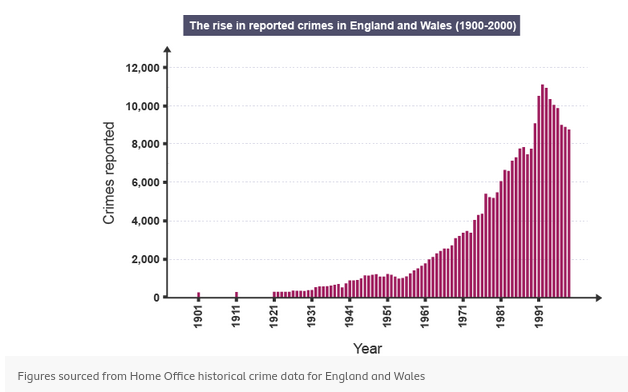
Crime rates between 1900 and 1955
Many factors make it difficult to be accurate about crime rates. However, there was an increase in crime from the late 1920s due to the economic depression and then World War Two. After 1955, crime rose steeply.
Problems with crime statistics
Statistics about crime rates were recorded annually by the government after 1898. However, historians must treat the data cautiously, for the following reasons:
- Some crime was not reported officially. For example, in the past, some problems, particularly with young offenders, might have been dealt with informally without being recorded by the police.
- Some crime was reported more than it had been in the past. This was the case in instances of burglary, because insurance companies required reporting to the police in order for a claim to be made.<==== THIS EXPLAINS THE EXPLOSION IN RAPE CRIME IN SWEDEN, COINCIDING WITH MASS-MIGRATION
- Laws changed so that some offences were no longer crimes and new crimes emerged. <==== AGAIN, THIS EXPLAINS THE EXPLOSION IN RAPE CRIME IN SWEDEN, COINCIDING WITH MASS-MIGRATION - “MARITAL RAPE” BECAME A CRIME, WHICH INCIDENTALLY THE RIGHT WING WOULD OPPOSE, YET THEY MAKE USE OF IT TO SAY MIGRANTS ARE “RAPE-FUGEES” CAUSING RAPES ALL OVER SWEDEN, WHEN IN FACT IT’S JUST STATISTICAL QUIRKS
Crime rates between 1900 and 1955
Between 1900 and 1925, crime rates were relatively stable. They then increased in the late 1920s and 1930s, with the onset of economic problems and unemployment during the depression. The government was also dealing with many strikes and protests during this period.
When World War Two broke out in 1939, crime rates fell initially, then rose again during the Blitz in 1940. Criminals took advantage of the air raids to steal from people’s homes, shops and even people killed in the air raids. The war also brought rationing, which led to the theft and illegal sale of goods on the black market.
Crime since 1955
After 1955, crime increased significantly, at a much faster rate than the increase in population. Violent crime increased, as did other types of crime. The number of murders fell, but this has largely been explained by improvements in medicine, which meant that fewer people died from injuries.
Car-related crime
By 1900, the motor car had been invented and car ownership increased over the 20th century. New laws were created to restrict speeding and driving under the influence of alcohol. As a result, car-related crime is now one of the biggest categories of crime.
Car-related crime includes:
- drink driving - an alcohol limit was introduced in 1967
- not wearing seat belts - compulsory for drivers after 1983 and adult passengers after 1991
- breaking the speed limit
- joy-riding, where people steal a car and then abandon it after riding around in it
- car theft and the sale of stolen vehicles
Road deaths have fallen since the 1960s, even though there are now more cars on the road. Car theft has also significantly decreased as security systems in cars have been improved.
Football hooliganism
Violence among spectators at football matches increased throughout the 20th century, reaching its height in the 1970s and 1980s. It has fallen again since match security has increased and the use of CCTV has become more widespread.
Hate crimes
In 1948, the government passed the British Nationality Act, which gave all citizens of the British Empire, now Commonwealth, unrestricted access to Britain. Between 1950 and 1975, many people from places such as the Caribbean, India, Kenya and Pakistan moved to Britain.
Although communities of black African and Asian origin have lived in Britain for thousands of years, this wave of immigration led to a great deal of social tension. New arrivals were often scapegoated for other social problems, and faced discrimination in finding housing or jobs, as well as physical violence.
From the 1960s onwards, British governments passed legislation in the form of Race Relations Acts aimed at ensuring equal rights for all people in Britain:
| Date | Act |
|---|---|
| 1965 | The first act made it an offence to refuse to serve someone because of their race or ethnicity. But it didn’t cover key areas such as shops, employment or boarding houses. |
| 1968 | This act made discrimination in areas such as housing and employment illegal. This was a step forward but hard to enforce. |
| 1976 | This act made racially offensive music and publications illegal. It set up ways for employees to report employers for discrimination. The Commission for Racial Equality was established to investigate racism. |
In 1998, racially and religiously motivated crimes were made specific offences. The 2003 Criminal Justice Act then increased the possible sentences available for offenders who commit hate crimes - crimes that demonstrate or are motivated by hostility towards victims on the basis of their actual or perceived characteristics. These characteristics now include
- race
- religion
- disability
- sexual orientation
- transgender identity
This type of crime is known as hate crime. Hate crimes are motivated by prejudice or hostility and can include, but are not limited to, acts of vandalism, physical assault and harassment.
The overall percentage of criminal offences that are recorded as hate crimes is small but government statistics show that the figure has risen in the 21st century. This might suggest Britain is becoming a more violent society. Alternatively, it could mean that hatred that has previously been unrecorded is now coming to light, with victims feeling more secure about speaking out and courts being more willing to listen.
Drug-related crime
The government made cocaine and opium illegal substances as early as 1920. However, it was not until the 1960s that illegal drug-taking became a serious problem in society.
In 1971, the government categorised drugs into classes A, B and C. Offences relating to Class A drugs carry the harshest punishments. Supplying Class A drugs to other people initially resulted in a maximum prison sentence of 14 years. This increased to a maximum prison sentence of life from 1985.
Despite these attempts and others, governments have struggled to prevent drug-related crimes, and drug smuggling and drug-taking are still rising. Organised crime groups make billions of pounds from the drugs trade. Gangs in cities sell drugs and addicts may turn to criminal activity to fund their addiction. Organised crime groups may fight - and even kill - members of rival groups to keep control of the illegal drug trade in areas of the country.
Cybercrime
When widespread internet access arose in the 1990s criminal activity in Britain changed. In 2015, the government included figures for cybercrime in the national crime statistics for the first time. The cybercrime rate had doubled from the previous year. Cybercrime includes:
- illegally downloading content (eg films or music)
- sending phishing emails to trick people into handing over personal details (eg their credit card details)
- using computer viruses to detect people’s passwords
- hacking into the systems of government departments or big businesses (or threatening to do so unless the organisation hands over money)
- directly hacking into banking systems and transferring money into the criminal’s account
Despite increasingly smart technology, cybersecurity cannot always keep up with the cyber criminals (sometimes also known as hackers).
MY COMMENT: NOW LET’S GET TO THE PRESENT
Demographics: The Muslim population in UK is mostly Asian. Not all Asians are Muslims of course, l’d say at least 60% are. Use the following graph to calibrate the later stats -
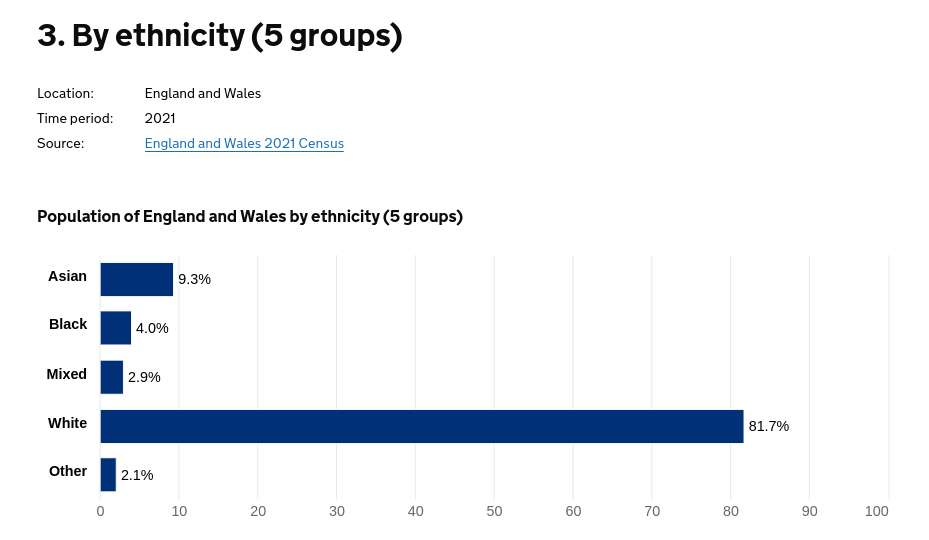
SO, FOR MUSLIMS, TAKE THE ASIAN PERCENTAGE OF UK (approx. 9%) and take 60% of that (6%-7% is a good generous estimate).
SO, FOR THE FOLLOWING STATS, IF MUSLIMS ARE PROPORTIONATELY REPRESENTED IN CRIME STATS, THEY WILL ACCOUNT FOR 6-7% ONCE YOU MULTIPLY THE ASIAN % BY 0.6 (60%) - i.e. IF ASIANS ARE 8% OF A CRIME CATEGORY, MUSLIMS WOULD BE (0.6*8)% OF THAT = 4.8%, WHICH IS BELOW THE 6-7% IF MUSLIMS WERE PROPORTIONATELY CRIMINAL IN THAT CATEGORY, i.e. Muslims are less criminal than their % stake in the population of the UK.
MY COMMENT: NOW THE JUICE
Source: Statistics on Ethnicity and the Criminal Justice System, 2024 (HTML) - GOV.UK
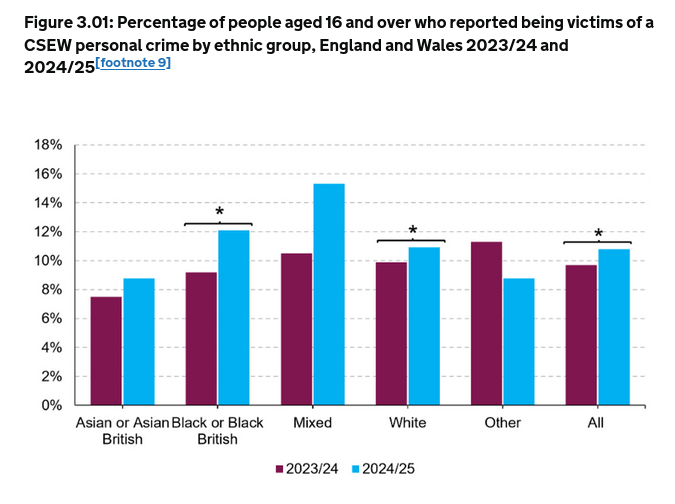
VICTIMS OF CRIME:
Sum across all horiztonal groups = 100%
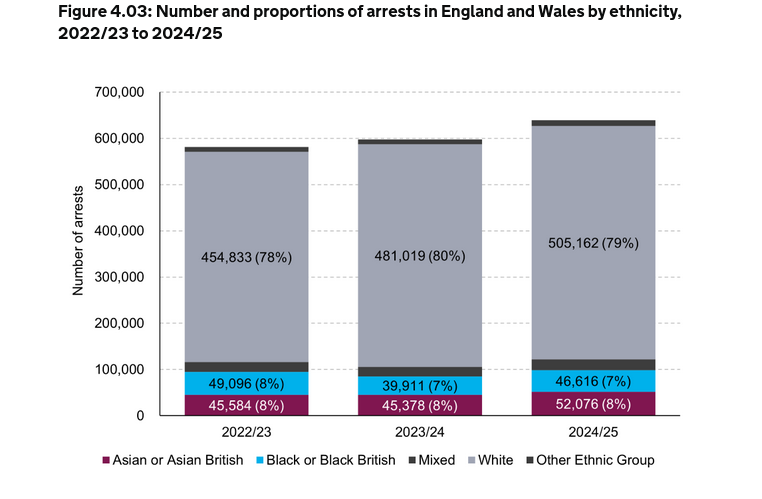
ARRESTS:
Sum across each VERTICAL bar = 100%
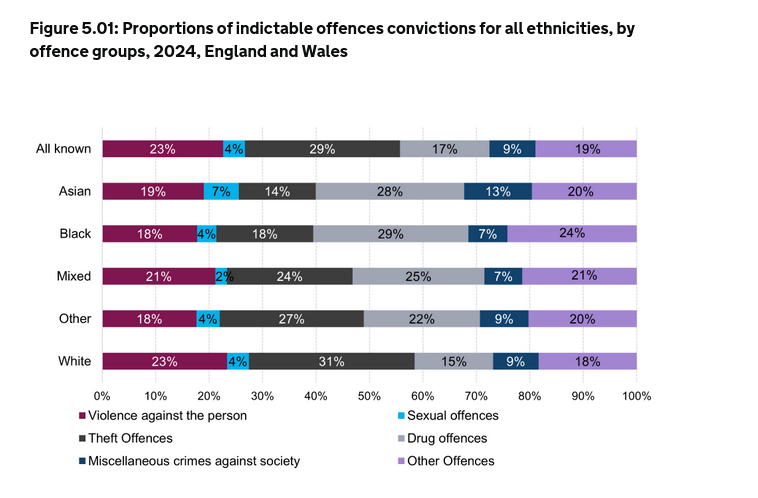
INDICTABLE OFFENCES:
SUM ACROSS EACH HORIZONTAL BAR = 100%
Of the defendants prosecuted for indictable offences in 2024, where ethnicity is known, 83% were White, 7% were Black, 6% were Asian, 3% were of Mixed ethnicity and 1% were of the Other ethnic group - with similar proportions seen in convictions.
PRISON POPULATION:
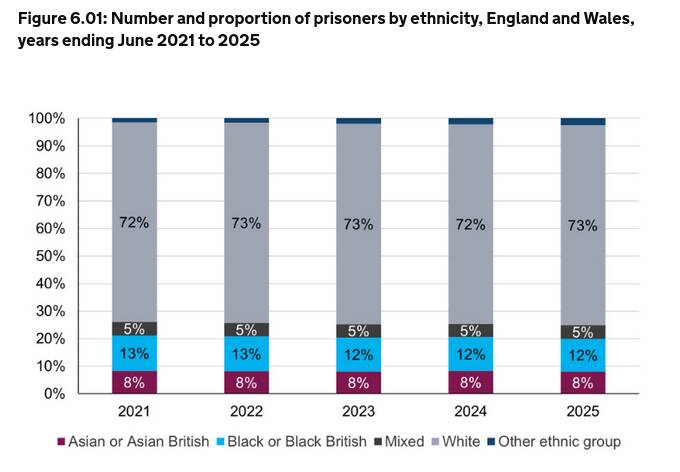
Sum across each VERTICAL bar = 100%