Well yes, I’m aware of that, but what I’m wondering is that if I was shrunk to the scale of a dust particle, for example, would time pass very much slower? I realise this depends heavily on perception, and is purely hypothetical as it’s obviously impossible, but how would time pass for me under those circumstances? Would an event that is over in nano-seconds from the perspective of full-scale me, take hours or even days to pass for dust particle me?
Do you understand what I’m getting at? It’s probably more philosophical than scientific, but it makes me wonder nonetheless..
Interesting question. Given also the level of ignorance we have at the very small scales (is electron a particle, a wave or both? Still open question), I agree that how time passes may be completely different from philosophical perspective.
I will try to approach it like this: We can have a good idea about the feeling of space, given the relative distance between particles. In human terms, you will be isolated since the next “human/particle” will be miles away from you. Due to isolation, it will feel like a prison cell: time will be kind of irrelevant, since you have nothing exciting to do. Even if you move, still you cannot observe difference around you.
Yes, but you’re limiting the thought experiment by applying realistic circumstances, let’s not do that, we’ve already established that this is completely impossible to ever realise.
Let’s say all my friends were shrunk to dust particles too, and we were all in a close-knit group. Let’s also say we were all wearing tiny watches too. How would our perception of time passing be?
Let’s also say an actual dust particle floats past us, how quickly would that occur? Perhaps if we perceive time on that scale, it would almost not seem to move at all, it might pass by glacially slow.
Let’s remove all practicality from the equation and adapt reality to suit the circumstances..
I am confused. You said that I limited the experiment by applying realistic circumstances, yet you close by asking to adapt reality.
It looks like you want to shrink the people without considering the realistic implications of isolation. If a particle passes by and you can see it, then you are describing an imaginary microcosmos, irrelevant with what we know about microcosmos. In this imaginary scenario time could be slower, faster or the same.
Forget it Einstein. Shite answer, shite imagination, you are defo the wrong one to ask. You want to sound clever, well you’re failing badly. You don’t even understand the point of the excercise.
“Irrelevant with what we know about the microcosmos.”
What a twat.
He is confusing “dust particle” with “subatomic particle”.
“A thought experiment is an imaginary scenario that is meant to elucidate or test an argument or theory. It is often an experiment that would be hard, impossible, or unethical to actually perform”
It is not my fault If you cannot explain properly your imaginary scenario.
quote="niallm12, post:143, topic:84784"
Let’s say all my friends were shrunk to dust particles too, and we were all in a close-knit group. Let’s also say we were all wearing tiny watches too. How would our perception of time passing be?
/quote
Your tiny watches are showing what time exactly? That is what you do not explain. How they measure time compared to how the real watches measure time gives you your answer. Because you and your shrunk friends are understanding time according to your watches.
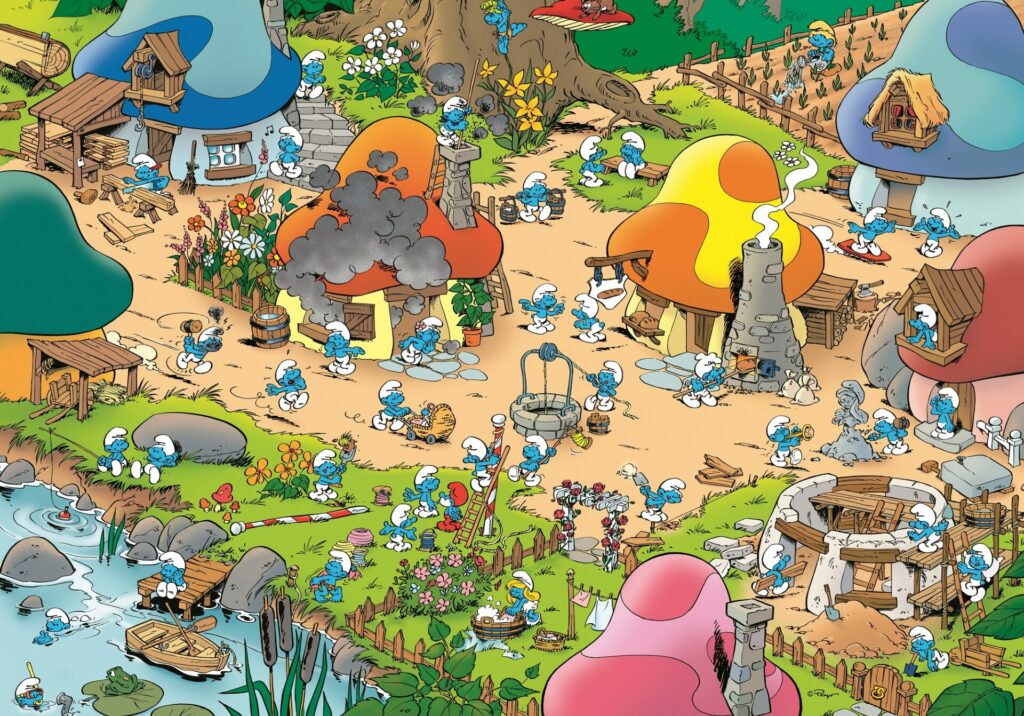
You want imagination? In Smurfs’ village, the time is the same with the time of the big people. And you can drink a Gargamel’s magic potion, shrink even further and still the time passes the same way.
No, I am not native English speaker. Yet, I went to electrons to show that your question is relevant for smaller sizes too.
Even if you do not go so small, the smurfs example holds. Tell us how the tiny watches function compared to real watches and you have your answer. If you do not know, then I cannot answer either.
But now I know how you got derailed at the start, it was due to a misunderstanding of the term “dust particle”. Well, at least one of us learned something.
Particles in science means one thing, in philosophy another.
There are different types and sizes of particles. Dust particle is at μm size, proton particle is at fm size. Electron, if seen as particle, goes even smaller.
In philosophy, particle was used as the tinest size of a discrete world. This is in distinction of the continuum interpretation of Stoics and Spinoza.