What is the nature of light?
- a particle?
- a wave?
- Dual nature wave/particle?
- Why does Ed picture things this way?
0
voters
I have never tried a poll before. So I thought I would give it a try.
What is the nature of light?
I have never tried a poll before. So I thought I would give it a try.
the nature of light is a heavy subject…
-Imp
That explains things. There’s actually a right answer to this one.
Hi to All,
Imp, I may not have told you this, but I love your one liners. One of the best things on ILP.
gib, I do like things that have answers, though I recognize that they are few and far between. Worse yet the answers seem to change periodically. (It is also the best thing).
I decided to post on this subject because I noticed that the xkcd forum had a number of posts that categorically stated that light had a Dual wave particle nature.
The standard schoolbook answer is Dual nature wave/particle, but we do have a notable exception.
Richard Feynman, who won a noble prize for his work on this matter, claims that the answer is particle.
In his book “QED: The Strange Theory of Light and Matter”* writes:
“We know that light is made of particles because we can take a very sensitive instrument that makes clicks when light shines on it, …. Thus light is something like rain drops - each little lump is called a photon - and if all the light is the same color, all the “raindrops” are the same size. …
You might wonder how it is possible to detect a single photon. One instrument that can do this is called a photo multiplier, and I will briefly describe how it works: …”
He continues:
“I want to emphasize that light comes in this form - particles. It is very important to know that light behaves like particles, especially for those of you who have gone to school, where you were told something about light behaving like waves. I’m telling you the way it does behave - like particles.”
“You might say that it’s just the photo multiplier that detects light as particles, but no, every instrument that has been designed to be sensitive enough to detect weak light has always ended up discovering the same thing: light is made of particles”.
The color selections are mine for emphasis but the italics are Feynman’s.
His book goes through various experiments where a wave like interpretation is implied and reports that a quantum sum over all possible particle trajectories yields the correct result.
Reading Feynman’s popular books are fun, and zeno assured me that his set of technical books on physics is also a good read. Though, I would caution that some people might be a bit offended/disappointed by his views on women.
The Introduction to “QED:…” can be found at:
kitp.ucsb.edu/~zee/feynman.html
And it gives some insight into Feynman’s huge persona.
*QED in quantum physics stands for quantum electrodynamics. However it also means quod erat demonstrandum, which translates literally to “which was to be demonstrated”. Mathematicians sometimes use the term QED at the end of a mathematical proof. My conjecture would be that Feynman liked the term QED because it added an otherwise missing connotation of logical rigor to a quantum model.
Thanks Ed
Feynman is one of my heroes of physics. But if you look at the poll, you’ll see you have another notable exception. Light is a wave. And so is an electron. And a proton. All this sort of stuff reminds me of Chinatown where Jack Nicholson is slapping Faye Dunaway and she’s saying “She’s my sister. She’s my daughter. She’s my sister and my daughter”. Yep, particles are waves, because they’re solitons.
Eh, when something is neither one thing or the other, but at the same time somehow being both, you’ve gotta suspect that it is a manifestation of something else underlying the whole shebang.
Prolly one of those “due to our 3D nature we are only seeing half the picture” kinda things.
Ed3,
Feynman is right that light is made of particles, but he puts it rather misleadingly in that he seems to deny that light is also a wave phenomenon (though he doesn’t deny it explicitely from the quotes you posted). Light, like material particles, is both particle and wave at the same time.
I know that the particle nature of light was something scientists liked to emphasize in the early years of the twentieth century because they had just overturned more than a century of conviction that light was exclusively a wave phenomenon. It was thought that the exclusive wave nature of light was proven conclusively. It was quite a shock to find out they were wrong.
However, throughout the 1920s, numerous experiments were conducted to show that both light (or energy) and matter exhibited both wave and particle behavior depending on the conditions under which you observe it. I’m not sure if they knew about wave/particle duality as it applied to light specifically before this time, which might explain Feynman’s emphasis on the particle nature of light (when was QED published?), but by the 1930s, it was pretty clear that wave/particle duality was the nature of both light and matter.
I think the language is fouling things up. When we talk about ‘particles’, the connotations of that term seem to imply that light is composed of little balls, that light is like sand in its particle ness, but we only mean that light is quantized. The same is true for ‘wave’: we picture the ocean or a vibrating cord, but the wave-ness of light just means that it can interfere with itself, so that that light of the same frequence shifted by half a phase will cancel out.
If we asked of snow, “is it a sand or a peanut butter, or does it have a dual sand-peanut-butter nature?”, the question is sort of ridiculous: snow is clearly neither. But it does have a sandiness about it (e.g. it’s granulated, it drifts, it forms similar patterns), and a peanut-buttery-ness (e.g. it’s sticky, it can be formed into balls, it gets liquidy when it heats up a little). Depending how it’s measured, it could be described as either. But really, the categories are inappropriate and poorly contain snow.
So with light: ‘particle’ and ‘wave’ are not good categories for light (or any fundamental particle) beyond a certain level of precision. They’re useful to some degree in quickly explaining how light works to someone who doesn’t have access to a photomultiplier or a defraction grating, but then sand and peanut butter might be useful in explaining snow to someone from the equator with no access to a snow machine. Ultimately, when we’re asking what light really is, it’s not either nor both. It’s its own thing.
Hi to All,
I have not voted on my own poll until now. It seems to me that Feynman was clear about not detecting waves, and the dual identity should be eliminated for Occam’s Razor.
All that would remain is the false dichotomy, which I now think should have been broken down into an anti anthropomorphic option (math only) and the false dichotomy.
Even though I am by nature and training a mathematician, I am beginning to think that our pictures of nature offer us a sense of intuition that is missed by a purely mathematical assessment. I think that this is somewhat akin to Gottlob Frege’s construct of “sense” in his construct of “judgments”. I’m not certain – haven’t figured it out yet.
Simply saying that it is a false dichotomy does not offer any model. Since Feynman’s model is as good as it gets in this domain. I am voting for Feynman.
Hi Farsight,
I am fascinated by Feynman. When I go to southern California on business, I try to take time off to go to Cal Tech and just listen to the conversations. The people there have been very kind to me and showed me where Feynman had his office. John Schwartz, who took the scale of modern string theory to its’ present size, currently has Feynman’s old office.
Hi Gib,
As far as I can tell, Feynman developed his theory sometime between 1947 and 1950. He received his Nobel Prize (which he shared with Schwinger and Tomonaga) in 1965. In addition the latest edition of his book “QED…” with a new introduction was printed in 2006.
History:
books.google.com/books?id=kn6mb0 … ed&f=false
His popular “GED…” book explains why the wave interpretation can be explained away by using a quantum sum of all trajectories.
Hi Tab,
Nice to talk to you again.
In the spirit of your post I will note:
If it is a particular particle and that particle exists in many different places at the same time, which to me means it is not a particular particle, then its non Boolean. Which fits right in with quantum mechanics. Don’t you just love it!
I think I would prefer another model but, if I recall correctly, Feynman’s model is the best model ever made.
Hi Carleas,
As I mentioned to Tab, Feynman’s model is the best we have, though I believe that it is mathematically equivalent to the Schwinger and Tomonaga constructions. I am not familiar with their models.
If we alter our models, without considerable thought, we risk degrading the correspondence with which our models match the phenomenon we are studying.
If you simply want to strip our normal language away and rely solely on the mathematics, then we will miss the “sense” that I spoke of in my opening comments.
Thanks to All
Ed
Sure, but it still doesn’t change anything practically (i.e. the mathematics, the results of experiments, the theory used to explain it). We’d still say that particles act like waves, or that they exhibit “wave properties”, which is all quantum mechanics ever meant to convey. It’s like saying we should call the glass half full, not half empty - we can call it whatever we want, but it won’t change the precise amount of liquid in the glass.
Hi Gib,
When you’re right your right. I sure would not want to do the Quantum calculations.
Thanks Ed
Well said, Carleas.
Ed, I’ve tried to take a tip from Feynman, whose nickname was “the great explainer”. Good bloke.
This wave/particle duality thing is actually quite easy to get past. Imagine space is a cubic lattice made of rubber:
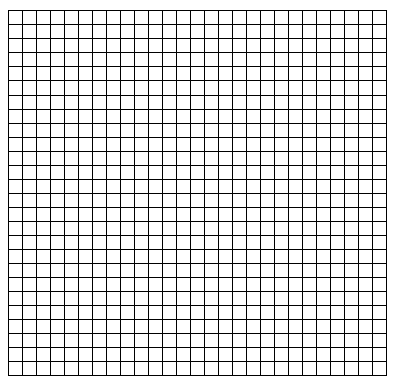
Now imagine you can reach into it with your hand. Hook your fingers in just below the middle centre. Stick your other hand in above the centre, now pull your two hands apart, so that the grid bulges. That’s what a photon “looks” like. If it just sat there and you closed your eyes and felt it, you’d feel something. Some kind of bump or particle that was vaguely lemon-shaped. But it isn’t “made” of anything. This is no billiard ball. It’s just distortion, and in truth it isn’t just sitting there. It’s moving at c, and it’s a wave rippling through space, like a ripple in a rubber mat. If you use pair production to convert this photon into an electron and a positron, you’re making a couple of “vortons”. They’s akin to eddies, and have spin. Think of an electron as a self-trapped photon going round and round. The photon is a wave, and if the electron is just a wave going round and round, it isn’t a little billiard ball either. It’s a soliton instead.
Note that I said the photon is distortion, so wherever the distortion is, the photon is. As you move away from the central location, the distortion reduces, but it doesn’t stop. Hence many-paths. Also note that the quantum of quantum mechanics is 3.86 x 10^-13 metres. E=hf, h is Planck’s constant, and it’s action, which is momentum multiplied by distance. The extent of the vertical distortion is always the same, hence the amplitude of all photons is always the same. This is “hidden in plain view”. Look at any picture of the electromagnetic spectrum, images.google.co.uk/images?hl=en … e&resnum=1 and note that the wave height is always the same.
This geometrical picture really is how it is, and goes back to Minkowski’s wrench. An electron’s electric field is a “twist” field. Stack a pile of electrons one on top of the other, then move down past them, and it’s like a drill bit. You perceive a “turn” field. A magnetic field. Hence the right hand rule for the current-in-the-wire. The changing electric field doesn’t generate a magnetic field, they’re one and the same, which is why it’s an electromagnetic field. If you move through it you perceive it in a different fashion. See en.wikipedia.org/wiki/Jefimenko’s_equations and see this:
There is a widespread interpretation of Maxwell’s equations to the effect that time variable electric and magnetic fields can cause each other. This is often used as part of an explanation of the formation of electromagnetic waves. However, Jefimenko’s equations show otherwise. [3] Jefimenko says, “…neither Maxwell’s equations nor their solutions indicate an existence of causal links between electric and magnetic fields. Therefore, we must conclude that an electromagnetic field is a dual entity always having an electric and a magnetic component simultaneously created by their common sources: time-variable electric charges and currents.”
Look back to your lattice with that lemon-shaped distortion in it, and note that where the distortion is, the lattice is twisted out of true. Trace the slope of this from right to left. It rises to a maximum, goes flat at the top of the “lemon”, then goes to a maximum the other way, then goes flat again. Draw what I’ve just described and there’s your sine wave:

I don’t know if I’ve mentioned it, but I’m the relativity+ guy. If you can access the Institute of Physics PhysicsWorld website you can see an advert for it. It’s only out in the UK, and I’m not famous yet, but you never know. Mind you, this isn’t all my own work. There’s been people talking along these lines for years, but you tend not to hear much about them. I’ve just joined a few dots here and there. But everything works, everything fits, and it’s horribly simple, and classical. Of course, there are a few people who aren’t too happy about that, especially if they’ve been banging on about many-worlds and things not existing until you look at them. But’s that’s life I’m afraid. Hence the old saying science progresses one death at a time.
I have Farsight’s book.
Just for the record, if you are interested in this physics aspect of what light is…I highly encourage you to pick his book up!
I’m not saying that in an advert kind of way…I mean that in a, “He makes a very compelling case and it really should be read if you can go for it!”
Ed, I don’t mean that we shouldn’t ever refer to light as a wave/particle, I think I worded my point too strongly. As I indicated about the sand/peanut butter nature of snow, in some circumstances it is useful to use non-ideal categories to bridge the gap between what we understand and what we don’t. For anyone who isn’t a quantum physicists, saying that “light has a dual nature” is useful for getting you mind around a rather incomprehensible phenomena. But it’s important to be clear that those categories are in fact imperfect, and as we get closer to understanding what light is it becomes useful to switch (as quantum physicists do) to entirely mathematical expressions of what they are studying. The math is a more accurate description of light than is the wave/particle description, but for almost everyone the mathematical description is totally meaningless, and as such the wave/particle description conveys more information about the nature of light.
Feynman takes liberties with his non-technical explanations about physics, from what I’ve heard. ‘Feynman diagrams’, which are very useful for understanding particle physics, are weird when translated into everyday language. They involve particles travelling backwards through time, and interacting with other particles travelling forward in time. But such descriptions are necessary to capture what more rigorously expressed models show. They’re poetry of a sort.
Carleas, try taking the “particles” traveling “back in time” and interacting with “particles” moving “forward in time” and then think about an arrow that loops back in on itself.

Now think of smoke or water

Then replace “time” with change of motion through space.
And you can watch how what was the “front” of the arrow, smoke, wave, is now looping back on itself and affecting the original “body” of the arrow, smoke, wave if left to continue in it’s motion.
So the change of motion isn’t reversing (going back in time), but looping back in a change of motion that will distort the original virtual “path” of motion that was taking place.
I’m doing a lousy job at explaining this compared to Farsight, but it makes sense when you think about it.
Thanks Stumps re amazon.co.uk/RELATIVITY-Theo … 0956097804 .
Carleas, the positron is an electron “going the other way”. But not through time. The motion is through space. Think of a moebius strip. You can make one in one way, and then make a mirror-image version. Only it isn’t a strip, and it isn’t static, it’s dynamical, a volumetric stress flow. Here’s a depiction:

People tend to say we move forward through time at one second per second, but we don’t actually move through time at all. Things move through space. They don’t move through spacetime, we just plot lines in spacetime. Think about a clock. It clocks up motion, not time. A year is derived from the motion of the earth round the sun, a day is derived from the rotation of the earth. It all comes back to motion. And when it comes to QED, there’s an underlying geometry that makes it understandable. All the mystery melts away. Chuck a few posers at me and I’ll show you what I mean.
Hi Carleas,
I think that a number of things that you have said are true.
After our “picture” is made, the math takes over. Additionally the picture becomes the distortion, because of the precision of the math.
I also agree, in general, that popularized science distorts the nature of the model. I believe that this is true even in the case where the popularizer is the principle author of the model. In fact I wrote as much in a response to James II, but I badly mangled my point. Additionally, it would not be out of character, for Feynman to overly dramatize a point.
Despite the above reservations, Feynman and Tony Zee have both gone a long way out of their way to assure the reader, that the basic physics has not been compromised. [size=150]Warning: Psycho-Babble:[/size] Further it is clear to me that Feynman felt guilty about not giving this lecture earlier, before the death of Alix Mautner; and was heavily motivated to do a first rate job of it.
I promise not to do psycho-babble again in the Natural Sciences Forum.
Hi Farsight,
To be honest I don’t really understand your model. But I am intrigued by some things that you say.
I think that I will just start with some questions.
Can you formally describe the topology of your rubber space?
Where does the electromagnetic component of light come from, if light is only made of space?
Does your electromagnetic model imply that there can not be magnetic monopoles?
As I understand it pair creation generally requires a relatively strong electro magnetic field; where does that come from?
I have always wondered why pair created particles spiral the way they do?
I guess this is enough for now.
Thanks Ed
Ed:
Can you formally describe the topology of your rubber space?
No. Space has no topology. Topology only appears when the space is distorted, and then we typically talk of an electromagnetic wave or a photon or some other particle.
Where does the electromagnetic component of light come from, if light is only made of space?
The electric field is a “twist field”. It’s curved space. The space is curved around an extension within the space, like I was describing with the grid where you’ve reached in with your hands and pulled, and hence the squares are twisted out of true. A photon is like lemon-like pressure pulse of “spacewarp” propagating through the space at c. Take a snapshot of a single square as the photon passes, and it twists to the left to become a rhombus, goes back to a square at the top of the lemon, then twists to the right to become a rhombus again, then back to square after the photon has passed. If you plot the twist you’re plotting the slope around the extension, and the result is a sine wave. That’s the electric field variation. The magnetic field is a “turn field”, where when you plot the sinusoidal field variation you’re plotting the turning action of the squares rather than how much they’re twisted out of true. The dualism here is important. There’s only one field, the electromagnetic field, but there are two ways of looking at it. Hence if you move past an electron, you see its electric field as a magnetic field. It’s the same if an electron moves past you, like the current-in-the wire and the right-hand-rule. The changing electric field doesn’t create a magnetic field, it’s the same thing seen from a moving viewpoint. Move throught the twist and it makes you turn. If the twist moves through you and you don’t think you’re moving, you’d say you were in a “turn field”. It’s like a reamer or a drill bit or a screw thread. See “Minkowski’s wrench” two pages from the end of Space and Time, and Jefimenko’s_equations. It really is like this, it’s why we have generators and dynamos. Look at gravitomagnestism and gravity probe B. Here’s a picture of an electron beam in a magnetic field:

Does your electromagnetic model imply that there can not be magnetic monopoles?
Yes. But note that this isn’t really “my” electromagnetic model. It goes back at least as far as Minkowskil. The depiction is from a paper by John G Williamson and Martin van der Mark written in 1991 that took six years to get into a journal. See cybsoc.org/cybcon2008prog.htm#jw . The extension is like a gravity wave, see LIGO, and it is in essence Weyl gauge change. Also check out Kelvin’s knots and quantum topology. I’ve joined a few dots, but most of the original work is by “unsung heroes of science”.
Does your electromagnetic model imply that there can not be magnetic monopoles? As I understand it pair creation generally requires a relatively strong electro magnetic field; where does that come from?
Generally: a nucleus. The “spacewarp” close in to a proton or neutron is more intense, sufficient to change the direction of a photon so it starts travelling through itself. It warps its own path, and at 511keV the twist and turn match and lock into what seems to be a stable “knot” of twisting turning spatial stress. But note there’s nothing solid to brace on, you can only make a twist if you make an untwist at the same time. It’s like you’re an astronaut trying to rotate a satellite in space. You turn too, the other way. The positron has the opposite twist to the electron. The original +1022keV photon has to split to form two opposite eddies or vortons. You can’t make just one.
I have always wondered why pair created particles spiral the way they do?
If the electron didn’t have this twist/turn that keeps it spinning in place, it would be a 511keV photon. You can only undo the twist with the opposite twist, hence annihilation resulting in two 511keV photons.

That electron is a photon configuration. It’s a double loop, see the black line in the depiction above. And because it has a mass/energy of 511keV, it tells you the amplitude of the spatial extension. The wavelength of a 511keV photon is 2.426 x 10^-12 metres. When we talk of photons we say E=hf, where h is Planck’s constant of action. Action has the dimensionality of momentum x distance, so divide by 2pi and the extension is 3.86 x 10^13m. It’s the quantum of quantum mechanics. And it’s sitting there in plain view. Look at any picture of the electrmagnetic spactrum, look at the sinusoidal waveform, and the height is the same regardless of frequency:

More electromagnetic spectrum images
It’s Einstein’s geometrical dream, Ed. And everything fits. So nobody plays dice.
Hi Farsight,
A topology consists of a set S and the class of open subsets of that set. Additionally the set S and the null set must be included in the topology.
As a related question, I would like to know what metric you use on your space?
Thanks Ed
Could you rephrase your topology question? One might study a moebius strip in topology, and a moebius strip is akin to an electron, but if you have no photons or electrons etc, all you have is space without deformations.

What metric do I use? Motion.
Ordinarily when talking about space I’d say our measure of it is distance. However we measure distance using motion. You might think we just use a tape measure, but think about a light year. A light year is a distance, which sounds simple enough. But there’s time involved there: a light year is the distance light moves in a year, but a year is defined by the motion of the earth. In the old days we calibrated all of our clocks using the motion of the earth. Nowadays we don’t, but we still employ motion. We use the motion of light. The second is currently defined to be:
the duration of 9,192,631,770 periods of the radiation corresponding to the transition between the two hyperfine levels of the ground state of the caesium 133 atom.
In a nutshell you sit there counting microwaves, and when you get to 9,192,631,770 you tick off a second. When light moves at a reduced rate, our second is bigger, and we account for the difference by introducing concepts like gravitational time dilation. It’s an immersive scale-change. Anything that reduces the motion of light will also reduce the motion of electron spin, because pair production is telling us that an electron is quite literally “made of light”. The same principle applies to protons and antiprotons, and to all material bodies including our bodies and brains and rods and clocks. Of course, the metre is also defined using the motion of light:
The metre is the length of the path travelled by light in vacuum during a time interval of 1⁄299 792 458 of a second.
Hence the saying motion is king. Whether it’s the motion of the earth or the motion of light. it always comes back to motion. If I magically snapped my fingers to make all light, or more properly all electromagnetic phenomena, move at half the rate it did previously, you wouldn’t be able to measure it directly, because you use the motion of light to calibrate your seconds and metres. It’s like running the movie at 15 frames a second instead of 25 frames a second, and you’re in the movie.