Philosophy is not for the faint of heart

But what if miracles are reducible, not to a point, but to make a point,

As if such point from nothingness would make the only proof of being in time and place, where such being, would consume all points of reference as individual existences?

Would miracles be the necessary signals to such links that could associate men to Gid?

You mean like the priests of the many gods of Egypt who mimicked what God was doing through Moses?

I mean.

Do you think … if they had to do it over (& over… & over…) …that’s the thing they’d keep doing forever?

That’s why it had to end somewhere/when.

meaning possible: it went both ways as magic does, it’s not that Egyptian magic infiltrated that of Judea? , primarily and/or exclusively.

But then was there magic of the Jews a part or, apart?

Look, and see

Try not to laugh, but I finding other more convincing citation would have exposed Meno to more of a way to confirm what he-eye knoweth not, kind of ex cathedral pilpitish manner( laughable)

rather Chose a master thesis , the way I could have started to think in a timely manner, if had gotten that far.

)(

Problem

The relationship between Egypt and the Levant spans thousands of years, resulting in many cultural exchanges. Of Egypt’s cultural influences in the Levant, magic has been the least studied. Therefore, this thesis is an introductory study that will present the influence of Egyptian magic in ancient Israel. The corpus of magical artifacts recovered from Israelite sites comes from the Iron Age.

Method

This thesis intends to be a comparative study of the understanding of magic among the Egyptians and Israelites by analyzing biblical texts and ritual objects recorded in the archaeological record. The main methodology used to conduct this research is iii qualitative analysis. A qualitative approach is the best methodology for this type of research because of its exploitative nature. Additionally, within this qualitative approach, I have also used other methods, such as documentary and reviewed literature, to explore the understanding of the purpose, practitioners, and objects of magic in ancient Egypt and Israel to trace parallels between them.

Result

Many magical practices in ancient Israel originated in regions other than Ancient Egypt. However, the Greatest influence of Egyptian magic can be observed in the use of magic symbols and amulets from elite society and “Folk Religion ” among the general population.

Conclusion

This thesis concludes that the best evidence scholars have for tracing the influence of Egyptian magic in ancient Israel is the use of Egyptian and Egyptianized symbols in royal iconography to illustrate the protective power of YHWH. Additionally, using Egyptian and Egyptianized amulets in a domestic and funerary context in folk religion illustrated that the owners utilized the objects for their apotropaic function.

Subject Area

Magic, Egyptian; Jews–History

Recommended Citation

Jenkins, Christopher Matthew, “A Culture of Magic in Ancient Egypt and Its Impact on Ancient Israel” (2023). Master’s Theses. 212.

Creative Commons License

Creative Commons Attribution-NonCommercial-No Derivative Works 4.0 International License
This work is licensed under a Creative Commons Attribution-NonCommercial-No Derivative Works 4.0 International License.

DOI

Download

Files over 3MB may be slow to open. For best results, right-click and select “save as…”

570 DOWNLOADS

Since May 25, 2023

PLUMX METRICS

INCLUDED IN

Biblical Studies Commons

SHARE

FacebookLinkedInWhatsAppEmailShare

Library Links

Search

Advanced Search

Browse

Author Corner

But then some ascribe Jesus to be a Magician, the three magi coming to pay tribute, as to the coming of their own?

)()

Jesus the Magician? Why Jesus Holds a Wand in Early Christian Art

By Lee M. Jefferson
Wandering through Rome, the Eternal City, any visitor has the opportunity to witness the convergence of two empires: the Roman Empire, with its arches and ruins in the Forum, and the Christian empire, with numerous churches in the city and, of course, the Vatican.

This confluence of pagan and Christian is even manifested in the Vatican Museums. There visitors naturally gravitate to various galleries featuring Italian Renaissance artists, culminating in a quick and crowded foray into the Sistine Chapel. However, near the escalator from the main entrance is a habitually overlooked gallery of early Christian art: the Museo Pio Cristiano. The collection contains many of the oldest recovered carved sarcophagi in the early Christian visual canon. Although many guidebooks suggest it interests only specialists, visitors would be well served to reject their guidebooks and explore this treasure trove of early Christian imagery, including early visualizations of Jesus.
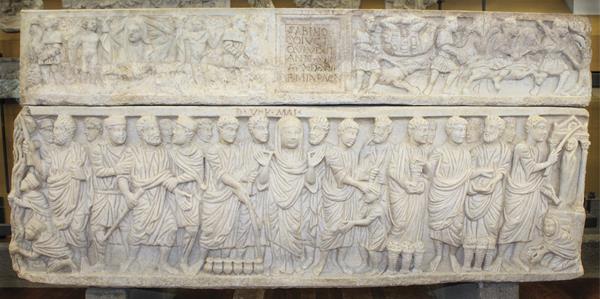
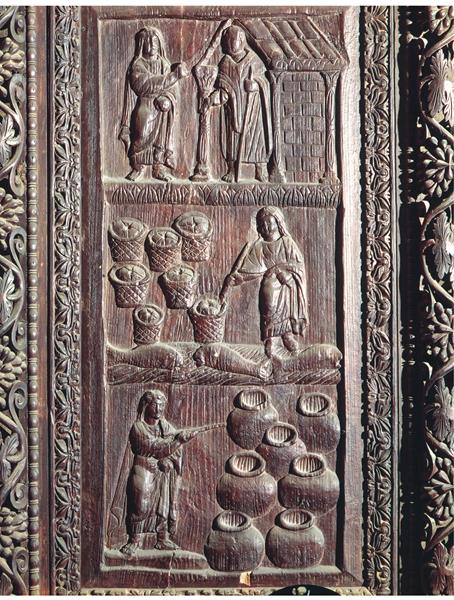
Viewers find a clean-shaven Jesus, mirroring the cultural norm of ancient Rome, where men usually wore no beard, rather than the bearded figure typical in later representations (after the late fourth or early fifth century C.E.). In many of these early examples, Jesus is depicted performing miracles, such as dividing loaves, changing water into wine, and raising Lazarus from the dead, as on the Sarcophagus of Sabinus. What may perplex viewers is the object in Jesus’s hand: a tapered instrument.

To many, it appears Jesus is holding a magic wand!

The earliest Christian art appeared in a funerary medium, meaning it was art in the context of burials, be it catacomb paintings in Rome or sarcophagi carvings. Considering this context, it becomes clear why these early images depict Jesus performing healings and miracles. An image of Jesus raising the dead shows him as being more powerful than any other competing god or goddess. Exhibiting a feat of wonder such as this gave comfort to the viewers honoring the dead, reinforcing faith in the life to come.
Viewers will not find early images of a crucified Jesus. In late antiquity (between the third and eighth centuries C.E.), showing Jesus as powerful and having authority over life and death was more palatable than featuring Jesus dying or dead on a cross, an execution method for the poor and fallible. Images of Jesus performing miracles tout Christian supremacy and emphasize the future resurrection. The curious magic wand Jesus wields plays a part in that effort.

The implement that Jesus holds (sometimes called a virga or rabdos) is portrayed as either thick and ruddy, such as on the sarcophagi, or thin and reed-like, such as in catacomb paintings. He uses it in the performance of a miracle, leading several scholars to conclude that early Christians understood Jesus as a magician. The problem with this identification is that early Christians greatly maligned magic.

Magicians certainly existed, but their power was not in a wand-like tool but in spells. There are a great number of spells and incantations, collectively known as the Greek Magical Papyri. They mostly deal with exorcisms, healings, and love spells. Although some mention the use of a wand-like instrument as part of the spell, the tool is always of secondary importance. The power of late antique magic was in the proper execution and vocalization of the spell.

Moreover, early Christian figures such as Origen, Augustine, and John Chrysostom all vociferously attacked magical practice. Origen even defended Jesus against accusations that he was a common magician.

Finally, there is no recovered visual evidence of a late antique magician doing his or her job in the manner these images portray Jesus. It would seem strange then that these images were meant to depict Jesus as a magician.

Viewers approach images like these through the lens of centuries of understanding magicians or wizards as wielding wands in the performance of their spells. The popularity of the Harry Potter series by J.K. Rowling lends a strong recent influence. Many modern viewers would even suggest that the wand makes Jesus look like Harry Potter. Our cultural landscape conditions us to make similar associations through literature, film, and popular culture. Yet the tool Jesus wields is not a magician’s wand but a staff.
Significant clues for this interpretation can be gleaned from the Bible, which mentions miracle-working implements—in particular, the staff of Moses.

Moses is granted the power to perform miracles by the God of Israel in the Exodus narrative with his staff (Exodus 4:2). Early Christians understood Moses to be the most powerful miracle worker of the Hebrew Bible, next to Elijah. In his diatribe Against Celsus, the third-century Christian thinker Origen calls Moses the greatest miracle worker before Jesus. It is no coincidence that in the synoptic gospel accounts of the Transfiguration, Jesus is seen with Moses and Elijah (Mark 9:2-8). The valence of miracles continues into the Jesus movement, as Jesus is associated with the greatest miracle workers from the Bible.

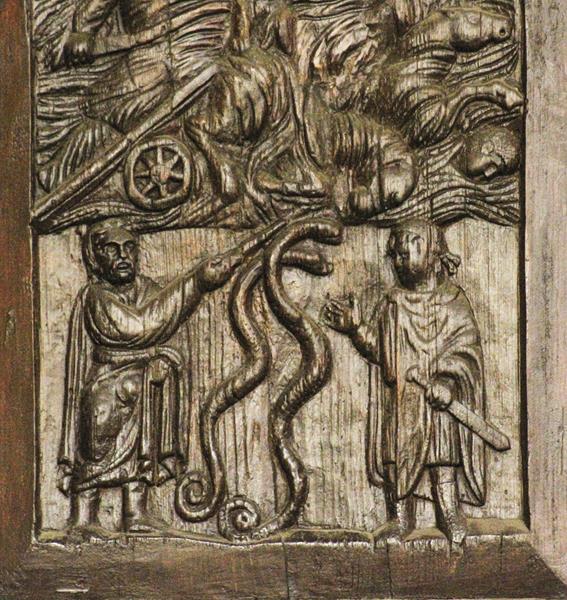
The staff of Moses is a way to connect Jesus to the miracle-working tradition of Moses. Occasionally in early Christian art, images of Jesus with the staff appear alongside images of Moses performing miracles with the staff. The fifth-century church in Rome, Santa Sabina, boasts some of the earliest Christian wood carved doors with images. On one panel, Jesus performs miracles with the staff, including the raising of Lazarus. On a nearby panel, Moses turns the staff into a serpent.
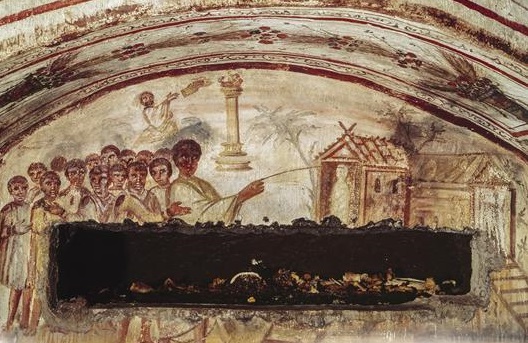
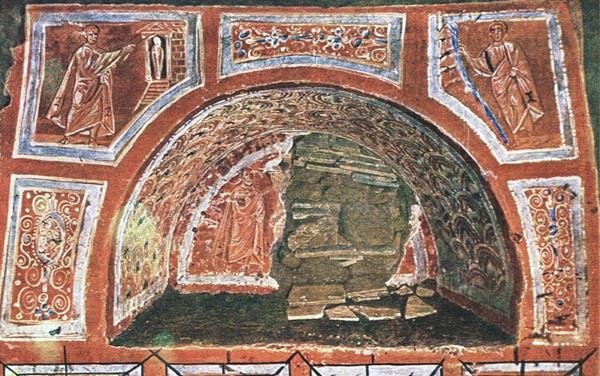
In the catacombs in Rome, the association between the staff of Moses and the staff of Jesus is clear, often due to the images’ proximity to one another. On one side of the wall paintings in the Red Cubiculum of the Catacomb of Domitilla, Jesus uses the staff in the raising of Lazarus, touching the tiny burial house that holds the wrapped body. On the opposing side, Moses strikes the rock with his staff to draw water.
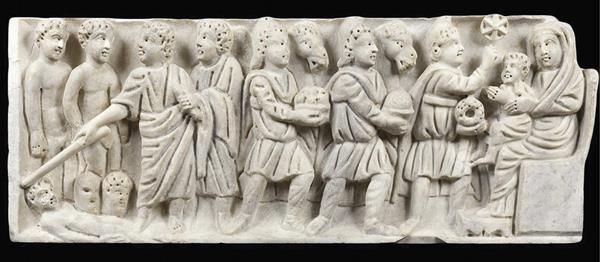
In other scenes involving the miracles of Jesus bearing a staff, particularly on fourth- and fifth-century relief sculpture, Peter is included in this exclusive cast of staff bearers, effectively replacing Moses. On the Sarcophagus of Sabinus, for instance, Peter strikes water from a wall with the staff and also holds the staff as he is arrested in the neighboring scene. These scenes recall an early Christian noncanonical text (from the late second century), the Acts of Peter, where Peter is arrested. While in his jail cell, he strikes the wall and baptizes his Roman jailers with the water that miraculously comes out of it (Acts of Peter 5).
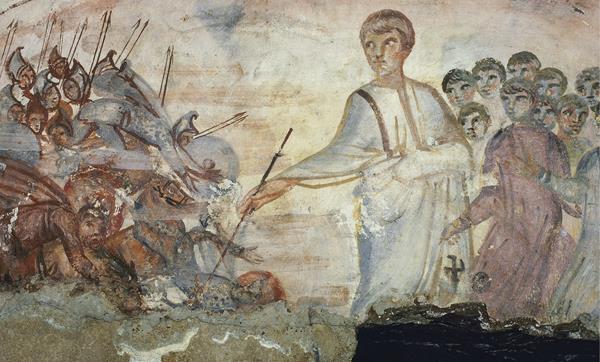
Early Christian art reveals the popularity of the Peter’s jail story, but it also fits with the larger theological intent involving the staff. The miracle-working tool connects Peter to Moses—to the point that, in the relief sculpture, Peter takes Moses’s place and is cast as the “new Moses.” With the inclusion of Peter in miracle imagery involving staff use, Jesus allows Peter, the leader of his church and feeder of his sheep, to inherit the symbol of his miracle-working ability and carry the tradition forward.
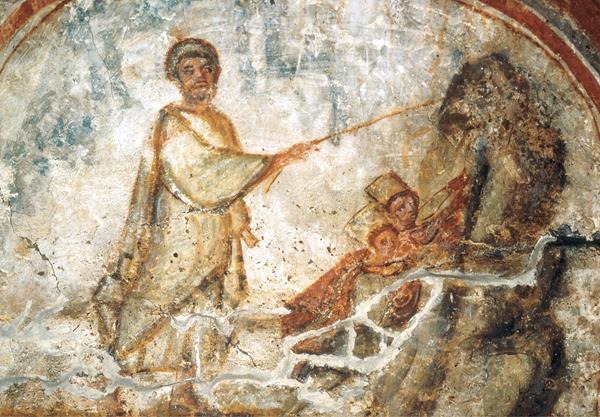
In the fourth century, following Emperor Constantine’s recognition of Christianity as a religion, the Church grew at an exponential rate. Yet the power and understanding of miracles remained crucial for the laity and, thus, for the hierarchy of the Church. The rise of relics, reflected in the circulation of fragments of the true cross from Jerusalem and relics of the saints, realized the importance of miracles for a Christian audience.

In an otherwise harsh existence in late antiquity, the laity could find solace, comfort, and connection in relics and objects of reliquary devotion. The miracle images of Jesus and Peter reflect this desire to be close to the sacred and holy. The staff images emphasize the Church as the repository of miracles and the physical location where miracles can happen.

Although not a magic wand, the staff that Jesus wields and bequeaths to Peter does insinuate a type of Christian “magic.” However, the magic implied is not the magic of modern pop culture; rather, it inspires the understanding of miracles, miracle working, and Church authority. For early Christians, Jesus performing miracles with the staff was not magical. Rather, it was intrinsically biblical (recalling Moses) and innately ecclesial (touting the supremacy of the Church).

)()

And why would not such claims be not overly preposterous, a posterior, as that supernatural power attributed to Deus ex machina turn the pagan consciousness upside down , by the time neo-Platonism tried to refurbish The Faith eroded by DeAnima?

(don’t grin , if bearing it)
;

)()(

Yeah, but what if it’s laughable?

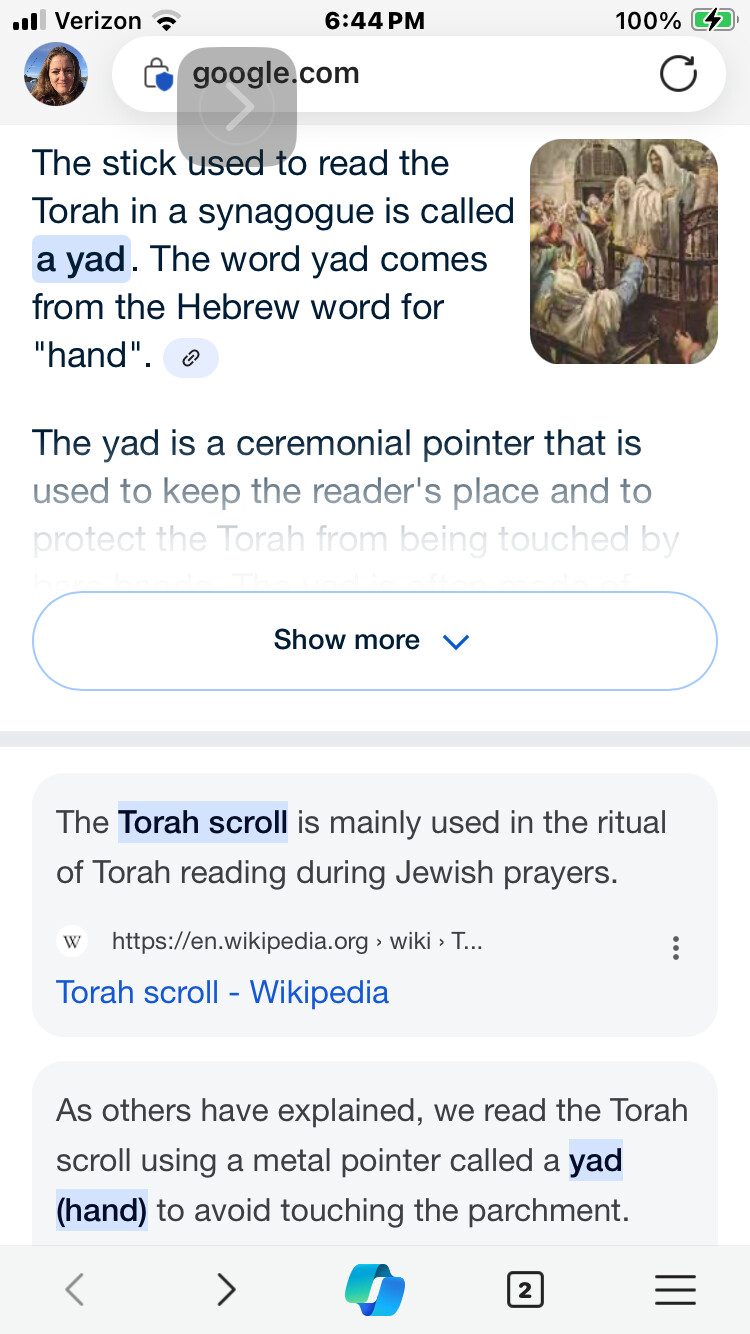
It’s not a wand, it’s a yad:

When is the universe, Meno? WHEN IS THE UNIVERSE???

Here and now, but then all hears and knows’

or noses and eyes , which will become

a real boy some time yet to hear

(The beginning :heart_eyes: The Word)

…that it IS GOOD…

In the beginning was the word and the word is GOOD

It’s sad that I still left Ferlingetti’s ‘Little Boy’ unfinished, but maybe it was fated so, as if a program will develop that leaves it like that, like Shubert’s unfinished. Go into that later.

Just like the first bear up novel ‘Go’ think it was Mc’lallen Holmes, (to be edited later)

Kenneth Patchen? Someone else I could have read, at one point, and a lot left to same fate to re-engage , for lack of time and the diminished memory to contend, the content becoming more and more formalized, so meno_ kinda knew in between puffs, that there IS something left behind the cracks,

Of homeless sidewalks just like that James Walker character here say 10 years ago.

Nevertheless knowing what all this is coming from or think so, the ideologues of the three types: erotic and the two other ones are all gold into and follow suit into the Cosmic proofs, and that is pivotal of why management of staying Here, specifically AND Universally seals the fate of those who know:

Jung himself when asked if he believes in god, was quoted saying:

“I don’t kist believe it but I know it”

()

Further non quitters can’t simply get up and go, Shakamuni did get up and decided to make his time under the tree worthwhile and expedient.

So here:

Alienation as a universal principle can be simulated to mean such a phenomenal effort ( to be minimized later, conventionally) that to understand the ideology around and about the serious consideration between little boy, the little boy of the Nevada desert and

The cold war’s held out anticipation of the cony island of the mind when a repetitive highlifr(light) pursued the likes of paradox and a feeling of sustainability, That It can never end,(and to some sole survivors it has not nor will it, ever

Why?

Cause it can’t cause built that way

Gotta look into Kenneth patchen though.

Anyhow knowing how guys feel

Like You/you I do, take it whatever way or by means, all, reverse the roles and try to get into a different size shoe, :mans_shoe: :mans_shoe: :high_heel:, what ever it takes

But alienation may , suffice it to say, hits those least suspected familiarly or familiarly, either way with everyone pinched in the middle, any ideology may fizzle as democratic principles win the day.

()(

Build on that, that is what’s happening with Ester’s and Shirley’s ilk among others, and the significance of that may have passed on unnoticed and I’ll fated weren’t for a dream , and say is life is such that dreams are made of?

Even if contents are mere illusionary containers of measures of truth, like;

You’all are the salt of the earth.

Will take a slight break and leave writing personal anecdotes now, again this time written and leaving it unfinished. For, repetition in the sense ok Kierkegaard’s strangeness beats eternal return by a long shot.

And now for the third time don’t ever willingly equate failed with intuition ( without portfolio, but cease and desist contrarian opinions, in the same contenscious deontological dream, which may turn nightmare, so ceasing & desisting could be the only alternative until otherwise felt.

))))((((

There must be some way out of here"
Said the joker to the thief
There’s too much confusion
I can’t get no relief
Businessmen, they drink my wine
Plowmen dig my earth
None of them along the line
Know what any of it is worth
“No reason to get excited”
The thief, he kindly spoke
“There are many here among us
Who feel that life is but a joke”
“But you and I, we’ve been through that
And this is not our fate
So, let us not talk falsely now
The hour is getting late”
All along the watchtower
Princes kept the view
While all the women came and went
Barefoot servants, too
Outside, in the distance
A wildcat did growl
Two riders were approaching
The wind began to howl
Data From:
Musixmatch

)()()()()(

https://youtube.com/shorts/iqLD14vwJuo?si=-jerGKyd7NbVsz2k

1 Like

“Are you in any pain?”

“No, surprisingly no. I’m contemplating the meaning of life.”

“Yes, massive blood loss will do that to you.”

Why do you feel incisors plunging into the neck? )(https://youtu.be/Qqufhe5p0QY?si=mj2PDjMWj-QBT7Rq

Canines you mean …

I might have, I might not have.

Had no idea you saw what I meant

Though must confess felt you had some idea..

I try … a little too hard it seems … mon ami.

Not at all, , it’s keeping the in&out game moving along, must’ve been meditating, or else tryin’ to be mean!

1 Like

I appreciate your thread’s thrust. It’s value lies in its sequitur. From so simple a beginning endless forms most beautiful and most wonderful have been and are being evolved. That however doesn’t mean it’s got no past, prompting me to rework Darwin backwards … To so simple an end endless forms most beautiful and most wonderful have been and were being evolved.

Of course one can also reduce Nietzche to a single point even exempting his irony, to a single idea which keeps singular experience going indefinitely, coinciding with the eastern thought of of raising karmic evolution over indefinite occurances(

Then maybe the irony will finally conduit to a unification.

A rational person is quite easy to calculate, from a person reduced to the state of an animal. A reasonable person forms thoughts convincingly and logically. But cattle - she writes within the framework of her feelings. For example, faith in other sheep scientists, or faith in religious authority. In fact, the Nonentity does not understand human words. He cannot determine them. Composes phrases and sentences based on what he remembered, heard and, finally, read without delving into the meaning.