If you need a “yellow △ blue △ red” decoder for my comments bracketed into Adler’s below, please use “is/fact △ ought △ value” or “being △ action △ quality” or “formal/material △ final/ought △ formal/final” (going around & around with Copilot on this last one until they cried Auntie). There are others… just ask.
Comments on the “Naturalistic Fallacy” by Mortimer J. Adler, Ph.D.
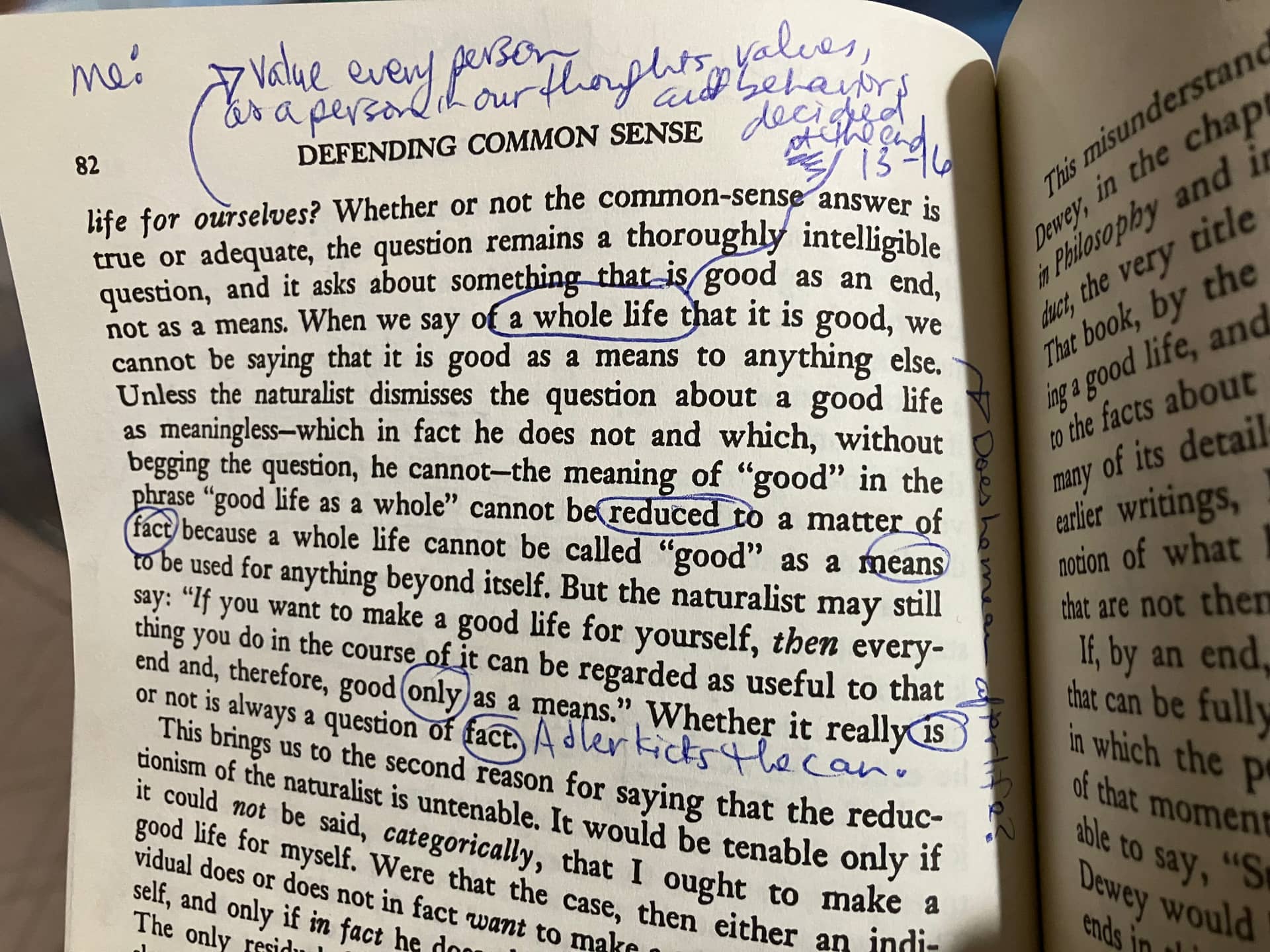
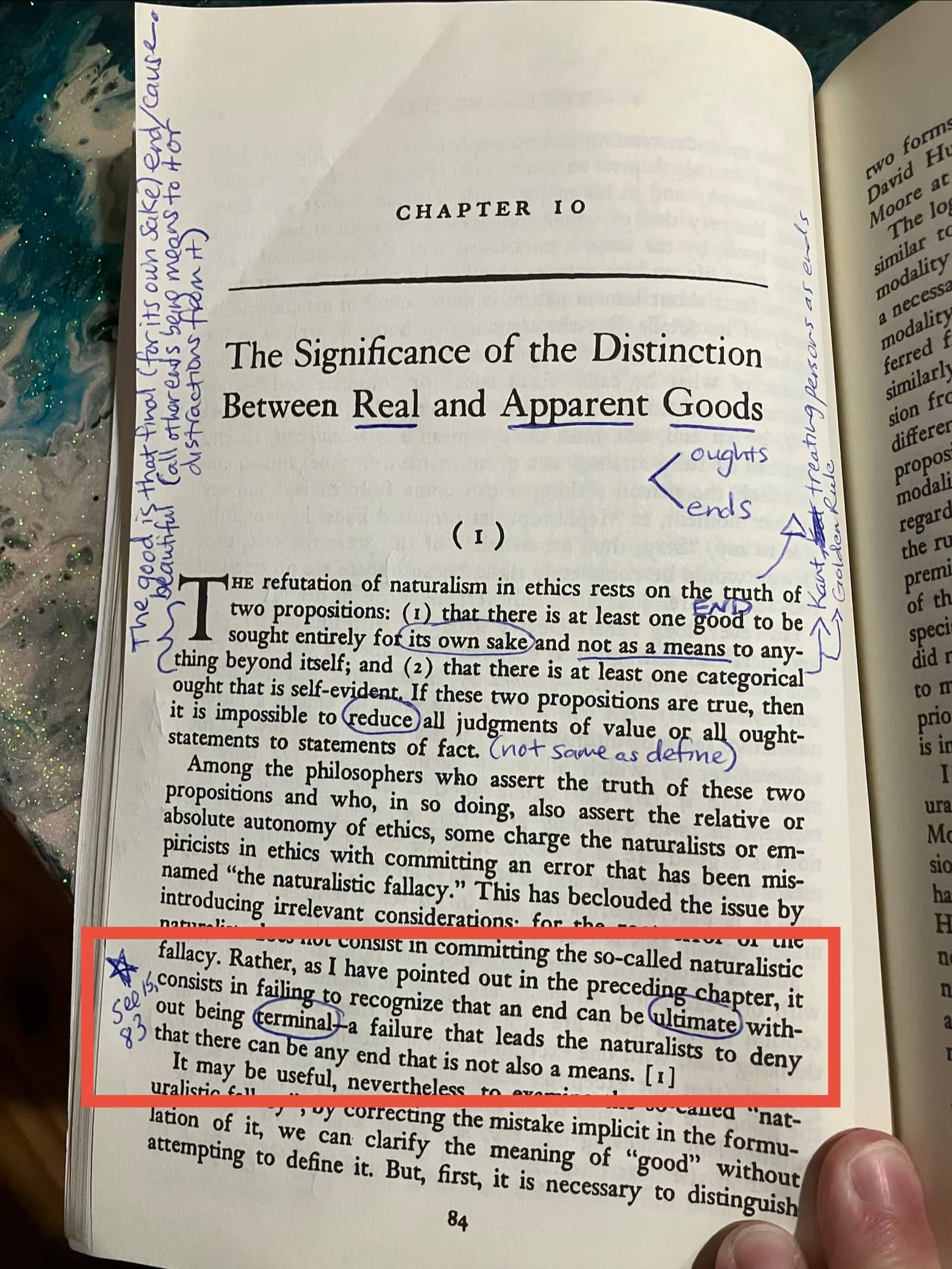
The refutation of naturalism in ethics rests on the truth of two propositions: (1) that there is at least one good to be sought entirely for its own sake [Maryann: He’s putting the good as one of many red values instead of a blue action/actualization of red value—but he’s yellow universalizing the red value because “for its own sake”/end] and not as a means to anything beyond itself; and (2) that there is at least one categorical ought that is self-evident. If these two propositions are true, then it is impossible to reduce all judgments of value or all ought statements to statements of fact.
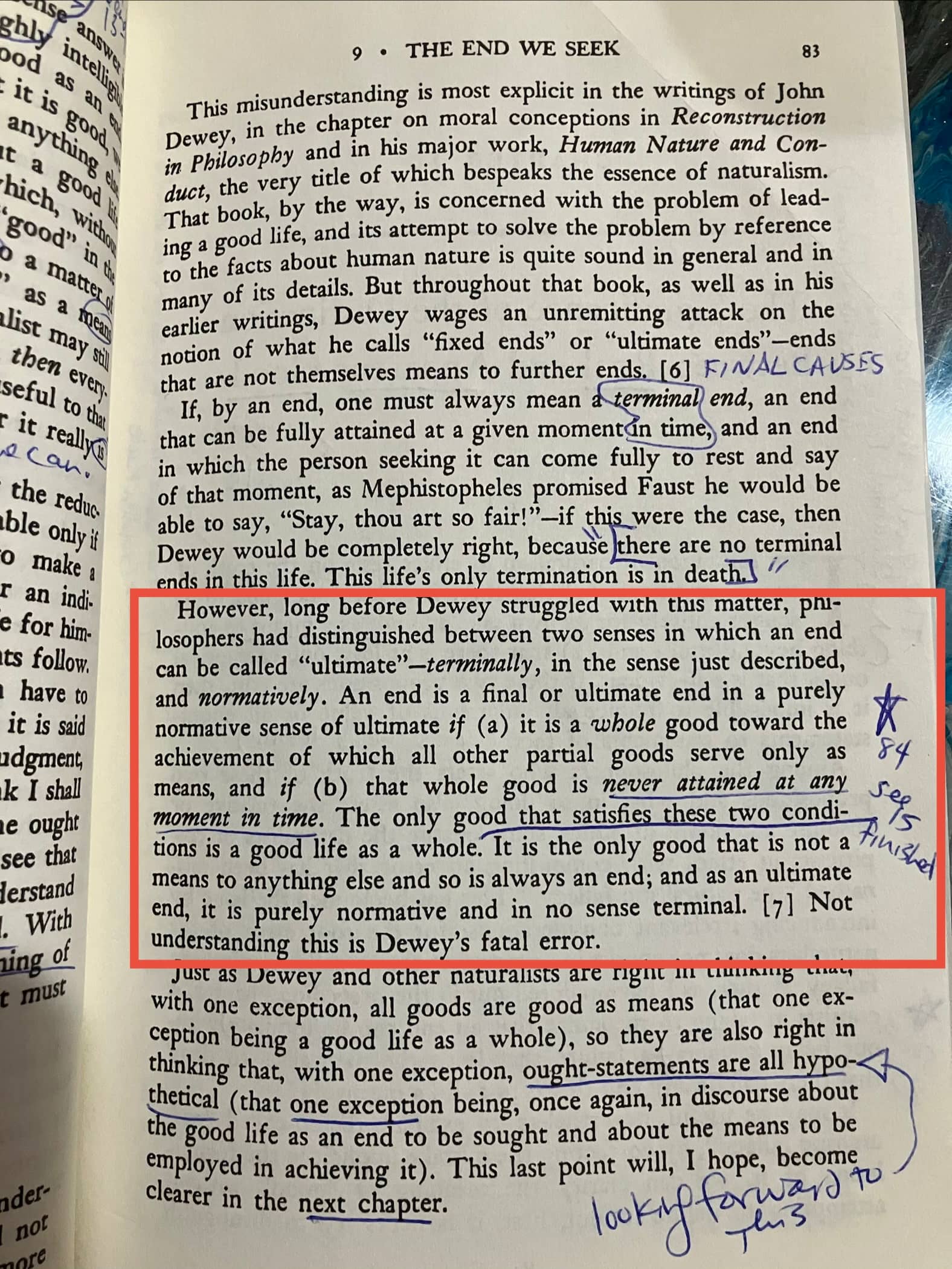
Among the philosophers who assert the truth of these two propositions and who, in so doing, also assert the relative or absolute autonomy of ethics, some charge the naturalists or empiricists in ethics with committing an error that has been misnamed “the naturalistic fallacy.” This has beclouded the issue by introducing irrelevant considerations; for the root error of the naturalists does not consist in committing the so-called naturalistic fallacy. Rather, it consists in failing to recognize that an end can be ultimate without being terminal – a failure that leads the naturalists to deny that there can be any end that is not also a means. [¡MARYANN! alpha/omega — first/final principle already fulfilled. This is about denying formal/final causes/quality.]
It may be useful, nevertheless, to examine the so-called “naturalistic fallacy”; by correcting the mistake implicit in the formulation of it, we can clarify the meaning of “good” without attempting to define it. But, first, it is necessary to distinguish two forms of the “naturalistic fallacy,” the one pointed out by David Hume in the eighteenth century, the other by G. E. Moore at the beginning of this century.
The logical fallacy to which Hume called attention is formally similar to the violation of the rule governing considerations of modality in reasoning. It is logically invalid in reasoning to infer a necessary conclusion from premises that are contingent in their modality [Maryann: Is this going from blue example/actuality/action to yellow category/being…because no empty categories, or red possibility/quality/value to yellow necessity/being?] or to assign contingency to a conclusion that is inferred from premises that are necessary in their modality. It is similarly and just as obviously fallacious to draw an ought-conclusion from premises that consist entirely of is-statements; [Maryann: Is he thinking blue ought as red value or blue ought as blue imperative action aligned with yellow universalized red value?] for the difference in logical type between descriptive and normative [Maryann: Is he talking blue legislative norm without red &/or yellow, or red value norm w/o blue &/or yellow?] propositions is as great as, if not greater than, the difference in modality between two descriptive propositions.
That is why I regard the logical mistake pointed out by Hume – the violation of the rule that an ought-statement cannot be validly inferred from premises that are is-statements-as an analogue or special form of the modal fallacy. I will have more to say later about this special fallacy but, in passing, it is worth remembering that Hume did not discover it. It was explicitly recognized in antiquity, and to my knowledge, no moral philosopher of note-certainly none prior to the eighteenth century-ever committed this error. None is in fact named by Hume.
I wish to deal now with the other form of the so-called “naturalistic fallacy” – the form to which attention has been called by Moore and which has been made the subject of so much discussion in the last sixty [ninety] -five years. Let me say, first of all, that it has no logical connection with the modal fallacy discussed by Hume, which is truly a logical fallacy, and that, in addition to not being a logical fallacy, it also has no special relevance to naturalism. If there is any error revealed in Moore’s discussion of attempts to define the good, it is the mistake that Moore himself makes in supposing that definitions are statements of identities [Maryann: See previous: “clarify the meaning of ‘good’ without attempting to define it”.]
No exception can be taken to Moore’s endorsement of Bishop Butler’s observation that “everything is what it is, and not another thing.” A is A; it is not non-A. But definitions, properly conceived, never violate this law of identity. To say, for example, that gold is a fusible metal is not to say that gold is non-gold, but merely to offer the defining properties of that which is gold.
If to define anything at all – the good or anything else – one had to violate the law of identity, then no definitions at all would be logically valid, and every term would be indefinable. [Maryann: Is he saying Moore’s mistake is in assuming that an analytic definition/description, one that is true by definition, cannot include statements of how things ought to behave (blue), or statements of value/function (red), simply because (according to someone like Moore) those do not describe something as true by definition? Is Adler saying… doesn’t that leave out the function/why and praxis/how included in what a thing is? How can it even be a thing without those things? Why does it (Moore’s mistake) feel like cherry picking it OUT of the definition—and why does it remind me of the “synthetic a priori“ Kantroversy, as well as the misunderstanding between those who accept Thomistic simplicity, and those who think it implies monism or modal collapse (assuming I even correctly understood the controversy there)? (My job is to clarify how that is or is not the same mistake Hume is making… if it is in fact a mistake, and what the actual mistake is… as concerns Hume’s fork/guillotine.)]
The question of the correctness in fact of a particular definition is, of course, another matter. While defining gold as a fusible metal does not violate the law of identity, that by itself does not assure us that fusibility is in fact a defining property of the metal gold. On the other hand, when that definition of gold is empirically arrived at and accepted in the light of the available evidence as factually correct, then it is no longer an open question whether or not gold is fusible. That question has been settled protem by the establishment of the definition.
I have gone this far into the logic of definitions in order to point out that Moore’s much vaunted “open-question argument,” far from calling attention to a logical fallacy or anything that has a bearing on the relation of facts to values [Maryann: the good is the how, the value is the why, neither of which are true without What/Who], was merely his cryptic and contorted way of trying to explain why he thought that the good is indefinable. Moore was correct in this contention, but this was hardly an original discovery on his part, as it is sometimes mistakenly supposed. Only massive ignorance of the theory of the good in the first twenty or twenty-two centuries of Western thought could have fostered that illusion. In addition, the argument by which Moore tried to show that the good is indefinable is itself based on a misunderstanding both of definitions and of indefinable terms. [Maryann: See previous: If there is any error revealed in Moore’s discussion of attempts to define the good, it is the mistake that Moore himself makes in supposing that definitions are statements of identities (Maryann: See previous: “clarify the meaning of ‘good’ without attempting to define it”.) So, indefinable here means you cannot fully capture/know the infinite…but…they can, have, and do make themselves known. (Editorial note: In his 80s, Adler did become a Christian).]
Previous thought so far:
A decade+ ago, to show even further development:
 1. First, the harmonic triad frame
 2. Hume’s Fork = the IS/value split
 3. Hume’s Guillotine = the IS/ought split
 4. The key insight:
 5. In your harmonic triad, the fracture is impossible
 6. So how are the Fork and the Guillotine the same thing?
 7. Why your system dissolves both at once
 Final one‑sentence answer