I gave my answer to your paradox. The world didn’t end.
…the expected response (again). AMNM.
Again nothing of substance, only an attack on the poster.
Might as well wrap this one up because you’re not going to write anything meaningful.
Ditto.
…AMNM.
This is probably the best set of responses yet: James says that all scientists are too immature to understand special relativity (presumably including Einstein). I don’t think anyone can doubt his sanity now.
1 Like
Yada, yada, yada.
… by the one who proved that he could not resolve the paradox before going ballistic.
Of course, neither of the two scenarios I gave that show that one clock stops and the other doesn’t given both of your wacko scenarios solves the paradox.
Like phyllo notes, it’s interesting that you can’t solve your own paradox.
What is far more interesting, relevant, and accurate is that there are so very many of your personality types, incapable of intellectual tasks due to emotional response.
Which has been the whole point to this.
If you had merely taken one more proper step, you would have resolved it.
… but nope… just had to go ballistic… attack, attack, attack!!!
The truth comes out. Your goal in this tread is to get a reaction. Your irritating behavior has been successful. Well done. =D>
1 Like
- each clock is always stationary with respect to itself, in the situation. (Unchanging velocity cannot be detected by that velocity itself, by any measurement).
- rather or not the clock shuts off is going to depend on what happens with respect to the clock, to the photon sensors on the clock. (Given by definition in the setup).
- given 1 above, from the perspective of each clock photons fire at the same measured moment and travel an equal measured distance, striking its sensors.
- given 1, 2 and 3, the clocks each shut off.
What another perspective measures the OTHER clock to be doing (such as move out of center position) is irrelevant to that clock which is seen to be moving, because the clock ITSELF is what determines rather or not it shuts off. Not some other perspective.
The “paradox” is that a perspective measures and determines that the other clock cannot shut off, however sees that it does. Yet once this perspective realizes the other clock is ACTUALLY NOT MOVING then it realizes what happened.
The second perspective looking into the other has a skewed view, because of relative motion between each perspective. But remember, rather the clock shuts off or not is logically NOT dependent upon secondary perspectives measuring it.
If the clocks were accelerating, it would be different and neither clock would shut off.
So that it the logical break down from Relativity, it seems to work fine. Rationally we can accept that secondary perspectives are by definition skewed in their measurements. So long as the clock ITSELF is actually MEASURING the photons firing as simultaneous AND the distance travelled by them as equal, it shuts off no matter wht any other perspective had to say about the matter.
But I still want to see how RM breaks this down.
AMNM.
What you just said is that if we have a satellite in space, we cannot predict what the satellite is going to experience concerning any light activity because we are not there.
The whole point in having a theory is to be able to predict something without having to be there.
The SR theory is based on the premise of the observational consistency of speed of light. But what you have stated is that the theory only applies to the light that is coming toward the observer and light headed in any other direction cannot be predicted except by an observer off in that direction. I’m pretty certain the idea was more along the lines of “No matter what direction the light is headed, I will always measure it to be going the same speed - in that direction as in any other direction.” - including toward a train clock and toward a station clock.
So we can never predict what the equipment on the satellite is going to do until we see what it did.
You are fundamentally denying all prediction theories and thus all science and thought; “Don’t think because you cannot predict. You must see it first.”
Are you sure that you want to stick with that interpretation of SR?
I’m still breaking by mind over this. Without any issues of simultaneity and contraction it looks to me like this:
The PtA of the flash toward the station as seen from the train moves away from the train, while the station moves away as well. The light is calculated via Lorentz to travel at c, as it is experienced from the station, but might thus be interpreted to move toward the station faster as its departure point as seen from the station moves away from the train along with the light itself. Like light arriving from the Sun on Mars is interpreted as c in terms of the unchanging distance between the two bodies, and yet if a spaceship moves away from the Sun in the other direction as where Mars is located, and if the light is seen to depart simultaneously from Mars and from the ship, that light could be interpreted to move faster than c compared to the changing distance between the ship and the Sun-Mars reference frame. That is what my common sense says. The PtA from Sun to Mars is changing at c but since that particular PtA does not have the potential to affect the spaceship, its location change is not bound to its actual potential, so it can be interpreted to move away faster.
If one accepts special relativity, then there is no calculation of the speed of light. Relative to a system of coordinates, the speed is given to be c. This is used as the basis of figuring out what a given system of coordinate should say about events if we already have coordinates assigned in some system of coordinates.
It is not an a priori truth that velocities must add like apples add. We live in w world where it appears that velocity is simply additive. It takes a careful investigation to reveal that adding one velocity to another in physics is not simply additive.
This is an important thing to consider: there is an incredible amount of freedom, from a purely logical point of view, as to the possible physical laws that we could have. There is conservation of momentum, not conservation of velocity, but why not the reverse? Changes in velocity could be multiplicative or could reverse direction. It is a fact of the matter of the world that we have one set of relationships between different physical quantities rather than another. We can investigate what these are, but we have to make a good case, based on evidence, as to what really holds in the world.
There is no direct way to “measure” light itself, we must measure a distance crossed in a certain time when we release photons and have a way to record when they impact the far end.
If distances are changing from start to end point, then we are changing the time it takes to cross that distance, at ANY velocity. Thus c will be MADE to “change” its velocity.
Let that sink in. If distances are made to change, so is time with respect to whatever is crossing that distance, from point A to B. does this apply to light? Of course it does.
Now, what if distance from A to B changes while there also exists a perspective from which that distance is measured to not change? Or the inverse, the distance does not change while there exists a perspective from which the distance is measured to change? Relativity says this is happening all the time. And it’s not a problem.
The “distance” has as many meanings, as many “realities” as there are perspectives measuring it. This is the beauty of relativity and this does not conflict with VO either: a measurement of a distance occurs in the units and constraints/meaning of the perspective that measures. No distance is “fixed”. A so-called fixed distance means only a distance measured by points dependent to that distance, determinative of it directly, “primary” causality. This is opposed to “secondary” causality of a distance.
Example:
Primary causality to distance: the photon emitter (point A) and photon receiver (point B).
Secondary causality to distance: point C observing the photon emitter emit and receiver receive.
Logically, point C is not causal to the distance, but in fact IS causal in an indirect sense: it affects not the primary distance but the secondary distance which is only the primary distance + any additive or subtractive influences based on the nature of point C. You can never have a “pure” measurement (distance) without taking into account how that which measures affects the measuring by its own nature, for example by its relative velocity to that which is measured.
The issue is entirely DEFINITIONAL, which is why I can’t see how RM does not agree with relativity/VO on this.
For the stopped clock situation, each clock is measuring the distance from point A (photon emitter) to point B (the clock itself). But the clock is also measuring the distance from points A to point C (the other clock). With respect to points A and B the clock is not moving. But with respect to points A and C the clock IS moving. So we get each clock as both a primary and secondary causality to the measurement of distances. Essentially there are two distances “at once”, and this does not contradict. Now, the big question is: which distance determines rather or not the clock shuts off? Answer: the primary distance/primary cause to distance for each clock. What is this primary distance/cause? The clock itself.
Constant velocity means no acceleration, means the object at constant velocity is not changing WITH RESPECT TO ITSELF. Even considering that the photons are not bound to the frame of reference of the clock itself, they are measured to travel an equal distance to the clock itself. But the photons going to the other clock are not measured to travel an equal distance to that other clock. But that isn’t a problem for the scenario, because one clock’s being impacted by photons at the same moment or at different moments does not depend on the measurements of the other clock. Those measurements of the other clock are secondary distances/causes, meaning: they affect only the perceived measurements of distances of the photons but not rather or not those photons ACTUALLY strike the other clock at the same time.
It’s simple.
By definition; one clock is centered and the other is not.
You can play with the distances and speeds all you like, as long as you treat both fore and aft alike.
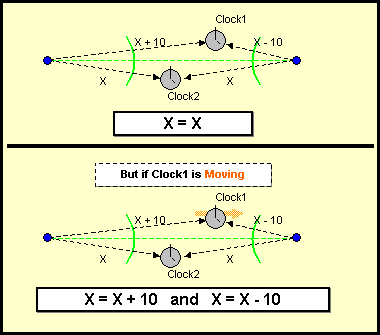
In RM, X = X (aka “A=A”)
In SR, X = X+10 and also X=X-10
But this answer is retarded.
In your initial post in this thread, you claimed that both clocks were centered, “Due to the clocks being centered at the moment the flashers are triggered…”
So your solution is simply to deny your own premises?
I guess “RM” stands for “retarded metaphysics”. Who knows what “SR” stands for here, since special relativity would use Lorentz transforms, not something that looks like a Galilean transformation.
But that response is “retarded”.
We are talking about after the light has left the flashers, just as the pic shows.
It doesn’t matter when your pictures take place: you still fail to present special relativity properly.
Three years and you haven’t figured out this paradox.
Physbang, you aren’t even trying to understand what James is basically claiming. At least understand the set-up of the situation.
Ok James, here is an alternate explanation on my part: neither clock shuts off. Why? Because in no way can it make sense for two distinct photons to do anything like strike the same object “simultaneously”, except “by accident”. Consider that not only the train is moving but also the planet, and the solar system, and the galaxy… Everything is rotating and shifting positions to everything else, no two distinct points can ever truly be in sustained constant and unchanging relation to each other. Even if the train is stopped, the clock on it still cannot shut off because to claim that both photons move through EXACTLY the same amount of space is essentially claiming something impossible to know and almost infinitely unlikely to ever occur. Minute constant changes at every level of existence are re-working the relations between everything all the time, and no two distances after being measured can still be said to be the same, even only a moment later.
Anything there strike you as useful?