The Patterns of Spacetime

James, all the above are based on a deep misunderstanding of both me and relativity. I can’t go on forever like this (the whole stamina thing again). I can’t keep running around in circles arguing the same points over and over again. You either get it by now or you’ll never get it–and you don’t seem to be getting it. So I’m going to throw in the towel.

I do want to return to this thread to give my thoughts on the nature of space and time and how reference frames fit into that, so I’m not bailing on this thread but only with the current round of back-and-forth between you and I. Maybe I’ll regain my stamina after a good break and go for another round.

So stay tuned.

Granted, it is pointless to continue denying the obvious. And to keep trying to support an obvious error by creative dodging and double talk gets rather tiresome. The art of “baffling with bullshit” doesn’t work on me. When you’re cornered, your cornered. And I was just getting started.

Next time try to get your story a little more coherent before you begin.
… and maybe watch those “details” a little closer.

James, I’ve noticed you edit your posts a lot and change what you say.

I wouldn’t say “a lot”. But yes, I change things for one of three reasons;

  1. correct mistaken typing or wording.
  2. reword something in a much more clear manner
  3. change of mind often due to bad timing of an issue or detecting a mistake in prior thought (but only before responses have been posted).

Can I ask why such would be an issue (since it never affects what is presented as retort)?
Is correcting my typos an important issue to you?

No, but it makes one wonder. If you stay true to the reasons you listed above, it’s no biggy, but seeing it happen makes one wonder to what extent you would do that.

Just be careful about this part: “but only before responses have been posted.” When it comes to some of my more lengthy replies, I don’t always whip them up and post them in one go. I sometimes start part of it, save it as a draft, come back to it later, write a bit more, save it, come back, write the rest, proof read it, correct mistakes, then post. This could be throughout the course of a day. I don’t go back to my interlocutor’s original post and cross-compare to see if he changed anything. ← It’s not a big deal to me, but just something for you to be aware of.

Anyway, I want to get into the nature of space and time and try to explain why the “nothingness” that spacetime really is makes relativity inevitable.

Space is the vast emptiness between the stars, the black void that fills infinity. There really isn’t anything there. The same is true of time–there is nothing there to grasp, nothing streaming passed us as clocks tick away.

This may seem obvious but it can be hard to wrap one’s mind around–we often stumble into the trap of thinking of this “nothingness” as something there. It can go so far as to be given a name: the aether. Or a coordinate system. We often project coordinate systems onto space from our minds, supposing that space is composed of an origin with axes stretching out in each of the three dimensions.

Most of the time we realize this is just a mental construct and that there is really nothing there. But sometimes we don’t. Sometimes we think there really are these invisible lines and origins and dimensions, and that this is what space is made of. Some of us become committed to such a view and become known as absolutists or objectivists. But I think the majority understand that these coordinate systems are an artefact of human abstraction.

With this understand in mind, we have no trouble conceding that there is no single absolute coordinate system that describes space. Which of the three coordinate systems below is a more “accurate” depiction of space?

You could even have coordinate systems that differ by scale:

None of these depictions are any more accurate or “true” to space than any other. It is completely arbitrary which one you choose. And the sole reason behind this is that these coordinate systems are mental constructs–we impose them on the world–but there is nothing there demanding that we impose them, or that “best fits” one of our projected coordinate systems over another. There is nothing there. So we can impose any damn coordinate system we want!

What about coordinate systems like these?

Yes, these are indeed candidates for valid coordinate systems depicting space–funky and strange as they are, and perhaps unnecessary, they too could work just as legitimately as any other spatial coordinate system. The only criteria a coordinate system has to meet is that for any given point in space and time, there is a definitive mapping of that point onto the coordinate system in question, no more and no less than a single and exact location in the coordinate system that defines the point’s value (x=1, y=2, z=3, t=4). This point may inherit different values depending on the coordinate system, but such values will be no less definitive and unambiguous in one coordinate system than in any other. For example, have a look at the two coordinate systems below:

The point highlighted in red in both diagrams is the same point in space, but in the coordinate system on the left, it’s value is (3, 2) and in the coordinate system on the right, it’s value is (4, 3). But either way, it works.

(Interestingly, we are coming full circle, talking about the patterns of space time once again).

In fact, there really isn’t any reason that space should be structured according to our customary “right-angled” style of coordinate system. The fact that “horizontal,” “vertical,” and “depth” feel so natural to us is more a result of our biology and history of adaptation to our environment. There is a much greater abundance of objects in our world that stand up straight (people, trees, sign posts) and objects that lie flat (the surface of water when it’s still, table tops, the horizon). This gives rise to neurons in the visual areas of the brain becoming more exercised and developed for processing “horizontal” and “vertical” information, and thus it seems more natural to us to suppose that “horizontal” and “vertical” (and based on those, “depth” too) are fundamental elements of the geometry of space, more fundamental than diagonal, or curved, or non-linear. But this is us. It is our biology and how we’ve adapted to our environment.

Now what if we take time into consideration. Time is a dimension interwoven into any coordinate system worth its salt that bears the same relation to the three spatial dimensions as those three spatial dimensions bear to each other–they are all spacetime dimensions intersecting each other at an origin at orthogonal angles. This type of coordinate system is known as a Minkowski coordinate system, Minkowski being the famous Russian mathematician who invented the idea of the 4D spacetime continuum, the notion that time really ought to be treated, at least mathematically, as a 4th spatial dimension, or rather that the 3 spatial dimensions ought to count as temporal dimensions, or that all 4 as “spacetime” dimensions. And mathematically, this makes sense (subjectively, it’s a bit of a different story, but that can be chocked up to the peculiarities of our biology and neural wiring).

Einstein banked relativity on this idea and this established the rule that whatever can be said of space can be said of time. Whatever applies to one applies to the other.

So take these two coordinate systems:

Note that the two points in the left coordinate system share the same horizontal value. The same points in the right coordinate system don’t. So are they on the same horizontal or not? The answer is: there’s no fact of the matter. The one coordinate system is just as arbitrary as the other. Now if time can be treated just like a spatial dimension, then a similar principle should hold for two events occurring at the same time. If we allow the vertical axis to represent time and the horizontal axis to represent space, and the two points two events occurring at the same time, then we see that there is no reason why we can’t switch to the coordinate system on the right and say that the left event actually occurred before the right event.

Most of you will recognize this as the relativity of simultaneity. The arbitrariness of spacetime coordinate systems explains it.

Recall the discussion James and I got into about differing time dilations depending on whether one was at the rear of the train versus the front. Also recall how I said this desynchronization of time between the rear and the front also nicely accounts for length contraction (the rear is further ahead on the track because we are seeing where it will be in a few seconds, and the front is further behind because we are seeing where it used to be a few seconds ago).

You might also recall I posted a video from which this is a frame:

Notice that from m-pov (the angled train), when a passenger looks to the rear, he is also looking back into the past, and when he looks to the front, he is also looking ahead into the future. That’s the first part in the paragraph above. In other words, from m-pov, the faster the train travels, the more it “twists” into the dimension of time. This is time dilation. It is just like the right coordinate system above. The left coordinate system is s-pov. In s-pov, the train is not seen as “twisted”–it is seen as straight, but at the expense of its resting length. That is to say, as the twisted train passes through what to s-pov looks like the horizontal “present”, the front end will pass through a point closer to that where the rear will pass through–in other words, the front and the rear are closer together along this horizontal present in s-pov.

Now where gravity is concerned, these principles are no different. No coordinate system is any more valid for describing a gravitational field than any other. James questions the reality of UUGFs. Is there really a gravitational field pulling the world back from the point of view of m-pov, or does all that GR amounts to say that we can only treat it as if it were a UUGF? Well, if he understood the basic principle that all coordinate systems are equally valid in describing spacetime, then he’d know what I mean by “there is no fact of the matter.” A coordinate system in which it is the train accelerating while the world stays still is no more accurate a depiction than that in which the train stays still and the world is pulled back by a UUGF. Some might recall I did say that all gravity is is a warping of spacetime–well, it is a warping that looks like this:

The vertical axis is time and the horizontal axis is space. Notice that as an object moves up in time (and all objects move in time), it slowly accelerates to the right due to its following the warped geodesics.

There is no reason this coordinate system couldn’t fit the scenario of the accelerating train any more than a linear one (i.e. one in which the vertical lines are straight and at right angles to the horizontal). Any point in the one coordinate system for which a value can be definitively and unambiguously determined can be so definitively and unambiguously determined in the other.

In fact, you could say that we’ve been falling in some arbitrary direction into a gravitational field since the beginning of time–everything has, just like the world falling into a gravitational field in the train scenario–and you wouldn’t notice a difference. A person in a free falling elevator, Einstein says, will feel no inertia from the fall. It will be as if he were suspended in space, floating in the air, with no forces acting upon him. He could suppose he were falling in any which direction he wanted–up, down, left, right, etc.–and he wouldn’t know which was right. It’s not much different with respect to some arbitrary UUGF while we’re anchored to the Earth. Being anchored onto the ground, we certainly do feel the Earth’s gravity, but who’s to say we haven’t been falling in some arbitrary direction into a UUGF all this time–we and the Earth together. We wouldn’t notice the difference. Feeling like we’re not falling comes natural to us, of course, and is the basis on which we suppose we aren’t in a UUGF, but there was a time when believing the Earth was flat came natural to us, or that the Sun revolved around the Earth came natural to us, and we would have thought the alternatives ridiculously counter-intuitive. But today we’re used to thinking in terms of these alternatives and it isn’t so counter-intuitive any more. Knowing that the Earth is round and that it revolves around the Sun is second nature to us now, because we have been taught to think like this since we were young. If we were taught to think that the entire universe has been pulled into a UUGF since the dawning of time, believing this would also come natural to us.

This is a critical point for understanding relativity. It’s really nothing more than Newton’s first law: What’s the difference between a universe containing only a single object at rest and a universe containing that same single object but moving at a constant velocity. Nothing! There is no substance to space, nothing for objects to “pass through,” and so the two situations are indistinguishable (this, incidentally, is what I think is Newton’s greatest insight–that an object in motion remains in motion because it is equivalent to being at rest and no one demands explanations for why things at rest remain at rest). The relativity of simultaneity is a bit trickier and took Einstein to figure it out, but I stand by what I said in the OP to this thread: it was his deepest insight.

The relativity of simultaneity might be explained by a simple analogy. Take your favorite scene from any movie. Take Gandolf from Lord of the Rings when he tells the Balrog “You shall not pass!” Now ask yourself, “What was I doing when Gandolf told the Balrog ‘You shall not pass!’?”–not “What was I doing when I saw that scene in the movie,” but “What was I doing when it actually happened?” Most would say this question makes no sense. It didn’t actually happen. Gandolf and his friends live in a completely different universe from us, a universe which doesn’t actually exist. Fair enough, but notice what this means–it means there is no simultaneity between events in the real world and events in Middle-Earth. They don’t happen “at the same time” because there is nothing to associate events in the one world with events in the other, nothing to link them up in time. Instead, there is a great big undeniable “nothing” that separates our worlds. Well, is the “nothing” of space and time that separates events in the real world any different? Well, it’s probably different in a few ways, but not on this score I say. The “nothingness” that is space and time are such that there is no spatial or temporal connection between the events that happen within it. One object is a complete world unto itself, like Middle-Earth, relative to another. Whatever happens with one has no bearing on what happens with another. Now, I’d be able to say this and get away with it if it weren’t for light and other force carrying particles. It seems that light indeed bridges the gap between events suspended in space and time. Light is emitted from one event, takes some time to travel through space, and arrives at another event. Then we can form a connection between the times when each event happened. Light, and other force carrying particles, are the element that connect our worlds together and makes them all part of one reality. But without light, there is no fact of the matter about where everything is with respect to each other or when everything happened. Light makes the connection, it establishes simultaneity between one event and another relative to a specific reference frame. But there is no simultaneity before that happens. There are no actual “lines” taken from some absolute natural coordinate system connecting events together in time and space. There is only nothingness–the void that makes everything that follows from Einstein’s relativity possible and necessary.
Gib, something else that I do is to ask verification questions concerning basic premises so that I don’t waste time writing really long explanations for things when a basic premise wasn’t acceptable. That is a really nicely formatted presentation of your personal theory concerning space time and the things that you believe other people to have problems with, but it is actually a complete wasted effort. You erred in the very first sentence and the rest really has nothing to do with my perspective anyway. On top of that, the whole thing is an ill constructed argument.

Just to catch some of the very first issues;
A) SRT made specific claims that were provably not true regardless of anything that GRT might later claim, specifically the one pointed out in the last few posts; the reversible use of that equation, ∆t’ = ∆t * (1 - β²)^½.

B) Space in NOT “nothingness”. And it doesn’t take a scientist to figure that out. You can argue about what all it is, but nothingness is not on the menu. Even Einstein didn’t agree that space was pure nothingness. He merely hoped that the relativity concept would make any aether theory irrelevant. But he admitted that he could never quite get it worked out that way.

C) I fully agree that coordinate systems are arbitrarily chosen and have stated that myself many times. Such has nothing at all to do with being objective nor absolute reference frames.

D) It is strictly your own theory that Einstein meant to say that two accelerating objects have an inherent gravity field between them affecting the travel of light. Such a notion directly contradicts Einstein’s theory that light is always measured by any observer to be traveling at the same speed. So if you are going to argue with Einstein, you are going to have to use something other than Einstein to make your case.

E) Time is NOT a spatial dimension (which is a topic well beyond your grasp of this whole subject).

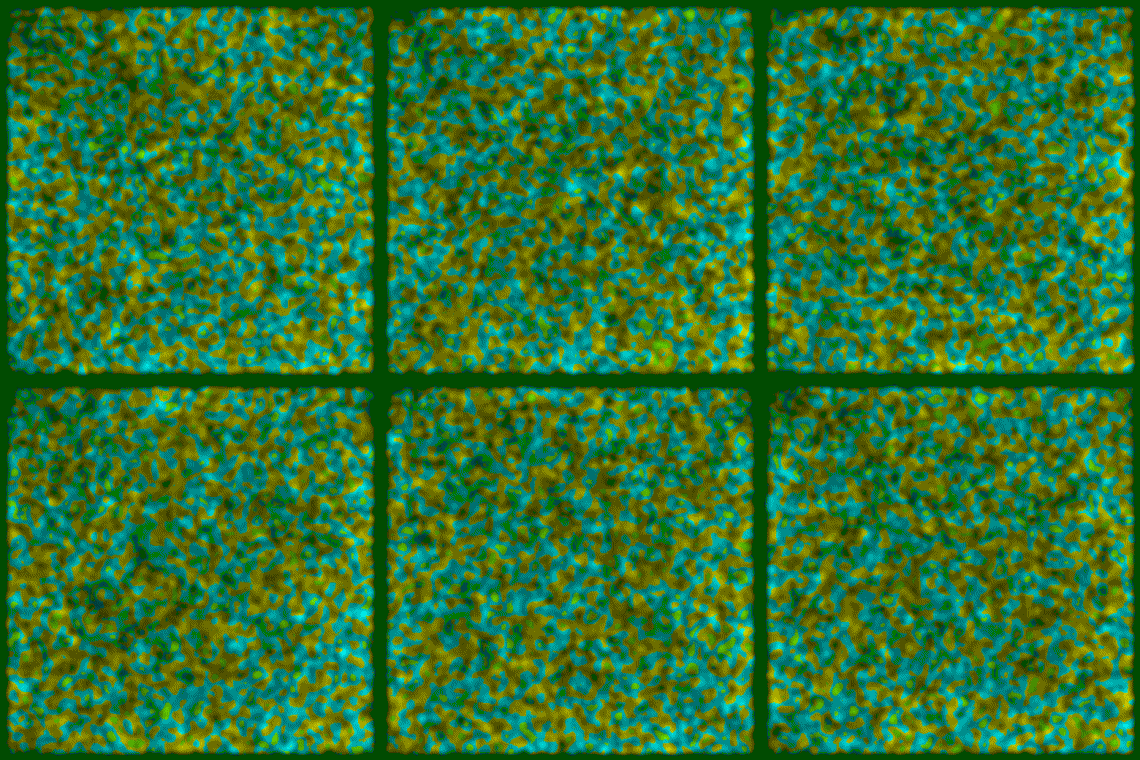
If you could visually see electromagnetic fields, what you are calling “empty space” would look something like this;

Objects, such as rockets or trains, must make their way through that substance (“affectance”). Fresnel, Stokes, Michelson, Morley, and Lorentz were all speculating about how to test that substance (assuming it to be their “aether”) and kept getting confused. At that time, they didn’t understand the exact make of it relative to objects and forces. Today, it is quite easily understood. All of the particles and “forces” are made of that same substance. And more importantly at the moment, it is impossible for there to exist even the tiniest bit of space without that substance completely filling it. But it doesn’t know that it is between two rockets or trains such as to know to follow them.

And if you were traveling through that space at near the speed of light, it might look something like this;

Which coordinate system you choose to use is irrelevant as long as it remains consistent throughout. Einstein’s intent was to allow for every observer to use his own coordinate system “bent” in his own way while still obtaining the same end effect as anyone else. He never got that working. But that didn’t stop it from becoming a social movement for a variety of nasty social reasons.

So how about start with issue b[/b].
Perhaps ask a few verifying questions before going on long fishing trips?

Who are you to tell me whether it was a wasted effort or not. That depends on my goals. I like to write anything and everything about philosophy. I derive a pleasure from the activity itself. I was quite satisfied the moment I hit submit.

So I didn’t want to get into the nature of space and time? I sure put in a lot of effort for someone who didn’t care.

The “reversible use,” you say.

If you’re talking about your electromagnetic static, your confusing space for it’s contents. Sure, space is filled with photons, neutrinos, the CMBR, countless virtual particles and even matter particles, but all that means is that space is very densely occupied, not that these particles constitute space. Would you say that there is no absolute/nature coordinate system in space except when there’s matter in the way?

OK.

Are you talking about the red-shifting/blue-shifting light with the trains again? Where did you get the idea that light changes speed due to gravity? It changes frequency. ← That’s what red-shifting and blue-shifting are. I never claimed light travels at any speed other than c.

Of course not. It’s a spacetime dimension.

You can see them (even visually!). What do you think the effect of light is on the cones and rods at the back of our eyes?

Space is not “nothingness”.

That’s what I said, a shorter way of saying what you said. One cannot merely reverse the pov and use the exact same equation. Yet that is what SRT stated. SRT was wrong.

According to SRT, both twins would be measured as younger than the other throughout the journey until the very end wherein magically one would have to very suddenly get very much older. It is very provable that such isn’t real. SRT was simply wrong about that.

The “space” that is not so occupied exists only in your imagination. That is why you are free to choose any coordinate system, because such unoccupied space is merely an imaginary mental construct. That stuff that you say is occupying space, IS the space itself. You can imagine that space bends because the way you measure it bends. But there is no physically existent space that is bending. Or are you are proclaiming solipsism?

Your claim was that light has to fight gravity when passing from train to train. None of those virtual or real particles that exist between the trains are fighting any kind of gravity. That physical space between them isn’t traveling with the trains.

It isn’t “a dimension”. It is our measure of change and can be recorded as a vector, similar to half of a spatial dimension. And even the spatial dimensions are merely constructs of the mind. They are not physically real. And if you want t get extremely accurate, you have to give time 3 dimensions/vectors, one for each of the spatial dimensions to be changing.

I wondered if you were really going to make such a dumb remark. The only EMR that you can see is the pulses that are sufficiently strong and traveling directly into your eye. The countless and infinite other pulses going in alternative directions, you do not see (depicted in those animes). Every point in space is Affectance EMR heading in every direction at all times.

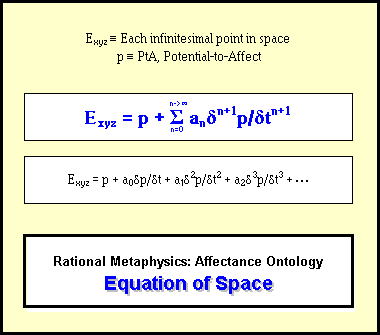
Unlike SRT, that equation from RM:AO has no alternative but to be objectively true.


Now that we know that SRT erred in at least that one way, let’s get back to your explanation as to why you think that the m-pov would measure the trains (f-pov and r-pov) changing location with respect to itself and what determines how much they change.

If the trains were to nearly instantly acquire their final velocity, would anything end up any different than very slowly acquiring that same velocity? Why or why not?
.
.

So there’s a spaceship at rest at (0,0,0). Another space ship coasts passed him at 100m/s. He keeps coasting for 10 seconds. How much distance does he gain from the first spaceship?

We have a formula for making such calculations: d = v x t.

That gives us: 100m/s x 10s = 1,000m.

Now you’re telling me that if we treat the second space ship as fixed and the first spaceship as moving in the opposite direction, we can’t use the same formula to calculate the distance he travels?

I’ve already explained this to you (but of course, by your own admission, you ignore half the things I say).

And strictly speaking, SR says that both twins will age slower relative to the other, not necessarily become younger.

That’s like a fish discovering H2O molecules and saying “Hey, space is really water!”

Exactly!

Only a rash mind like yours can jump from the thought of a physically existing space bending to solipsism.

Because they aren’t space.

I still don’t get how that would have implied that light travels at any other speed than c. Light fighting gravity means that it loses energy which manifests as a reduction in frequency, as I’ll repeat here for the 3rd time:

That’s like saying “space isn’t a dimension, it’s our measure of distance.”

Exactly!

I don’t know why change in each spatial dimensions needs its own separate time dimension, but having 3 temporal dimensions would give us 6 spacetime dimensions all together, and you want to say there isn’t even any more than 3.

Hey, you set yourself up for it. :smiley:

Have you gone completely senile?

∆t’ = ∆t * (1 - β²)^½
… is the equation we are talking about (or at least the one that I have been talking about again and again), having nothing at all to do with what you just argued.

I’ll take that as an acceptance that SRT was obviously flawed (yet still preached as though gospel).

Not that such wasn’t another dumb thing to say, but what does that have to do with my question:

Just remarking on your comment based on how you worded it: “One cannot merely reverse the pov and use the exact same equation”.

Oh, so ∆t’ = ∆t * (1 - β²)^½ is “special”.

You would.

I wasn’t answering your question. I was trying to get you to shut up about the whole light travelling at something other than c bit which you claim I said.

It is the one said to be able to be used equally by both parties. Yet if it is used equally by both parties, one of them will be conspicuously wrong. Calculating velocity and/or distance traveled isn’t the issue.

I wasn’t answering your question. I was trying to get you to shut up about the whole light traveling at something other than c bit which you claim I said.
[/quote]
Well, if you can’t answer that one, how about this one…

Given a specific light frequency and if the centered stop-clock (m-pov) is perhaps 1000 wavelengths away from both front (f-pov) and rear (r-pov), when the m-pov later measures the distance as longer, does your theory have those 1000 wavelengths stretching out to match the stretched space? Or do you just have more of them to fill the extra space? It seems that they would have to stretch with the space.
.
.

James, you’re just begging the question. You start out by assuming that there is one absolute reference frame, that there is an objectively right answer to the question “Who ages faster?” without recourse to a reference frame. And on that basis, you say Relativity is wrong because it posits more than one reference frame according to which more than one observer can be right. ← Do you see how circular that is?

But let me humour you for a second. That equation I brought up–the one for distance–is indeed a good example as it is based on the same principle as your time dilation equation.

You agreed that we can impose any arbitrary reference frame on space that we want, right? That means, in the scenario I described wherein we have a rocket ship coasting by another at 100m/s, you can very well can say that the one is stationary while the other is moving or visa-versa. Now, unless you deny that time dilation happens as a function of velocity (which I suspect you do), then it follows that as the one ship is coasting by at 100m/s, the other will age faster. But if the reference frame we choose is indeed arbitrary, then the same must be true of the other ship if we say the first one is stationary. You cannot say that time dilation really occurs only for one of the ships because that would be to deny that we can switch reference frames, and you said that we could.

This is why one of Einstein’s postulates was that “the laws of physics are the same in all reference frames.”

Well, first of all, the space doesn’t stretch. What I said was that the rear train accelerates at a slower rate relative to m-pov. This is because, being lower in the UUGF, time dilates slower for the rear train, and thus it slows down relative to m-pov (think of it in terms of bicycles: if the rear bicycle rider is time dilated slower, he will peddle slower, and so his propulsion will not be as much). Space doesn’t have to stretch for this to happen.

What’s happening with the light is that since time slows down for the rear train, so does the machinery of the light source. If you think of each light wave as a pulse emitted by the light source, then it follows from the light source slowing down that it’s pulses will be further apart in time. This means that the light it emits will have a lower frequency.

So if you visualize this, I guess it would fit your “stretching out” image (except it’s only the light that gets stretched out, not space).

Gib, you are aware of those who read emotion into posts when none or sometimes the opposite emotion was actually there, right? They do that because they can’t imagine the actual truth easily so they guess at what is going on in the other person’s mind. You see me as “begging the question” merely because you can’t understand or accept what is being said and thus guess at the only thing you can imagine. And the reason that you can imagine it so easily is that it is what you do yourself (Dorian Gray Syndrome - projecting your sins away from yourself).

The error in this one issue is not about objective or absolute frames. That has nothing to do with it. Every time, I have always allowed either frame to be used as long as the other is equally treated. You have not been doing that nearly so well. The actual error involved is one of contradiction. BOTH reference frames can’t be right at the same time. In the case of the Earth and the ship, because that problem has been hashed out for so long, we already know what the real answer is. But even without knowing which might be right, we can already know that they can’t BOTH be right. Thus we already know that the equation cannot be applied accurately to both, perhaps either, but certainly not both.

No it isn’t. But since you think that it is, why not just use the proper one? Why are you trying to slip in a different (and irrelevant) equation?

That little bit is you (again) being guilty of your own accusation. YOU are “begging the question” (again). We are arguing about whether you can switch frames concerning one particular equation. You offer the logic that because we can switch frames arbitrarily, it must be true that we can switch frames arbitrarily. I never said that we can SWITCH FRAMES ARBITRARILY. I said that you can arbitrarily CHOOSE ANY ONE COORDINATE SYSTEM as long as you STICK WITH THE ONE YOU CHOSE.

But if you then run across a contradiction in your own calculations, that means that you have done something wrong. A contradiction doesn’t mean that EITHER or BOTH are right. It means that at least one is wrong, possibly both. When you calculate that BOTH are aging faster than the other, you already know that you have done something wrong. The fact that you don’t know what is wrong yet, has no bearing on what is actually right.

That was his goal in coming up with proposed laws. But he didn’t make it. He guessed wrong.

And that is one of the many things that you have been absolutely wrong about. NO one in the physics field ever said what you are now claiming. That is entirely your own theory. And look at what you just said, "being lower in the UUGF, time dilates slower…". Don’t you remember us talking about a UNIFORM gravity field? And how there is actually no such thing? You are talking about a gravity field that is UN-uniform when you really shouldn’t be talking about one at all. There is no “lower in the field”, mostly because there is no gravity field at all, but also even if there was one, there could be no “lower in the field” if it was uniform. Uniform means that it has the same effect everywhere. There is no lower or higher in a uniform field.

Einstein’s comment was referring to merely a single item being treated as if that one item was in a gravity field that did not vary (which is close to being true). But you cannot presume a gravity field stretched over more than one item or not even one large item unless you have a true uniform gravity field which can never actually exist. And a uniform gravity field does not treat any one item any different than any other. That is why it must be “uniform” even though there isn’t such a thing.

But the bigger question is, why are you even talking about gravity at all?

The rear train is NOT “lower in a gravity field” and thus accelerating slower. That is just plain silly. And Einstein never said anything like that. If it really was accelerating slower then the s-pov would also reflect such an occurrence and the distance between the trains would change from that pov as well. You can’t arbitrarily stick a gravity field into your reasoning whenever it suits you and leave it out when it doesn’t.

And here you are “begging the question” again. The rear train’s time slows with respect to who? The center has the exact same treatment on it as the front and the rear. How can you justify one behaving differently than the others? Apparently you have imagined some magical gravity field involved such that the rear train has a different environment. The situation was already defined as both front and rear trains being in the same situation and being treated identically.

This goes all the way back to one of my first questions to you, “How does the rear train know that it is in the rear?”

So that answers the question that I had just asked, “there are the same 1000 waves, merely stretched out over the greater distance rather than more waves filling the greater distance”. And leads to the situation wherein both trains are feeding longer wavelengths to the center which is itself also time dilated just as much as the trains. And your claim is that the trains have “time-shifted” due to one accelerating more quickly than the other. They both end up at the same speed. The only proposed difference is that one got there sooner than the other, leaving a greater distance between them. And that is why I asked you that other question that you refused to answer;

But it seems that your issue involves some magic gravity field notion wherein light going in one direction has to “fight gravity” while not having to in the other direction. Which is a notion that you apparently acquired because it never dawned on you what a uniform gravity field means. If you are going to stick a gravity field in there, it must be UNIFORM. And that means that there is no “lower” or “higher” in the field. It is UNIFORM.

Or you can more wisely just leave out the entire notion of gravity and just accept the scenario that already states that the trains are given equal acceleration (regardless of why).

In physics what they are talking about is the fact that the accelerating object contracts and thus measures distances as longer than they were until he stops accelerating. Thus during acceleration, the train objects would measure the distances between the trains as longer than before. But that is only during the actual acceleration.

James, I didn’t want to go through a third round with you. The shear density of your inability to understand is irritating the hell out of me, and besides, everything you’ve said in this last post–literally everything–has been addressed before and shown to be a misunderstanding. If you really want answers to your questions, go back and read them. I’ve got better things to do with my time.

“Down” means further back, “up” means further forward. It has nothing to do with the strength of the gravitational field at different points, as I explained to you before, but with where things are in the gravitational field relative to something else.

And if that irritates you just wait until you discover that you were the one doing the misunderstanding.

So you are imagining a gravitational field in which a difference in location is important, but not a difference in strength?

If a gravitational field is ever found that has the same strength in all locations, then everything in that field will very uniformly accelerate. There would be no changing of relative locations between them because everything is being treated identically. Nothing would accelerate any slower than anything else in that field.

You really need to explain this magic “gravitational field” of yours where “down” means back, “up” means forward, “back” means slower, and “forward” means faster and yet all is uniform. The world of physics might be interested.


But assuming your magical acceleration field that separates the trains in the eyes of m-pov but not s-pov, you are left with the front timer firing a little early and the rear timer firing a little late? It seems to me that the one in front should be behind because it accelerate more, but it is your invention, so which one fires first?
.
.

Fuck you.

:laughing:

I warned you.
:laughing:

You had no chance of winning anyway.
No matter what kind of strange theory you believed, it wasn’t going to work. It takes me a while to figure out what each person has come to believe (such as Carleas and yourself), but in the end, you can’t make the SCP work with relativity.

Without the right emotional/religious balance, one simply cannot learn certain kinds of things. The heart guides the mind that guides the eyes into only narrow more safe fields of vision.

Ooooooh, that’s deep James.