Ooooooo, apparently too deep for you, but it’s hardly anything new. It’s often called being blinded by bias.
Hi to All,
In the station’s frame of reference the specific span of track is 20 meters long. Let v = .8c be the velocity of the train with respect to the station.
Then:
Statement 1: From the station’s reference frame, a measuring tape in the train’s reference system would measure that same span as 12 meters long.
Statement 2: From the train’s reference frame the measuring tape, again measuring that same specific span, is 33 – 1/3 meters long.
Are Statement 1 and Statement 2 mutually inconsistent? Why or why not?
What would be the consequence if the answers are different than above?
Ed
And thus, 0.8c is the velocity of the station and track with respect to the train.
??? You can’t reference both frames at the same time. The train’s tape represents the train’s frame.
The train’s tape would measure that track span as 12 (having nothing to do with the station’s reference frame).
And actually doesn’t the math work out to be 10 meters?
Emmm… length expansion?? Where did that come from?
Certainly. Statement 1 has stated the opposite of statement 2.
Perhaps you intended to say something a bit different?
Statement 1: From the station’s reference frame, a measuring tape on the train would be shorter and thus require a measure of 33.3 (or 40) on the tape to stretch over that span of track.
Statement 2: From the train’s frame of reference, that same tape measure would require only 12 (or 10) to stretch over that same span.
??
They are not.
I don’t know if they’re correct but they are not inconsistent. So long as you are talking about what is the case in two different reference frames, they are not inconsistent.
But as James pointed out, I think statement 2 is incorrect.
Nothing. It would still be consistent to talk about two apparently contradictory claims so long as they are held to be true in relation to two different reference frames.
No, 12:

You can so reference both frames at the same time–that is, in the same statement. All statement 1 amounts to is that from s-pov, you can predict what things would look like from m-pov.
Yeah, I was thinking of the standard v = 0.866c => 0.5v0, as used throughout most discussions (which yields 10m).
But statement 1 still doesn’t make sense.
Not sure I’m familiar with that standard but…
Perhaps you can flesh that out for me.
I’m thinking of it as similar to the statement: According to Sally, the Bible says that God created the world in 6 days.
That can be paraphrased as: In Sally’s reference frame, it is the case that in the Bible’s reference frame, God created the world in 6 days.
^^ There’s nothing inconsistent about that, is there?
It’s more like;
From Sally’s perspective, the Bible writers see her life as 0.0006 years.
Sally must fully see from the perspective of the other perspective - the station must fully see from the train’s perspective. So why even mention Sally or the station? If they fully see from the other perspective then just say what the other perspective is. Sally doesn’t actually know what the Bible’s perspective is (it is a different language using the same words). And the station doesn’t know what the train’s perspective is (it is a different measure using the same units of measure).
The intention is that Sally learn how to interpret the Bible into her own language and that the station learn how to interpret the train into the station’s own measure units.
Hi Gib,
While everyone on this post has screwed up from time to time, I generally agree with your comments and have been impressed with both your humility and personal growth over the years.
Ed
Hi James
James wrote:
There are always two reference frames, when talking about contractions. Typically the observer is said to be in a “rest” frame and that observer is trying to determine the coordinates in a moving frame.
A Side Comment on Notation:
Many times these two frames are referred to as S (the rest frame) and S’ the moving frame.
Smoot refers to the “rest” frame as the laboratory frame. I think this might be because no reference frame can actually be considered at rest.
The rest frame is typically, though not as universally as I would like, designated with the coordinates of x, y, z, t and the moving reference frame has its coordinates designated by x’, y’, z’ and t’.
You can see how this is classically setup at:
viewtopic.php?f=1&t=173286&p=2175197&hilit=Derivation+Lorentz+Transform#p2175197
It is largely taken from Robert Resnick’s text book on Special Relativity entitled “Introduction To Special Relativity” on pages 56 through 60.
In Statement 2 the rest frame is the train, and the moving reference frame is the station. The length in the moving frame, (x2’ – x1’) is 20 meters which we know from the setup. This means that (x2 – x1) must be 33-1/3. (33 – 1/3 x 3/5 = 20). We need to get a contraction in the moving frame.
Hopefully your comment about expansion will clear up after reflecting on this response, but I will comment further if you want me to.
Now about whether or not the statements are mutually contradictory.
To be logically contradictory, Statement 1 and Statement 2 would need to be of the form x = a AND x = b, where a and b are not equal, or some logical equivalent.
Consider the statements:
The tape in the train is 12 meters long.
The tape in the train is 33 – 1/3 meter long.
To me these statements are logically contradictory, but I cannot reconcile Statement 1 and Statement 2 to be of this form.
It is OK by me if Flannel Jesus, who has corrected both James and myself on the finer points of logic (actually not even that fine) to be an arbitrator.
What would be the consequence if the answers are different than above?
Originally, the Lorentz transforms were derived from 4 fundamental and absolute assumptions.
(If I recall correctly, Einstein originally considered calling his theory the Theory of Invariance).
The assumptions were:
“Empty” Space is homogeneous.
“Empty” Space is isotropic.
The laws of Physics are the same in every inertial reference frame.
The speed of light in a vacuum is constant for every reference frame.
Currently the Lorentz transforms can be derived without reference to the constancy of the speed of light. Additionally, the first and second assumptions need to be modified to add the stipulation that we are restricted to a macro space.
The derivation of the contractions from the Lorentz transforms is simple from substitutions and multiplications.
This means that if the contractions are not valid then at least one of the assumptions is not valid.
i.e. “Empty” macro Space is not homogeneous OR “Empty” macro Space is not isotropic OR the laws of Physics are not valid in all inertial reference frames.
In logical form:
If (A AND B AND C) imply Contractions then NOT Contractions implies NOT A OR NOT B OR NOT C.
NOTE: I know that James does not believe that macro “Empty” space is homogeneous but, in the pool of people that are knowledgeable about this subject, he is in a very small minority.
Ed, after our last exchange wherein you failed to defeat SRT properly with the Twins Paradox, I hoped you would be able to keep this stuff straight.
You have stated, improperly, that “The length in the moving frame, (x2’ – x1’) is 20 meters which we know from the setup”. That is not what your setup stated.
You stated that it is in the station’s frame that the track is 20m. So which is it?
You tend to reference everything as if you are seeing both stationary and moving frames from an absolute frame. I don’t mind that except when you are talking SRT.
In SRT, if viewing from the station, the train’s tape would seem to be only 12 meters long even though it read 20 meters. The tape would appear to have the wrong reading.
In SRT, if viewing from the train, its own tape does not appear incorrect. Instead, the track (or the station’s 20 meter tape) appears to be shorter than the station would have claimed. According to the train’s tape, the span of track is only 12 meters.
So according to SRT, neither of your statements make any sense. They both read the other as shorter than themselves.
The newer versions of relativity correct for that problem by declaring “Proper frames”.
A “Proper Frame” is a frame wherein the distance being measured is not in motion relative to the one measuring it. So the track is in the Proper frame with the Station (the S frame), but not with the Train. And the Train and its tape are in Proper Frame with the Train, but not the Station or track (the S’ frame). Since it is the track that you are asking about, the Station and track are the S frame, “Proper Frame”.
And that’s bullshit. Most don’t bother to think about it, but there isn’t a physicist alive who would argue with the fact that every tiniest bit of space is fill completely with random EMR. In QP they claim it to be a foam (ref L. Krauss).
Geez, James, I was only talking about whether Ed’s two statements were logically consistent or not. You may have some good points there, but I don’t think they say anything about whether Ed’s two statements are logically consistent or not.
Furthermore, what you’re saying simply isn’t true. If Sally says “The world was created in 6 days according to the Bible,” and then I say “According to Sally, the world was created in 6 days according to the Bible,” I am making a true statement, and it’s perfectly consistent with saying “…but I don’t think the world was created in 6 days.” You don’t have to fully embrace the other person’s perspective to say such things. Making statements about what’s true according to Sally or according to the Bible is perfectly possible and coherent because we aren’t necessarily talking about “the Truth”, we’re talking about what other people believe. It’s perfectly fine to talk about what other people believe, or how they perceive things, even if it clashes with your own beliefs and perceptions, because multiple and conflicting beliefs and perceptions can coexist in the same reality. I can say, “according to the train, the station measures 5 inches shorter than it does according to someone at the station,” because I don’t have to embrace the train’s perspective–I only have to see it as a perspective.
About what Sally knows, or what the train station knows, I’m in full agreement that they don’t know. I’m skeptical about the very coherency of the idea of knowledge itself, which is why I said earlier that I don’t think any scientific theory is ever perfectly accurate and flaw free, but that doesn’t stop us from following certain implications that follow from certain theories or arguments or lines of reasoning. Sally doesn’t know what the Bible’s perspective is, but she can speculate based on her current level of understanding–there is still logic there–and that’s often what we do–follow up on the logic of the ideas we currently understand and believe, however misunderstood or fallacious they might be.
Hi Ed,
Over the years?! Well, I guess that’s a compliment (thank you  ), but what are you measuring my growth by?
Well no. You asked me to explain what is wrong with your wording concerning Sally and statement 1. I explained that statement 1 referenced two perspectives at the same time by having the station interpret the train’s perspective.
The statements were mutually inconsistent, but I think for an unintended reason. Statement 1 was poorly worded such as to be ambiguous (I explained why) but concluded that the train’s tape would measure the span as 12m. Also statement 2 says that from the train’s perspective the same tape would measure the track length as longer, 33.3m.
According to SRT, the train’s tape would measure the span as 12m, not 33.3m (the track being a contracted moving object).
The only way the number 33.3m can arise is if the station viewed that tape and mentally stretched it out further to cover the whole 20m span. If the tape had read 20m, even though only appearing to be 12m long, the tape would have to read 33.3m in order to appear to stretch out over the entire distance. But the train observer stops the tape at 12m (not 20m), believing it to have already covered the distance. Thus the station observer has to mentally pull the tape out from 12m up to 33.3m in order to visualize it spanning the entire 20m distance. But that scenario is befitting of Statement 1 rather than statement 2 where it mentions the 33.3m distance. Ed seems to have the numbers backwards between statements 1 and 2.
And btw, that is why SRT relies on the relativity of simultaneity in claiming that the ends of the tape were not both aligned according to the station whereas they were, according to the train. The station doesn’t see the tape spanning the entire distance, but the train does.
Hi James,
Lengths from the point of view of the Train.
I did assume that x2’ – x1’ was still 20 meters. Wrong!
On the Twin paradox.
It is true that I failed to come up with a specific numerical evaluation during a traveling twin’s acceleration for a specific example. (This is very difficult for me). In my minority opinion, efforts to debunk the paradox have failed . The reason that these efforts to debunk the paradox have failed is because they do not account for the effects of Special Relativity during the acceleration periods.
Without accounting for the effects of Special Relativity the empirical observations of Muon decay and the Hafele – Keating experiment would fail to agree with current theory. The Hafele-Keating experiment is probably the main reason most people think that the Twin Paradox has been debunked.
All efforts (with the exception of The Hafele-Keating experiment), that include an analysis of the acceleration component, to debunk the Twin Paradox, to the best of my knowledge, fail to account for the effects of Special Relativity during those periods. The The Hafele-Keating experiment is dependent on the Earth’s gravity which is not part of the generalized Twin Paradox.
On homogeneous space
Perhaps I could have better phrased my comment about homogeneity.
In your opinion can we write?
x’ = a11x + a12y + a13z + a14t
y’ = a21x + a22y + a23z + a24t
z’ = a31x + a32y + a33z +a34t
t’ = a41zx + a42y + a43z + a44t,
where x’, y’, z’, and t’ are coordinates in any other inertial reference frame, and ai,j are constants
Do you believe that you hold a majority opinion?
Ed
P.S. I agree with your comment about EMR. (I also recognize that on distances that are greater than intergalactic there is some speculation as to the homogeneity of space).
Hi Gib,
My comment was intended to be a compliment. It is my opinion that since 2006, the way you see things has changed. (I know that my view of things has changed).
Ed
Yes. That is the primary failure of SRT. SRT doesn’t say anything about acceleration issues and proclaims that all motion is perspective-symmetric. But clearly it isn’t, else acceleration wouldn’t have anything to do with it. And acceleration makes all the difference.
Those kind of experiments actually don’t count. It isn’t much different than saying “But my Mom said that I was right!!” There is far too much involved in sub-atomic experimentation to be making any SRT claims due to the results they decide they got. And when the results do not support SRT, they simply don’t use that experiment and proclaim a different kind of mystery. They still don’t seem to understand what they didn’t understand about the exact make of particles 200 years ago. Thus they keep assuming that a particle must act this way or that, else some theory is bad. It isn’t that easy.
As long as they include the concern of acceleration (avoiding or canceling gravity issues), the Twin Paradox is easily resolved (as I was explaining in our last thread) simply because you know to whom to apply which equation (you dismiss perspective-symmetry - the basis of SRT).
And that actually debunks SRT in itself because SRT does not say that each perspective is dependent upon who accelerated but rather that it doesn’t matter, yet clearly it does matter.
That would depend on how you are using the matrix and what you mean by t and t’. The variable t’ might mean;
t’=
- “the time reading of the S’ clock by an S’ observer when the S’ clock is at location x,y,z” or
- “the time reading of the S’ clock by an S observer located at x,y,z”
Those are two conventions and one of those is used to falsely excuse SRT problems (as discussed on a thread long ago).
If time settings are Lorentz-synchronized, the interpretation 1 of those will be uniform for accurate analysis. Interpretation 2 implies that at every location, time is different for every observer and things get pointlessly complicated as the term “time” loses any meaning. Thus any time SRT gets into trouble, someone tries to use interpretation 2 as an escape through a portal of obfuscation. Apparently either interpretation is arbitrarily being taught in universities.
To me, there is no question that such span cannot be homogeneous at all and at times, very significantly variant. That is the issue of “dark matter/energy” (merely relatively denser space). An understanding of that issue also resolves the Double-Slit experiment.
I use the term “Affectance” to include all forms of EMR and matter (and for a reason). Space is merely low density affectance. Dark matter/energy is higher density affectance. And matter is extremely dense affectance.
And I use the equation below:
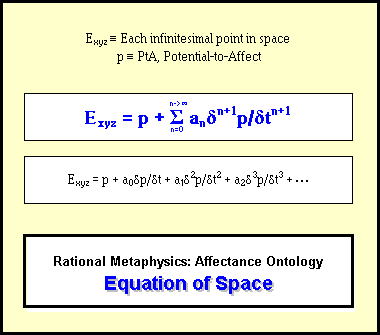
That one equation accounts for all gravity, EMR, mass, and time issues. Motion in space is caused by the change variables in that equation altering, which yields the effect known as relativity wherein observers measure events involving their own relative motion differently and must compensate with transformations similar to Lorentz.
Yeah, that’s about when I joined. I think I’ve definitely changed over the years.
I’m going to have to leave this thread in your hands–both of you–as I’ve got absolutely no time these days and probably won’t until sometime next week. Have fun!
non sense thread falling eternal replies to it
non sense thread falling , eternal replies to it
Hi James,
You wrote
Psychologically, I would prefer explanation 1, but I am pragmatic and will take what I can get. (I am assuming that you meant to write x’, y’, z’ in explanation 1).
You might note that at this point there is no reason to think that t’ cannot be interpreted in your explanation # 1. An absolute transform is still possible. For example the Galilean transform is still a possibility at this point.
As far as how far homogeneity extends, I just don’t know. I do know that from the perspective of General Relativity, if there are masses involved, space will no longer be homogeneous (At least from the perspective of a theoretical inertial reference frame.
Some time back I wrote the following:
I would like you to address this issue.
Thanks Ed
I was referring to your;
t’ = a41zx + a42y + a43z + a44t.
To me, interpretation 1 is the sane one, but we don’t live in a sane world.
Interpretation 1 is not saying that time depends on the position, but rather that given the subsequent position from an x0, due to velocity v, and an amount of time t, one can derive the time reading of an S’ clock, t’, that an S’ observer will see (assuming zero distance between himself and that clock).
Some people try to say that the x value is the distance from an S observer to an S’ clock and that merely because the S’ clock is located 20 meters away from an S observer and moving, t’ will reflect that 20 meters regardless of where it was at t = t’ = 0. In fact, they deny that t can ever equal t’ unless the S observer is sitting on the S’ clock. If I remember right, you don’t interpret that equation in that manner (which is good because it gets insane if you do).
If you are using the equation correctly, the x value represents the change in x from the S’ clock’s position when t = t’ = 0 (when they were originally synchronized). The equation that you provided works for that. And since the train is actually two independent trains, each with its own clock, the x value is the same for both of them at all times. There is an x1 for train 1 clock and x2 for train 2 clock (20 meters apart).
And then because the x, v, and t are the same for both trains, t’ must be the same for both trains as per;

Each train is first accelerated on different days from their prospective positions x1(0)=P1 and x2(0)=P3. On the third day, both trains are accelerated together which leaves the original 20 meters D3 = D4 and the S’ time reading for the clocks to also be the same t1’ = t2’.
An S observer at the station would not visually see the clocks properly due to the time it takes for the light to travel to him and might conclude that the train clocks (timers) are not in sync, but that is never the issue. What is needed is the x position when the timers are set to go off at t1’ and also t2’. Timer 1 should go off at 10 meters before the S clock (station) and Timer 2 should go off at 10 meters after that same point. And they must go off simultaneously according to the station clock.
And that means that the station clock must stop as seen in the UPPER portion of this anime;

Once light leaves its source it travels independently with the exception that it is continuously being absorbed and released by the molecular material along its path. It’s speed, however, does not depend on the speed at which its emitters had been moving at the moment the light was created.
The photons travel toward the station clock. The clock remains stationary with respect to the points in space at which the photons were generated. Since the photons move independently of other frames of reference, however, even the station clock is moving slightly relative to those points in space at which the photons were generated, simply because the earth is moving through space. However that minuscule amount of movement in the time it takes a photon to go 10 meters probably won’t throw off the clock’s position enough to cause it to fail to shut off.
The train is another story, because it is actively moving at a relatively greater speed out of the center at which the photons will mathematically impact each other. Remember, that center is already determined and will not vary no matter how the earth or the train or anything else are moving or were moving at the time the photons were created. Since we are assuming the train’s velocity is adequately fast to be a factor in the thought experiment, the train is therefore moving its clock out of the mathematical center between the two photons; while the photons are traveling from their creation points to their eventual meeting point the train is shifting its clock slightly out of that eventual meeting point.
Thus the train clock fails to shut off. But the station clock does shut off, again assuming the movement of the earth rotating and moving through space is not sufficient to cause the station clock to also shift out of the exact center at which the photons will eventually meet.
It all depends on how accurate the photon detectors are on the two clocks. If they are very accurate then neither clock will shut off. If they are accurate moderately or within the seeming scope of the thought experiment’s setup, then the station clock will shut off and the train clock will not shut off. If they are not very accurate at all then both clocks will shut off (because the train’s movement will not be fast enough to shift its own clock out of that mathematical center between both photons racing toward its clock).
“Stopped Clock “Paradox”” = destroyed. There is no “paradox” at all, except perhaps for the motives behind creating such a deliberately confusing and misleading scheme to represent the concepts of relative motion and of the constancy of the speed of light.
Hi James,
I should think your interpretation though more clearly, but here is what the equation means to me:
At any given time (after the train obtains its maximum velocity), in the station’s reference frame, we will call that time t0, the symbols v, c, and L (the Lorentz factor) are constant.
Since t0 is fixed (for this particular time) I will call that k1, and the quantity v/(c^2) is fixed, which we will call k2 then
t’ = (k1 – k2x)L
This says to me that t’ is determined by the position, x in the station’s reference frame. Since the clocks on the train are all at different positions, x, as viewed from the station, t’ will vary for each clock. They will always have different readings, as viewed from the station, once the train obtains its maximum velocity.
I know that you are only interested in the concept and not the technical details, but you should know that k2 is incredibly small. Even at .99c k2 is approximately 1/(3 x 10^8). In order to measure this, one should have a clock that is accurate, at least, to the one billionth of a second. An accuracy of 1 ten billionth of a second would be better for smaller velocities.
Basically, as I see it, the sandwich fell jelly side down.
I do not like my understanding, and I do think that it will lead to paradoxes. As I recall Farsight had one and as you know I still believe that the Twin paradox is legitimate.
But, if I were to quantify it, SRT gives good predictable results as long as the observer is in a preferred/ rest/ laboratory/ inertial frame. Under this particular condition, even relativistic mechanics yields good results.
However, reversing reference frames and looking at what goes on in from the point of view of the observed reference frame can lead to problems.
The problem becomes particularly acute when the answers are compared in what appears to be a single reality, or event, as the relativistic physicists would call it.
I think that I will give yet another rendition of the Twin paradox as an OP. This time I will stick to general concepts and try not to get bogged down in heavy detail. (You can tell me how radioactive decay cannot be used as a true clock).
Ed