The Patterns of Spacetime

Hi James,

Just a short note about the Wiki article on time dilation @ en.wikipedia.org/wiki/Time_dilation.

That article is possibly the worst article on science in all of Wiki.

Can you tell me what you think that the relationship between delta t’ and delta t is? For example is delta t’ less than delta t or is delta t less than delta t’? And what does delta t’ stand for and what does delta t stand for?

Many very intelligent people are screwed up by this extremely misleading article. Additionally, I think that the derivation is outright false. In particular I think that they only proved that 0 =0 L.

I will have more on a reference frame located at x = 100 and t = 0 later.

Ed

Oh, I wouldn’t bet on that. Like you, I have found definitive errors on Wiki, although the ones that I get upset about are usually about logic rather than merely math, such as their attempt to prove that “1 = 0.999…”. Their logic proofs for that are entirely invalid.

That is a common and understandable confusion. It is an issue of their definitions vs older standards.

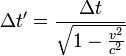
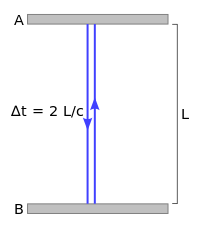
Δt = t1 - t0, the change in inertial time reading, not the time reading itself, for an inertial clock (an S clock) during a light travel event (the non-moving Lorentz-Einstein parallel-mirror clock).

and
Δt’ = t1’ - t0’, the inertial clock’s change in time reading during the same light travel event as in Δt (the same S clock) but assuming that the light source was moving laterally.

It is a simple issue of geometry as to which will be larger. And I see no error in their derivation. Δt’ will always be larger than Δt.

The confusion comes in because Δt’ is NOT the time-difference or time-dilation factor between a stationary clock vs the moving clock. It is actually the inverse of the time-dilation because it is premised that the moving clock will read the same amount of time change during the event as the inertial clock would have read (Δt) if there was no movement. And that means that the moving clock will have to be turning slower, else it would read that more time had passed, violating the very premise of SRT. It would read the Δt’ change rather than the Δt change.

The longer distance D must yield the same time duration on the moving clock as the shorter distance L does on the non-moving clock. That requires that the moving clock turn slower.

So to sum it up;
The value of Δt’ will always be larger than Δt. And that means that the relative speed of the moving clock (whichever you choose to call “moving”) will always be slower.

For example;

If Δt’ = 1.5
the moving clock would be running 1/1.5 as fast as the non-moving clock.
Time Dilation Factor = 0.6667

And that means that if the station’s clock said that 10 secs had passed, the train’s clock would say that only 6.667secs has passed - no matter where the train is located at the time. The time dilation has nothing at all to do with where the moving object is located relative to a stationary object (the x value is irrelevant).

Thus their equation;

is exactly correct, given their premises.

You just have to realize that the Time-Dilation-Factor will be 1/Δt’ .

The equations that you are using are for calculating the time-reading (not the time-dilation) assuming that the clocks were initialized at the same location (which in the SCP, they are NOT).

Hi James,

Good for you! Most people might think that delta t’ is time duration in the moving reference frame. Then delta t’ = (delta t)L would claim that the moving clock is running faster than the clock in the proper reference frame.

On .999…

Almost every mathematician from high school students, to collegiate students studying limits, to graduate students studying Real Analysis thinks that .999… = 1.

The only logical exceptions might be the constructivists like L.E.J. Brouwer. But I am not even certain that they could logically object.

You can count me with the group of people that think that .999… = 1.

Some simple questions:

Do you think that .999… is a number?
Do you think that .333… = 1/3?
Do you think that if 0 < a < 1, the limit ,as n goes to infinity, of the sum, from i = 1 to n, of (1/a)^(i-1) = 1/(1-a)? (This is something that all high school students who have taken Algebra II are taught).

On the clock times versus time duration

We are both watching a movie. I like the cinematography and you like the plot. My cinematography is based on the Lorentz transform and your plot is based on the inverse transform. The birds are in the sky, the sun is shinning and all is right with the world.

Ed

The counter proof is pretty easy but it involves a touch of ontology, thus mathematicians and their students are clueless.

The limit as 0.999… approaches its infinite resolve is 1.00
The limit as 0.333… approaches its infinite resolve is 1/3
But they never reach their limit (by the definition of “infinite” ≡ “limitless).
Why do you think they keep saying “the limit as x approaches infinity” rather than merely saying “when x reaches infinity”? If anything could ever reach infinity, 0.999… would equal 1.000. But in that case, infinity would not be infinite.

The issue is that “unbound numbers” are not equal to “bound numbers” - for a reason (and by definition). In fact, unbound numbers aren’t really numbers, given that a number is a fixed/countable quantity (thus “bound”).

Realize that the resolve of 0.999… is never reached (by the definition of “infinite” or “…”). In order to get 0.999… to equal 1.000, one must add a [0.000…1] ≡ 1 infinitesimal.

0.999… is defined as being one infinitesimal less than 1.000. Mathematicians have unwittingly declared that an infinitesimal doesn’t exist (no doubt as part of the Quantum Magi’s social effort to dismiss all notions of infinity).

Well, perhaps … perhaps not.

Now (re)answer these questions, please;

If “all is right with the world”, you will see that TC1 = TC2 at all times.
And then we can get back to the SCP issue.

Hi James,

To answer your questions:

t measures the amount of time that passes in the Proper Reference Frame. It is calibrated relative to a specific moving Reference frame, such as the train, so that at x = 0 and t = 0 then t’ = 0. It is possible to talk about another clock in the Proper Reference frame that is located at a different location. And as long as that clock is not moving with respect to the first clock then the clocks can be calibrated to read the same over time. I.e. SC1 = SC2.

This is not the case with the moving clocks. Once the clocks start moving t’ will always depend on x, therefore TC1 will never equal TC2.

More formally:

Claim: At any given time, t, if x1 is not equal to x2 then t’1 is not equal to t’2.

Assume not:

Then for all t, in the Proper Reference Frame, such that t1’ = (t – (v/c^2)x1)L and t2’ = (t – (v/c^2)x2)L where x1 is not equal to x2, t1’ = t2’

Because t1’ = t2’ by substitution, we must have (t – (v/c^2)x1)L = (t – (v/c^2)x2)L. Dividing both sides by L (Note L is never equal to 0 because v < c) we get:

t – (v/c^2)x1 = t – (v/c^2)x2.

Subtracting t from both sides and multiplying both sides by -1 we get:

(v/c^2)x1 = (v/c^2)x2.

Dividing both sides by the quantity (v/c^2) we get:

x1 = x2.

This is a contradiction of our assumption that x1 is not equal to x2.

Note: the Proper reference frame to test the Stopped Clock Paradox:

Since the Stopped Clock Paradox relies on a test taking place at x = 0 in the Station’s reference frame, the correct place to view the experiment is at the Station’s origin (x = 0).

The test is done when the first clock is equidistance from the second clock as viewed from the station’s origin (x =0).

Assuming that the clocks are 20 meters apart this means that the first clock is at -10 meters and the second clock is at +10 meters as measured in the station’s reference frame.

We will designate the leading clock as TC1 (= t’), which will be determined by the coordinates (x1, t1) in the Station’s Reference Frame.

Since the train is traveling at -.8c (or -239833966.4 meters/second) then, in the station’s reference frame we have a time t1 given by the equation t1 = x1/v. For the first clock, t1 = -10/-.8c or t1 = 10/239833966.4 and thus we get:

t1 = .000000042. Expressed in scientific notation t1 = 4.2 X 10^-8

Similarly, at x2 = 10 we get t2 = 10/-.8c = 10/-239833966.4 or t2 = -.000000042

We know directly from the Lorentz transforms that t’ (The clock you referenced as TC1) = (t – (v/c^2x)L where L is the Lorentz factor (in this case 5/3).

Thus TC1 = (.000000042 – (-.8/c)(-10))L = (.000000042 – 000000267)L = -.000000225L.

Thus TC1 = -.000000225L. Or TC1 = -.000000375

Applying the same formula t’ = (t –(v/c^2)x)L to t = t2 and x = x2 we get:

TC2 = t2’ = (t2 – (-.8/c)x)L = (-.000000042 – (-.8/c)10)L = (-.000000042 + .000000267)L.

Now TC2 = ( .000000225)L = .000000375. Thus TC2 = .000000375.

So TC1 = -.000000375 and TC2 = +.000000375. Therefore the clocks are not equal and the Station’s test will fail. (The testing clock will not stop).

What would happen if the clocks were reset during the inertial motion? i.e. Someone just changed the TC2 clock to read the same as the TC1 clock when x = 100 meters

I am here assuming that someone could reset TC2 so that it is equal to TC1 while the train is moving. (This might not be feasible in real life, but it is fun to speculate).

Setting x = 100 and t = -.0000004169551 we get TC1 = -.0000002501731.
Setting x = 120 and t = -.0000004169551 (measuring at the same time in the Station’s Reference frame) we get TC2 =-.0000001612226.

Setting the Offset = TC1 – TC2, we get Offset = -.0000000889504.

Then if we add TC2 + Offset we get TC1.

Now let’s see if we can always add the same offset to TC2 in order to get the clocks to match.

Now let’s look at what happens when the train is .01 seconds away.

x = -2,398,339.66 t = .01.

Then TC1 = .006 and TC2 found at x = -2398339.66 and we what to measure at the same time so t =.01. This means that TC2 =.01.

But TC2 + Offset = .0099999110496.

Since TC1 = .006 we see that TC2 + Offset is not equal to TC1.

The Offset will continue to change over different positions.

This means that the Stopped clock paradox will never be right.

Recapping:

If we assume that space is Homogeneous, space is Isotropic and the laws of physics are the same in all inertial reference frames, then the Lorentz transforms are the logical consequence.

This means that t’ (the time dimension in the moving reference frame) can be determined by the equation:

t’ = (t –(v/c^2)x)L, where L is the Lorentz factor.

Here x and t are the coordinates in the Station’s Reference frame.

A General solution for those wanting to play with various scenarios:

To avoid problems with arithmetic one can setup a spreadsheet. There are a number of ways to do this, but the following should work:

I will start at A4 (leaving room forappropriate captioning in the rows above.

Set cell A 4 = c. Set cell B4 = v. Set cell C4 = Lorentz factor. Set cell D4 = x. Set cell E4 = t. Set F4 = Traveling Clock
Set cell A5 = 299792458 and format cell as a number.
Format cell B5 as a number with 13 digits after the decimal place. Note cell B5 is a number like -.8, or .5 or .99. In our case v should be -.8

Set C5 = 1/(SQRT(1- (B5*B5))). Format cell C5 as a number with 13 digits after the decimal point.

Format D5 as a number with 13 digits after the decimal point.

Format E5 as a number with 13 digits after the decimal point.

Set F5 = (E5 – (B5*D5)/A5))*C5 Format cell C5 as a number with 13 digits after the decimal point.

Special Notes for above:

While this formula will give corresponding times, ‘t, in the moving Reference Frames for any coordinates (x, t) in the Proper Reference frame.

In order to find the times for the clocks on the train you need to first write x = (-.8c)t and determine x if you know t. If you know x then you find t using the equation t = x/(-.8c) .

Ed
I have been telling James this for years, Ed. He’s not having it. It’s like trying to talk to a rock with this guy.

I told him: James, t’ will always depend on x, therefore TC1 will never equal TC2 once the clocks start moving. I told him about the Lorentz transforms (I practically did the math for him), I showed him the cell setting solutions, and I even explained how the Offset will continue to change.

James, I hope you’re happy because I’m sure Ed3 has better things to do than explain something to a sharp lad like yourself who should already understand all this.

Hi Zoot,

It is nice to see you again. And you are right about my time. I hope you have some fun!

Ed

Wait! Ed, I was kidding man. You didn’t really believe me, did you? I haven’t been telling James anything for years… I…I just met the guy… and if I had been telling him anything for years, it sure as hell wouldn’t be any of that stuff.

Look, I didn’t mean bother you man. Just forget I said anything.

James if Ed3 leaves this thread because of my behavior, I accept full responsibility and I apologize.

It’s like every hour is comedy hour with me or something.

So what? It takes only two weeks for you to forget our entire conversation?

1)Again, realize that you cannot dictate which is moving and which isn’t. So if SC1 = SC2, it is already necessary that TC1=TC2, else you break the very foundational premise of SRT - that there is no privileged frame.

2)
Because we initialized the train clock to 0 when the train was far away, your equation;

[b]t’ = (t – (v/c^2)x)L

does not apply.[/b]

3)
You fail to understand that the x variable is merely the location where a clock will be at a particular time assuming that it was initialized with t=0 and t’=0 at x=0, which is not the SCP scenario.

4)

Negative time reading??? No clock can have a negative reading.
You have one train clock running backwards.

And assuming the train didn’t stop, shortly both clocks would be running backwards.

If you are going to use an excel sheet, realize that both clocks TC1 and TC2 must begin at 0 and count upward. And if you do it right, they will both count upward exactly together.

Dilation TC1_TC2.png

Hi James,

The best laid plans… :

In an effort to free us from the trivialities and travails of doing basic arithmetic I thought that we should work these calculations out in Excel.

However, when my Excel spreadsheet subtracted BN* DN/AN from EN, where BN = -.8, DN=-10, AN = 299,792,458 and EN = .000000416955, it came up with the answer of .000000150104 when it should be .0000003902699. All I can think of is that it cannot deal well with long strings of decimals. It could be that I have not properly formatted the cells, but I don’t know.

In any case, the clocks TC1 and TC2 as they are read from the Station’s reference frame should be:
TC1 = .000000650450 and TC2 = .000000739400. I have verified this 3 different ways – but who knows.

Your comment number 1 is true.

However, we always chose a “Rest/Proper/Laboratory frame” from which to do measurements. In this case, since the test is at the origin of the station, I think that the best place for the “Rest/Proper/Laboratory frame” is at that point (it is where the clock that is supposed to stop is placed).

Other reference frames will give you different numbers for TC1 and TC2 which will not, generally, match what the calibrated station clock reads.

Your comment number 2 is correct.

Again, different “Rest/Proper/Laboratory” frames will, generally, give different answers for TC1 and TC2. (This is why having more eyes on the event is pointless).

However, since you want to look at the problem away from the test point, (which IMHO is foolish because the test results will not match), I will oblige you.

Let’s setup a new reference frame which we will call I (for the initial frame). Cartesian coordinate system will be oriented in such a manner that its x axis corresponds to the station’s track or x axis. We assume that I is not moving relative to the station. Now we will designate the coordinates in the I reference frame.

We will let s = x – 100. We will let u = t + .000000416955.
Then at x = 100 we will have s = 0 (The position of the first clock and where the clocks are synchronized). We also have that at t = -.000000416955, u = -.000000416955 + .000000416955 = 0.

Now the reference frame I is setup so that, at s = 0 and t=0, the train will be located at the origin, of the I reference frame, and ti’ (the time of the first clock) on the soon to be moving train = 0. We will assume that TC2 is also 0 since the train is not yet moving.
Once the train begins to move we will need to be sure that v, as measured in the I reference frame, is the same as v in the Station’s reference frame.

v in the I reference frame is (s2 – s1)/(u2 – u1). But by substitution (s2 – s1) = (x2 - 100) – (x1 – 100). But (x2 – 100) – (x1 – 100) = (x2 – x1). Plugging (x2 – x1) into the first equation we get :

v in the I reference frame = (x2 - x1)/ (u2 –u1).

But (u2 – u1) = ((t2 + .000000416955 – (t1 + .000000416955)) = (t2 –t1). Substituting (t2 – t1) for (U2 – u1) gives us v in the I reference frame is equal to (x2 – x1)/(t2 – t1). This is the definition of the velocity in the Station Reference frame. Therefore velocity as measured in the I reference frame is equal to v as measured in the Station reference frame.

These are the conditions required for the use of the Lorentz transform and we must have:

TC1 = ti’ = (u – (v/c^2)s)L.

Now let’s look at what happens when the train is located at x = -10 meters. Since s = x – 100, s =-110.
Similarly, since u = s/-.8c, u = -110/-239833966.4 = .0000004586506.

Now we will plug s = -110 and u = .000000458651 into the Lorentz time equation to get:

TC1 =ti’ = (.0000004586506 –(-.8/c)(-110))L. This means that TC1 = ti’ = (.0000004586506 - .0000002935364)L. Adding the numbers inside the parentheses and multiplying by L (5/3) we get:

TC1 = ti’ = .000000275190.

TC2 = ti’2 = (.0000004586506 – (-.8/c)(-90))L. This means TC2 = ti’2 = (.0000004586506 - .0000002401661)L. Adding the numbers inside the parentheses and multiplying by L (5/3) we get:

TC2 = ti’2 = .0000003641408

Thus, in the I reference frame at s = -110 and u = .0000004586506, TC1 = .000000271904 and at s = -90 and u = .0000004586506 we get:

TC1 = .000000271904 and TC2 = .0000003641408.

However, in the station’s reference frame, where the clock is set to 0 when the train is at the origin, we get:

TC1 = .0000000650450 and TC2 = .0000000739400.

Both Reference frames read a different time for TC1 and TC2.

Again the only reference frame that counts is the reference frame where the test takes place!!!

With regard to point 3:

I understand everything up to the comment:

If TC1 is never equal to TC2, as viewed by either the station reference frame or the Initial reference frame, how can the test clock stop?

With regard to point 4:

In general the time t = 0 can be set to calibrate with any event. Typically clocks are calibrated to important events like robbing a bank, or the birth of Jesus, or the final score in a hockey game, or the time a rocket blasts off. Things that happen before that time correspond to negative numbers.

When I setup the Station’s Reference frame, I set the time t = 0 to correspond to the time when the train’s first clock was at x = 0. Thus any time, t, during which the train had not reached the station, t is negative time.

Comments about your chart:

You are showing that at any given time, t, TC1 and TC2 are NOT equal. Do you really want to show that?

You are also showing that for the first 3 seconds TC2 is undetermined. I assumed that TC2 was set to 0 at t =0.

Does that mean that for the first four seconds v = 0?

A couple of small quibbles:

  1. Originally the distance between the clocks, as measured in the Station’s reference frame, was 20 meters. Now it appears that you want the distance to be 40 meters.
  2. It is Ok by me if delta t’ = .6(delta t), but technically you should not say that LF = .6. LF = 5/3 and .6 is the reciprocal of LF. But I am not objecting to your general analysis.

Ed

Ed, it looks like I have to tell the story all over again. My X numbers were not in meters. In fact, they weren’t even used because they were irrelevant. But now I will make them relevant just for you.

In that Excel sheet, SC1 and X are not actually associated, although obviously they can be taken that way by the casual observer. The station clock isn’t changing it’s X position so every second of its time would have to appear at the same X location. I just showed SC1 because of its relation to TC1. But the same columns can’t be used to associate it with TC2 because they are all at t=0 at the same moment.

So okay, see if you can follow this;

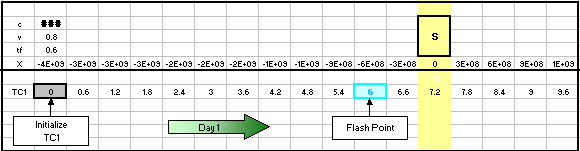
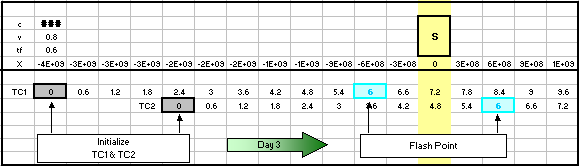
First day, John runs his relativity train TC1 at 0.8c and has the train’s clock stamp its time reading onto the track as soon as the train’s clock reads 6.0. He starts the train back 3597509496m from the station and presses the instant acceleration button which initializes the train’s clock and instantly accelerates the train up to speed. The train is instantly going 0.8c while it approaches the station. He had predicted the following situation and discovered that exactly 599584916m down the track there was indeed a little number “6.0” stamped onto the track.
TC1 Day 1.png

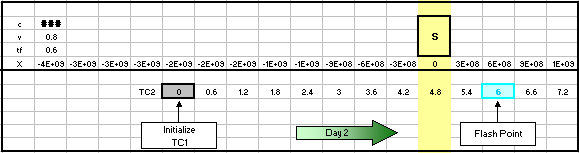
He was all happy that his calculations worked out. But then a friend told him that time was relative and dependent upon how far from his station the train started. That made him wonder what would happen if the train had started a little closer. So the next day, he ran the exact same experiment again but started another train TC2 only 2398339664m back down the track. Again he discovered that his calculations seem to work out fine.
TC2 Day 2.png

He was then satisfied that it didn’t matter how far down the track a train started as long as everything else was the same. But then his friend mentioned something about length contraction between two objects as they travel. So again, being curious he set it all up again but this time with two trains, TC1 and also TC2 and both to start at the same positions they had before. He wanted to see if the distance between them changed because of them going so fast.
SCP Day 3.png

He discovered that if they started 1199169832m apart, when each of their clocks read 6.0, they were still 1199169832m apart as was indicated by the marks on the track.

Now Ed, apply which ever equations you want to each of those days and explain why your equations would indicate anything different.

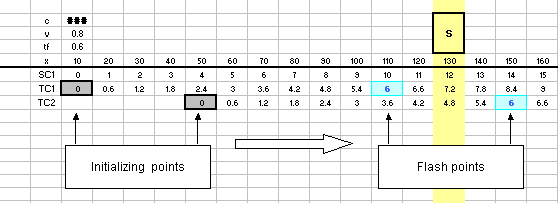
All of that is what this picture has been all about but without the need for instant acceleration;

Hi James,

What would you like as the “Rest/Proper/Laboratory” reference frame? I think it is obvious that we should chose the Station’s frame at x = 0, t = 0 where x’ = 0 and t’ = 0. But if you want another reference frame (IMHO inappropriate) I can go with I, the Initial Reference Frame.

I don’t know why you would mark the track with the image 6. Even if this can be done in some practical way, the stamped t’ will not be t’ in either I (the initializing reference frame) or at the station’s reference frame. A proof of which, I can provide if you wish.

It seems to me that you believe that there is an actual fixed value for t’ e.g. t’ = 6 without regard to reference frame. This concept is inconsistent with the Special Theory of Relativity and cannot be used to prove a paradox of the theory.

Ed

You can choose whichever you want. I agree that the simpler case is for the station to be the chosen proper frame at observational rest. But there is an issue with setting x = 0, x’ = 0, and also t’=0. Those together don’t fit the scenario.

This is the scenario:

The station, S is at X=0.
At t=0, TC1 is not at x=0.
At t=0, TC1 is at -3597509496m.
And that is the point where TC1 is initialized, t’=0, t=0, x= -3597509496m.
The “6” is the actual TC1 clock reading in seconds, “Flash Point”.

And on the next day TC2 is initialized at t’=0, t=0, x= -2398339664m.

If you don’t believe that TC1 would be actually reading 6.0s at x= -599584916m, use those settings and show the math. The TC1 clock has a reading at that point in space (one and only one reading). The scenario merely states that whatever that reading is, will be stamped onto the track.

This is crazy… the whole point being argued here is whether or not simultaneity can be true for one observer but not another observer for the same event.

This means, that if true, an event is both simultaneous and not simultaneous at the same time for both observers, which still leaves you with simultaneity, which leaves you with an absolute reference frame. If it solves as an event being both simultaneous and not simultaneous for both observers at the same time and not at the same time… then this discussion reduces to the absurd.

Take your pick.

How this went on for some odd pages I don’t even know, the mental gymnastics is unnecessary.

Hi James,

For a setup that I hope meets your criterion we could use the following:

Day 1: t = -20 & x = -4,796,679,328. Here x’ = 0 and t’ = -12.00
After 14 seconds, t = - 6 & x = -1,439,003,798.4. Here x’ = 0 t =-3.60

Day 2: t = -8 & x = -1,918,671,731.2. Here x’ =0 & t’ = -4.8
After 14 seconds, t = 6 & x = 1,439,003,798.4. Here x’ = 0 & t’ = 3.60.

Now we could setup a train where x = 0 is the center of the train and there were clocks at:
The front of the train x = 1,439,003,798.4 and at the end of the train x = -1,439,003,798.4.

This train could start at t = -14 with the center of the train located at x = -3,357,675,529.6.

Then, at t = 0, x =0. From the Lorentz transform x’ = 0 and t’ = 0.
The front clock would be located at x = 1,439,003,798.4 and the back clock would be located at
x = -1,439,003,798.4.

Again from the transforms t’ = (t – (.8cx/c^2))L . Or t’ = (0 - .8(1,439,003,798.4)/299792458))L.
We must have t’ = -6.4 for the front clock and t’ = 6.4 for the back clock.

The “stopped clock” will not stop.

You also cannot simply read the clock on the train and send that reading out to the stations’ frame of reference because the inverse transforms will show that t = (t’ + vx’/c^2)L. That is to say that time, in the station’s frame of reference, is a function of both time and position in the train’s reference frame. For a given t’, there are 2 different x’s and thus t will vary for each clock.

Ed

Hi Ecmandu

The situation is surprisingly simple.

There is the observer and the observed. The observer is taken to be in an inertial reference frame which is denoted by any of the following:

The Rest frame
The Proper frame
The laboratory frame.

Generally his coordinate system is denoted by the unprimed variables x, y, z, t.

What he wants to do is to relate his variables to the variables is a moving reference frame. These variables are generally denoted by the terms x’, y’ z’, t’

It turns out that by assuming that space is homogeneous, isotropic and that the laws of physics are the same in both reference frames the Lorentz transforms are valid.

Now any point (x,t) can be mapped to the corresponding point (x’, t’) by the function F. (Here F is best represented by a matrix whose elements correspond to the coefficients of the Lorentz transform.

Now there are only two times to be considered. i.e. t and t’.

The question is can t ever equal t’? In the trivial case, at the setup, the answer is yes. i.e. if x =0 and t =0 then x’ = 0 and t’ = 0. However generally the answer is no, because the specific equations for F require that t’ depends on the location for x. In addition there is the Lorentz factor which is not equal to 1 unless the observed reference frame is not moving.

Ed

That’s fine, but my point was… what if both people know about relativity? Assuming your even correct, both of them knowing about relativity causes an absolute reference frame.

That has been the point of relativity objectors for very many years. Basically, Einstein said,
“Because we are such extreme selfish idiots, we can all assume the following…”

And he was proven right, they really were such extreme idiots. And now Ed3 is trying to prove it once again.

Seriously?
Are you trying to be insulting or is it just coming out that way?

I say, “this is my scenario. Now apply your equations…

Then you say, "this completely different scenario is what you propose, so let me use it instead…"

In case you didn’t notice, each spreadsheet column represented one second of “proper” time at the speed of light, which means that each column represented 299,792,458 meters.

And, at x = -3597509496, both t and t’ = 0 because that is where both were initialized.

Thus further back, to the left, 16 columns back from the station is where your;
x = -4,796,679,328m and [size=150] t = -4[/size], NOT t = -20 (and t’ = -2.4).

So where did you get that t = -20 while x = -4,796,679,328 has anything at all to do with my scenario???

So you are saying that your interpretation of mathematics declares that it is physically impossible for a moving train to stamp a clock’s time reading onto a non-moving track???

Come on Ed. Surely you know better than that. Isn’t it more likely that you are misinterpreting the mathematics?

That is a direct contradiction to your own equations;
x’ = (x – vt)*L
y’ = y
z’ = z, and
t’ = (t – (v/c^2)x)L
t’ can only have one x or x’.

Ed, given up yet? :sunglasses:

Hi James,

The “stopped” clock will not stop.

The clocks on the train are placed in two different positions x1 and x2 (the two x’s – my wife says that I can be obtuse), as measured in the station’s reference frame.

This means that, –vx1/c^2 is different than - vx2/c^2, and t – vx1/c^2 is different than t – vx2/c^2, and (t – vx1/c^2)L is different than (t-vx2/c^2)L.

Since t1’ = (t –vx1/c^2)L and t2’ = (t – vx2/c^2)L, where t1’ is the time on one of the moving clocks that will be read at the station and t2’ is the time on the other moving clock as read by the station, the clocks (as seen at the origin of the station) will never be equal.

Because the test is done in the station’s reference frame, this is the end of the story.

Trying to explain to me what is seen by anyone in the moving station is pointless as their clocks will now be in the new “Proper/Rest/Laboratory” reference frame. The times in the new reference frame will not match the times in the station’s reference frame or the station’s observed reference frame. (You know the equations and you can figure this out for yourself).

Ed

P.S. Do not expect a quick response, if one at all. I am in the process of buying both a new home and another company, and frankly these things are more important.

There are two “stop-clocks”. I assume that you mean the station’s stop-clock won’t stop.

But I asked for you to apply your equations to the exact scenario. Since you didn’t, I have to also assume that you tried it and it didn’t work.

I refers to those as “timers” rather than “clocks” just to help keep it straight because there is also a stop-clock centered between those two timers.

And that is where you are misunderstanding the math and why you can’t get your equations to workout. Do you want to get that straightened out or not?

Surely you understand that I could set each timer to anything I like, regardless of the x distance. So certainly I could cause them to go off simultaneously with respect to the station, with or without relativity issues. If I needed one timer to be a little earlier, I could easily just set a little earlier than the other. It’s nonsense to think that is impossible to do.

That is why your equations can’t be used. What I set the timers to is irrelevant to the x distance.

You are conflating “the time” with “the time reading on a clock”.

Every clock in each position it finds itself in has a time READING. That reading is the same for all reference frames for that one clock in that one position (discounting the extra time it takes for sight of the clock to get to the observer, who might be standing anywhere). That is why I have the train in this scenario stamp the time reading onto the track, so as to verify the time READING, moving or not.

And now you are making me wonder what you do for a living. :sunglasses: