Dear Xtians (= those who call themselves “Christians”, e.g. @reason4emotion ), please can you comment on the following [sorry, l’m just asking Xtians, and please, no computer gamers e.g. RealUn/Mary_Poppins/Socrates ]
What do you think of / do you obey the following:
PREAMBLE - THE EASIER STUFF
-
Christianity forbids a woman discussing theology without her head covered:
"every woman who prays or prophesies with her head uncovered dishonours her head - it is just as though her head were shaved. If a woman does not cover her head, she should have her hair cut off; and if it is a disgrace for a woman to have her hair cut off or shaved off, she should cover her head. (I Corinthians 11:3-10). -
Ephesians 5:22 "Wives, submit to your own husbands, as to the Lord. 23 For the husband is head of the wife, as also Christ is head of the church; and He is the Savior of the body. 24 Therefore, just as the church is subject to Christ, so let the wives be to their own husbands in everything. "
-
Job 37:18 invites to join God
“can you join him in spreading out the skies, hard as a mirror of cast bronze?”
This reflects the Hellenistic beliefs of the time, that the sky was a metal mirror. -
Regarding the Marriage of Mary to Joseph, Catholic Encyclopaedia ( CATHOLIC ENCYCLOPEDIA: St. Joseph), says:
“Mary, then twelve to fourteen years of age, Joseph, who was at the time ninety years old, went up to Jerusalem among the candidates; a miracle manifested the choice God had made of Joseph”
Would you have any reason to doubt the Catholic version? Why would it be wrong?
Do you feel it’s fair for Xtians to condemn the Prophet Muhammad (the blessings of Allah be upon him, and Peace) for marrying Lady 'Aisha under her father’s auspices when she was 9 years old? She had already been engaged to a pagan, the engagement had to be broken off. Nobody condemned the Prophet for this until circa the late 1900s, prominently the 1990s, by which time the 11 year old prostitutes of European cities had been conveniently criminalised to pave the way for self righteous anachronistic hate against Islam. The age of consent in the Talmud is 3 years and 1 day.
- The Christian attitude seems to be handwringing and soulwrenching for blasphemers and rude people … but cold contempt for Muslims who pray and fast, call you “sister”, reverence Lady Mary (may Allah be pleased with her) at least as much as you do, their women dress like her, Muslims believe in the Virgin Birth, the Messiahship of Christ, the Ascension and the Second Coming, etc.
It seems like you find greater affinity for outright haters of you than for those nearer to you in faith.
THE “COMFORTER” PREDICTED BY JESUS (Peace Be Upon Him):
REGARDING MOSES (Peace Be Upon Him) CONFRONTING THE PHARAOH, THE QUR’AN EXCELS THE BIBLE IN HISTORICAL ACCURACY, REVEALING THE BIBLE TO BE TAMPER-EVIDENT:
The source for most of this (l highly recommend watching the entire video, it has convincing CGI graphics of the Pharaoh, very close to what he would have looked like, according to my gut feeling, terrifying):
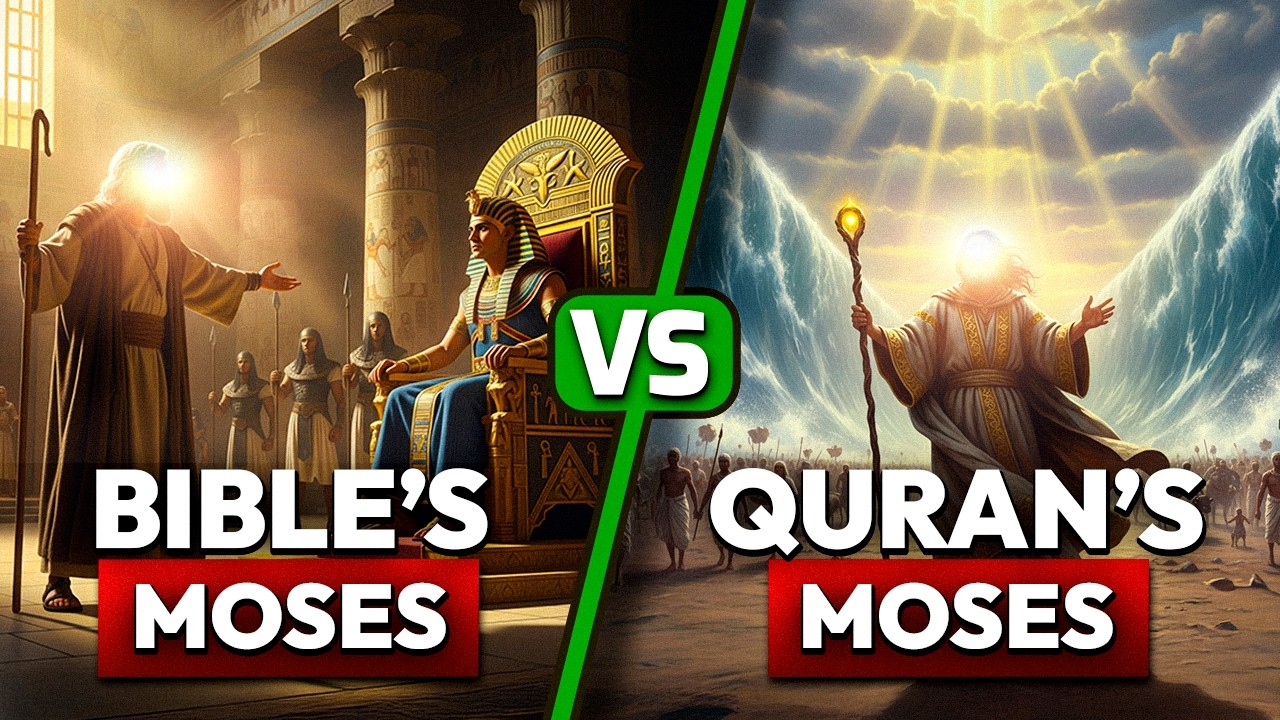
SUBHEADING: KING VS. PHARAOH:
Prophet Yusuf (Joseph) (peace be upon him) lived between 1747 BCE and 1637 BCE.
The Qur’an only ever calls the ruler of Egypt at his time “Al Malik” (the King).
e.g. Surah Yusuf, 12:50 - “And the king said: Bring him unto me …”
“Pharaoh” originally meant “Palace”. It was in use long before Moses but was only applied to the human Ruler after 1400 BCE, during the 18th Dynasty, which covers the time Prophet Musa (peace be upon him) lived.
The point is, at the time of Yusuf, the ruler was a Hyksos king, they styled themselves “King”.
The Hyksos were the kings of the Fifteenth Dynasty of Egypt (fl. c. 1650–1550 BCE).
The Exodus is traditionally dated c. 1446 BCE (early date) and c. 1250–1270 BCE (late date), associated with the reign of Ramesses II.
The Qur’an correctly only ever calls the King of Joseph “King” (“Al Malik”)
The Qur’an correctly only ever calls the King of Moses “Pharaoh” (“Fir’awn”)
The Bible calls the ruler of Egypt “Pharaoh” 274 times in the OT. It sometimes indiscriminately alternates between “Pharaoh” and “King”. King is used roughly 50 times, and of those times, Pharaoh and King are sometimes used together e.g. Genesis 41:46 “Joseph was thirty years old when he entered the service of Pharaoh king of Egypt. And Joseph went out from Pharaoh’s presence and traveled throughout Egypt.” Genesis 40 also mentions the ruler of Egypt as “King”. However, as l say, the terms are used interchangeably throughout the OT and even within the story of Joseph.
POSSIBLE MIRACLE: Only with the advent of modern Egyptology have we been able to make the historical distinction between the King of Joseph and the Pharaoh of Moses.
SUBHEADING: MID-MORN ON THE DAY OF BEAUTY:
The Qur’an in Surah Taha 20:59 relates to the contest between Pharaoh’s magicians and Moses being arranged for the “Day of Beauty” (Yawm al Zinah) at mid morning:
20:59 “(Moses) said: Your tryst shall be the day of the feast, and let the people assemble when the sun hath risen high.”
Translators unanimously seem to call this “Day of the Feast” or “Festival”, however the literal translation of Zinah is “beauty, adornment, ornament, or decoration”, often referring to elegance. The OT doesn’t mention a national day, the encounter just occurs inside the Palace.
The “Day of Beauty” appears to be the “Opet Festival”, an annual national holiday in Ancient Egypt, wherein houses and temples were decorated, idols were adorned and paraded through decorated streets, and people dressed in special clothes.
POSSIBLE MIRACLE: There was no way people could have recalled this until the advent of modern Egyptology. The ancient Egyptian language was lost centuries before Islam.
The Qur’an’s timing of the contest being mid-morning is remarkable too: the ancient Egyptians believed magic to be most powerful during festivals and at dawn and mid-morning.
POSSIBLE MIRACLE: The Qur’an records Moses has challenging the pagan Egyptians at the time they felt stongest - The Day of Beauty, at mid-morning. None of these nuances appear in the OT. There was no way people could have recalled this until the advent of modern Egyptology.
SUBHEADING: MAYBE THE BIBLE GOT HAMAN WRONG, NOT THE QUR’AN, OR AT LEAST THERE WERE 2 HAMANS:
The Qur’an in 6 places names “Haman” as some kind of minister of the Pharaoh at the time of Moses, e.g.:
28:38 “And Pharaoh said: O chiefs! I know not that ye have a god other than me, so kindle for me (a fire), O Haman, to bake the mud; and set up for me a lofty tower in order that I may survey the God of Moses; and lo! I deem him of the liars.”
This was decried by the Judaeo-Xtian scholarship throughout the centuries, as a glaring error because Haman is the Prime Minister of the Persian King Xerxes I in the Book of Esther. His plot to destroy the Jews occurred circa 474-473 BCE, and thus they conclude the Qur’an got both the time and location wildly wrong!
In fact, the historicity of the Book of Esther is also widely doubted by scholars, including Judaeo-Xtian scholars (the Universal Jewish Encyclopaedia states “The very tone of the book itself, its literary craftsmanship and the aptness of its situations, point rather to a romantic story than a historical chronicle.”
The Jewish Encylcopaedia had already asserted that: “The vast majority of modern expositions have reached the conclsion that the book is a piece of pure fiction.”
I can give more and more denouncements of the Book of Esther, but that’s enough for now.
There exists an unhistorical Haman in the Book of Esther. This unhistorical Haman is portrayed as the Prime Minister of Ahasuerus (Xerxes I?), King of Persia. Though the author shows familiarity and knowledge of Persian life and courtly customs, the events recorded in the Book of Esther show little correlation with those of the actual reign of Xerxes I. Long ago theologians both Jewish and Christian, had a difficult time accepting the Book of Esther whose canonicity was held in low esteem, especially in the east among early Christians.
Finally though, get this: There was a rank / title in the Pharaoh’s court, which would correspond to the possibly Arabised name “Haman”:
From Wikipedia: The description of Haman in the Quran serving in both a priestly religious role and that of one who’s in charge of building projects answerable to the Pharaoh himself draws parallels with the High Priest of Amun.
McAuliffe’s Encyclopaedia of the Qurʾān reports multiple possible identifications of the name: Muhammad Asad (Leopold Weiss) identifies the name with a supposed Egyptian title Hā-Amen, as a high priest.
Also, according to an inscription / inscriptions in the Hof Museum in Vienna, Egyptologist scholars compiled a dictionary of personal names from the New Kingdom. “Haman” is listed as a personal name, and his role was Chief of Stone Quarry Workers.
Sources:
- Walter Wreszinski, Aegyptische Inschriften aus dem K.K. Hof Museum in Wien (Egyptian Inscriptions from the K.K. Hof Museum in Vienna) (Leipzig: J C Hinrichs’sche Buchhandlung: 1906).
- Hermann Ranke, Die Ägyptischen Personennamen, Verzeichnis der Namen (The Egyptian Family Names, Listing of the Names), Verlag Von J J Augustin in Glückstadt, Band I,1935, Band II, 1952.
POSSIBLE MIRACLE: So, again, in ways inconceivable before modern scholarship, the Qur’an may have gotten right, what the Bible got badly wrong.
SUBHEADING: HEAVEN & EARTH WEPT NOT FOR THE PHARAOH & HIS ARMY:
The Qur’an says of the drowned Pharaoh and his entourage, of Moses’ time:
44:29 “And the heaven and the earth wept not for them, nor were they reprieved.”
This curious motif, of the sky and the earth weeping, actually finds a possible root in the Ancient Egyptian Pyramid Texts of the Fifth Dynasty, which predate the Pharaoh of Moses (said to be Rameses II, of the Nineteenth Dynasty) by about a thousand years:
https://www.sacred-texts.com/egy/pyt/pyt33.htm
1364d. that thou remain Chief of the mighty ones (or, spirits).
1365a. Thou purifiest thyself with these thy four nmś.t-jars,
1365b. (with) the špn.t and ‘ȝt-jar, which come from the sḥ-ntr for thee, that thou mayest become divine.
1365c. The sky weeps for thee; the earth trembles for thee;
1366a. the śmnt.t-woman laments for thee; the great min.t mourns for thee;
1366b. the feet agitate for thee; the hands wave for thee,
1366c. when thou ascendest to heaven as a star, as the morning star.
POSSIBLE MIRACLE: So, again, in ways inconceivable before modern scholarship, the Qur’an got something right that couldn’t have been known to the Arabs of Makkah
SUBHEADING: PHARAOH WAS PRESERVED FOR POSTERITY
The Qur’an also mentions the fate of the drowned Pharaoh:
10:92 “But this day We save thee in thy body that thou mayst be a portent for those after thee. Lo! most of mankind are heedless of Our portents.”
POSSIBLE MIRACLE: But at the time of the Prophet Muhammad, nobody knew that mummification was a practise of the Ancient Egyptians.
It is a popular view that the Pharaoh of Moses was Rameses II, and his mummy is indeed very well preserved to this day. French officials bowed to it when it arrived in France in 1976 for a makeover.