In this modest essay I’ve posted here some months ago:
I’ve talked about how this world seems to be perpetually enshrouded by darkness, human thinking, human awareness, working as a spark of light, as a timid, yet powerful tool to try and illumine this large room of fear, ignorance, superstition, speculation with the cold light of the day, the cold light of reason.
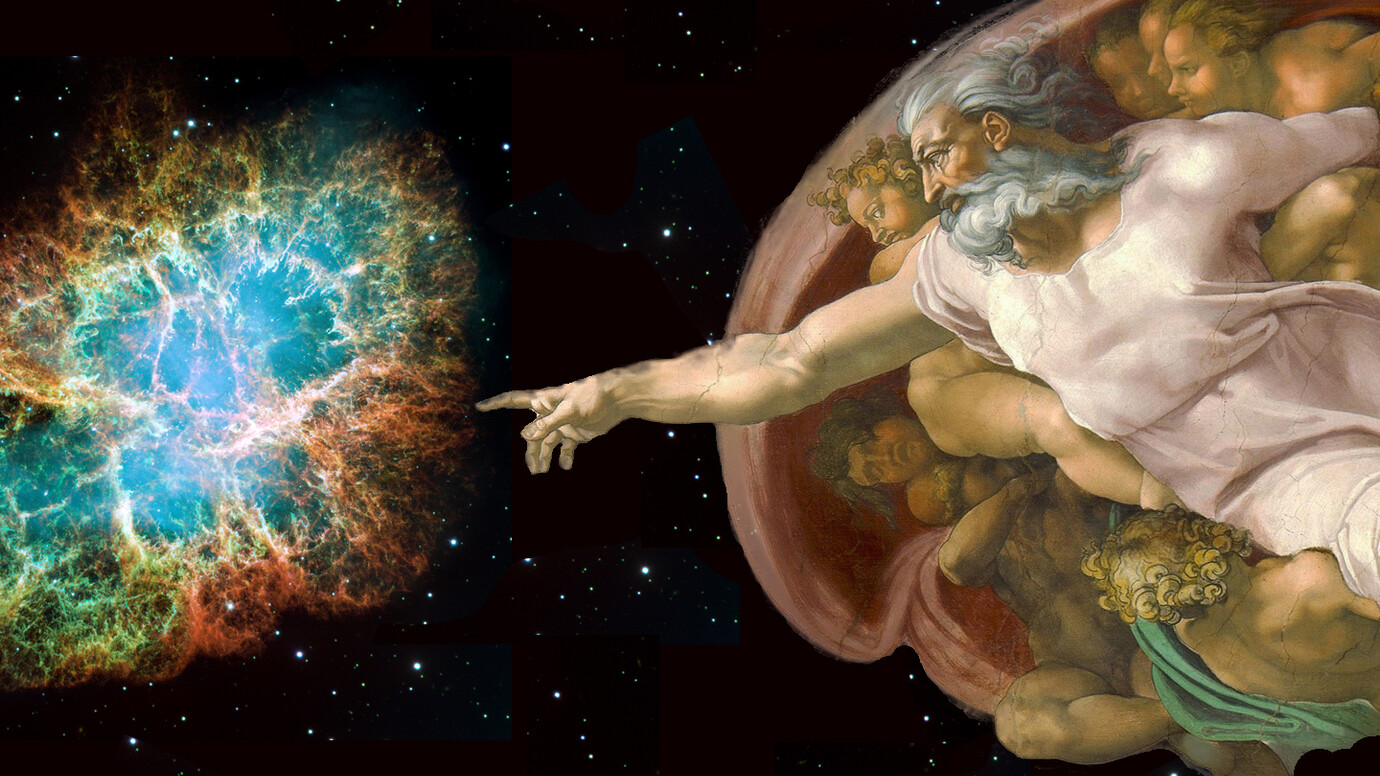
While people might disagree about virtually anything, one thing I think most would concede: it’s better to be in an illuminated room than in a darkened one, it’s better to feel the warmth of the day on one’s skin than the dreary touch of night. The day, the sun, light, brings with it a perception that one’s two feet are firmly on the ground, whereas night, darkness, makes one not only doubt whether there is a ground, but whether there are feet, and whether there is a body to which feet could be attached to. The cold light of day makes one stop, ponder, think, analyze, the dread fears the night insist in nurture in one’s mind and which the darkness almost seems to consist of. I will repeat again what I said there: I want the rooms I live in to be permanently illuminated.
That’s why I need education. That’s why I need science. What is science, if not a technique to purge fear from the human mind? While the complimentary (?) fields of religion and philosophy can’t actually rid one permanently of the horrifying ghost of fear, religion particularly doing the almost opposite of that, science begins its attempts at freeing a man’s mind from fear by first advising him to keep his mind, literally, down-to-earth.
Down-to-earth is the precise term to use here. Not only because it means to have one’s feet firmly on the ground, but because it implies that whatever a man does or experiences in life is related to this planet, to this world. We are creatures of this world, living on and off this world, and not able to live anywhere but here.
For countless centuries now men have been doubting not only whether this world here is the only one there is [for us], but also whether it’s even real to begin with. Some have boldly asserted this here is just a shadow of the real thing, passing as true only for unreasoning creatures living in a kind of… cave. The discovery of real philosophy would free one’s mind from this world of shadows and open one’s eyes to the real world. Such a perspective, widely famous yet incredibly depressing in its sheer naiveté, was bought freely and gladly by such a big part of the species that it has gone beyond the realm of speculation and into that of reality, becoming a truism, ie, something self evident. Most people think we are only passing through this world, waiting for death to begin our journey to the true world, where true life will, after all, begin. This is evident when we say someone has “passed”. Someone having “passed” is a poetic, profound, comforting and essentially religious way of dealing with the following cold observation: someone has ceased being. Someone died, permanently.
One can choose, hey, one has to choose a way to conform to the inevitability of death and also with its irreversibility. Whether it’s through philosophy or religion or even through cold cynicism or hedonism, the fact remains that when one turns to science, it has nothing to offer besides the dreary conclusion of cold observation: that person is dead and is not coming back. Ever.
While religious or mystical thought tend to enshroud men in layers and layers of mystery, one question leading to another, but never being clearly or definitely answered, because our feeble senses and myopic eyes can’t see deep enough, science does the opposite and tries to decodify and understand the layers of reality one by one, leaving no part of the experience of the living unexplored except for the most intimate of all aspects of existence: the abysses of one’s mind. Even this aspect is investigated by some, but here science progresses slowly, because the human brain is the single most complicated thing in the whole universe, and it will take a long time for it to be fully understood, if ever it will be. None of us will be alive to see it. But even though the brain remains, fundamentally, a mystery, science still has lots of valid things to say about it. Religion, on the other hand, nurtures on mystery. The analogy of the dark room may be brought back here, science is a room full of dark spots here and there, but with a pervading light that, given time and patience, will manage to illuminate even the most persistent corner of darkness. Religion is a room enshrouded by darkness, attractive precisely because of that, because instead of illuminating life, it brings with it a permanent sense of mystery, of the occult, things that can’t be verbalized or understood even by the initiated, and one feels comfortable in it, oftentimes, because one’s not brave enough to face life and reality through the cold lenses of reason, but prefer to recede to darkness wherever one feels threatened by the discouraging perception of one’s utter insignificance in this world.
I need science then not to make a cult out of it, like one naive Auguste Comte did once, but to ensure the room remains with enough illumination, to prevent me from stumbling over my own ignorance all the time, to safeguard these little snippets of knowledge human intelligence has collected throughout the ages, to ensure they will never, again, be subjected to the power or the scrutiny of those who are bearers of darkness but pretend to bring the light, of those ignorant enough not to perceive it’s not through speculation or wild guess one arrives at a semblance of sagesse, but through much labor, much pain, through relentless research that many a time takes a lifetime, obsessing a man who devotes his existence to it, apparently vergebens, but still his work is infinitely more valid than the bold assertions of those who pretend to have acquired infinite knowledge through a single minute of epiphany. As modest as the scientific research result can be, it’s still something. The bearer of truth, on the other hand, brings absolutely nothing to the table except a blind belief in his own infallibility.
It’s thus that a man feels entitled to talk about the most absurd notions as if they were unquestionable fact. He loses any sense of ridicule and becomes a loudmouth, the spokesman of a hidden Power that only he can understand but which
a) can’t be seen
b) can’t be heard
c) can’t be touched
d) can’t be smelled
e) can’t be measured
f) can’t be demonstrated
g) can’t be related to anything we can observe in the phenomenal world
h) can’t be proven
i) can’t be unproven
j) can’t be compared with other’s accounts of similar phenomenona (?) as each one’s experience with such a Force is inextricably related to one’s unique perception of things [ie, each man’s God is a different God than his neighbor’s God]
Since science has nothing to say about unseen and undemonstrable occult forces, religion has a vast field to explore, the field of human imagination. A scientist will roll his eyes at our everyday escathological prophet and goes back to his research. Since nothing the guy says can’t be proven, but can’t be unproven either, he’s generally left alone with what amounts to his own imagination. Religion is the realm of imagination, and more, the realm of magic. The realm where things occur that can’t be explained. And occur routinely, not here and there or every once in a while. In the religious mind, magic occurs every single day, every single moment.
Only, it never, ever, does.
One experiment we could make to measure the possibility of the occurrence of magic is the following:
Let’s pretend we’re observing a man—a skeptic, of course—permanently seated in a large, brightly lit public square. He’s sworn he will never leave that spot until someone appears who can demonstrate, in front of him, in broad daylight, in a place where anyone can see and everything can be recorded, the occurrence of some supernatural phenomenon. It could be the appearance of a spirit. It could be a miraculous healing. It could be a resurrection. A man levitating in the air or multiplying loaves of bread. It could be a hand appearing from heaven, delivering a tablet with ten new commandments to humanity. It could be an alien, finally, making its appearance. It could even be Donald Trump performing a gesture of humility. Anything completely out of the ordinary. Our skeptical friend is stubborn and won’t budge until this miracle-bringer appears. The information that he is there is publicized, broadcasted, so that anyone interested can find him there and demonstrate the possibility of the miraculous. What would we conclude if such an experience were possible? We would conclude, my friend, that it is possible, after all, to reach some consensus here in this world. After much waiting and much hesitation, we would all agree that that poor devil will never, ever, leave that square.
Does any of that mean I would like to fight religion and deny its practitioners the right to believe whatever they want? Far from that. I only wanted to point out what sounds as the most rational approach to the topic: religion is a personal subject, it can mean a lot to a man who finds meaning in it, but it has little, if any, factual information to provide for those who aim to understand the phenomena happening in this world.
Phenomena such as CONSCIOUSNESS, the topic of this thread, to which I finally turn after this long introduction.
The only effective way of studying what happens in this world is to assume that everything that occurs here is natural. Being natural doesn’t mean only “which happens naturally”, but also that it’s part of a long, never ending, process called evolution. This process, which encompasses each and every event involving living creatures in this world, interrelating them in a long chain where one being depends on the other, and evolves according to the circumstances of the environment in which it lives, is what best fits to provide a coherent theory of consciousness: just as man represents an evolution of his ape-like ancestors, human consciousness seems to represent an evolution of the consciousness of our ape-like and primate ancestors.
Whatever consciousness is, then, is something arisen in and related to this world. It’s not something coming from above or from the ether. It’s certainly not something that magically appeared out of nowhere. Like everything in evolutionary biology, it developed, painfully slowly, as a tool to achieve a means, and this means, roughly speaking, is not something transcendental, [=otherworldly], but mere surviving, on this world, sine die. Biological machines, as Jupiter123 calls it or, simply, animals- that’s what he means: a man without a soul is an animal- that’s what we fundamentally are. Our purpose here, if we’re going to use such a term, is not something beyond this world. It’s to go on living. Sine die. The individualized creature repeats the same process of the species it belongs to: it wants to live sine die. Animals, most animals at least, display this innocent and uncompromising will to live most effectively. Every new day is a repetition of the previous one. All days are basically the same as far as survival is concerned AND YET something fundamentally new, unheard of. The living creature wakes up every new day prepared to repeat the same cycle it’s been repeating since birth. Most of its waking hours are busy with either finding food or running from danger. One day, however, either the food disappears or the danger gets the better of it. One less biological machine in the world.
Employing this biological/evolutionary perspective to analyze any phenomenon presents a problem: everything in the realm of biology happens incredibly slowly, randomly, and without any apparent purpose or intention. Let’s not be mistaken: there is a purpose, survival sine die, but there is no Purpose, no apparent motivation external to the maintenance of the process itself. Life is an end in itself. The first truth of biology. The slowness with which life unfolds here, and with which it passes from one evolutionary stage to the next, literally millions of years, brings another logical consequence. All human conceptions of life, inherited from our ancestors who lived within an infinitesimal fraction of biological time, were founded on a completely mistaken understanding of human existence on Earth. Men of old had an infinitely more restricted notion of time than ours. They could not have imagined that humankind’s “arrival” on Earth took billions of years to occur. They commonly imagined humans as a special being among earthly creatures. We needed a Charles Darwin to bring to the table the most devastating of all scientific ideas: humans are “just” one more animal species.
The implications of this finding were so devastating that even today, there are those who vehemently oppose evolutionary theory based on the simple fact that it removes humans from the pedestal they placed themselves on and casts them into the animal kingdom, along with all other lesser animal species. That is, they don’t deny Darwinian theory for scientific reasons, but because they need and prefer to nurture a false sense of their own importance. After all, certain accounts claim that the entire universe was, magically, created just so humans could be here. And also that, once here, humans will always be somewhere. Eternal life. How surprised would someone who believed this for so long be to look around the world around them and realize that not only it is entirely indifferent to the existence of anyone here, but the very universe in which such a world exists is so vast that this entire world of ours, our entire reality, becomes insignificant?
It doesn’t matter how much some believe we need uplifting religious or philosophical systems to escape or counterbalance such a bleak perception of things. It doesn’t even matter what my own convictions are (I have them). What really matters is the lesson Darwin taught us: to understand the natural world, we must turn to science, and biological science finds its best foundation in evolutionary theory.
What evolution teaches us is that all life forms derive from a very simple one that arose, randomly, many, many millions of years ago. Although today the process seems incredibly complex and multifaceted, due to the millions of living species on Earth, in those humanly unimaginable times, all that existed were single-celled beings without even the luxury of a cell nucleus. Such early creatures are called prokaryotes. They are the humble ancestors of everything that lives today. In those primeval times, there was not much oxygen on the Earth’s surface, yet oxygen is vital for almost all living creatures. So naturally, living creatures at the time could only be infinitesimal and extremely simple. Then, about 3 billion years ago, a fundamental revolution: some microbes evolved the ability to use sunlight to produce energy, creating oxygen as a byproduct. This was the kickstart to more complex life forms. From then on, with the earth becoming rich in oxygen, the immense picture of life we have today was slowly drawn, with the most complex creatures coexisting today with the simplest.