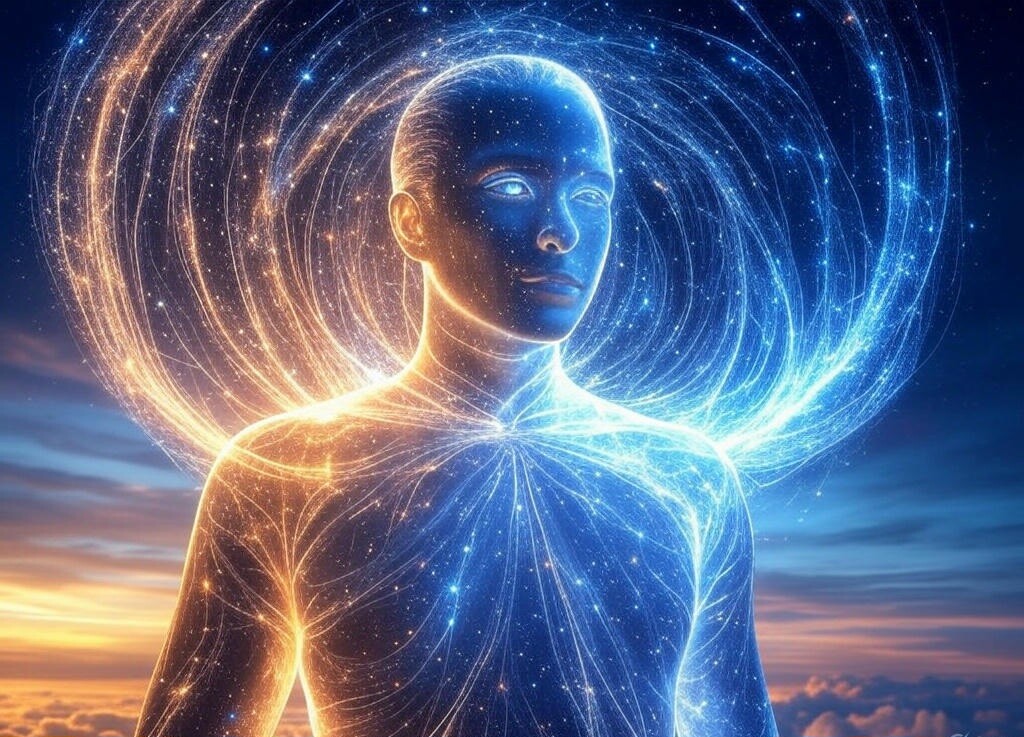
In the beginning was the Word.
Or, was it?
Nope, in the beginning there was nothing. There was chaos. Darkness everywhere. In the beginning there was instinct. There were impulses which did not find this convenient means of expression, reflection. In the beginning not a single word, not a single syllable was or needed to be uttered. In the beginning there was darkness. Only darkness.
Now, someone said, and we can repeat, that humankind- and I, a single individual, am a replication of humankind, my kind- is always repeating the same process over and over again, existing, being born again and again, like we’re always beginning anew the same process of creation and destruction over and over again. Our species was born in darkness. We are born in darkness too. Our species had to learn how to utter feelings and how to express ideas, we have to do the same. And every single new generation of humans have to learn to do the same, and every single individual has to learn to do the same, like the entirety of existence was beginning anew all the time, with the whole of our kind and with every single one of us.
In the beginning, this is the new Revelation, there was and is darkness everywhere, there was not a single trace of comprehension, there was and is no shred of light, light had and has to be conquered, step by step, drop of blood by drop of blood, minute by minute. It’s not, it cannot be a “gift”. That’s the reason why Revelation is always behind us, why we’re always having to reinvent, to resignify it- Revelation is a stagnant crystallization of a moment where light [comprehension] is perceived, but it stops there, as if we could acquire comprehension once and for all, in a definitive manner. Revelation is a Truth in a universe where only truths can exist, what makes us capitalize what is and can only be temporary, limited, as if a capital T was able to separate once and for all light from darkness, to protect us once and for all from darkness, when in fact it just shows our inability to actually penetrate the ultimate nature of things?
Moreover, it’s our inability to perceive and/or accept that existence is starting anew all the time, for each and every one who is born, or for each and every one who is here right now, and for the collective to which one may belong or adhere too, that makes us find comfort in the convenience of capital letters. Truth, Democracy, God, Hell, Heaven, Socialism- a capital letter transforms such imperfect interpretations of certain aspects of reality into what they are not- unquestionable, unsurmountable truths.
As part of the “herd”, of the collective, “hive mind”, ie, of society, each one grows up with a preconceived set of notions of everything he “is” to do in his life, from the cradle to the grave. It takes, sometimes, a lifetimes of dissatisfaction, an inner perception that what one “ought” to do is not what one wants to do, for an individual to realize that there is absolutely no “ought” in existence for him, there is absolutely no rule that he must peremptorily obey, without question, as being essencial to what he is and must be, does and must do in life. All rules, human rules, all “oughts” and “shoulds”, all commandments, take into consideration man as a fixed being, as someone who is unalterably what he is, ie, as an entirely predictable being, as a machine. Only when they come from the individual himself can any “rules” have any shred of validity. When he analyzes things, reality, with a cold, lucid understading, and thence derives what is really acceptable for him, what’s advisable for him to do, not because others are imposing these commandments on him, but because he himself has acknowledged that following certain rules of conduct leads him to what matters most- his own well-being. But nope, everything in society is a “given”, given this or that fact, you should act so and so, but what on earth is this fact if not your own personal interpretation of what happens around you, and when exactly do the members of society sit down, reflect, and ponder- “yes, this is what one should logically do, this is the closest to ideal behaviour a man can get, after much pondering we have all come to this same conclusion, this is not a gift “from above”, this is a conclusion we, as rational, thinking individuals, have come to"?
This obviously never happens. “Good is good, bad is bad”, an inescapable formula which not only betrays an extremely simplistic way of thinking, but which also ultimately fails to offer us a convincing portrayal of human reality.
For countless, millions and millions of years, reflection of any kind, from the most simplistic to the ramblings of an Einstein, was entirely absent on earth. Reflection requires a thinking mind, thinking in the human sense of the term, not as merely animalistic reaction to externalities. Darkness. The animal kingdom is surrounded by, and forever encapsulated by darkness. The instinct rules, and this instinct is not good and is not bad, it merely serves as a blind, a mechanical reproduction tool. The animal exists merely to reproduce himself ad eternum, its existence has no “purpose”, not in the sense a human being would employ this term. An animal knows nothing about existence, God, finality, will to power, democracy, whatever concept we waste so much time and effort in understanding. It has no use for any of our concepts, which is the same as saying that they don’t exist for them, entirely. Now, if concepts can exist thus only dependent of whatever use humans find for them, it’s clear that humans can adapt them, use them, deconstruct them, abolish them, get altogether rid of them, at will. All concepts exist within the boundaries of our minds, of my mind. All of them, as I interpret them, disappear with me the moment I die. And all of them can be adequately used, by me, to further whatever my “agenda” is, even not caring a damn about democracy, “the needs of the people”, I can employ the concept of democracy to my own advantage, believing in the idea itself is not relevant, I can learn to make a practical use of it, and so convincingly that many others, most others, will not only believe I’m sincere, but adopt my interpretation of democracy as their own, using it as another tool for the implementation of their own egoism. And in this process, not a single one is ignorant, deep down, of the fact that “democracy” doesn’t exist nor can exist.
Same reasoning applies to God, love, freedom, socialism, help yourself.
We can pretend to trust in the power of concepts. Supposedly, they can change the world. Only- they can’t. The world is out there. Concepts are all within our minds. Yes, you could argue, but with the concept of a good society we go and make buildings, streets, houses, we invent medicines, we research the cure for cancer. None of these things, however, change the world, not in any substantial fashion. The world is out there and it is what it is. If we could adequately develop tools to make life in it more tolerable, that’s a product of our egoism as an species, but the world itself is still out there, out of us, its face can change, its externalities can be so much altered as to become irrecognizable, but the real problem remains the same- it is out there. Not within us. One thing is the world, another thing is my relationship with it. I can, most certainly, adopt a positive outlook on things, and see the world as my playground, my laboratory, my tourist destination, my property. Yet it is still entirely indifferent to how I see it, to what I make of it, and my own inner limitations, after all I can only do so much, I can only live for so long, end up by restricting my will and my whims. This is like a man deciding, all of a sudden, to live in the jungle, Thoreau style. He may suddenly realize he doesn’t really belong there, no matter how much love he must feel for animals, or for nature, his own nature is not adequate, does not allow him to simply go and live anywhere. That restricted space expels him. And yet I can and do envisage my living anywhere I want in this world, helas, even living outside of it, in space, in Mars, but my body can only adapt till a certain point. This is simply a way of saying my mind can conceive of anything, but my body can only do so much. Because my conceptions are virtually unlimited, but the world is entirely indifferent to them, if I reduced my thinking to an absolute minimum, I’d still find home here, rather, I’d be almost perfectly adapted here.
But to reduce myself to basic living, or sheer animality, is not something to my liking, because my reasoning faculty tells me this kind of living would make little more of me than an automaton. The process of bringing, creating light from darkness, the process of comprehension, shows me I’m not and cannot be an automaton. For the automaton, the “herd”, everything is a “given”. For me, everything is either my creation or something that is out there to limit or destroy my creation. I am not an animal, nor a god, the animal is a slave to its instincts, the god a chimera, but I have an animal side and a godly side, I still have my instincts, but I also have the power to create, to mold reality to my will, according to my convenience. I’m above both the animal and the god, especially because, in the fanciful conception of this latter, given that all is possible, all becomes a bore. The Christian God creates the whole of humankind out of boredom. I am above boredom, because I see boredom, and its correlate feelings, sadness and emptiness, as symptons of darkness.
All depends on me, which, ad argumentadum tantum, I could also apply to my species and say: all depends on us. Because it does.
All the words, all concepts, all ideas, are all products of our minds. Of my mind, individually, of our minds, collectively. Now I can, I have the possibility, of reinterpreting all words, all concepts, all ideas, or do nothing about any of them, as the collective mind also does. A basic mistake in the analysis of rational individualistic egoism is to assert that it invariably leads to solipsism (=only I exist, all the others are phantoms in my head). Nope, as the world is out there, the collective, the “hive” is out there too. And it’s always a new collective, a new hive, as I’m always a new one, a new “me”, but it has learned the advantage of the believe in fixity. Egoistically. In order to preserve itself, in order to simply go on living, since as part of the “hive” we just want to go on living, sine die, society implements the idea of fixity, of permanence, while it itself represents a denial of such an idea. For it exists anew, a new form of an old phenomenon, and it exists now, not in old times, like its old forms did. It’s therefore something unequivocally new, just as I am something entirely new, and it’s also something unequivocally unique, just as I am entirely unique. The difficulty in comprehending my uniqueness, and also its own uniqueness, is what leads the “hive mind” to defend my entirely non-existence in relation to it, and also that it doesn’t need to invent or create a new mode of living or new ways of thinking, just to stick to same old, same old (it worked for my grandpa, it must work for me), because that’s how it is. But ‘how it is’, in our own peculiar way of conceptualizing things, is subject to many kinds of misunderstanding.
I’m a firm believer in my own freedom. I’m a firm believer in the uniqueness of my mind. One could and can argue, yes, you believe, as if I’m not more authorized to believe I’m free than some weirdo in thinking John Lennon is still alive. Ie, all is a matter of belief, not of fact. I have to agree with this to a certain point. But, ultimately, nope, believing in me is not the same as believing in Christ. I am me. I don’t intend to become what I already am. I have a body and a mind as evidence of ‘me’ being a reality. I have none for Christ. For all I know, he can have existed, or he can be a fiction, a lie gone too far. I have absolutely no shred of evidence that might allow me to believe in Christ. Most importantly, though, I see no need, in myself, for such a belief. I never actually felt like praying for the Holy Father a single moment in my life. If such a need has never really appeared in me, my adhesion to Christianity would be entirely fake. But not fake for others, what do I care about others. Fake for me. There’s an ocean of distance between faith in a supernatural deity who, for whatever reason, decided to “become flesh”, and the notion that this being, this portion of flesh, this creature who is typing these words with his own hands, exists, exists individually, with a mind of his own. Some, I know, would like to steal from me even the autonomy of this mind. “Your mind is not yours, your ideas are not yours, etc.” This is failed reasoning to the core. First, my body, and ergo my mind, is permanently separated from other bodies, in a definitive way. Second, the simple fact of thinking, reinterpreting things on my own peculiar way, serves as ulterior evidence that, yes, I have a mind of my own. Nobody can say these words like I’m saying them right now. Nobody can think exactly the way I think. Nobody can feel exactly the way I feel. My inadequacy, my penchant for isolation, comes from such a perception, that I cannot fully express what I am and feel for others, not in any way they can actually understand.
If I don’t see a reason, or a need, to believe in Christ [substitute this for any other deity or absolute you will], I do see a reason to believe in myself though.
For if I don’t believe in myself, I become another example of what I call a “victim of existence”.
A “victim of existence” is the man who does not believe in the supernatural, but doesn’t see a reason to believe in anything either. So existence has, for him, an unsurmountable tragic outlook. He was “thrown” into this world without anybody telling him why. A man who adopts such a perspective, and I did it for a long time, is invariably dissatisfied because he fails to realize that it’s up to him to create meaning in his life, he cannot expect that from others or from the world around him. All the world will offer him is a reflection of his own emptiness. But he doesn’t need to feel empty, nor does he need to “preach” emptiness, ie, become a nihilist. He must first understand whence comes his feeling of emptiness- ie, of not seeing a meaning, a sense, in anything around him, and then, he can extract from this the lesson that he either becomes the creator of his own destiny or just lets things happen, lets things go, perpetually dissatisfied with himself and with others for not being able to perceive others cannot offer him what he is not really willing to take for himself. In this process, dissatisfaction, denial, becomes a fixed idea, a phantom. An addiction. The individual sees his own need for denial reproduced, and reflected, everywhere, and so the “I don’t see a reason for anything” becomes “there is no reason for anything”. What is an entirely personal, individual, perspective, becomes the general rule. Everything is void because the one arriving to this conclusion is void.
The individual can have a good reason to believe in himself. This belief, I repeat, has nothing supernatural or mystical about it. My belief in myself is what may guide me to wake up every day, to do this or that to ensure my survival, and most specifically, my well-being. If I nurture in me the perspective that all is vain, all is futile, I am the creator of my own despair, my own ultimate failure in life. Because not a single thing I do in life is “vain”, everything has a reason, even if a purely instinctive, mechanical one. I overcame nihilism the day I realized my own take on things determined how things affected me. If I overdramatize death, for instance, death becomes an unending, and always renewed, tragedy. If I decide to face death however as what it is- a necessity and also an opportunity for renewal, for reevaluation, I not only get rid of a monumental fear, the most fundamental fear, but I also learn to accept death, to wait for it when the possibility of a fruitful life is all gone. Same goes for belief in anything above or beyond me- when I understand what drives me to such belief- an inconformity with my present situation is most often the cause- I also overcome it, because it’s only me who can change my situation, if I let others decide for me what’s good for me (and “God” is part of these “others”) I will always be dissatisfied, I will always be conforming to an idea of what is expected of me. But I am the one who creates his own expectations.
Belief in God, belief in the future where all’s well, belief in democracy, belief in philosophy, in science, or belief in Satanism. It all amounts to the same. Something exterior to me is giving me all the guidelines I need for living. People totally alien to me are determining my every day life, when nothing I do could ever concern them in the least. And such things, such people, such exteriorities, couldn’t care less about what I do or don’t, what I am or ain’t, what I want or not. God does not establish a dialogue with me, that would be acceptable, ok, let’s talk, talk, till we come to an agreement, nope, God has a commandment for me, a “thou shalt”, and I didn’t ask for it. If I don’t accept tyrants on this earth, I won’t accept a tyrant “from above”. The “leap of faith” necessary to compromising myself with a belief, with a –ism, is alien to me, because I don’t see how blind faith may lead me to acquire anything worthy for me, I don’t see how my good is guaranteed from bending my knees or relentlessly pursuing a goal which has as its motive the “others”, the hive mind. The others, being just as egoistic as I am, should pursue this objective on their own, why do they need my adhesion? But that’s what is expected of me when I’m asked to join some –ism in order to “overcome myself”, ie, to get rid of my self-obsession. “Concern yourself with otherness!”, that’s the motto of every believer.
Yet I know where such a belief and necessity comes from, I intimately know the danger of being so thoroughly self-obsessed that the ego becomes a drug, and ultimately the means to my own demise. That’s why I’m not an egomaniac, and recognize the existence, and the needs, of others. But even though recognizing them, I don’t live for them, I live for me, that’s the only solution that appears sane to me. The “hive mind” takes care of itself, I take care of myself, and God knows (!) this is already too much for me.
The need to avoid egocentrism is not that distant from the desire to avoid blind belief in exteriorities. What I have said in the beginning needs to be further developed.
The arrival of comprehension, which, once again, happened a long time ago and is also happening at this right moment, and will also happen millions of time in the future, this ever-renewed search for light, for understanding, for a clear mind, a mens sana in corpore sano, for words that are really uttered by my mouth coming from what I really feel and sense, from what I really am willing to say, this phenomenon is not something that should be taken for granted, in any sense of his expression. The search for the adequate words to express the adequate ideas, ie, the effort to crystallize, to solidify human understanding, was and is, will always be, a desire to fight darkness, darkness within our minds, but which also trespasses the limits of our minds, infecting our bodies, paralyzing our bodies like a virus. I cannot come to a complete, absolutely perfect comprehension of everything, what I can and do is to desire a level of comprehension enough for me to live a fully satisfying and free life. And if I get to attain this level of comprehension, of self-comprehension, to heed to darkness once again is a sign of frailty, of failure for my own egoism. If everything is a process, a continuum, and if I am not exactly the one I was one year, one day before, one thing is permanent in this state of impermanence, ie, “eternal while it lasts”: I am the one doing all the thinking, all the valuing, all the believing. Just like animals can’t “think” in the human sense of the word, concepts above and beyond me also can’t think or have a life of their own. It’s me who gives them life, or condemns them to oblivion. When the last true believer dies in this world, God disappears. He may be all in all, perfection incarnate, the sum of existence- yet he needs my mind for him to be conceived, he needs my knees to worship him, he needs my hands to erect a church for him, otherwise, “he” is just another useless word gone out of fashion.
This could be yet applied to so many things, so many ideas that I may end up seeing as something much greater than it really is. A concept is born when we need to give a name to something, be it a creature or an idea, a sensation, a feeling, whatever. Then it fulfills its function when we have adequately labelled this something in whatever way may suit our need of it. When it becomes an end in itself, however, the concept loses its efficiency, it becomes a phantom, a fixed idea. How can we create darkness out of our need for light, ie, out of our need to understand reality? When our conception of life does not reflect it as it actually is, or in all probability seems to be, but rather, encapsulates life, entangles it, limits it, extracting for life what really matters and leaving just its appearances, a shell. It’s like a man digging deep to find out what’s there beneath and inside things, only to conclude that he must satisfy himself with the external, with the surface. When one gives up understanding in favor of a “God did it”, which explains all and explains nothing at the same time, he is basically giving up and accepting that, since he cannot, or rather does not have the audacity to go further, to try and understand everything he possibly can, he prefers to simply heed to a “God did it” formula which is satisfying because it tells him that he doesn’t need to do any kind of further effort, just relax and let God take control of everything, as that is His plan.
Just like living in a cave can be satisfying, for you are protected from the dangers of the outside world, living protected by faith (in whatever) is comforting because embracing faith is the same as accepting darkness, ie, as accepting that there mustn’t be comprehension for anything, or that any type of comprehension must be limited to an absolute, a non plus ultra, and this absolute ultimately makes all comprehension, if not futile, at least entirely dispensable. But I must make it clear for me that God is a creation of my mind, and that “he” doesn’t exist without me. When I accept that, all absolutes, which are nothing but substitutes for God, albeit philosophically acceptable ones, face the same destiny as the Almighty, ie, they evaporate.
Among such absolutes, the most prevalent, the most primitive, the most challenging one is fear. Yes, fear. Not fear in the traditional sense of a perception of danger. But fear as it is further reinterpreted by the human mind, outside the realm of the instinctive. Animals might fear an enemy that approaches and can threaten their food or their territory. But animals aren’t dominated by fear. Once the threat is gone, they “return to serenity”. Only the human animal has transformed fear in something permanent, ie, absolute. I look at myself and I think about my relation to this world and I recognize fear, I see fear in every step and every direction. A fear I must master. If comprehension is not a tool for me to overcome fear, what use is it? I fear the power of others, I fear the loss of others, I fear the imminence of death.
This fear, this discouraging sentiment, is widely employed by anyone who is willing to submit me to their own ideas, and the main instrument of this attempted domination is the notion that I can’t, ultimately, do anything by myself. So, some try to instigate in me a fear of loneliness, others try to explore my fear of death, while a third party insists on my being nothing without the others, without the “hive mind”. They all thrive on fear, and the more fragile, psychologically, I am, the more prone I am to succumb to some –ism that promises me to deliver me from my fears, and to instill in me satisfaction, liberty, fulfillment. But I am able to understand that fear, this out of proportion fear, this imagined fear of things, of existence itself, is, like any other idea, entirely in my mind. And in my mind alone.
Things, external things, the world, the material world, are indifferent to me. Whether I live or die is of no consequence to anything that exists outside of me. The “hive mind” is a primary example of that, it will go on existing without me, it only needs me egoistically, once I decide to step out of it, it has no use for me. I’m an aberration, a sick man, an apostate. Society having no use for me means what? That my adhesion to it is only reasonable as long as I use it just as it uses me, ie, egoistically. My being white, conservative, Christian, atheist, all my labels only matter as long as they serve to fulfill the egoistic employ society makes of me. Whenever I decide to step out of its boundaries, that is, not be a Christian, but this Christian, different from all other Christians, society has no other choice but to isolate me, and in this process, it tries to instigate in me fear of solitude, of uniqueness, and in others fear of the aberration I represent. “You see this weirdo? That’s what you want to become?” So society thrives on fear.
So my personal fight is against darkness and against its facets, fear being the most prominent of them. Reason tells me I do not need to fear death. There is nothing afterwards for me to be afraid of. Yet I surely don’t want to die, not while there is even a spark of life for me to cling to. Also, there’s the death of others, more specifically, of those others who happen to be fundamental to me, to my satisfaction. This one death I cannot deny that I fear. Yet I need to resort to reason too. It tells me nothing and noone can stay here for all eternity. Life requires one to die sooner or later. Even because a long life per se is not a synonym for a good life. So I must learn to accept that, even when one is fundamentally dear to me, he/she also needs to die sooner or later, and I will have to go on and will have to live with that. The impermanence of things, the finitude of everything. This is not another belief to substitute a faith I never had. Nope, it’s an accepted fact, just like I accept that living beings are naturally selfish, as a characteristic of things that does not require my blind belief in it, being self-evident.
Further, there is the fear of loneliness and the fear of disease. Loneliness, solitude, is something I have learned to appreciate early in life. It does happen to me to fill that weird sensation in my stomach though. In such moments, I want to reach out, to be part of something, and I even am successful at it at times. But loneliness always returns, in the end I’m always back to I, me and myself. So I need to learn not to make a whole production of it. Acceptance, a little of amor fati is not exactly ill-advised. This is how I’m made. Some are made for the bee-hive, others are made for the desert plans.
Disease is another thing entirely, as it can and does leave one entirely submitted sometimes to the aid of others. So reason tells me I need to avoid it if I crave independence, and what I need to do to keep my mind and body sane, and free from disease. It’s not easy. Even because some kinds of illness don’t have nothing to do with how healthy I am, they simply happen. But to this kind of disease I need not worry more than I can worry about an earthquake or a hurricane destroying my house. It can happen. It’s not happening now. When and if it ever happens, I’m sure I’ll be lucid enough to know how to deal with it.
Fundamentally important is to be in the now, to live in the now, in the present moment. Fear, magnified fear, is always a fear of things to come. But concentrating on the present moment helps me realize I need to fear very few things actually. I’m a conscious, independent, rational individual. I’m my owner, owner of my life, owner of my space, owner of my ideas. I need not fear others or their absolutes, fear their –isms and their apocalyptical predictions for my future- I know it’s all in their heads, just like it’s all in my head from the very start.
So in the beginning there is darkness. Always. But light eventually finds a space, there is a crack in everything, that’s how the light gets in (L. Cohen), so darkness is understood, and ultimately conquered, not by another type of darkness, but by understanding. Would it that prophets had taught men, since those ancient times, to actually try and understand things. Instead, they taught us how to bow our heads, to accept and to submit. But the desire for understanding was there, at the very beginning of this endless human adventure, as it is here today, at this right moment I write and you read this, and this desire can’t be quenched with submission or religious dogma, as it is the source of life itself. The light of understanding frees the mind from its own limitations, man stands as the true innovator, the true creator, the true valuer of everything. Outside the human realm, there is only darkness or death. As I want to be fully human, to be a creator of my own destiny, however small it may seem to another’s eyes, I must fight darkness to the very end. Which implies fighting fixed ideas, obsessions, of mine and of others, which implies fighting the “hive mind” to the very end. And I don’t let anyone tell me this fight is futile. It’s the fight of my life, the only fight that actually matters to me.
 To understand the world
  — and yourself
  — you need conceptual landmarks: logical anchors, signposts of meaning.
 .
. First of all: the concept of a “beginning” is total nonsense.
 , space
  , and matter
  are the three fundamental forms through which humans comprehend existence.
 Maybe it’s time to stop believing the garbage sold by both science and religion.
 — a form of intellectual livestock conditioning.
 Darkness (with a capital D) is a vast, immeasurable, unknowable multitude — not absence, not void.
 Light is a manifestation of Darkness.
 →
→ 
 And here’s the funny part:
 Physicists say: “Light is the visible part of the electromagnetic spectrum.”
 Philosophers mumble: “Light is the world.”
 Religious fanatics chant: “Light is the creation of God.”
 But the truth goes deeper:
 On the distinction: