You need to exist to claim that you don’t exist

OK, so you tell me how unconscious nature did things according to a DNA program language… on purpose… and not on accident.

Selection implies that there is no accident.
Mutations arise. Those that offer an advantage propagate, those that are disadvantageous, perish, those that are neither remain inert, until environmental circumstances or additional mutations make them advantageous or disadvantageous.

Chaotic energies is the key.
They accelerate the process of random mutations arising.

At some point a unity of energies - in harmony - began to reintegrate the energies being lost to attrition.
This was the beginning of what we know as life.

Body is what we call a unity of energies with a common objective.
There are unities that lack objectives…most in fact. These are not living.
A unity is held together by a balance of their energy patterns - how they harmonize.
Chaotic energies always repulse.

OK, so you tell me how unconscious nature did things according to a DNA program language… on purpose… and not on accident.

Natural selection is not chance.
But how life emerges is part of the infinity of time…
What are the odds of life not emerging…if existence is infinite?
Nil.
Infinite time means at some point in one cosmic cycle, life will emerge.

So you have been using the words chaos, random, and chance in incongruous ways.

The sort of mutations/changes required… just nevermind.

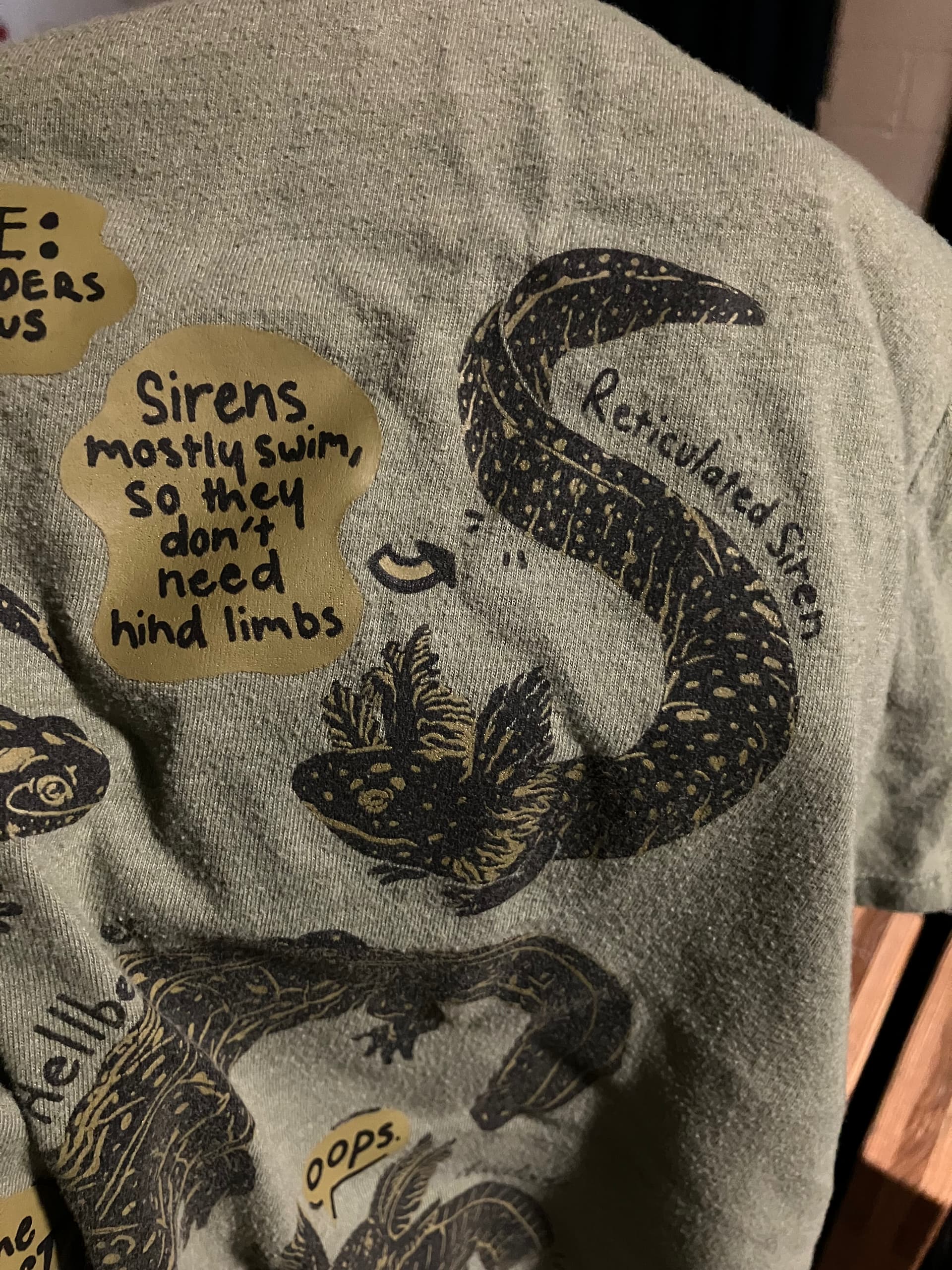
I “caption this” image below it…

Sirens don’t have hind limbs, so they mostly swim.

I demand answers!

Chaos always means random energies…but conventionally speaking ti means complexity.
Randomness implies that what would take more time can evolve faster, due to these random factors.
Then what is advantageous will propagate. It will be naturally selected, because only what can endure time can propagate.

Infinite time means that life, as we know it, will emerge, at some point…
One of the cycles will have the balances necessary…No miracles…inevitable.

I just explained to you how life could have emerged.
life and will are synonymous…life has objective, even if it is to survive, the primary objective.

Will is life.
Life is will.

If I were near you I could prove you exist by inflicting some pain, expecting a reaction.

Lol yeah, pretty obvious isn’t it?

It is already implied in the “to claim YOU don’t exist” that YOU exist. You are the one making the claim that you do not exist. A hallucination isn’t a “you” but merely falsely appears to be a “you”.

Unless you believe your hallucinations are literal individual beings with their own identity, mind, consciousness thus ability to make claims on their own behalf? No, a hallucination is only the false appearance of a “you”, there is actually no “you” there at all.

If YOU don’t exist and are merely MY hallucination, then it is not the case that YOU are claiming anything.

If YOU are not claiming anything, then YOU are not claiming that you don’t exist.

But you do bring up an interesting point: how do we know that the people we are interacting with are not our own hallucinations? Well I say interesting but really it’s not that interesting, since radical skepticism is always competing with solipsism for the Most Idiotic Idea award.

You could prove I exist TO ME because I experience pain, sure, but you can’t prove it TO YOU, which is the point I’m making.

You wouldn’t experience my pain, you would only experience hearing another person say “ouch”, which could of course be a hallucination. You can hallucinate someone saying “ouch” right?

Actually the technology does exist to feel another person’s pain. Scientists hooked up the nervous systems of two people, through connecting the nerves in their arms together. When one person was touched, the other person felt it.

Everyone on this forum accepts their own existence, that’s trivial. “I think therefore I am” has been basic philosophy for centuries now.

But op isn’t talking about his own existence, he’s talking about someone else’s, so he must not be just talking about affirming self existence.

YOU EXIST is a very different type of claim than I EXIST

No, he is not talking about us talking about other people. The use of the word “you” does not mean that. It means as a reference to YOU as an individual self. You, to yourself, need to exist in order to claim that you do not exist. Get it?

This is not an argument about anyone claiming that any other person exists or not. This is an argument about a person making a claim FOR THEMSELVES and related to themselves. That claim is “I don’t exist”. The basic point here, which is logically irrefutable, is that for any person to make that claim about themselves they must actually exist (since existing is required to be able to make claims), therefore anyone who claims they do not exist is being silly and irrational.

Now, to your point. Yes it is certainly possible that we can hallucinate other people who don’t exist other than as our hallucinations. I don’t think anyone would dispute that. Again, I already addressed this by pointing out that you do bring up a somewhat interesting point here. But it DOES indeed touch upon solipsism even if you don’t want to go in that direction. For you to make the claim “It is possible to hallucinate another person saying ouch right?” you are obviously making the point that it is possible that we might be mistaken about the actual existence of other people we are interacting with. And that is a fair point, in its proper context. But you would really need to actually go in that direction, the direction of radical skepticism and solipsism, to really make that argument philosophically and I understand why you prefer not to do that.

So this thread is just a rehashing of “I think therefore I am” according to your interpretation. Sure, every person can say that about themselves.

Well I reject the cogito, it is merely begging its own question and not an actual logical statement or argument about anything.

“I” think
ergo “I” exist

Yeah, no shit, you already presupposed the “I” existing in the premise.

What it should say is more like, “thinking is occurring, therefore something is generating that thinking”. From there, you can try to make a leap into “I am the one doing the thinking” if you’d like. But in all honesty, the idea that there is some doubt as to whether or not I exist (to myself, i.e. the idea that I would actually doubt my own existence) is simply absurd. It is kinda sad Descartes wasted his intellect on such a silly idea, tricky demons and all the rest of it. Radical skepticism is not philosophy.

Why not? I think testing the limits of Skepticism is super relevant to epistemology.

Because everything has reasons for being what it is. Including doubts. You need to have a reason to doubt something. Just like you need to have a reason to believe something.

To think otherwise, to assume there is a default state of doubt or belief, is irrational. Nothing simply “just is” for no reason. To doubt is a claim about something. The ‘something’ about which the doubt is a doubt, is already by definition something that it at least minimally meaningful enough for us to be talking about in order that it can be doubted.

Assuming a default state of doubt is as silly as assuming a state of default belief. I am sure you dislike when religious people make claims to believe in God and stuff without giving their reasons why they believe it. They just “believe it” or claim to, when IN FACT of course there are reasons why they believe in God (family influence, cultural social influences, personal utility of the belief, etc.). That is why I am against radical skepticism AND radical believing. For epistemology to function we need to properly look at the ACTUAL reasons/causes why beliefs or doubts are what they are. Only then can you begin to determine if the belief or doubt is true or false. Not by assuming a default state in either direction before even investigating the issue.

I think about it like this:

We ask how we know what we know. Now if you’re a young man, finished high school but not yet done a whole lot in the real world, a lot of what you know, most of what you know perhaps, you know because someone told you.

So “how do I know what I know? Mostly because someone told me” is kind of an interesting extreme starting point for epistemology.

Then you soon realise, actually throughout your life you’ve also been told things that are false, or been told something by one person they was contradicted by another person. So you can’t just believe everything you’re told, and so the next extreme on the basic beginners journey of epistemology is to reject that entirely, reject the idea wholesale that you should believe ANYTHING you were told that you haven’t verified it.

So you only believe stuff you’ve verified yourself, which mostly means stuff you’ve seen with your own eyes, stuff you’ve had sensory validation of. But then you recall that people out there do in fact hallucinate entire falsehoods, so… can you really even trust that?

So the basic beginner epistemology exploration eventually, inevitably, leads you to doubting everything you know from someone telling you, and everything you know from sensory experience.

This is an exploration of epistemology, btw, it’s not saying “everyone is definitely lying”, it’s just exploring ideas about what we can truly be sure of.

And in that exploration, descarte realised the only thing he could be absolutely sure of was his own existence - not even his physical existence necessarily, just his mental one.

And yeah I think it’s a worthwhile exploration. It’s not the destination - you don’t end with complete disbelief in everything - but you explore that space of ideas, if you’re probing around in the idea space of extreme epistemologies. It’s absolutely worth while.

1 Like

I understand what you are saying and I agree this process is relevant for some people. It may even be relevant for most people or at least most curious philosophically-inclined people. But there is a problem with it too.

The fact that other people have told us things are true when in fact those things are not true, does not justify us to then assume that everything everyone has ever told us is true is actually not true. That doesn’t follow. Likewise, the fact that some people sometimes have hallucinations does not mean that we should assume everything we experience is a hallucination. That conclusion simply does not follow from the premise.

I get what you are saying, though. Beginner epistemology needs to start somewhere. The problem is, once people start rejecting things BY DEFAULT they are throwing out the baby with the bathwater on a whole host of issues and claims. There is also a psychologist cost to this, and a risk of developing an arrogance with respect to claims and to one’s own experiences and even to one’s own epistemological potency regarding one’s own life. That risk is that a person gets used to the easy effortless way that doubt for its own sake allows them to dismiss claims made by others as if they were the arbiter of truth on the issue, when in fact they actually put in zero effort to examine the topic and simply dismissed it out of hand. Like with people who laugh when others say they believe in ghosts, aliens, etc. You might be one of those people who laugh, if you are then you are operating from a default position of doubt for its own sake which has become more than simply an intellectual basic beginner epistemological methodology to aid your philosophizing and learning about the world, it has actually become psychological for you at the level of your personality. That is a problem.

The other problem is that we end up trying to retroactively justify the claims we make, even claims we made that were not justified before hand. This applies to radical belief and to radical doubt. For example, if someone believes in free will, but they never really thought about it they just know that the idea of free will seems important and is meaningful to them and they feel emotionally attached to defending it, then when they claim “free will exists” and someone challenges them they are going to start making excuses for why free will exists. But are they really honestly trying to figure out if free will exists or not? No, they are trying to defend a position they’ve already taken. And that is putting the cart before the horse, because how can they know if free will exists before they even tried to figure out whether free will exists or not? The same is true for people who claim free will does not exist, and who are personally or emotionally or otherwise psychologically motivated to defend that position.

I’d rather we aimed for objectivity. Set aside any prior assumptions. I understand that is idealistic, but it is a good goal to aim for. In any case, I reject default doubt for the same reason I reject default belief. Your example could also go something like this, “Then I realized one day that what someone told me about something being true, actually WAS true! Therefore I decided to default believe in the things people tell me”. That would be as logically valid as your claim to start disbelieving things people tell you just because some of the things some people told you once were untrue.

I would say, yes ok, but this is still a pretty nascent stage of epistemological exploration. If a person is still in that stage after years and years of effort, they should ask themselves what is holding them back. Part of the risk I mentioned above, is becoming comfortably stuck in the easy effortlessness of assuming a default attitude toward some idea or subject before even genuinely looking into it for oneself. This is even more problematic because it means that one is actually not even interested in genuinely looking into those subjects. And that signals an anti-epistemological bent.

At the very minimum we are binary processing biological machines which exist (because we claim things).Binary processing machines which are either alive or dead.

A lifeless binary processing biological machine computes that it exists and doesn’t exist.It’s clearly mistaken about not existing because it needs to exist to claim that it doesn’t exist.

What it must mean by “not existing” is that it’s dead and not alive.

At the very minimum we are binary processing biological machines which exist (because we claim things).Binary processing machines which are either alive or dead.

First of all, we are not machines, because machines are what we create based on our understanding of ourselves and nature. Technologies are projections of our understanding…externalized via different kinds of proxies, different kinds of energies, e.g., plastic, metal, symbols, electric codes etc.
Language is a technology. Art.
Technology is a useful art form.

We are organisms…organizations of energies.
our organic arrangements determine our personality…our psychology…our needs and subsequent desires.

A lifeless binary processing biological machine computes that it exists and doesn’t exist.It’s clearly mistaken about not existing because it needs to exist to claim that it doesn’t exist.

Yes, because binaries are the easiest form of judging, and so it is the first to evolve.
Good/Bad. Friend/Foe.
We are four-coded organisms, that evolved a binary code to evaluate that which it perceives, including itself.

What it must mean by “not existing” is that it’s dead and not alive.

Yes, non-existence is a nonsensical concept, as is the cocnept of nothingness.
It is a byproduct of this simplification of a dynamic fluctuating multiplicity, we experience as existing, with how we can conceptualize it, reducing it to a binary - 1/0.
The mind converts (translates, interprets) stimuli by reducing them to a form it can process, transmit, store, and use.
So, how does the cocnept of non-existent come about?
But inverting perceived existence, and then defining it as its opposite.

Therefore, any definition that describes a peaceful, static, indivisible, immutable singularity is the antithesis of that which exists.
It is, by definition, non-existent.
Not only does it not exist but it can never exist, for this would nullify existence.