How Christianity emerged

Now Marcion concluded that this god could not be the god of Jesus, who he declared the highest and perfect good in Mark and the Sermon on the Mount in Matthew. The old testament god was an evil creator. This god goes on to slay the first born sons of Egypt and to command genocide by the kings of Judah.

But, what about the god of Jesus condemning people to punishment for eternity? How does the New Testament solve the theological problem of evil found in the Old? This is a problem Christians were addressing in multiple ways in the second century.

Set an Egyptian god, the Platonic demiruge and the Judaic Exodus story evolved and interacted in minds among competing cultures during the Hellenistic period and influenced early Christian theogonies and theodicies. https://youtu.be/7xPlIdDYs10?si=3aQuk2I0fIl6HX3C

You had me up until,

Wait, what? Are you invoking the supposed eternal return? Because that’s just silly.

The idea that the universe (or rather, just reality, since there are probably infinite universes) has always existed and is beyond time, is logical. But the idea that somehow we as individuals have existed in the past or will be resurrected, does not follow.

What does follow is that there will be other beings who will exist after we no longer exist, just as there were other beings who existed before we existed. Where is the supposed connection between me right now and another person who exists 1000 years in the future? Only in terms of lineages of genes, culture, etc. But to say that “I” will really be resurrected somehow is a totally different claim, and I can see no justification for thinking that.

Even within the context of an eternal return, if another universe exists a trillion years from now and it just happens to mirror this current universe almost perfectly, and in that future universe there happens to be someone who is very much or even totally identical to the me and I am right now, there is still no connection between the two and no sense in which it would be accurate to say that “I” was “resurrected”. It would be more accurate to say that a similar or identical copy of me happened to be created at some distant future time, perhaps only because of statistical inevitability given the realities of endless time and endless numbers of big bangs.

Or maybe you mean that time itself is looping over and over? That is an interesting concept I read once in a physics book, basically that the physical 4D universe (3 spatial dimensions and 1 time dimension) is really a 5D universe that exists as basically a frozen sculpture with every arrangement of matter at every time from all of history to all of the distant future already existing as an aspect of that sculpture. So as energy or potentiality travels around the sculpture it lights up whichever stuff it is passing over, causing that to think it is alive or real in that particular locale. But in the end nothing really changes and every point in space and time that ever was and ever will be simultaneously and always exists just the same way as this very moment right now does. But we are only aware of this moment, we have no way to see the sculpture itself.

Also, saying that we can be a giraffe in the next life, is just silly. Unless you have a theory about how what “you” are as a mind, being, consciousness, self, memories, physical body, etc. would somehow reincorporate into a giraffe in a way that meaningfully retains the original “you” from now. It’s a silly think to suppose, especially without providing some kind of theoretical framework of explanation for what you really mean by saying it.

Q would either be the Injil as Islam teaches (a first person book revealed by God to Christ), or an early translation into Greek as you seem to think it was.

  • edited - new thread

Q is a hypothetical “sayings gospel”. The sayings are attributed to Jesus. It partially accounts for differences between Mark, which has no Q sayings, and Matthew and Luke. One theory of the relationship is like this
https://images.app.goo.gl/hZUoTpFD39hCiDJXA

I understood but they say the same about our Prophet re: the Qur’an. If the Qur’an were fragmented and parts lost, what remains, when collated would be a sayings gospel, perhaps?

Also consider this: maybe Paul wanted to hush the Injil up without raising too much alarm. So, he keeps a semblance of the original Gospel, but removes God out of the equation. It’s now Jesus’s sayings alone, and fragmented. And then translated into Greek, and then turned into the “According To” pamphlets that are today’s gospels.

By the way. l once made a stunning theory on another philosophy forum (not to sound like a psychotic with delusions of grandeur but it was an elegant post which ended over a century of semantic anarchy).

The moderator was so confounded by it, he split my post into two or three topics and filed the different parts under each topic rather than face what l was saying.

It occurred just like that. And l’d suggest that’s what Paul did with the Injil.

Well, Paul didn’t write the canonical gospels so he didn’t have anything directly to do with their composition. One wishes for more historical information about their composition in vain. Scholars speculate endlessly without consensus. There is considerable evidence of editing though. You can get ideas of theological differences by the way Matthew and Like edit Mark. Only one of the authors, either Matthew or Luke had to have access to the Q document. Luke could have copied from Matthew or vice versa. Literary analysis suggests that Q includes the earliest available layer of Jesus sayings.

Netanyahu: Jesus “was a Jewish teacher” … “The birth of Christianity came from, uh, from Jewish teachers.” D’Souza: Aggressively nods

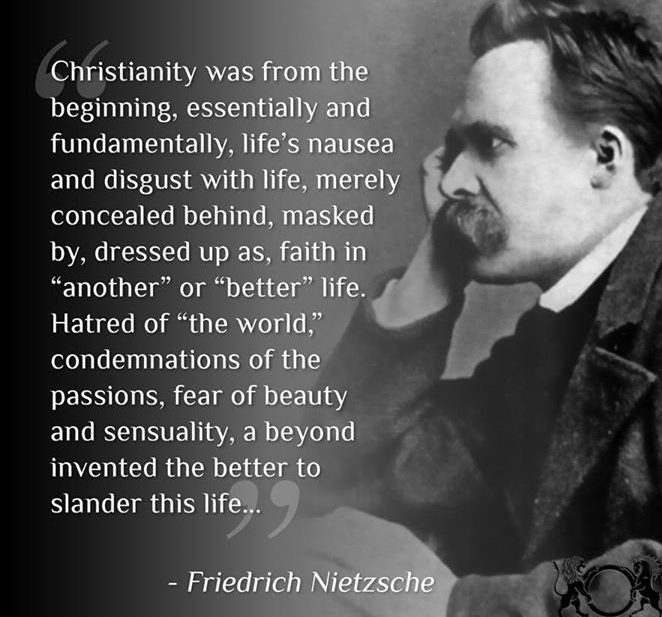
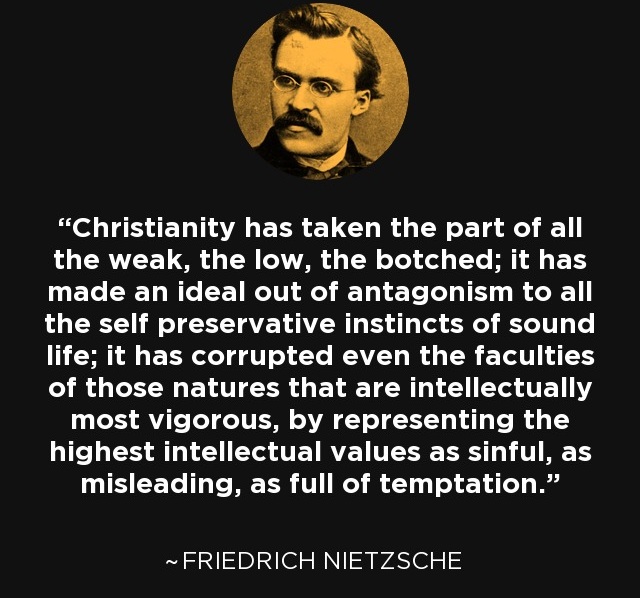
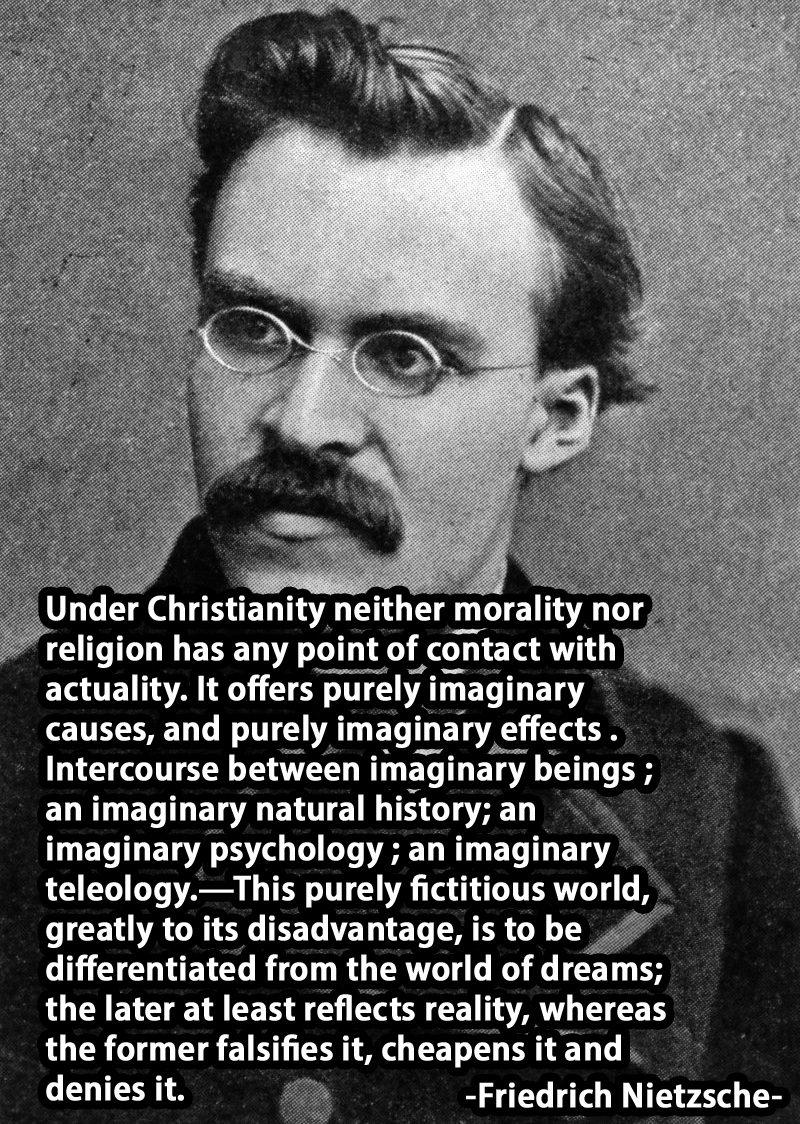
Christianity IS Judaized Paganism…Platonism, to be more precise.

Slave ethics.
Herd psychology.

Nietzsche was obsessed with Christianity because of his father and the plight of his Germanic tribe.

His critique applies to both Judaism and Islam.
Slave ethics…herd morality.

Jews appropriated corrupted and then adapted foreign ideas to their parasitical objectives.

How did Christianity emerge?
Same as Buddhism.
The cause was population pressures and urbanization necessitating ascetic ideals that deny the self.
Self-abnegation.

@Kallikantzaros

Again, I don’t think Christianity and Buddhism are comparable.

:clown_face:

I see the comparison.

I mean I don’t have that much against Buddhism because it emphasises peace and the history of it shows this, and today.

But I am not a buddhist.

One thing that doesn’t seem to make sense is the denial of the self, and a desire to not want anything.

I see how far and destructive soul crushing this can go.

That’s what Silenus is talking about.

1 Like

@Airwater37

There’s a difference between Buddhist monks and Buddhist laypersons, not all Buddhists live a solitary monastic sort of life.

Just as not all Christians live like Benedictine monks.

I understand where Silenus is coming from, pagan or polytheistic perceptions are not alien to me. I have spent most of my life studying world religions, politics, and philosophies, I make it my point studying various different belief systems from everywhere.
:clown_face:

Vietnam seen the strangeness of buddhism.

Vietnam is the most atheist nation in the world.

A whopping 80% of the people are atheist.

They only may participate in buddhist activities here and there, and give donations to buddhists, but that’s it.

So they aren’t buddhist, even loosely. They are officially atheist. They don’t say ‘we are not monks but we are still buddhist’. They don’t follow the double standard. They reject it.

They just adopt some practises they think is a good idea, but they do not use buddhism as excuse.

1 Like

@MrAuthoritarian

*What’s up with all the profile avatar changes? :grinning_face_with_smiling_eyes:

1 Like

@Airwater37

Just looked it up, “Not a truly atheistic nation.”

I was an atheist for many years as well, I understand the mindset. No God is worth worshipping if it is forced upon people and some just find religion or spirituality to be useless. Live and let be.

:clown_face:

1 Like

Okay, the Communist government wants to say most are atheist, but that’s not the case.

1 Like

@Airwater37

Changing avatars is fun for me.

:clown_face:

1 Like

@Airwater37

I am a communist and I support the right to religion or spirituality. And?

:clown_face:

Then why did the communist government declare atheism as its official policy?

Communism is traditionally hostile towards religion of any kind and only supports atheism. The USSR was the same way.

One of the few things I praised communists for was oppressing Christianity and tearing down churches.

1 Like