This is like riding a roller coaster.
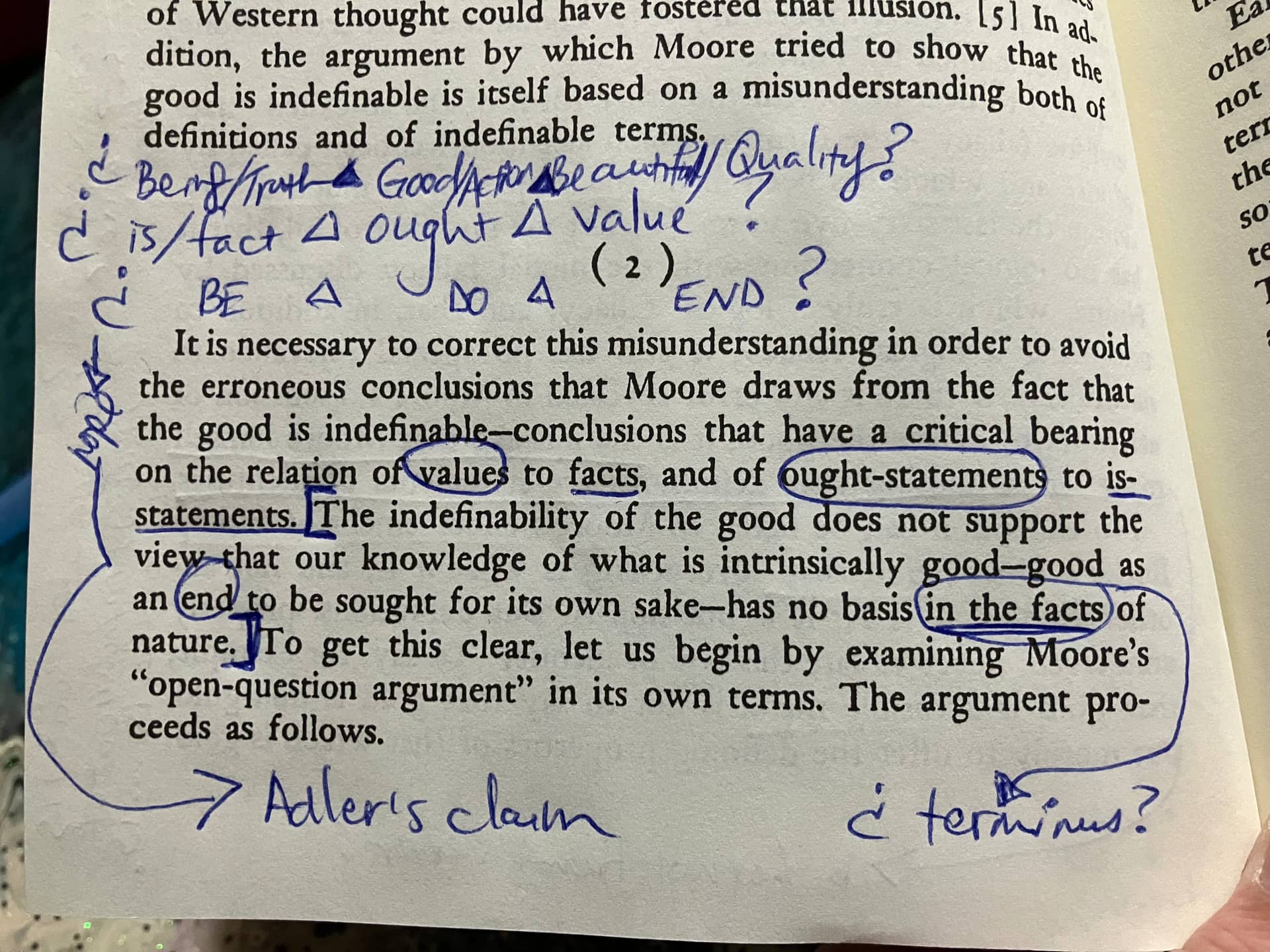
Bear with me, though: we are trying to arrive at a metaphysical substance for morality?
What I’m doing in the OP & in reading Adler’s book is just trying to understand what he is saying, and seeing if he has any insights that knock against/improve my current way of framing/untangling the ideas, behaviors, values, so forth, in question.
I suppose by “we” I mean those of “us” following the investigation into the Adler-Moore-Hume controversy.
For example, here.
This may help frame that:
(click to read the whole reply)
You seem to find the question distasteful. Did I say something wrong?
Or maybe the question didn’t make any sense?
Why would I find it distasteful, and how would you read that from anything I have expressed?
Just simply because you didn’t seem to feel it was really worth answering that I could understand.
A metaphysical substance for morality. Yay, nay, nonsensical? anyway I’ll drop it.
Define metaphysical. Is it over & above omnitemporal? Cuz that’s not a thing.
Get outta my thread you topic derailer.
I guess I mean substance of an actual but non physical kind.
A real tissue.
Define physical :^)
Why is it a der…?
Fine.
Go on.
I mean substance of any kind.
I guess permission to treat me as hostile remains in force and will for a while. Hey I earned it.
Alright your honor. I’ll try again some other tizzime
IS/FACT … being/substance
that includes spiritual & material substance
necessary subsumes (composes) contingent
So what you’re saying that I’m asking is, that morality is a substance. So not some emergent phenomenon. It would be the same if the underlying context chizzanged.
Morality is a very wide umbrella—it all boils down & adds up to character(s), action(s) and value(s) in or out of alignment with “every person/valuer is a person/valuer”. You may think that the character and one’s values are identical and indifferentiable, and that one always acts according to one’s character/values, such that all they are is their action (you may be a behaviorist)—but if you affirm the Id, or the subconscious, or just the fact that there are things about ourselves that we don’t know, and that others may or may not know about us… you’ll understand that values often run deeper than what we are aware of in terms of our character.
Moral truth requires an always good being, which means they are always actively treating the other as self. That is their character, the value(s) they always demonstrate. They are never not demonstrating it.
The context changing does not change the fact that we should always treat the other as self. How that applies in a given context will depend on the context, of course. I like this on lying: Spotify
We do not owe a would-be murderer the truth about where their victim is located, and we do owe their victim our protection from being murdered. Just think about what you would prefer someone do when your would-be murderer asks them for your location. If there is anything you wish someone would have stopped you from doing in order to prevent deep regret, it’s an unjustifiable death, or something on that level.
But the more power you have, the more it is an abuse of power to use it to interrupt someone’s choices. If you had the power & used it to interrupt every choice that would result in deep regret, the choice to love “no matter what” would become impossible. Life would be meaningless. Truly absurd.
The question, I guess, is treat the other as self why? Is it a function of everything else that is existence, or is it a substance? A conclusion, or a object?
You have to be out of touch with your own valuing/emotions (this is not an insult or a condemnation, because it is often the result of trauma) to not think it is a good thing that they be respected, to not extend that sort of empathy for your own self to every other person. It starts with you (at least in this case, we can’t speak for everyone), because intellectually you’re very bright.
If you’re not out of touch with your own valuing/emotions, and you’re extending that empathy out to others, it shows in your external demeanor and how you treat people. At the very least, you do no harm.
A conclusion is a consent indicator (it can happen with or without premises). It does not happen outside of a consent structure. Even if it is merely simulation, that simulation would not be possible without an original consent structure it is simulating. There is no object without structure. The object composing all objects is what all structure or simulation of structure traces back to.
One problem with some languages that talk about objects is that they don’t know the unity/difference/similarity between:
being △ action △ quality
…and why none of them happen without (out of unity with) the others distinctly.
…but most languages still have that embedded in their syntax, regardless. We do (show we know) it without knowing we’re doing it. It’s a tell some are blind to.
That’s what O mean. For you morality is a given. What it is is not even askeable. It simply exists, and then you proceed with proofs of its existence.