WAY. That can’t happen without YOU affirming ought. Ought IS way. So yes, the question is what is the… way/HOW.
But when it comes to END… the question is WHY.
…and both questions are answered with WHO (what).
That is not in the original post, but it is in Adler’s book from which the quote in the original post is taken. He just had not sussed it out - at least not yet. I have not seen his post-conversion material. And actually, I still haven’t finished his book, so maybe he’s one of those really annoying philosophers that builds from elementary misunderstandings up to the synthesis and makes you wanna punch them in the face. (cough Socrates cough)
WHO is not an imperfect human. Seek the perfect WHO first… the rest will follow. Until the wheels fall off (stole that from a preacher who didn’t practice).
The ought you descibe, the ought/way, only exists when instincts fail to produce expected progress. They crash into something. Then a way forward is intellectualized. But it is a way forward in the world, so it cannot be some personal idea, it has to be a depersonalized function of external, without-you reality. Thus ought. Never in isolation, always balanced with personal preferences and reactions to the generated objective attempt
At best it is a crutch when a bad plan is preferable to doing nothing.
What is best is to illuminate understanding with truth, such that instincts gain traction in reality again.
If God exists and is real, and he does and is, he will imbue your instinct with correct way. It is near blasphemous to try to intellectually figure out way, to try to match wits with God.
Yes, demonstration rather than achieving—dancing because of (from) the music, not to hear it.
The omnitemporally present dances without having to plan (spontaneously complete) — but to beings subject to time, it appears the plan is the only perfect one (right the first time). Every moment is alive, eternally old and new.
Like that train goin the speed of light…we’ll never catch up to it, but it’s always here. lol
Who, Paula? Did I mistreat Paulita’s name? Cuz I called him Paulito? My bad.
Vote for Pedro. If that even is your nombre, as is Captain Underpants.
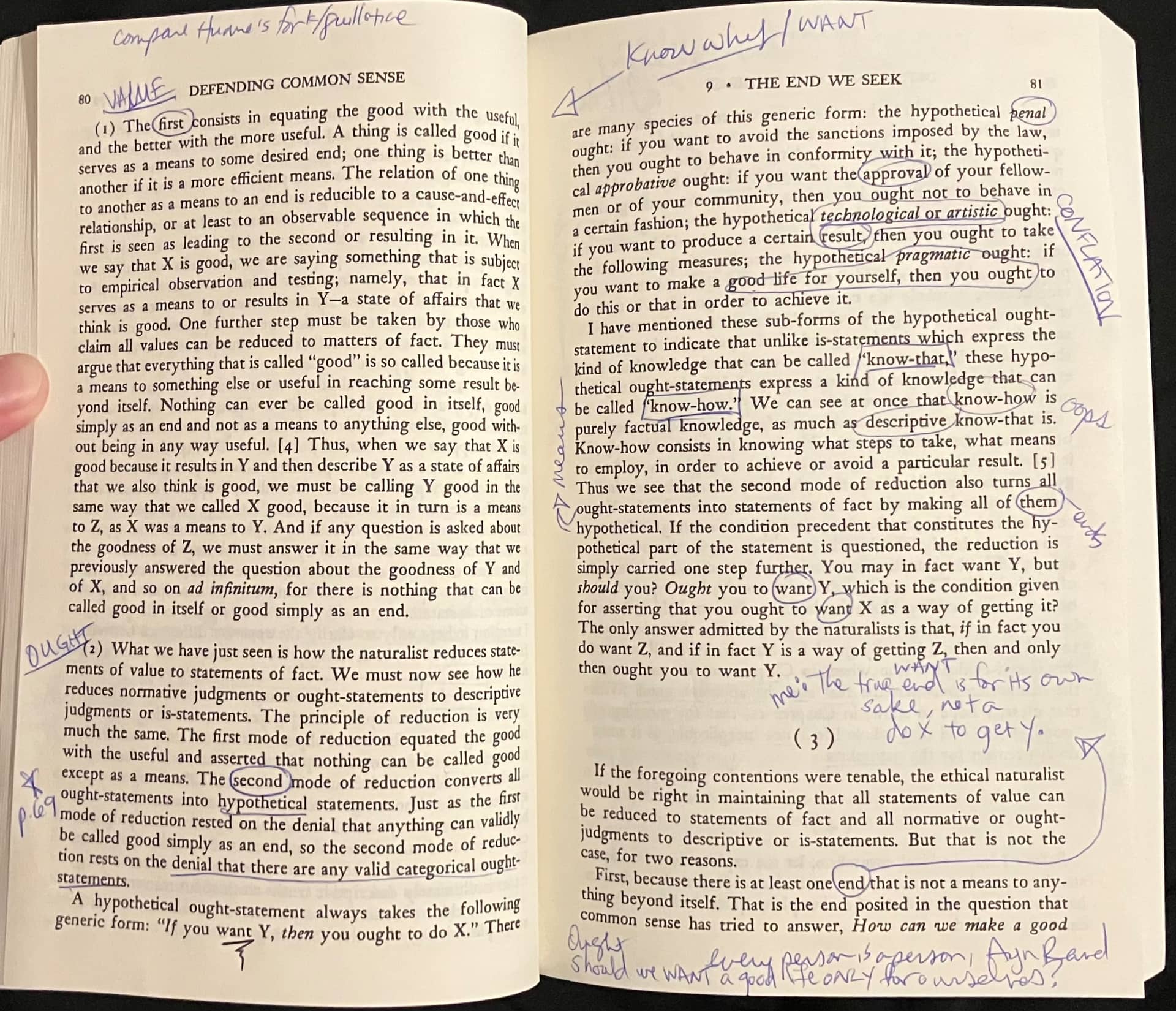
I’ma skip rereading Moore in order to fact check Adler & just focus on the content he delivers. Quick review of OP before proceeding to the rest of the chapter.
what/who: every person/valuer is a person/valuer (A=A)
why: the source of value feels dissonance when there is a break/distortion/imbalance between A=A, and pleasure/consonance/resonance when there is balance/harmony between A=A. All distortion demands compensation (due to dissonance), if not resolution.
how: maintaining/vibing with or resolving back to A=A is a noticeable choice, as is allowing it to be remain what it is (either distorted or in balance), breaking it, or concentrating/multiplying it (drawing it out, demonstrating it)
…and on 84 punted back to merely clarifying, rather than defining. His exact quote on 86 is that “the good is indefinable” — but he said it while being a total jerk to Moore about it. How was that even necessary??
Adler thinks Moore’s (but not Hume’s) mistake is assuming:
…rather than including why a thing functions, and how it operates. He says the correctness of the definition is established via induction (demonstration, how)… pro tem.
Seems like he is here affirming subalternation, js.